$AMD is easily a $1,200 stock IMO| CPUs TAM 🧵
Not Financial Advice! DYOR!
In this thread, I want to discuss the actual TAM for CPUs data center for just 2026, where many are giving different ranges, where I don't agree with. I will explain in detail why I disagree with these research firms and financial analysts using Math. And this thread should not be treated as Financial Advice. I'm just explaining my research and thought process so we can have a discussion.
In 2024/2025, I gave out $620 PT for FY2026 was too conservative for AMD potential. At the time, It was early and many were just laughing, that PT was unrealistic and the AI world is run on GPUs only. Today, most of these folks are laughing with me. That is ok, I dont offer financial advice, and I do not need everyone to agree with me. I respect other opinions.
If you enjoy this kind of thread, slap the like/repost/bookmark.
If you want to support my work further and gain more in-depth analysis, consider subscribe!
In early 2026, hyperscalers, enterprises, and OEMs are scrambling as Intel and AMD server CPUs are largely sold out for the year, with prices jumping 10–20% and lead times stretching from weeks to months (or longer for certain SKUs). What was once a GPU dominated story has flipped: the shift to explosive Agentic AI with its multi-step reasoning loops, tool calling, multi-agent orchestration, real-time data movement, and reinforcement learning, is dramatically tightening CPU:GPU ratios from the old training-era 1:4–8 all the way to 1:1 to 5:1 or even CPU-heavy configurations. CEOs across NVIDIA, AMD, Intel, Google, Meta, Microsoft, and public companies have been sounding the alarm on CNBC, Bloomberg, and earnings calls. CPUs are “cool again,” and in many agentic deployments they are becoming the new bottleneck alongside (or even ahead of) GPUs and custom ASICs.
In 2025, roughly 12-15m AI GPUs + AI ASICs GPUs shipped, and is expect to be 15-20m units by 2026, where it suggesting Training demand is not going away. The actual TAM is structural, multiplicative demand that has already forced AMD to double its long-term server CPU TAM forecast to >$120 billion by 2030 (>35% CAGR), with Dr. Lisa Su noting Q2 2026 server CPU sales expected to surge 70%+ year-over-year and demand “far exceeding expectations.”
At the same time, AMD’s secured 30–40% share of TSMC’s initial 2nm capacity (behind only Apple’s >50%) positions it to ramp Zen 6-based EPYC Venice exactly when this agentic wave hits hardest but even that aggressive five-fab 2nm expansion (with plans scaling toward 11 total advanced facilities) cannot instantly close the gap in the near-term. Supply constraints on wafers, advanced packaging, and power are compounding the squeeze, just as hyperscalers forward-buy and lock in long-term deals.
1. The actual potential TAM
Various sources and institutions are giving $50-$160-$200B CPUs TAM toward 2030, and i disagree, where supply is severely behind vs Demand by at least 2-3 years or even longer by some estimates.
The actual TAM will probably be 15-20m for FY2026. The typical average selling price from low to high end is $5,000 to $15,000, but due to rising memory, and different inflationary pressures on Semi, it would be more logical to think between $7,000-17,000.
A. CPU:GPU Ratio at 1:1
A basic calucation at mid range
=12,000 x 15-20m CPUs= $180-$240B TAM
B. CPU:GPU Ratio at 5:1
= $12,000 x 75m-100m CPUs= $900B-$1.2T TAM
Of course TSMC cannot even supply 20% of this massive inflection TAM in 2026. But do we think of Demand for TAM or Supply for TAM? Hence we are seeing massive 2nm Ramp from TSMC for $AMD.
IMO, conservatively, I would take down 15-20% on 1:1 or $135-$192B TAM for just 2026. Im not even talking about 2030.
We are just months into this, it is impossible to estimate Cagr atm, but this is 1-5 agents running tasks, I wrote a thread on 24/7 autonomous agents thread, where companies could use 50-250 agents to run tasks for them 24/7. It would require a different structural CPU:GPU to bring down the cost of token as well as handling the Orchestration bottleneck. GPUs would be useless and sit idle waiting for CPU due to highly CPU-intensive nature.
The cost per Million tokens must come down more rapidly for this 50-250 autonomous agents to work, otherwise the token cost would be too enormous.
Helios Rack is estimated to bring inference cost down to $0.0003-$0.0005/M tokens with 18 EPYC Venices along with 72 MI455x and other chips+ Components.
A heavier or CPUs dense rack would bring down inference cost further.
EPYC Verano(2027 gen 7 AI-optimized) is expected to drive inference costs meaningfully lower than the Venice baseline likely to the $0.00002–$0.00025 per million tokens range (or even sub-$0.00015 in highly optimized agentic/batch workloads).
Verano have higher core counts than Venice, LPDDR5X SOCAMM2 memory support, more AI optimized and Next-Gen rack density & efficiency.
2. $AMD secured at least 30-40% of TSMC 2nm capacity and Memory from Samsung through 2028-2030.
2 2nm fabs are entering ramping phase toward 60-65k wafers per months and 5 dedicated 2nm fabs entering mass production/ramp in 2026. Will link sub threads below if you are interest for full detail.
Apple is reported to secure 50%+ 2nm capacity for Iphone 18 and Mac chips and AMD secured at least 30-40% capacity while $NVDA $AVGO $ARM $AMZN $GOOGL and others are on 3nm.
This broader aggressive ramp from TSMC to target up to 11 fabs is to address $AMD massive growth ahead. Where $ARM is facing massive CPUs supply constraints as they have to compete with other Mega Cap players on 3nm allocation. And $INTC is also facing supply constraints for data center CPUs and PC per management with lead times extrended to longer than 12 weeks.
Dr. Su is aiming for higher than 50%+ Market share, and I believe it is achievable in 2026 or 2027 as AMD has the strongest CPUs offerings. Dr. Su did not want to take advantage of the shortage and she said during the Q1 earning call, AMD is prioritizing Units shipped while guiding margin to be inching 60%. If Jensen were in charge, I'm sure margin would be 70-75% in this kind of severe CPUs shortage condition. But that is not how Dr. Su operates for more than a decade. She wants most market share. So we will see it in revenue growth, but as TSMC ramps faster and faster, AMD Operating and FCF margin will massively improve vs prior decade. A significantly higher margin profile than before.
3. How I came up with $1,200 withint 12-18 months?
At $1,200/ share, that would be around $2 Trillion MC.
I expect FY2027 revenue to be $124-$144B where data center revenue dominates overall revenue.
AI GPUs: I will stick to the lowest end so show u that I'm conservative at $18B for each GW vs $NVDA Rubin is $30B+ (most likely Helios Rack in the $20B+ due to memory price rising). We know deals with @OpenAI and @Meta are around 12GW and additional multi-customers at multi-GW scale were hinted and will be revealed as we get to July 22-23 2026 Advancing AI event. For now I will conservatively add a bit more to this model. (3-6GW Helios Rack Range)
EPYC Venice is reported to be in $15,000-$20,000. However large customers will likely to enjoy $10-$12k discount. I expect AMD to be able to ramp 7m EPYC Venice for entire 2026 and 3-4m of EPYC Verano(higher price than Venice). If we take an average selling price of $10,000 to be on the conservative side. Take down another 30% to be even more conservative on projection. I like to be conservative. That would be ~ 7m EPYC CPUs(Venice + Verano) for FY2027 or 583,000 units per month or 15,000 additional 2nm wafers per month which is completely reasonable for current TSMC Ramp, and I may be too conservative here.
EPYC Verano and MI500 series will also be on 2nm.
AI GPUs: 3GW x $18B= $54B
EPYC CPUs: $10k x 7m CPUs= $70B
= Data center revenue alone is $124B
Other segments= probably in the $20-$25B FY 2027.
FY2027 revenue = $124-$149B
At 7m EPYC CPUs for entire 2027, that would be more than 50% market share when we comp it to availability from supply side, not from total Demand. It is possible that TSMC could significantly ramp even more capacity in 2027, so we will see.
Metric Q1 2026 FY2027
Gross Margin 55-56% 60-62%
Operating Margin 25-26% 32-35%
Net Income Margin ~22% 26-30%
FCF Margin 25% 28-30%
At $124-$149B Revenue FY 2027
Net Income would be $32-$44B
EPS would be $20-$27 (GAAP)
Non-GAAP would be $25-$31
At $1,200 a share or $2T valuation that would be:
13.4-16x Price to Sales (P/S)
38-48 P/E
At this kind of growth of AI SuperCycle, I think it is very reasonable valuation.
If we use today at $406/share or $661B MC:
2027 P/S = 4.4x-5.3x
2027 P/E = 13x-16x
Is AMD today expensive or cheap to you?
Above is already a very conservative where I trimmed 20-30% of doable units. Meaning, there could be upside if TSMC is able to ramp meaningfully like they are planning.
Conclusion:
A $1,200 per share valuation IMO for AMD in FY2027 is not expensive at all; it is, in fact, conservative when viewed against the structural explosion in agentic AI demand we have mapped out.
With server CPU TAM potentially scaling into the $100–$200B+ range in just CPU:GPU 1:1 Ratio for just 2026. AMD positioned to capture 50%+ share thanks to its 2nm TSMC allocation advantage and full-stack leadership, the company could realistically deliver $124–149B in total revenue and $25–$31+ non-GAAP EPS. At those levels, $1,200 implies a 2027 P/E = 13x-16x. Entirely reasonable for a company that will have become the clear Inference Queen (and in many workloads the preferred) AI infrastructure provider, with operating margins expanding above 30% and tens of billions in high-margin rack-scale AI revenue.
Dr. Lisa Su was right presciently so about the Agentic AI inflection all the way back to her early 2022–2023 commentary on the coming shift from pure training to inference and orchestration-heavy workloads. While the broader market only fully woke up to this in 2026 when she doubled AMD’s long-term server CPU TAM forecast to >$120B by 2030 (with >35% CAGR), Dr. Su and her team have consistently positioned the company at the center of the CPU renaissance. The explosive demand we are seeing today, sold-out lines, rising ASPs, and hyperscalers forward-buying entire gigawatts of Helios-class systems is exactly the outcome she forecasted years ago.
Not Financial Advice! DYOR!
$AMD shareholders when both $INTC and $ARM are facing severe CPU supply constraints and Dr. Su secured at least 30-40% 2nm capacity & memory through 2028.
BREAKING $AMZN Upgraded to $348| BUY Rating👀
UBS analyst Stephen Ju raised the firm’s price target on https://t.co/0CF5cLt9Kc (AMZN) to $348 from $318 and keeps a Buy rating on the shares. Amazon’s muted post-Q2 share performance reflects investor concerns that 2027 capex could exceed $300B and eliminate free cash flow, while AWS margin expectations remain a key upside opportunity, as strong incremental revenue may outpace the operating expense growth required to offset AI-related margin pressure, the analyst tells investors in a research note.
$AMD shareholders just realized there will be intense comeptition with $META @Muse from $AMZN $GOOGL $MSFT $AAPL @AnthropicAI@OpenAI to perform Agentic Tasks for consumers(B2C).
And @AMD has the best x86 CPUs to truly scale Consumers Agentic. The biggest Agentic AI use case at massive scale to generate Hyper Revenue growth for decades to come.
This is a massive AMD CPU shortage that most will likely see a bidding war. Meaning AMD will have
~Pricing power
~Margin Expansion
~Years of TAM & Market Share Capture and Expansion
~Even faster Revenue Growth
~ Much higher multi-year CAGR than what was projected just weeks ago
This is going to be fun!
AMD shareholders gonna do VERY WELL in the next 3-5 years!
Not Financial Advice! DYOR!
$AMD | $META @Muse will MASSIVELY accelerate CPU Orders- 30-60 million Venice Chips🧵
Context: Meta launched Muse on September 8, 2026: a consumer personal agent that does work, not just chat. Muse is not sitting on your phone. Each user gets a dedicated cloud Linux computer called Muse Secure VM: its own browser, files, credentials, cron jobs, and room to compile code and spawn sub-agents. Inference for Muse Spark still hits shared accelerators. The always-on “personal computer” layer is CPU, RAM, and storage.
Read more here: https://t.co/IHDcRYl6Dv
Muse plans and executes: send email, book travel, fill forms, negotiate, shop with a one time Stripe Link card, keep working after you close the app. You talk to it in the Muse app, the web, or WhatsApp. US adults only at launch; glasses coming later.
Pricing is usage gated:
~Free, with a weekly cap (reports put it around 100 million tokens/week)
~Power: $20/month
~Maximum: $100/month
An agent loop is: plan → call tools → browse → parse → write code → wait on APIs → spawn sub-agents → schedule cron → ask you for approval. A lot of that is control plane and systems work.
Meta’s own security write-up is explicit: each VM is “an isolated linux box with a browser and enough storage, CPU, and memory to do real work like compiling code the agent writes, developing custom skills and handling concurrent sub agents and crons.”
Naive version: 100 million users × a 24/7 2-vCPU / 8 GB box.
Muse VMs are reported at 2 vCPUs each. Flagship EPYC 9996 “Venice” is 256 cores / 512 threads at 600 W. Meta Family Daily Active People is 3.60 billion . Muse is US only today; the full Family number is the theoretical ceiling, not the current product.
Users per Venice 9996
1 vCPU = 1 physical core, no oversubscribe = 128 users
1 vCPU = 1 SMT thread, no oversubscribe =256 users
4× oversubscribe =512–1,024 users
8× oversubscribe = 1,024–2,048 users
An estimate of 30-60 million EPYC Venice chips today could support all 3.6B Family Daily Users.
Not Financial Advice! DYOR!
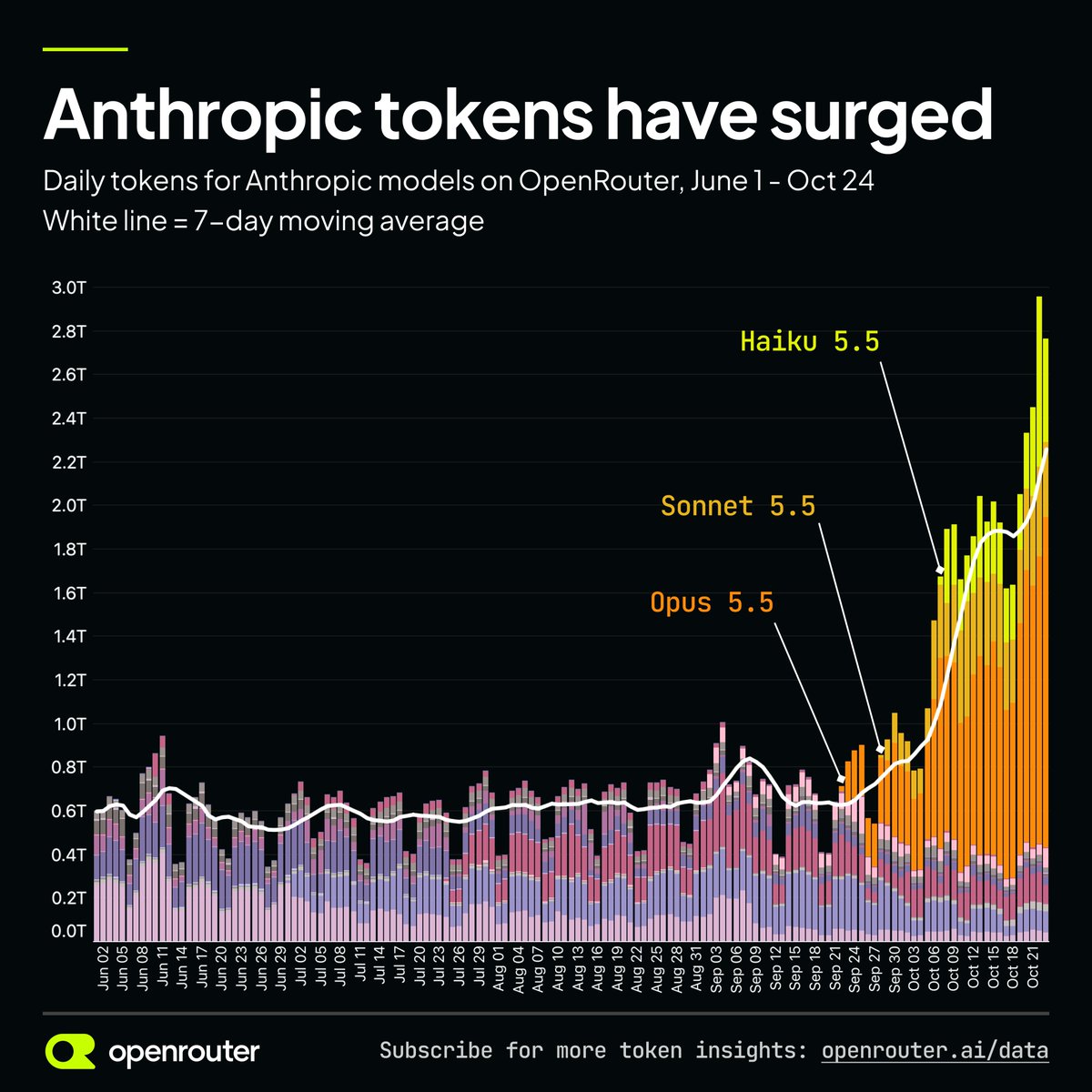
New from OpenRouter: 7-day average token volume for Anthropic models is up 3.6x since the launch of Opus 5.5
Sonnet 5.5 and Haiku 5.5 have also been well received.
$AMD MI455X vs $NVDA Rubin ✅
Capacity: AMD 432 GB HBM4 vs NVIDIA 288 GB HBM4
→ +50% more memory on the MI455X (144 GB advantage).
Peak bandwidth: AMD 23.3 TB/s vs Rubin 19.2 TB/s
HBM stacks: AMD 12 stacks of HBM4 vs NVDA 8 stacks
→ more parallel memory channels and higher aggregate interface width.
Rack-scale memory pool (comparable 72-GPU systems): ~31 TB HBM4 (AMD Helios) vs 20.7 TB (NVIDIA Vera Rubin NVL72)
→ ~50% more total high-bandwidth memory.
Bandwidth density / efficiency edge: Higher capacity at higher bandwidth means better support for large models, long contexts, and high concurrency inference without as much reliance on offload or multi GPU sharding for memory capacity alone.
Not Financial Advice! DYOR!
$AMD $INTC $TSM | Most CPUs estimates are are way off or too bearish. Here is why ✍️
Agentic workloads are dramatically more token intensive than simple chatbot era (2022-2025). Multiple analyses put the multiplier in the 5–30x range per task (Gartner and others), with coding agents reaching hundreds to 1,000x+ versus basic interactions because of multi step loops, tool calls, retries, reflection, and especially the repeated resending of growing context.
OpenRouter data has already shown agents consuming roughly 5x more tokens overall than humans, with agentic token volume rising extremely fast in 2026.
The real world multi agent coordination as 24/7 workers will run than the BofA assumptions. 2027 total X86 Demand could be as high as 15-20m units, not 2030. Don't forget years of unbalanced system CPU GPU Ratio and replacement of old CPUs.
Enterprise Agentic is a different animal vs Consumer Agentic. IDC has forecasted active AI agents in enterprises rising from tens of millions in 2025 to over 2 billion by 2030. If multi-agent systems, persistent “digital labor,” higher concurrency, or deeper enterprise/consumer embedding become the norm, effective compute intensity per “user” (or per agent) could exceed the ~20M CPUs/1B users ratio easily.
Not Financial Advice! DYOR!
BofA: we estimate 1 billion total agentic AI users could result in ~2.7 million incremental CPU demand in 2026 and as much as ~21 million in 2030.
Given ChatGPT alone reached monthly active user of 1+ billion in its first 4 years of operation (excluding other AI services such as Gemini, Grok, etc.), we estimate agentic AI could similarly reach 1-2 billion users by 2030.
$INTC $NVDA $AMD $ARM
Pretty much.
As of the past few weeks, debt markets have almost entirely shut off access to money for any company that doesn’t have substantial revenue independent of AI data centers.
SpaceX closed $40B of debt for GPUs, but we’re investment grade and have Starlink & launch revenue.
That means the 200+ neoclouds are going to see guppy-level death and consolidation. Some will make it through, but not many.
$AMD| $META Muse is pushing 4-8 CPU : 1 GPU ratio 🧵
1. “Make CPU Great Again”
@Muse is the clearest example. Meta does not just run a chatbot on shared inference clusters. Each user gets an isolated Linux VM with its own browser, storage, CPU, and memory so the agent can browse, fill forms, compile code, run cron jobs, and keep state after the app closes. Community reports put a typical instance around 2 vCPU and 8 GB RAM, plus storage. Multiply that by millions of users on a generous free tier and the bill is racks of general purpose compute, not just more H100s or MI300X .The “Make CPU Great Again” captured a symptom, not the actual constraint. Agentic products like Muse and Instinct are not mainly a story about chips beating GPUs. They force hyperscalers, AI labs, and enterprises to treat persistent per agent computers as a first class line item in CapEx .
In February 2026 AMD and Meta signed a multi-year deal for up to 6 GW of Instinct GPUs, with first gigawatt shipments in 2H 2026. That first wave is not GPUs alone. It is a custom MI450 class Instinct GPU plus 6th gen EPYC “Venice” CPUs on Helios racks that @AMD and Meta co-designed through the Open Compute Project. Meta is also a lead customer for the next EPYC generation, “Verano.” AMD has already shipped Meta millions of EPYC CPUs and earlier Instinct MI300/MI350 parts. @finkd framed the deal as compute for “personal superintelligence” and as diversification away from a single accelerator vendor.
The 6GW is the dominating headline, but the actual partnership is co-design, co-engineer and co-optimize together. Meaning @Meta will be buying tens of millions of EPYC from AMD in the coming years, because scaling consumers Agentic will require massive ten million Muse class users is tens of millions of small CPU boxes, plus a much smaller pool of shared inference GPUs for the tokens those boxes request. Consumer agent fleets push that ratio toward 4-8 CPU : 1 GPU or past it on the sandbox tier, because the “computer per person” layer does not batch the way tokens do. Free tiers make it worse: Meta can give away 100 million tokens a week only if the VM behind those tokens is cheap enough to keep allocated.
Muse’s product architecture is a dedicated Linux VM per user: browser, filesystem, Sentinel process, cron jobs, code compilation, sub-agents. That box is a CPU, memory, and storage problem. Inference of Muse Spark still wants GPUs. Keeping millions of isolated agent computers alive wants dense server CPUs. Dr. Lisa Su has been telling us that story explicitly since 2022: EPYC SKUs for agent sandboxes, AI host nodes, and general-purpose tool execution, with Venice going to 256 cores / 512 threads. Dr. Lisa Su has already said server CPU demand “far exceeded” forecasts because of agentic workloads, and AMD raised its server CPU market outlook from $120 billion to $220B+ industry target by 2030 and she aims for 50% market share of that.
Enterprises follow the same logic at smaller scale. An OpenClaw or Instinct like agent on-prem is a 4–8 vCPU Linux box with a browser. A fleet of those is an EPYC purchase, not an B200 or Rubin purchase. AMD’s marketing and product split (sandbox density vs host node I/O vs general purpose) is aimed at that exact mix.
2. Why AMD?
x86 compatibility for agent sandboxes. Muse, OpenClaw, and enterprise agents run Linux, Chromium, compilers, and random third party tools. Custom Arm CPUs win on cloud native efficiency. They lose some of that advantage when the workload is “give this agent a real computer.” EPYC’s core density and PCIe/memory bandwidth are the merchant answer to packing more VMs per rack.
Meta is both design partner and volume customer. Helios sits on Meta’s Open Rack Wide spec. Muse’s scale out is therefore not a generic CPU RFP. It is incremental demand on a stack Meta already standardized with AMD. If Muse VMs land on the same generation of EPYC that hosts Instinct nodes, AMD sells twice per watt of Meta campus: accelerator dollars and sandbox dollars.
The most expensive part of the product is keeping that machine isolated and busy: page loads, form fills, compiles, API calls, file I/O. Muse Spark inference is a burst on a shared GPU cluster. The VM is reserved CPU capacity. That is why Meta renting “a massive number of virtual machines” is a CPU shortage story.
The same pattern shows up in the rest of the consumer stack. OpenClaw with a browser wants roughly 4 vCPU and 8 GB, not a GPU, unless you host the model locally. Instinct is waitlisted on compute while it hands every user a cloud machine they can text and call. Tool heavy agent traces in the literature put 50–90% of latency on CPU side tool processing; some vendor testing says seven of eight stages in a realistic agent pipeline run on the host, not the accelerator. GPU utilization drops while the agent waits on Chromium, a compiler, or an API. Adding more GPU does not fix that. Adding more cores/threads, DRAM, and VM density does.
Density follows from concurrency, not from model size. One consumer does not need a dedicated GPU. They need a private address space that can stay up for hours. Ten million Muse class users is tens of millions of small CPU boxes, plus a much smaller pool of shared inference GPUs for the tokens those boxes request.
Conclusion:
The conclusion is that Dr. Lisa Su kept funding the unfashionable layer. In 2022 the market was already pivoting to GPUs. She still said, “We’ve said the datacenter represents our largest growth opportunity and the number one strategic priority for our company.” On Genoa she added, “It’s the highest performance datacenter processor, it’s the most efficient, and we’re delivering significantly better performance-per-watt than our competition.” Meta was already putting third gen EPYC into Open Compute servers. That was the bet: keep winning the general purpose socket even while Instinct chased NVIDIA.
Agentic consumer products paid that bet off. A Muse or Instinct user is not a batched token stream. They are a reserved Linux computer with a browser, tools, sandbox, and Sentinel that only sometimes wakes a GPU. In March 2026 Su said, “We’re seeing a significant CPU demand, frankly, as a result of the inference demand picking up,” and then, “the CPU portion of the business has actually far exceeded my expectations in terms of demand.” She told the same audience that top customers were saying CPU compute sitting alongside AI “was perhaps something that was under forecasted.” AMD then raised the server CPU TAM and split EPYC into GPU host nodes, high frequency head nodes, and dense agent sandbox parts. Venice is the sandbox chip: 256 cores, 512 threads, first PCIe Gen 6 on a CPU, tuned for agents per watt, per dollar, and per rack.
Versus NVIDIA Vera, EPYC 9996(Venice) is 1.2x per core and more than 2x platform SPECrate integer, and roughly 3.3 to 3.4x throughput in a modeled 100 kW rack. Versus Intel Xeon 6980P, the same part is in the 1.8x to 3x range on the enterprise and HPC suites AMD cites. Versus Arm AGI, AMD has a large per core gap. The direction matches the product: more cores in an x86 box that already runs Chromium, compilers, and enterprise tools without a platform change. That is what a consumer agent VM needs.
Dr. Su was early on not abandoning the socket that agents would have to live on years after. NVIDIA still owns more GPU dollars. Intel and custom Arm still take a large share of general cloud cores. AMD is the merchant vendor that kept the best high core x86 CPU line through the GPU years, then sold Meta both that CPU and the Instinct GPU in the same Helios rack. Consumer agentic being CPU dense is why that 2022 decision now looks like winning strategy for AMD long term shareholders
Not Financial Advice !DYOR!
South Korean retail investors are once again taking on massive amounts of leverage.
According to Korean media reports, they made net purchases of approximately $300 million across 14 single-stock leveraged products linked to Samsung Electronics and SK hynix between October 1 and 23.
They are also taking on substantial leverage in the U.S. stock market, reportedly making net purchases of $3.54764 billion in the Direxion Daily Semiconductor Bull 3X Shares ETF (SOXL), which seeks to deliver three times the daily return of a U.S. semiconductor index.
https://t.co/caLpVUOnaB
$AMD shareholders just saw Elon Musk confirmed the thesis of Agentic SI!
@AMD is ready to supply EPYC Venice Rack (Helion) to AI labs, Hyperscalers and Enterprises!
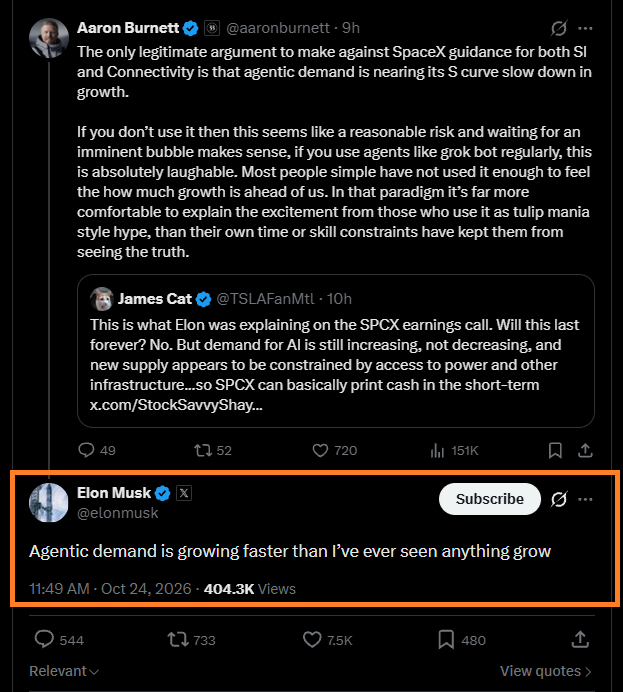
BREAKING $AMD | @elonmusk just said "Agentic demand is growing faster than I’ve ever seen anything grow" = Extreme Hypergrowth for CPUs 🧵
One skeptical argument on $SPCX was that agentic demand (for AI agents that autonomously plan, use tools, call APIs, execute multi step workflows, run sandboxes....) might be approaching the flattening part of an S-curve. Musk’s repied “Agentic demand is growing faster than I’ve ever seen anything grow” directly rejects that. He is saying the pace exceeds any prior technology or trend he has observed, implying substantial runway ahead. This aligns with broader industry views of exploding token consumption, continuous agent operation (vs. intermittent chatbots), and infrastructure needs for power, bandwidth, and compute or basically what Dr. @LisaSu said the need to bring up CPU GPU Ratio to a more balanced system or even pure CPU rack like Helion ( 8 CPU 1 GPU) .
This is broadly supportive of the strong demand thesis driving @AMD server CPU business, even though Musk’s own companies (SpaceX/xAI/SpaceXAI) have committed heavily to Nvidia GPUs, but if demand is this extreme, it would be logical to buy significant CPU racks from AMD to scale @bot. What do you think @grok ?
x86 CPUs ( AMD EPYC Venice / Zen 6) excel at scaling agentic AI primarily through extreme core/thread density, mature ecosystem compatibility, and strong platform level throughput for the CPU heavy parts of agent workflows.
GPUs handle model training & inference; CPUs handle most of the surrounding sequential/control work. This shifts architectures toward higher CPU content (often approaching or exceeding 1-2:1 CPU:GPU ratios). Scaling means running thousands of concurrent agents efficiently within power, rack, and cost limits.
Flagship EPYC 9996 “Venice” offers up to 256 cores / 512 threads per socket (Zen 6 / Zen 6c on TSMC most advanced 2nm). This is far higher than Nvidia Vera’s 88 Olympus cores / 176 threads.
Higher density directly translates to more concurrent agent sandboxes and orchestration tasks. AMD’s Helion open rack reference design packs up to 32,768 Zen 6 cores in a CPU only configuration (or mixed CPU+GPU enterprise racks).
x86 ecosystem maturity means that the vast majority of server software, enterprise applications, databases, middleware, compilers, operating systems, virtualization platforms, and development tools have been optimized for and extensively validated on x86 for decades, giving agents reliable, high performance access to existing toolchains, libraries, and codebases without emulation overhead or compatibility friction. This includes deep ISV certification, mature driver and firmware support, broad cloud and OEM validation, and a large body of performance tuned open source and proprietary software that agents routinely call ; advantages that newer $ARM based designs are still far behind but have not yet matched at scale for general purpose and enterprise/consumer agentic workloads.
This is another big confirmation how SI CapEx gonna look like in the next 3-5 years, significantly more resources allocate to the best CPU.
Not Financial Advice! DYOR!