@PathfinderAstro Where is there any evidence Uranus was the 6th moving star, Hipparchus mentioned it once and then it doesn't show up until the 1600s in reference
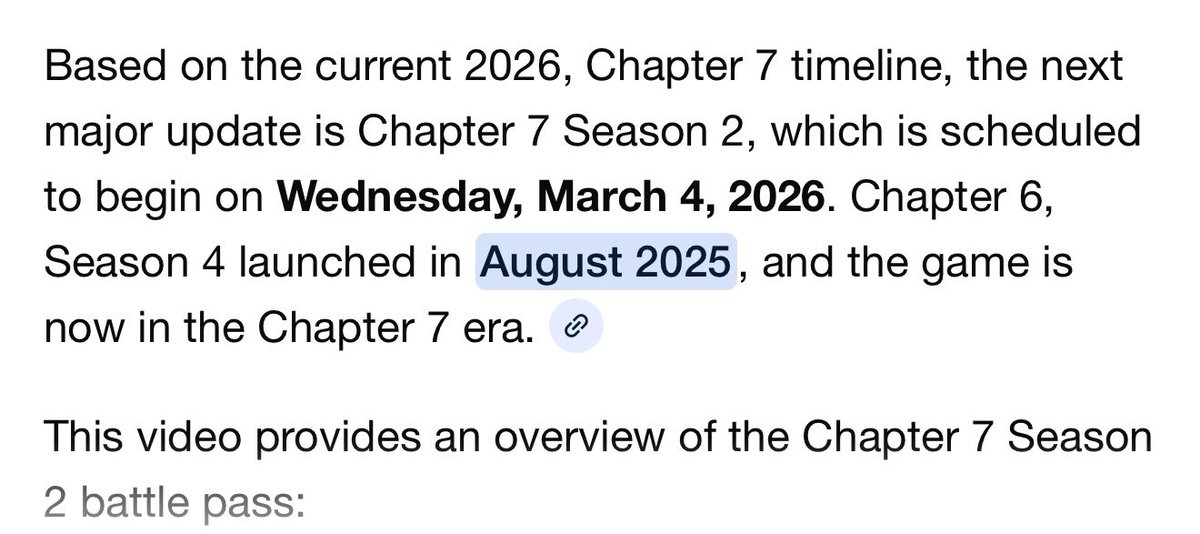
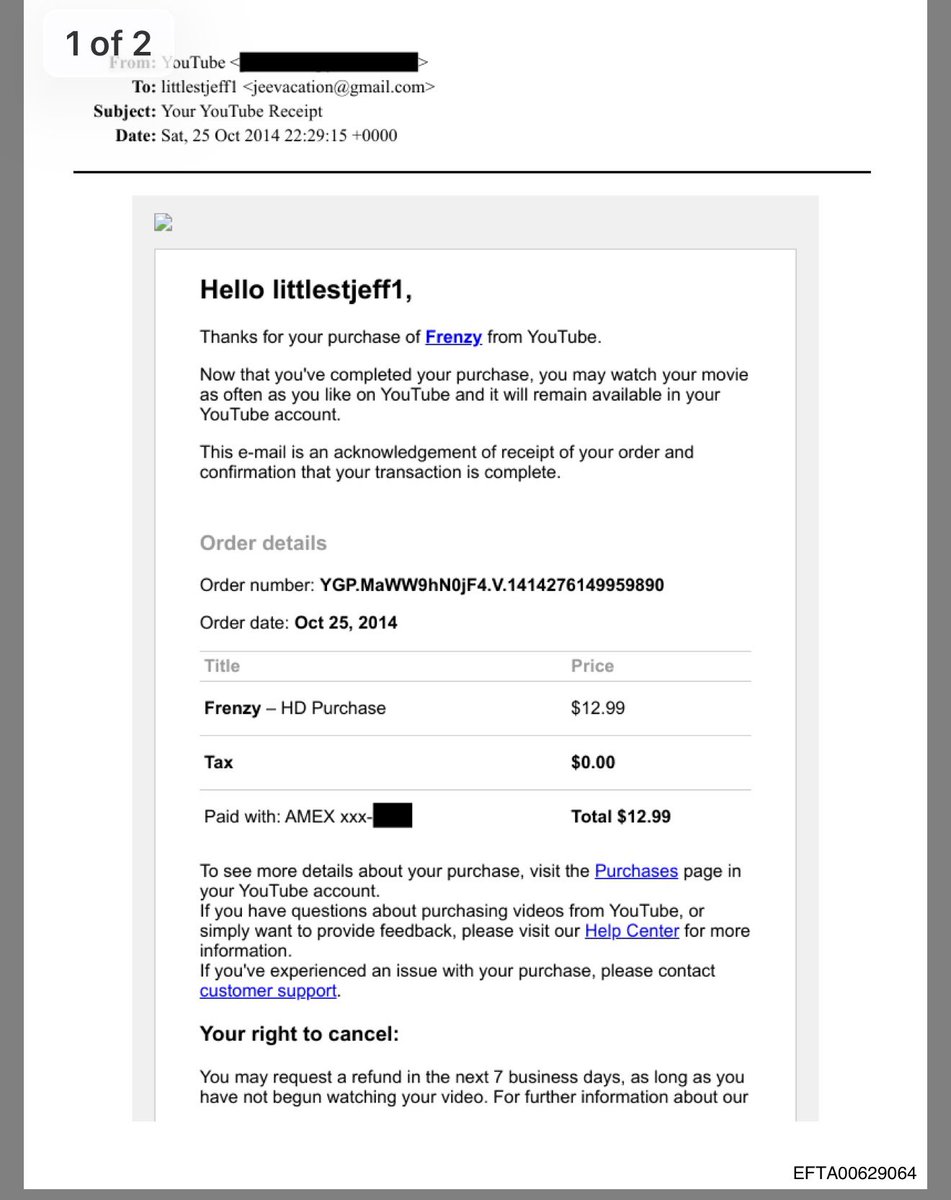
Since we now apparently live in a reality where the most bizarre possibility is what is real, we have to inform you that Jeffrey Epstein‘s Fortnite account is live and active in Israel multiple times in the last year alone.
People in the Global South are asking why Russia and China are not intervening in Venezuela instead of just issuing condemnations.
The truth is that China’s and Russia’s lack of physical intervention highlights the often unspoken cold realities of geopolitics.
Like everything in geopolitics, the reasons are complicated. However, a few things immediately stand out: For one, Russia is already at war in Ukraine, 10 000 kilometres away. This is not a small detail.
Power is finite, and states act based on capacity, risk, and return. Russia being tied down in a large, grinding war thousands of kilometres away is decisive here. Military intervention is about logistics and sustainment. Opening a second front in the Western Hemisphere would be a strategically reckless move.
Second, geography still matters, even in a globalised world. Venezuela sits deep inside what has historically been treated as the United States’ strategic backyard. Any overt military intervention there would immediately trigger confrontation with the United States on its home turf.
Unlike Russia, which has had a minor military presence in Venezuela, China lacks the power projection capabilities to challenge the U.S. Navy in the Caribbean, especially against the USS Gerald R. Ford carrier group currently stationed there.
Venezuela is not what Ukraine is to Russia or Taiwan to China in strategic terms. It does not sit at the centre of Russia’s security perimeter or China’s long-term territorial ambitions. States are far more willing to fight when defeat would threaten regime survival or core sovereignty. Venezuela does not meet that threshold for either nation.
While Maduro often touted his “ironclad” friendship with Putin and Xi, these relationships have proven to be largely transactional. When faced with the prospect of a direct kinetic conflict with the United States in its own “backyard,” both Moscow and Beijing have prioritised their own national security and economic interests.
Also, unlike NATO, the agreements between Venezuela, Russia, and China do not include mutual defence clauses. Legally and strategically, neither country is obligated to go to war for Venezuela.
Beijing’s 2025 policy papers on Latin America emphasised “strategic partnership” but steered clear of military guarantees, prioritising a “peaceful multipolar world” over direct confrontation.
In fact, China has not been to war in many decades, and this is by design. Its model of power projection prioritises economic leverage, infrastructure, trade dependency, and diplomatic insulation instead of warfare.
Intervening militarily in Venezuela would undermine the very image China works hard to project, that of a non-interventionist alternative to Western coercion.
By condemning US “hegemonic behaviour” and “illegal abduction,” China presents itself as the defender of international law and the UN Charter without firing a single shot.
This is not to say China has nothing to lose in this situation. Quite the opposite, actually. Venezuela owes Beijing an estimated $60 billion. A US-installed administration could use the legal doctrine of “Odious Debt.”
A new government could argue that the loans provided by China were used by the Maduro regime to “finance narco-terrorism” and “suppress the people,” and therefore, the debt is not the responsibility of the new state.
Trump and his handlers would likely support this move. Cancelling Venezuelan debt to China would simultaneously relieve Caracas’s balance sheet and inflict a significant financial loss on Beijing. Oil exports currently directed to China as debt repayment could be rerouted to the US and Western markets, leaving China with unpaid loans and stranded supply contracts.
A US-friendly government would likely redirect oil exports, which currently go primarily to China to pay off debt, back toward the US and Western markets, leaving China with empty tankers and unpaid bills.
This explains why China is currently “fuming” but physically stuck. They know that a military confrontation with the US in the Americas would be a total loss, but they also know that a US-led regime change could lead to a total financial default.
Beijing may have hoped that Maduro could survive long enough to pay back more of the debt. Now that he is captured, China is shifting to a legalist defence, using the UN Security Council to demand that “private contracts and international debt obligations” be respected by any successor government.
China has essentially been “priced out” of Venezuela by American military force. The “might makes right” reality today means that Beijing’s $60 billion investment may have just vanished into the Caribbean along with Maduro.
So, both Russia and China are forced to resort to attempts to shape outcomes through vetoes, financial mechanisms, energy deals, intelligence sharing, and diplomatic delay.
This is the same MO deployed by South Africa, which is leading the diplomatic charge at the UN, accusing the US of “state-sponsored kidnapping” and “state terrorism,” arguing that if a leader can be plucked from their capital by a foreign power, the UN Charter is effectively dead.
The argument here is that international law has become “meaningless,” and we have entered an era where if a power can enforce its will in its own backyard, it will. This puts pressure on the rest of the world to decide whether it agrees that “might makes right” or not.
Both Russia and China are now using the US action to win a diplomatic war in the Global South. By allowing the US to act like a gangster, they can point to it as the “true aggressor” and “lawbreaker” on the global stage.
More cynically, they can use the “dangerous precedent”, as noted by the UN Secretary-General, to justify their own future actions in their respective spheres of influence in Taiwan and Eastern Europe.
In that sense, Venezuela is a marker of a world drifting from “rules” toward raw enforcement, and forcing every state to decide whether “might makes right” is now the governing principle.
Neuroscience
I love this illusion because it's proof that human visual perception is based on edge movement detection by retinal ganglion cells (RGCs) in the retina.
Deep learning experts have no clue what true vision is. It will revolutionize computer vision. I estimate that the data efficiency of pattern recognition in the brain is at least 2 orders of magnitude higher than DL. This alone will change everything.
Work in progress.
Important point, and it was not just South Korea. In the 1960s, for example, it was widely "known" among development economists that countries with predominantly Confucian cultures were incapable of developing thriving, manufacturing-driven economies, which is why East Asia was likely forever to remain among the poorest parts of the world. Japan and Hong Kong were the exceptions only because Japan had supposedly escaped its Confucian heritage during the post-Meiji period, and because Hong Kong was actually British. Meanwhile Latin America, in part because it had absorbed US and European cultural values, was growing so fast and so inexorably that it was the only developing region certain to reach rich-country status within a few decades.
By the late 1980s, perceptions had reversed. It was then widely "understood" that having predominantly Confucian cultures and "Asian values" would propel any developing country to rich-country status, and Japan and Hong Kong were restored to the Confucian fold. Latin America, it turned out, had actually been Catholic and authoritarian all along, and so was incapable of advancing except temporarily through debt and corruption (never mind that being "authoritarian" had long been considered among the cardinal Confucian values).
Analysts love cultural explanations for why countries are or aren't able to get rich because they seem to explain all the things that are hard to understand, but as a Franco-American who grew up in Spain, Pakistan, Peru, and Morocco, went to university in NY, and who spent his entire career in international finance, including 24 years living in in China, I have always found cultural explanations for economic performance very provincial – superficial at best, and often pretty foolish, usually based on pretty simple-minded comparisons and an ignorance of history (there was once a theory, for example, that Confucian cultures excelled at simple manufacturing because their use of chopsticks made their hands more nimble).
You can make a much stronger argument that it is institutions that mainly matter, although unfortunately, as Albert Hirschman warned, institutions in each country develop within their own historical and cultural contexts, so that there isn't a one-size-fits-all set of institutions that guarantees success.
In fact a disappointingly small number of developing economies have achieved advanced-economy status in the past 100 years, and they all followed very different paths. They include Hong Kong and Singapore, two city-states that achieved a unique kind of economic success as trading and financial entrepôts; South Korea and Taiwan, two economies that succeeded during the worst years of the Cold War at least in part because of very heavy US and Western economic support; and perhaps Chile, with its set of "Latin American" conditions. You might also want to include Spain, Poland, and a few other European countries, but only if you consider them to have been developing countries in the same sense as those in Latin America, Asia and Africa, which I don't.
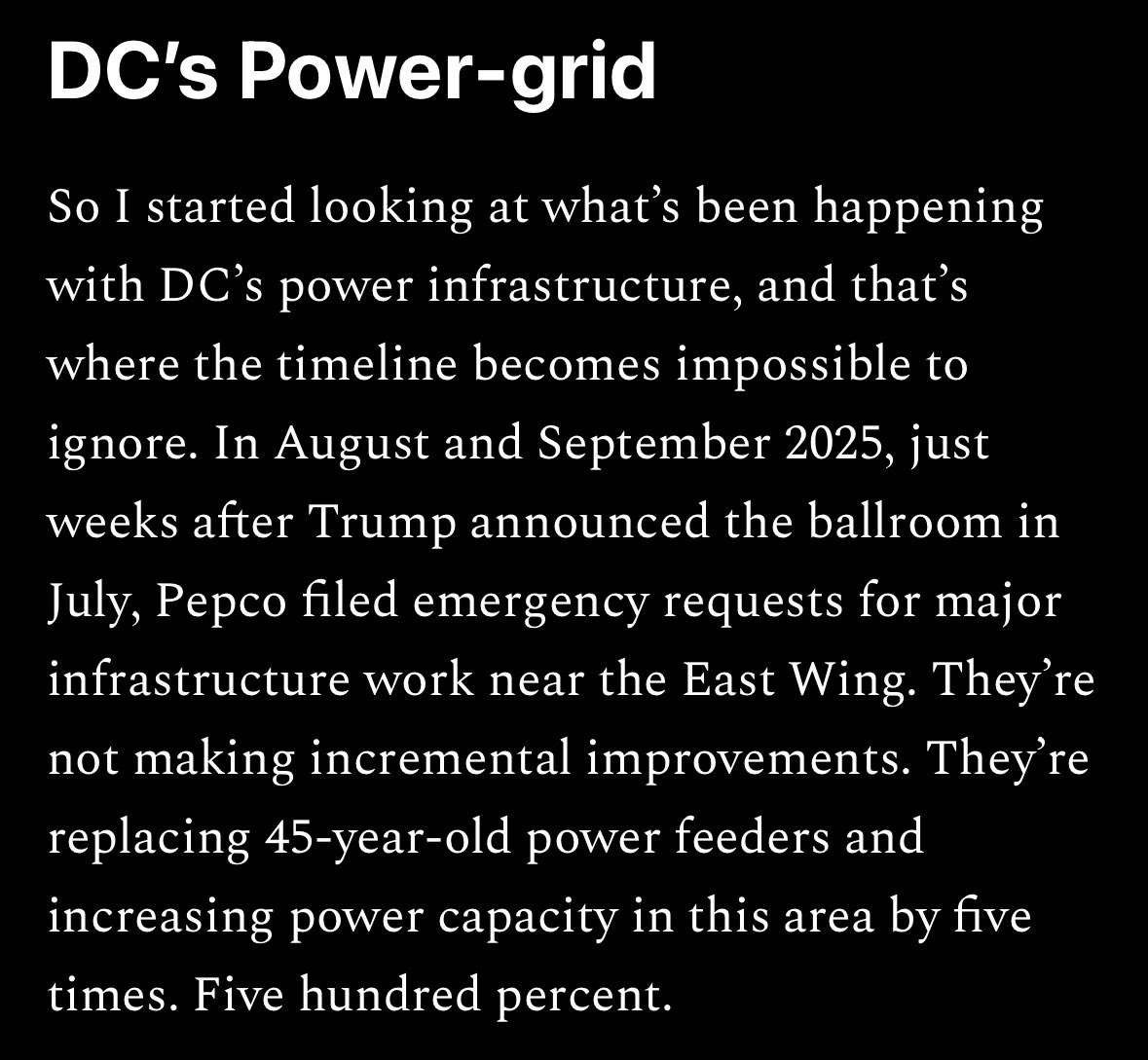
Trump is building an underground data center disguised as a ballroom. The research in this story could have been done by corporate media with ease, but why would they? https://t.co/ej5iIIo2vS
A leaked copy of the U.S. National Security Strategy suggests that the current administration wants to pull four countries away from the European Union.
The stated goal is to “realign Europe with U.S. interests.” The reality is far simpler: it is much easier to bully a single country with tariffs and one-sided trade deals than to pressure the EU as a bloc into submission.
A similar sentiment was recently voiced by Elon Musk: “The EU should be abolished, and sovereignty returned to individual countries so that governments can better represent their people.”
In reality, Musk couldn’t care less about “the people.” His objective is straightforward: weaken Europe so it cannot set rules for how he does business there. Fragmented, small European states would be far easier to pressure using his immense financial and media power. A strong EU, by contrast, is doing exactly what Musk dislikes most: regulating his companies and forcing him to pay for schemes like the fraudulent monetization of the “blue check.”
According to the leaked document, the U.S. aims to pull Italy, Poland, Hungary, and Austria away from the EU. How? By “supporting parties, movements, and intellectual and cultural figures who seek sovereignty and the preservation or restoration of traditional European ways of life - while remaining pro-American.”
How did the United States move from being one of Europe’s greatest allies to behaving like a nemesis - following the very playbook perfected by russia? The damage to U.S. credibility will not be repaired quickly. It will take decades.
In a normal world, this should be an immense scandal in Europe.
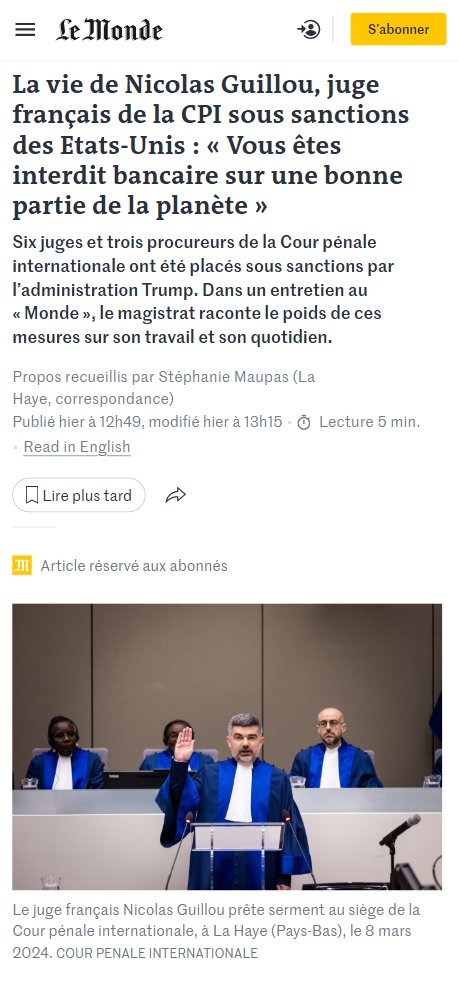
Le Monde has a long article (https://t.co/HsWFThQ5wF) describing the hellish life of Nicolas Guillou, a French judge at the ICC in The Hague, due to U.S. sanctions punishing him for authorizing arrest warrants against Netanyahu and Gallant for war crimes in Gaza.
Guillou's daily existence has been transformed into a Kafkaesque nightmare. He cannot: open or maintain accounts with Google, Amazon, Apple, or any US company; make hotel reservations (Expedia canceled his booking in France hours after he made it); conduct online commerce, since he can't know if the packaging is American; use any major credit card (Visa, Mastercard, Amex are all American); access normal banking services, even with non-American banks, as banks worldwide close sanctioned accounts; conduct virtually any financial transaction.
He describes it as being "economically banned across most of the planet," including in his own country, France, and where he works, the Netherlands.
That's the real shocking aspect of this: the Americans are:
- punishing a European citizen
- for doing his job in Europe
- applying laws Europe officially supports
- at an institution based in Europe
- that Europe helped create and fund
and Europe is not only doing essentially nothing to protect him, they're actively enforcing America's sanctions against their own citizen - European banks closing his accounts, European companies refusing him service, European institutions standing by while Washington destroys a European judge's life on European soil.
Again, in a normal world, European leaders and citizens should be absolutely outraged about this. But we've so normalized the hollowing out of European sovereignty that the sight of a European citizen being economically executed on European soil for upholding European law is treated, at best, as an unfortunate technical complication in transatlantic relations.
"Grandpa, what were movies like before the Collapse?"
"Before the Collapse?"
"Yeah. Grandma says you guys were always watching films and stuff on your handheld computers."
"Actually, we mostly let our AR Smart Glasses sear AI-generated futa-furry gangbangs directly onto our retinas while cute animal-girl Vtubers fatally injected untested grey market peptides in a desperate bid for hundreds of views.
"Uh."
"But there were movies too, yeah."
"What were they like?"
"Pure magic. Film as dream, film as music. No form of art goes beyond ordinary consciousness as film does, straight to our emotions, deep into the twilight room of the soul."
"Wow."
"Ingmar Bergman."
"Gesundheit."
"No that's—"
"It does sound magical, Grandpa."
"It was. And we spent all our time arguing about it online."
"Arguing? Why?"
"Because all art is political, Billy."
"All art, Grandpa?"
"Mhm."
"Even the AI-generated futa-furry gangbangs?"
"Sure. Take the Lion King."
"Was that an AI-generated futa-furry gangbang?"
"No, it was a film."
"Oh.
"I mean, there was fan art."
"Okay."
"Not all of it was AI though."
"Um."
"Anyway, the naive viewer could interpret the film as a bildungsroman about a guilt-ridden youth who flees his homeland and carelessly squanders his virile prime while singing Hakuna Matata with grotesque but affable social outcasts, until the re-appearance of the Feminine forces him to reckon with the demands of Manhood and mature, assuming the Mantle of Duty and re-taking his proper place in the great Circle of Life."
"Uh, sure. I haven't seen it. The Collapse, remember?"
"But actually the film is an anti-democratic Moldbugian ethno-revanchist screed extolling the virtues of hereditarian monarchy, starring a race of square-jawed, long-haired, pure-bloods who gleefully hunt and consume the rightfully subjugated citizenry."
"Uh."
"The Divine Order is only undermined when a weak, effete degenerate in the royal family commits regicide and sells out the country in an act of venal prebendalism to his insurrectionist coalition, a dysgenic lower race—delightfully played by Whoopi Goldberg and Cheech Marin—whose churlish stupidity and insatiable appetites plunge the land into perpetual disorder and famine-ridden kleptocracy."
"Wow."
"In the end, the vile usurper is overthrown by the divine heir and consumed by the perfidious barbarian immigrants he once foolishly thought he could control."
"Man. It sounds like movies were really heavy."
"They were. Mr. Bean played a cartoon bird."
"I don't know who that is. Again, the Collapse..."
"Or take Cars. On first blush, it seems like the straightforward tale of a young hotshot racer who learns that while it's important to be competitive, people matter and winning isn't everything."
"...and it wasn't."
"Of course not! It's a nationalist-nostalgia-cum-anti-globalist manifesto about the hideous and pernicious ways neo-liberal '''progress''' ravages our small communities, crushing the common man's wages and spirit."
"That sounds miserable."
"Or take Frozen, a paean to radical self-sovereignty, featuring the libertarian Power Ballad 'Let It Go'."
"Grandpa."
"And don't even get me started on Zootopia and how it exposes the insidious Eweish conspiracy to incite a race war and sow chaos in our beleaguered inner cities."
"GRANDPA!"
"Eh?"
"This all sounds unbearable. There must have been at least 𝘰𝘯𝘦 movie that wasn't political."
"Well...there was Minions."
"Okay."
"A story of a bunch of funny little yellow guys who are always looking for a bad guy boss and unwittingly become heroes in 1960s Great Britain."
"Okay, see, that sounds like something I might actually watch—"
"But in reality, the minion represents the eternal brownshirt: the herd of homogenous conformists, spiritual serfs who seek to be ruled by a strong man, forever indifferent to ideology."
"Oh for God's sake."
"The sequel, Rise of Gru, lacked this clarity of vision. A big step down."
"Grandpa, I'm sorry, but I just—I don't buy it."
"Don't buy what, Billy?"
"You're telling me that not only was every movie political, but they all validated and reinforced your idiosyncratic political ideology?"
"Careful, Billy. You're starting to sound Media Literate."
"Media Literate?"
"People who were Media Literate believed they could understand the intentions of the creator and what any film meant, given its themes and context."
"Okay."
"Which is stupid, because I always knew what these films meant and these morons always disagreed with me."
"Grandpa."
"If you saw the kind of bug-loving bullshit I had to deal with every time Starship Troopers showed up on the timeline."
"Grandpa!"
"Eh?"
"I'm not saying Art can't have politics in it or anything, but like, I think that Bergman guy was saying films are something more, you know?"
"Well—"
"That art speaks in an ineffable language and every time we try to compress it into meager words, something, like, truly vital is lost."
"Maybe."
"Something that touches our souls."
"I get what you're saying, Billy. But the next time you watch Starship Troopers, you should think about how much these morons wish they were bugs."
[sigh]"I can't watch Starship Troopers Grandpa."
"Ah right because of the—"
"Collapse."
"Yeah, yeah."
"..."
"I keep forgetting."
"..."
"...you ever see Point Break?"
---
[m][title: All Art is Political]