Bird flu in South Australia: Local transmission confirmed as authorities warn of threat to endangered sea lions. 11 new #H5N1 cases in greater crested terns, a local species. https://t.co/DvZBWyOTcL
🚨 BREAKTHROUGH: Scientists develop a new treatment that can remove Alzheimer’s plaque in just 1 hour
Researchers have created supramolecular nanoparticles that act as the medicine itself, directly targeting and clearing the toxic plaques linked to Alzheimer’s disease.🧵
@SBS Hologic Global Women’s Health Index has found Australian women’s health has declined since 2019 (“since COVID”) but no mention of multitude of ways in which COVID can damage the body.
https://t.co/HcR4wTUIMP
A med student asked me today:
"If every breath contains thousands of microbes, why aren't we constantly sick?"
It's one of the most fascinating questions in microbiology. Let me explain.🧵
By 2023, 40% of college students developed brain damage from Covid infections.
The finding is striking in that it's from New Zealand, where the cumulative reinfections are lower than in the U.S.
The surgical mask shown in this article will do almost nothing to reduce particulate inhalation because it's just a splash guard. Wear a well-fitted N95 respirator or better https://t.co/1RiH1ihmeZ
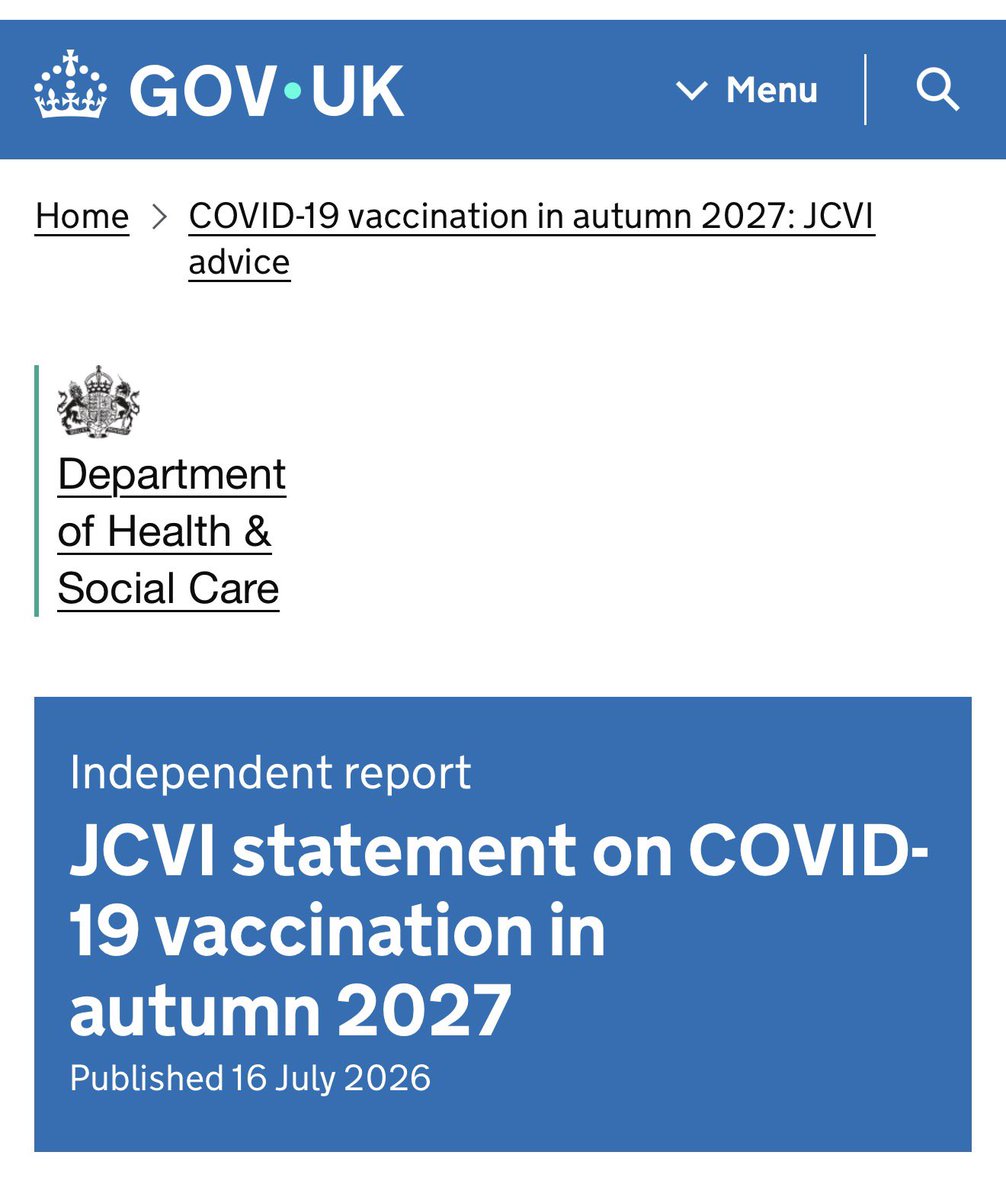
@aparachick@1goodtern Yes. Here it is. By their own admission the decision appears to have been made purely on cost. Just as HCW lives weren’t apparently worth the price of a £3.99 FFP3 mask, our elderly <80yrs lives aren’t worth a £25 vaccine 🤬
https://t.co/t7JwvR1AkI
There has been a discussion on X lately about biomarkers for #LongCOVID, so I thought I would share some blood markers available that might point to immune, clotting and endothelial dysfunction. Encouragingly, all of them are available at specialised pathology labs worldwide.
These are also the molecules we keep finding trapped in fibrinaloid microclot complexes across our various (proteomics) analyses: fibrinogen, von Willebrand factor, Factor VIII, serum amyloid A, complement proteins (C3, C4, C5, C1q, factor B), platelet factor 4, P-selectin, myeloperoxidase, neutrophil elastase, transforming growth factor beta-1, endothelin-1, vascular endothelial growth factor, Serum Amyloid A, and many more. We also know that many of our collaborators have also find these molecules in the soluble fraction of plasma, when when they have done proteomics and ELISA tests.
We have known for a while that these proteins are present in both the soluble and the insoluble fraction of plasma, mostly, we have just been searching inside the insoluble fraction of blood plasma for possible dysregulated inflammatory molecules that might in future, be targeted by treatment regimens. What is new in our approach, is that we have only recently started looking at post-translational modifications (PTMs), on proteins and we have found that some are extensively modified: glycated, oxidised, deamidated, citrullinated.
What is PTMs? A post-translational modification (PTM) is a small chemical change made to a protein after it has been built, that slightly alters the protein without changing its underlying identity.
A simple way to picture it: the protein is the basic product, and PTMs are the stickers, tags and add-ons attached to it afterwards. The item is still the same item, but the additions can change how it looks and behaves, whether other things can grab onto it, and how long it lasts.
In the body, these tags get added in response to conditions like inflammation, high blood sugar or oxidative stress. Common examples are sugar molecules stuck on (glycation), oxygen damage (oxidation), or other small chemical groups. The protein's amount in the blood can look completely normal, while these tags quietly change how it works, which is exactly why a routine test can read "normal" and still miss the problem.
Also note that much earlier work by well-known researchers in the fibrinogen field has found post-translational modifications on fibrinogen in various inflammatory diseases.
More to come from our research group! Please, in the mean time see a the table below. These might be some valuable biomarkers that might to used in clinical investigations and might assist clinicians to target some symptoms.
@dbkell and I have also discussed possible devices like capillaroscopy for detecting vascular damage. @ImmunoFever has recently discussed the applications in numerous posts.
Lastly, this is in no way suggesting that these are the only biomarkers, it is just a small snapshot molecules our lab is finding and studying. There are numerous more biomarkers that can be looked at for neuro-immunology, muscle and many more systems.
New paper from the Prusty group: SARS-CoV-2 spike protein reactivates latent herpesviruses in Long COVID patients 🦠
In this new paper, the authors argue that many cases of Long COVID may be caused by the SARS-CoV-2 spike protein changing cellular metabolism, in a way that allows normally latent (inactive) herperviruses to reactivate.
We all have various herpesviruses in our body. Depending on genetics and several other factors which have yet to be identified by science, most of the time our immune systems are able to keep these viruses suppressed, even though they remain hidden in the body in an inactive state after we contract them.
However, sometimes something can shift in our internal environment that interrupts our immune systems' ability to keep the virus suppressed.
Here the Prusty group argues that in Long COVID, spike protein is affecting the way our cells function in a way that allows normally latent viruses such as human herpesvirus 6, human herpesvirus 7, and Epstein–Barr virus to reactivate.
They discuss possible antiviral treatments, with some caveats. They write,
"Anti-herpesvirus drugs may be therapeutically relevant for carefully selected long COVID or ME/CFS subgroups with clear evidence of herpesvirus reactivation, particularly EBV, HHV-6, CMV, VZV, or HSV. However, they should not be viewed as broadly applicable treatments in unstratified patients. Existing ME/CFS studies with artesunate, valganciclovir, or valacyclovir suggest possible benefit in virus-reactivation-defined subsets [143], while long COVID evidence remains more inferential. A key therapeutic dilemma is that different herpesviruses have different antiviral susceptibilities, so covering EBV/HHV-6/CMV versus HSV/VZV may require different or combined regimens, increasing complexity, toxicity risk, and the need for precise virological diagnostics before treatment."
What this means is that while sometimes antivirals can help, we need much better diagnostics to pinpoint which patients need which drugs.
Research from ME/CFS, which in many cases also appears to involve reactivation of latent viruses, shows that select subgroups of patients can respond to certain drugs - but it really depends on which virus you have, as available drugs do not work on all of the viruses. You really have to know which one you're treating, and be mindful of the risk of side effects.
Additionally, they write that SARS-CoV-2 persistence may be the ultimate root cause reason as to why these viruses reactivate- so ultimately, we will need diagnostics for that as well.
While we unfortunately have a ways to go in developing biomarkers, it's great to see the issues of SARS-CoV-2 persistence and latent virus reactivation receiving more attention in a mainstream publication like Cell.
Thank you to the authors for this important work! 🙏
https://t.co/CKVlJN7R8w
Please tune in this Friday 1pm AEST to hear @DavidJoffe64_2 and @AndrewEwing11 "#COVID-related Neurological Sequelae: From Delphi to #Dopamine – The Dilemmas We Face" - a @KirbyInstitute seminar. Online or f2f. Registration essential.
https://t.co/YJFSJRAnid
🚨 BREAKTHROUGH: MIT Scientists just invented a breath test that detects pneumonia in MINUTES.
No X-rays. No blood draws. No 48-hour lab waits.
Just one breath.
Here’s how it works & why it changes everything.🧵
"Long COVID patients are told symptoms are in their head – here’s how to change the narrative"
"People living with long COVID, ME/CFS... need careful assessment, respect, support, research and treatment" and "healthcare that does not give up when the tests come back clear."
Bird flu H5N1 detected in local bird in SA, suspected in seal in #NSW. The greater crested tern is a native bird, breeding season from September to March, and can fly long distances. Very bad news. https://t.co/mMBVHekdlL
Australia is changing how you get your COVID-19 vaccine starting October 1, 2026.
The old pharmacy program (CVCP) is shutting down, and vaccines are moving over to the national program (NIPVIP). Eligible people will still receive funded vaccines, while others must pay privately.
#H5N1
➡️ Cattle and human organoids reveal 2.3.4.4b H5N1 cross-species transmission potential and neuraminidase-specific neutralizing antibodies in humans
https://t.co/79FHqTWmU8
”Abstract
The unexpected circulation of clade 2.3.4.4b H5N1 influenza viruses in dairy cattle and the transmission to diverse mammalian species poses a pandemic risk.
We sought to explore cattle and human respiratory susceptibility to the 2.3.4.4b H5N1 virus. We establish long-term expandable cattle airway and mammary organoids.
➡️ The 2.3.4.4b H5N1 virus exhibits high replicative fitness in cattle mammary organoids, recapitulating its remarkable mammary tropism. ➡️ The virus also replicates robustly in cattle airway organoids, suggesting an underrecognized respiratory component in ongoing outbreaks.
Interestingly, human airway and nasal organoids are highly susceptible to the 2.3.4.4b H5N1 virus. Yet, a novel organoid-based neutralization assay reveals that ➡️ N1 antibodies in human sera had cross-neutralizing activity against the 2.3.4.4b H5N1 and ancestral H5N1-VN1194 viruses.
The cross-neutralization, exclusively manifested in the organoid-based assay, is ➡️ enhanced after seasonal influenza vaccination and diminished after depleting N1-specific antibodies. Therefore, ➡️ cross-neutralizing N1 antibodies are likely limiting zoonotic infection by H5N1 viruses in humans.”
https://t.co/r26H145MQZ
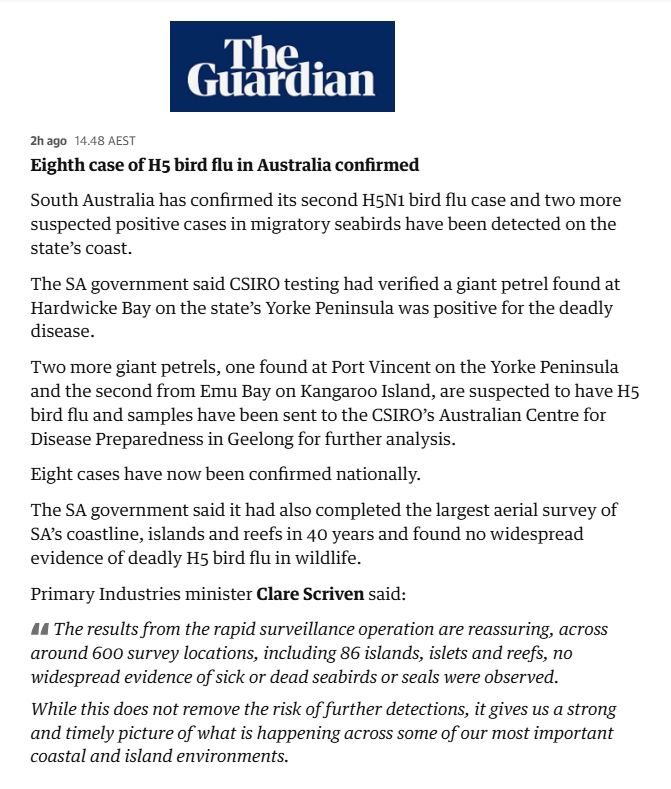
8th case of H5 bird flu in Australia confirmed
"South Australia has confirmed its second H5N1 bird flu case and two more suspected positive cases in migratory seabirds have been detected on the state’s coast."
#BirdFluAustralia
Source: https://t.co/9b5aNitxSV