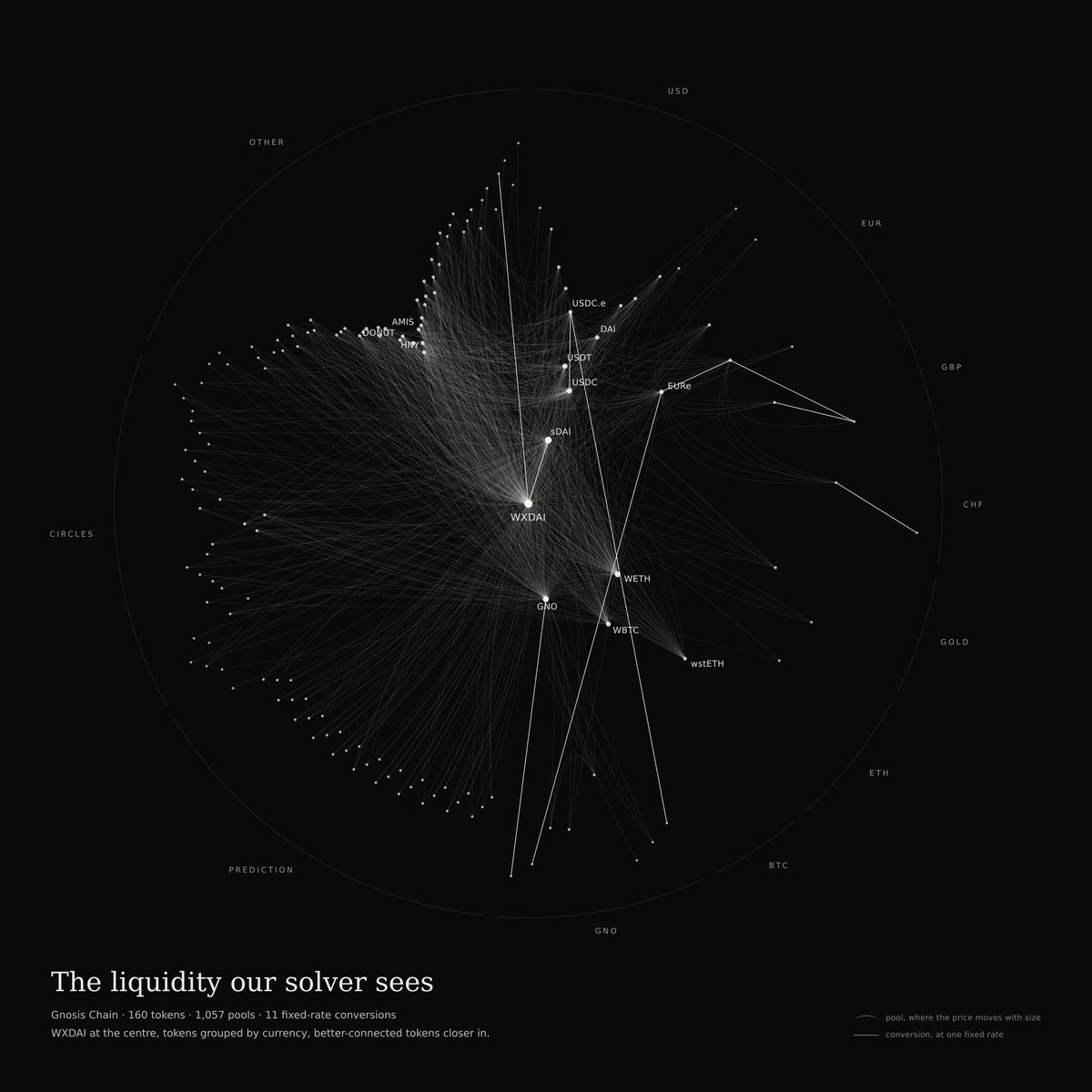
Here is the onchain liquidity graph of Ethereum and @gnosischain. Under EEZ those two, and the graph of every other chain joining EEZ will just become one!
10mo ago, Lido’s dev team received exactly 10m ethereum:0x5a98fcbea516cf06857215779fd812ca3bef1b32 worth $6.79m, and >80% has been sold, mainly on CoW Swap, a low-slippage platform with limited price impact.
The remaining 1.9m tokens are held in 0x305, which is also slowly selling the rest through CoW Swap while holders are waiting for a 10x lol!
CeFi is still the largest part of the desk, and the DeFi side is already live, including the @CoWSwap solver now #1 on consistency.
They still don't share inventory. Capital sits idle on one side while the other needs it, and the same risk gets paid twice.
That's the leak one book closes.
https://t.co/NKUun7bepD
@newmichwill@koeppelmann https://t.co/0mj6A55kO9 shows quote deviation for CoW Swap (Mainnet) in September. Median as well as vol weighted mean is positive for all trade size buckets.
Most "classic" aggregators eat 100% of positive slippage so you never get more than quoted.
Only ETH will provide fully private txns with zero counterparty risks and access to biggest Defi ecosystem on earth.
While being quantum secure.
Unparalleled, there is literally nothing else which can do that.
Be prepared for a monster rip.
zkAPI combines:
- ETH: productive, neutral money for private API calls and AI inference
- Ethereum: cryptographic world computer holding the zk-enabled compute vault
zkAPI gives AI agents access to private, secure compute - paid in ETH, powered by Ethereum
Incredible.
THE BLOCK: The Ethereum Foundation launched zkAPI on mainnet, based on a design co-authored by Vitalik Buterin.
It lets users pay for AI and other APIs from prepaid $ETH or $USDC using zero-knowledge proofs, so providers can't link requests to who paid.
🤖 Ethereum Just Made AI Payments More Private
.@ethereum mainnet has officially launched zkAPI, a privacy-focused payment solution co-authored by Vitalik.
The idea is simple but powerful: users can pay for AI and other API services with ethereum:native or $USDC using zk proofs, without revealing which specific requests are linked to their identity.
Why does this matter for Ethereum?
• Privacy for AI agents: AI agents can access paid APIs without exposing their payment history or linking every request to a single wallet.
• ethereum:native and $USDC utility: Enables crypto-native payments for AI services without relying entirely on traditional billing systems.
• A new infrastructure layer: Connects Ethereum's payment capabilities with the growing demand for autonomous AI services.
• Stronger ecosystem convergence: As AI agents increasingly interact with external tools, Ethereum can serve as a financial and privacy infrastructure for these machine-to-machine transactions.
The bigger picture is that Ethereum is expanding beyond being a settlement layer for DeFi.
With zkAPI, it is exploring how blockchain payments, zero-knowledge privacy, and AI infrastructure can work together.
If AI agents are going to transact autonomously at scale, private and programmable payments could become an important part of Ethereum's next growth phase.
Cash was private because it was paper. Nobody bought a new currency to get it.
Privacy was a format, never a money.
On Ethereum, the dollars, Treasuries, stock and ETH you already hold can take a private format without leaving their ledger. https://t.co/3IHmHeC1Ek
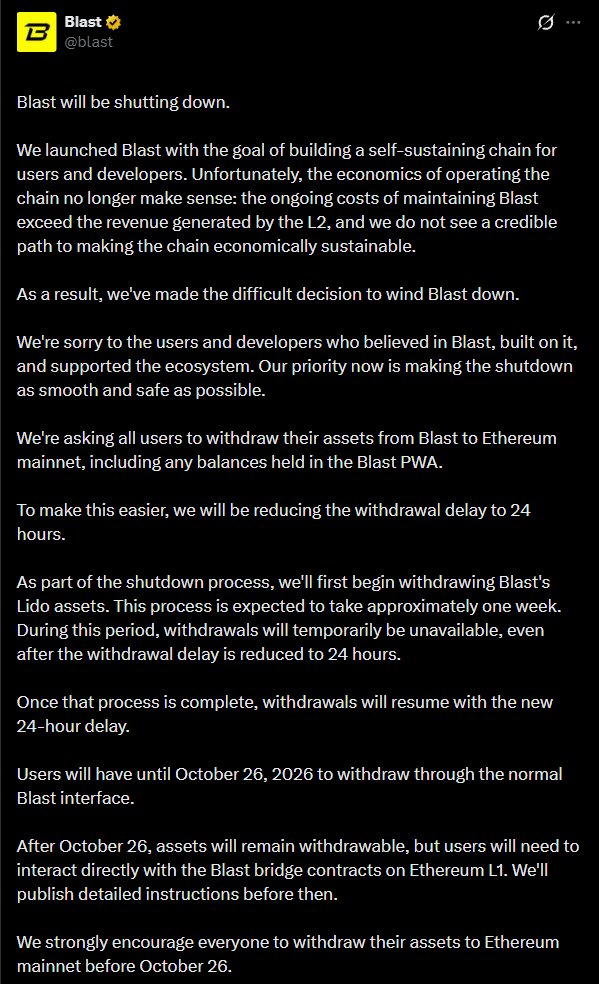
Blast to Shut Down After Raising $20 Million From Paradigm and Others in 2023
Ethereum Layer 2 network Blast announced that it will shut down, saying the ongoing cost of maintaining the chain now exceeds the revenue generated by the L2 and that it sees no credible path to becoming economically sustainable. Users are being asked to withdraw assets to Ethereum mainnet by October 26, with the withdrawal delay set to be reduced to 24 hours. After that date, assets will remain withdrawable through Blast’s bridge contracts on Ethereum L1.
Blast launched in early access in November 2023 after raising $20 million from investors including Paradigm and Standard Crypto.
Today the EF and OA announce zkAPI—a new means for private AI
Picture this: deposit ether into a vault, sign a zk proof, get a fixed amount of private inference. Advances like these help us move past middlemen's requirements that we link our data and identities.
Read more below
Blast will be shutting down.
We launched Blast with the goal of building a self-sustaining chain for users and developers. Unfortunately, the economics of operating the chain no longer make sense: the ongoing costs of maintaining Blast exceed the revenue generated by the L2, and we do not see a credible path to making the chain economically sustainable.
As a result, we've made the difficult decision to wind Blast down.
We're sorry to the users and developers who believed in Blast, built on it, and supported the ecosystem. Our priority now is making the shutdown as smooth and safe as possible.
We're asking all users to withdraw their assets from Blast to Ethereum mainnet, including any balances held in the Blast PWA.
To make this easier, we will be reducing the withdrawal delay to 24 hours.
As part of the shutdown process, we'll first begin withdrawing Blast's Lido assets. This process is expected to take approximately one week. During this period, withdrawals will temporarily be unavailable, even after the withdrawal delay is reduced to 24 hours.
Once that process is complete, withdrawals will resume with the new 24-hour delay.
Users will have until October 26, 2026 to withdraw through the normal Blast interface.
After October 26, assets will remain withdrawable, but users will need to interact directly with the Blast bridge contracts on Ethereum L1. We'll publish detailed instructions before then.
We strongly encourage everyone to withdraw their assets to Ethereum mainnet before October 26.