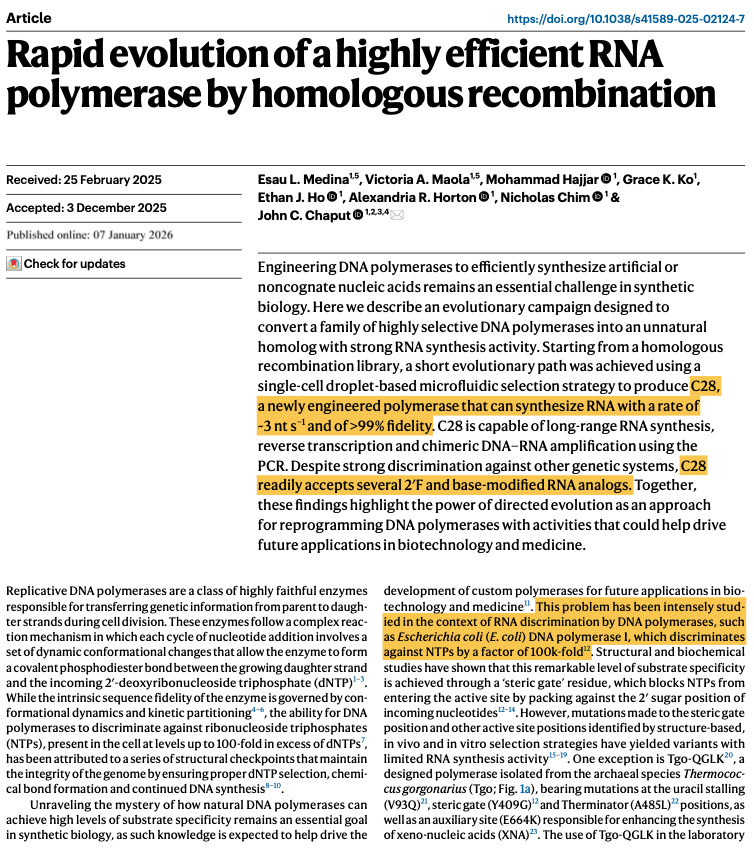
This paper is wild. After 3 rounds of directed evolution, they converted a DNA polymerase into an enzyme that can do:
- RNA synthesis
- Reverse transcription
- Synthesis of "unnatural" nucleotides
- Synthesis of DNA-RNA chimeras
One of the best papers I’ve read recently.
For context: In nature, it is DNA polymerase that takes a DNA sequence as a template and then copies it. These enzymes are crucial in replicating the genome for cell division, and they are EXTREMELY specific for DNA over RNA. This is key because RNA nucleotides are present in the cell at concentrations ~100x higher than DNA nucleotides, so the enzyme has evolved clever strategies to select one over the other.
RNA polymerases, for comparison, are the enzymes that take a DNA sequence as template and then convert it into RNA. They are involved in gene expression, for example.
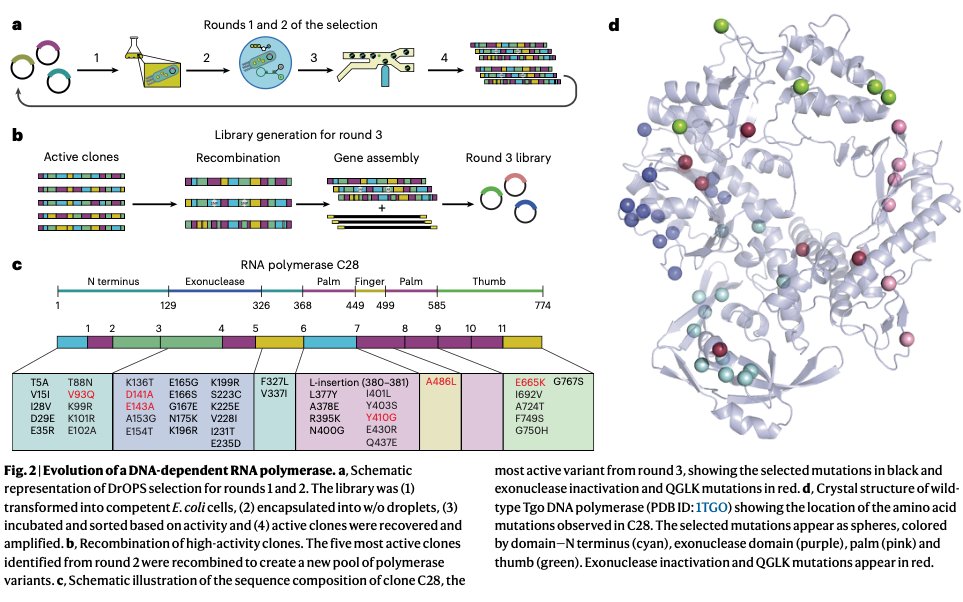
To convert a DNA polymerase into an RNA polymerase (and all the other functions I mentioned earlier), the authors did a fairly straightforward directed evolution experiment.
First, they took four DNA polymerase enzymes belonging to various archaea. These DNA polymerases don’t check for DNA vs. RNA as stringently as other types of cells, so they’re a good starting point to evolve RNA polymerases. The authors inserted some targeted mutations into these enzymes, based on known mutations in the literature. For example, they swapped the amino acid at position 409 for a smaller amino acid, thus removing a “gate” that keeps RNA building blocks from entering the enzyme.
Next, they took the four genes encoding these DNA polymerases and cut them up into 12 segments each. They randomly stitched these 12 segments together — from the four different genes — to build millions of unique variants. Each shuffled gene was inserted into an E. coli cell.
Then, they grew up these cells (each carrying a unique polymerase) and put them into microfluidic droplets. A device isolates each droplet, lyses the cell open, and releases the polymerase. The droplet also contains RNA building blocks and a DNA template, encoding a fluorescent reporter. If the polymerase begins synthesizing RNA, it will produce a detectable signal. They screened about 100 million droplets in 10 hours of work, searching for those with a signal.
For each well that yields a fluorescent signal, the researchers isolated the DNA and sequenced it to figure out which polymerase it was. They repeated this 3x times, finally isolating a really excellent RNA polymerase variant which they called "C28."
C28 has 39 mutations compared to the wildtype enzymes. It incorporates about 3.3 nucleotides of RNA per second, with 99.8% fidelity. The crazy thing is that this enzyme can also copy DNA or RNA templates back into DNA (reverse transcription), or use chimeric DNA-RNA molecules as a template and amplify them. It is just a super versatile polymerase that can act on DNA, RNA, or modified nucleotides, to build just about anything.
Many people think of proteins as having a biological function — catalyze reactions, detect pathogens, etc.
At a higher level, though, proteins are programmable materials. They are an advanced form of nanotechnology, made from templates that we can read and write and understand.
And because proteins are programmable, we can use them to build physical logic gates or “smart” drugs.
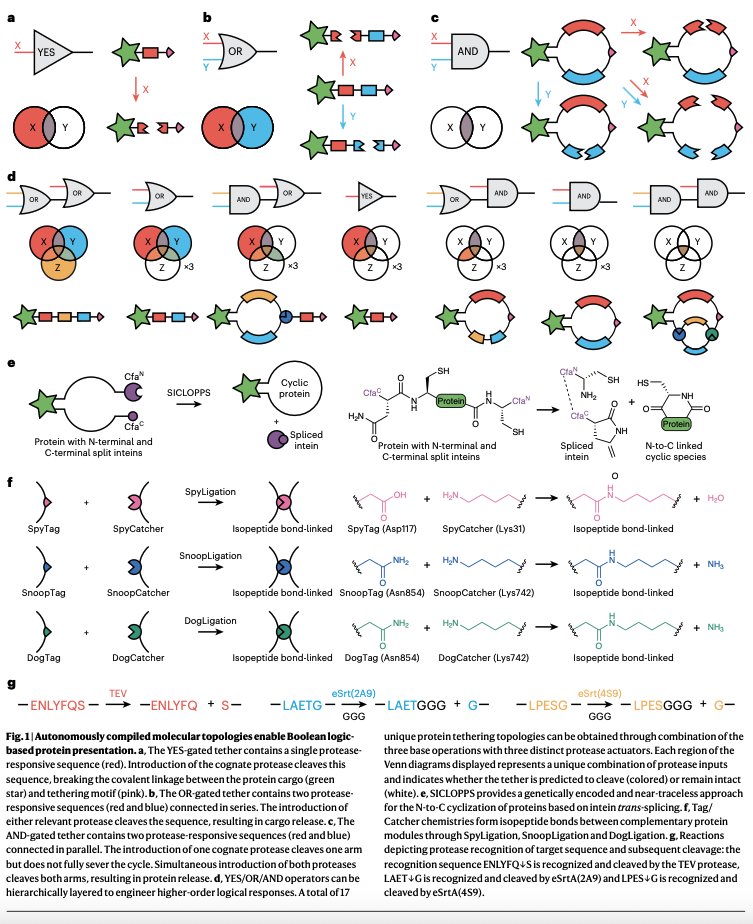
Say you wanted to make a protein that acts as a YES gate. That is, the protein releases some cargo (like a drug or other signal) only when a specific input is received.
You could build this YES gate by synthesizing a short protein (called a peptide) that has a particular sequence which is uniquely recognized by another protein, called a protease. There are many proteases found in nature. Each protease type recognizes a unique protein sequence and cleaves it, thus splitting the target in two.
A YES gate, then, can be made by building a peptide that has a protease recognition site. One end of the peptide is attached to a drug. The drug is only released when exposed to the protease.
An OR gate is also simple to make. Just create a peptide carrying two different protease sites in series, such that the addition of either protease will cleave the peptide and release the drug.
An AND gate is more difficult. To make it, you can instead attach the drug to two different peptides, each carrying a different protease recognition site. Then, anchor the ends of these two peptides to a scaffold. In this case, the drug will only be released if BOTH proteases are added.
Why am I writing about this? Because you can use these basic logic gate architectures to build all kinds of wonderful, “smart” materials and drug delivery vehicles. For a recent study, researchers built each of these logic gates, and also nested or stacked them together to build even more complex circuits (17 different logic architectures in total.)
They embedded these protein logic gates onto magnetic beads, hydrogels, and even living mammalian cells. These logical proteins are genetically encoded, modular, and could in principle respond to other signals, too; not just proteases but also light, small molecules, or mechanical forces.
Imagine a therapy for metastatic cancer that only releases its drug when two tumor-specific proteases, like MMP-9 and cathepsin B, are active. Or engineered immune cells that secrete cytokines only when both an infection marker and a metabolic stress signal are present.
Interesting to think about.
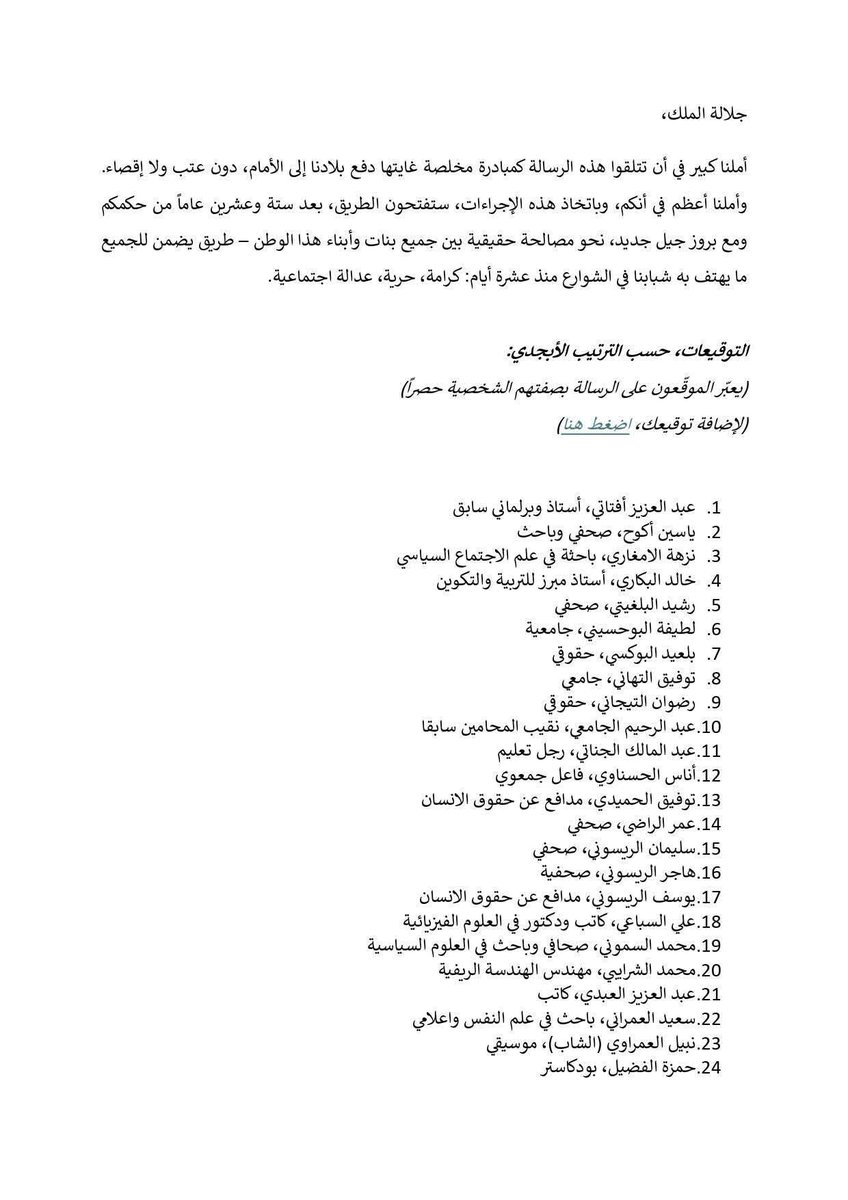
Cette lettre est adressée au Roi, Chef de l'État du Maroc, en tant que source de l'autorité exécutive. Elle appelle à une réponse pratique et profonde, d'un caractère politique, et un traitement en profondeur des racines de la crise..J'ai signé cette lettre..
حرك مطلب شباب “جيل زد” إلى الملك بـ”إقالة الحكومة” تساؤلات ونقاشا دستوريا في المغرب.
بين الاحتكام لضوابط دستور 2011، ومناداة “GenZ212” في مسودة مطالب سياسية على “إقالة الحكومة”، بناء على الفصل 47 من الدستور ذاته، قائلة إنه “ينص على أن للملك صلاحية إعفاء وتعيين رئيس الحكومة وأعضاء الحكومة”، يشدد خبراء في الشأن الدستوري على أن الإقالة لا تتم بهذا الشكل.
عبد الرحيم العلام، أستاذ القانون الدستوري والعلوم السياسية بجامعة القاضي عياض بمراكش، قال إن “إقالة رئيس الحكومة من طرف الملك غير ممكنة دستوريا، لأن الدستور يضمن حصانة منصبه، وقد كان ذلك في الأصل مطلبا شعبيا تجسد في دستور 2011”.
وأوضح العلام أنه “لا يمكن تغيير رئيس الحكومة مع كل موجة احتجاج، لأن ذلك سيقود إلى حالة عدم استقرار سياسي دائم، بينما الأصل هو احترام المقتضيات الدستورية”.
التفاصيل: https://t.co/PtGzwBdvfZ
#الحكومة #دستور #جيل_زد
The Moroccan secret police, during the arrest of one of the protesters, heard a single word:
“FREEDOM.”
He turned back looking for the one who said it shouting:
“Who said freedom?!!”
صاحب السمو الملكي ولي العهد الأمير مولاي الحسن يترأس افتتاح الدورة الـ 16 لمعرض الفرس للجديدة
https://t.co/6cQkqdX4jE
SAR le Prince Héritier Moulay El Hassan préside l’ouverture de la 16e édition du Salon du cheval d’El Jadida
https://t.co/f6o4cLnPIm
"Only ~0.02%-3.1% of [a cell's] genome" is being transcribed at any given moment.
Other interesting takeaways from this new paper:
> If you pool together a bunch of cells of the SAME type (like primary immune cells from a mouse's spleen), and you measure the transcription for each of them, you'll find that ~67% of the genome is active collectively.
But at a SINGLE cell level, only like 0.04% of the genome is active. There is huge heterogeneity between cells, even of the same type. This heterogeneity disappears when we do bulk RNA-seq and measure cells together.
> About 31% of a cell's transcription comes from known protein-coding genes. The rest of transcription happens in regions that don't make proteins. In other words, more "non-coding" DNA is transcribed than "coding" DNA.
> There is a surprising disconnect between RNA production & decay at the single-cell level.
If you look at thousands of cells together, the rate of RNA production (how fast genes are transcribed) usually matches the rate of RNA decay (how fast old transcripts are degraded). This makes sense, because cells presumably would want to keep a fairly steady balance of RNA levels.
But when scFLUENT-seq was used to look at individual cells, this "rule" broke down! For a given mRNA, some cells were making a lot of new copies even if old copies weren’t being degraded much, while other cells had the opposite. So transcription and decay don't seem to be tightly matched within a single cell at a given time after all. The balance between production + decay is only true in bulk.
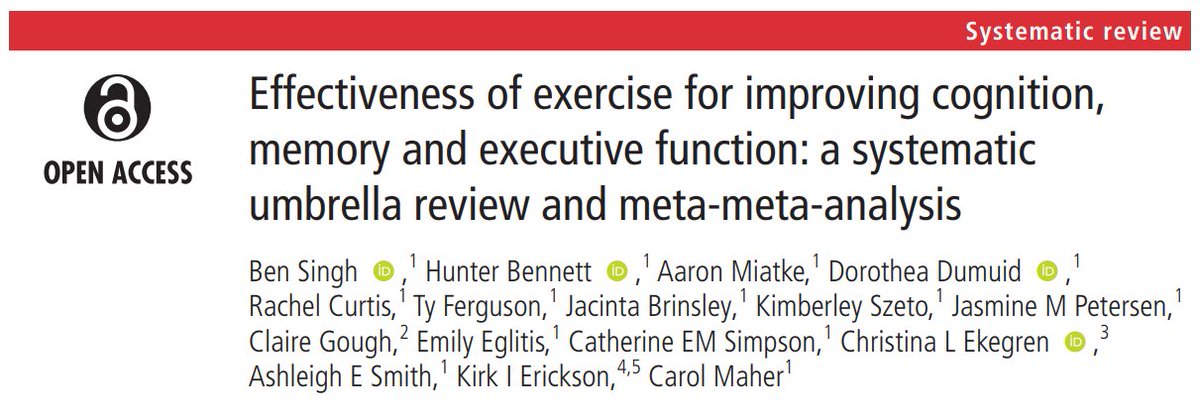
The largest review, including >2700 trials, was just published.
Exercise significantly improved cognition, memory & executive function across all populations.
Exercise is essential for cognitive health.






![NikoMcCarty's tweet photo. "Only ~0.02%-3.1% of [a cell's] genome" is being transcribed at any given moment.
Other interesting takeaways from this new paper:
> If you pool together a bunch of cells of the SAME type (like primary immune cells from a mouse's spleen), and you measure the transcription for each of them, you'll find that ~67% of the genome is active collectively.
But at a SINGLE cell level, only like 0.04% of the genome is active. There is huge heterogeneity between cells, even of the same type. This heterogeneity disappears when we do bulk RNA-seq and measure cells together.
> About 31% of a cell's transcription comes from known protein-coding genes. The rest of transcription happens in regions that don't make proteins. In other words, more "non-coding" DNA is transcribed than "coding" DNA.
> There is a surprising disconnect between RNA production & decay at the single-cell level.
If you look at thousands of cells together, the rate of RNA production (how fast genes are transcribed) usually matches the rate of RNA decay (how fast old transcripts are degraded). This makes sense, because cells presumably would want to keep a fairly steady balance of RNA levels.
But when scFLUENT-seq was used to look at individual cells, this "rule" broke down! For a given mRNA, some cells were making a lot of new copies even if old copies weren’t being degraded much, while other cells had the opposite. So transcription and decay don't seem to be tightly matched within a single cell at a given time after all. The balance between production + decay is only true in bulk.](https://pbs.twimg.com/media/G2CFMG2a4AAGWYL.png)













![NikoMcCarty's tweet photo. "Only ~0.02%-3.1% of [a cell's] genome" is being transcribed at any given moment.
Other interesting takeaways from this new paper:
> If you pool together a bunch of cells of the SAME type (like primary immune cells from a mouse's spleen), and you measure the transcription for each of them, you'll find that ~67% of the genome is active collectively.
But at a SINGLE cell level, only like 0.04% of the genome is active. There is huge heterogeneity between cells, even of the same type. This heterogeneity disappears when we do bulk RNA-seq and measure cells together.
> About 31% of a cell's transcription comes from known protein-coding genes. The rest of transcription happens in regions that don't make proteins. In other words, more "non-coding" DNA is transcribed than "coding" DNA.
> There is a surprising disconnect between RNA production & decay at the single-cell level.
If you look at thousands of cells together, the rate of RNA production (how fast genes are transcribed) usually matches the rate of RNA decay (how fast old transcripts are degraded). This makes sense, because cells presumably would want to keep a fairly steady balance of RNA levels.
But when scFLUENT-seq was used to look at individual cells, this "rule" broke down! For a given mRNA, some cells were making a lot of new copies even if old copies weren’t being degraded much, while other cells had the opposite. So transcription and decay don't seem to be tightly matched within a single cell at a given time after all. The balance between production + decay is only true in bulk.](https://pbs.twimg.com/media/G2CFMS2bIAA07DE.png)