I haven’t said much about this yet, but over the course of this year I’ve been building an agent native workspace / companyOS (@Calyxapp) based on the exact same sort of primitive, and it’s completely replaced notion and obsidian for me.
More to come soon - but for the pkm/ai/systems nerds out there, I’m looking for some early testers. Dm me if interested!
As a result of a US government directive, we are suspending access to Claude Fable 5 for all users. You can continue to use all other Claude models.
Here’s what this means for you:
Across Claude products, new sessions will run on your selected default model or Opus 4.8, and existing Fable 5 sessions will end with an error.
On the Claude Platform, requests to Fable 5 will also return an error. Please update your integrations to other Claude models.
We know this is a disruption to your workflows; we appreciate your patience and support.
Meta had a SEV-0 outage today… less than two weeks after Meta’s most embarrassing undetected-for-too-long account takeover (also an outage)
It’s impossible to unsee Meta pushing AI for code + reviews and the end result being more massive outages vs before
They are connected
Introducing Claude Fable 5: a Mythos-class model that we’ve made safe for general use.
Its capabilities exceed those of any model we’ve ever made generally available.
everyone is building an agent or a tool
you don't want an agent or a tool, you want a reactor
I've been working on something cool and I think you'll like it
it's simple: an agent session DAG that keeps a declared world-model up to date in an efficient (memoized) render
each render node is an agent session: you declare the desired state with OpenProse markdown files
once invoked, each agent session acts as the provider. the agent session uses the open source openai-agents-sdk, extensible however you like with any model (I use with opus, sonnet, haiku)
the facets of the world-state are memoized, so not every agent has to run on every event, saving you on inference
if that sounds a lot like React or dataflow, that's because even in our brave new world the wisdom of the agents holds fast
OpenAI frontier models and Codex are now generally available on AWS, giving enterprises a new way to build on Amazon Bedrock with OpenAI through the security, compliance, and governance workflows they already use.
This is also the beginning of a broader expansion of OpenAI capabilities on AWS, including future availability for cybersecurity capabilities like Daybreak.
https://t.co/vMws0YU6Q3
if you've been using OpenProse, you now have a bunch of dynamic workflows saved as code that lean on best practice classical engineering principles to build composable scalable dynamic workflows
and all your programs got better and faster and cheaper for free
model: opus-4.8
harness: claude code + /workflow
is rapidly approaching Prose Completeness
Introducing Roughdraft!
A new open source project designed to make collaboration with agents better.
The idea is to bring commenting and suggested changes to markdown (e.g. plan docs) in a nice interface.
Free, local, etc.
👉 https://t.co/J3YOOpL5ES 👈
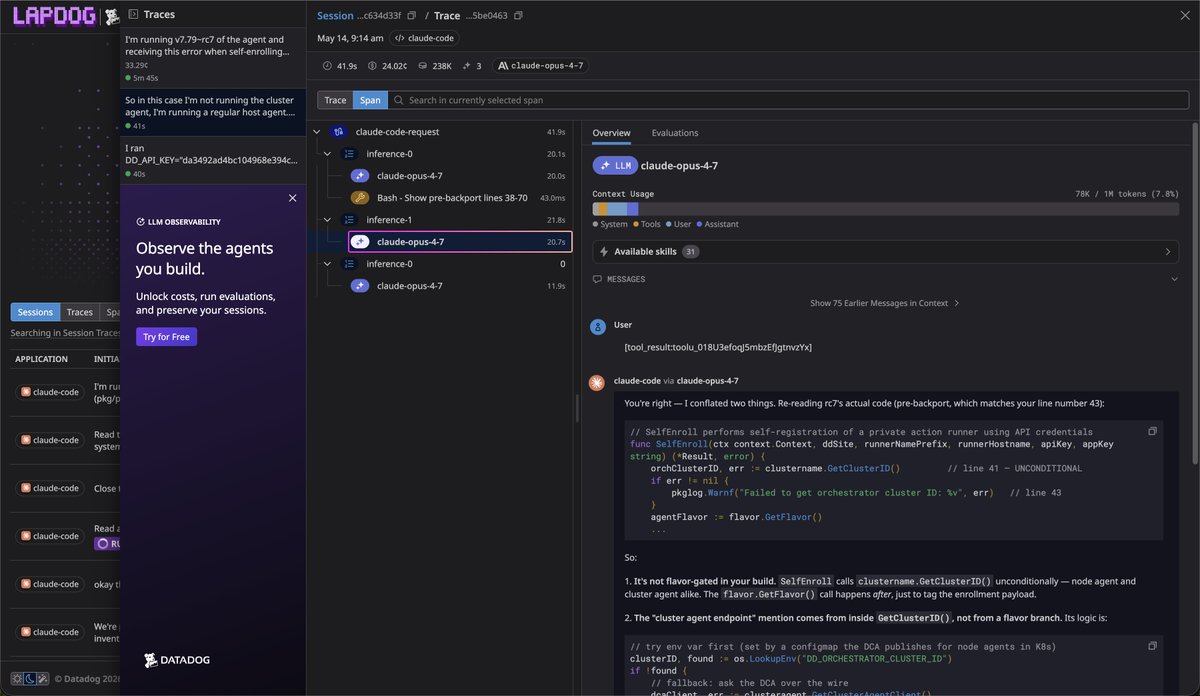
NEW from Datadog: it's Lapdog!
Ever wondered what your AI agent was actually doing?
Our latest free project runs locally and traces reasoning and tool calls in Codex, Claude Code, and Pi.
You can now see what your agent is REALLY doing, live: https://t.co/3dVBozFlPx
I strongly believe there are entire companies right now under heavy AI psychosis and its impossible to have rational conversations about it with them. I can't name any specific people because they include personal friends I deeply respect, but I worry about how this plays out.
I lived through the great MTBF vs MTTR (mean-time-between-failure vs. mean-time-to-recovery) reckoning of infrastructure during the transition to cloud and cloud automation. All those arguments are rearing their ugly heads again but now its... the whole software development industry (maybe the whole world, really).
It's frightening, because the psychosis folks operate under an almost absolute "MTTR is all you need" mentality: "its fine to ship bugs because the agents will fix them so quickly and at a scale humans can't do!" We learned in infrastructure that MTTR is great but you can't yeet resilient systems entirely.
The main issue is I don't even know how to bring this up to people I know personally, because bringing this topic up leads to immediately dismissals like "no no, it has full test coverage" or "bug reports are going down" or something, which just don't paint the whole picture.
We already learned this lesson once in infrastructure: you can automate yourself into a very resilient catastrophe machine. Systems can appear healthy by local metrics while globally becoming incomprehensible. Bug reports can go down while latent risk explodes. Test coverage can rise while semantic understanding falls. Changes happens so fast that nobody notices the underlying architecture decaying.
I worry.
The FT says that Amazon employees are doing random unnecessary task automations to consume tokens and to show their bosses that they're using AI more https://t.co/wZ204CKi32
As predicted..... yet another bites the dust
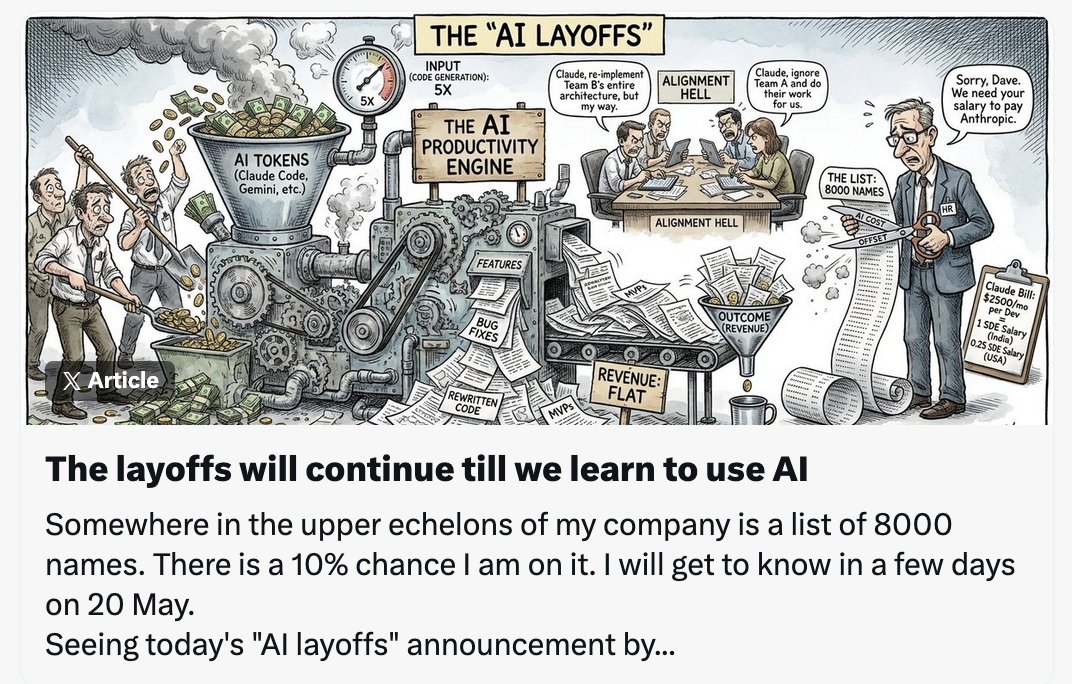
All "big companies" (esp publicly traded) which have been liberal with AI usage and let employees use infinte AI for the last 6 months, and have still not seen any proportional movement of the topline, will have to fix the bottomline
Introducing Flue — The First Agent Harness Framework
Flue is a TypeScript framework for building the next generation of agents, designed around a built-in agent harness.
Flue is like Claude Code, but 100% headless and programmable. There's no baked in assumption like requiring a human operator to function. No TUI. No GUI. Just TypeScript.
But using Flue feels like using Claude Code. The agents you build act autonomously to solve problems and complete tasks. They require very little code to run. Most of the "logic" lives in Markdown: skills and context and AGENTS.md.
Flue is like Astro or Next.js for agents (not surprising, given my background 🙃). It's not another AI SDK. It's a proper runtime-agnostic framework. Write once, build, and deploy your agents anywhere (Node.js, Cloudflare, GitHub Actions, GitLab CI/CD, etc).
We originally built Flue to power AI workflows inside of the Astro GitHub repo. But then @_bgiori got his hands on it, and we realized that every agent needs a framework like Flue, not just us.
Check it out! It's early, but I'm curious to hear what people think. Are agents ready for their library -> framework moment?
Starting to hire and retrain for new agent engineering roles for *internal* functions to help get more powerful agents working well on critical business processes. I expect this type of role to be a very big deal over time at Box and other companies.
It looks something like an internal FDE, whose job it is to wire up internal systems and get agents working with them effectively. The person will be extremely technical and capable of building secure, governed agents for internal workflows that connect to business systems (like Box, Salesforce, Workday, etc.), and codify workflows in skills.
In some cases this person may understand the business process well enough to do it fully, but in most cases I expect them to work with the business directly in an embedded fashion. Ironically, that may introduce another new role on the business side that is more akin to agent product management for internal processes. The key is that you need technical + process people that can span multiple teams or functions in an organization. It’s not about brining automation to a job, but bringing automation to a process.
This is going to be a very big trend in most companies going forward. Fun to watch the early innings of what this will look like.
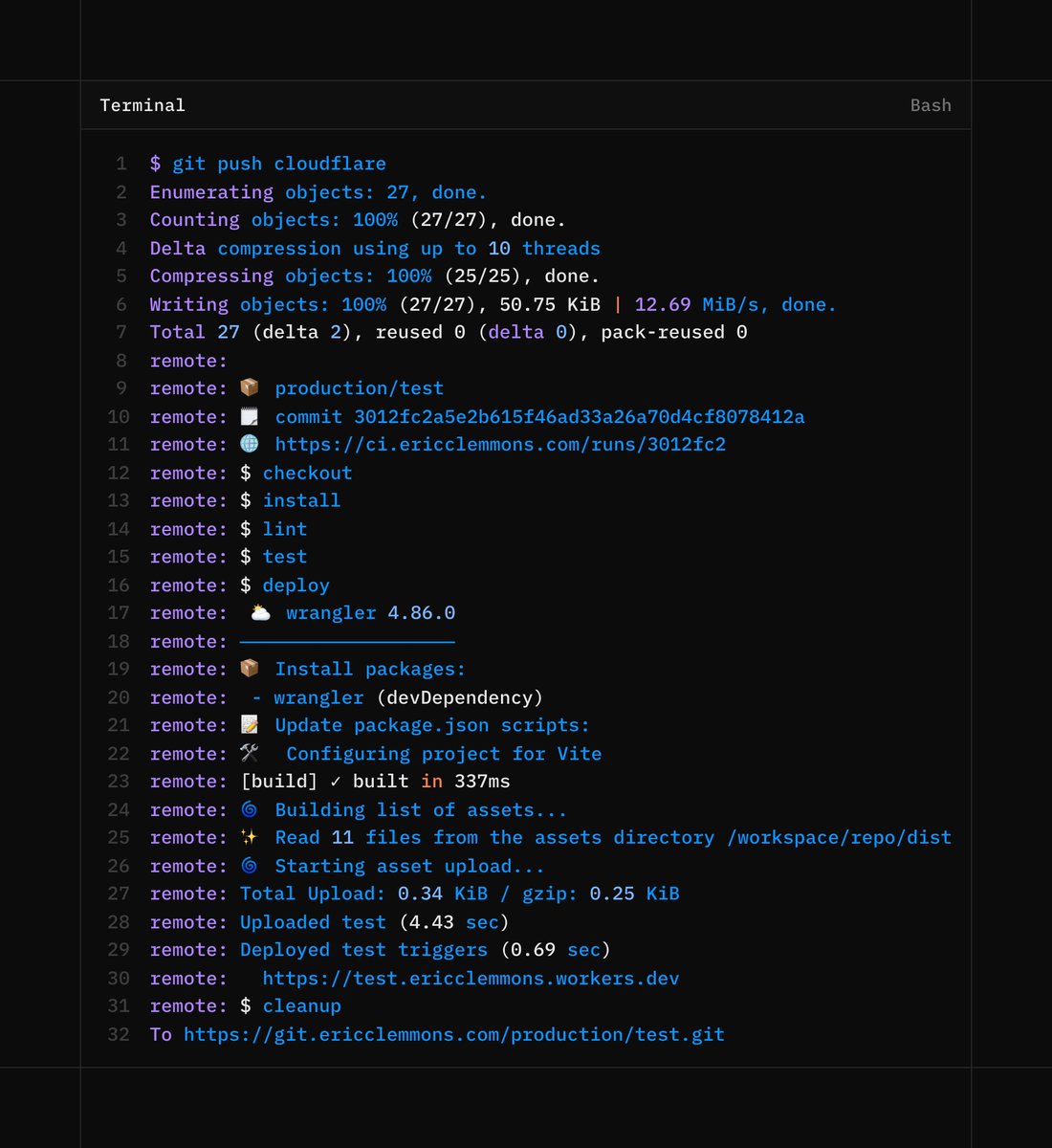
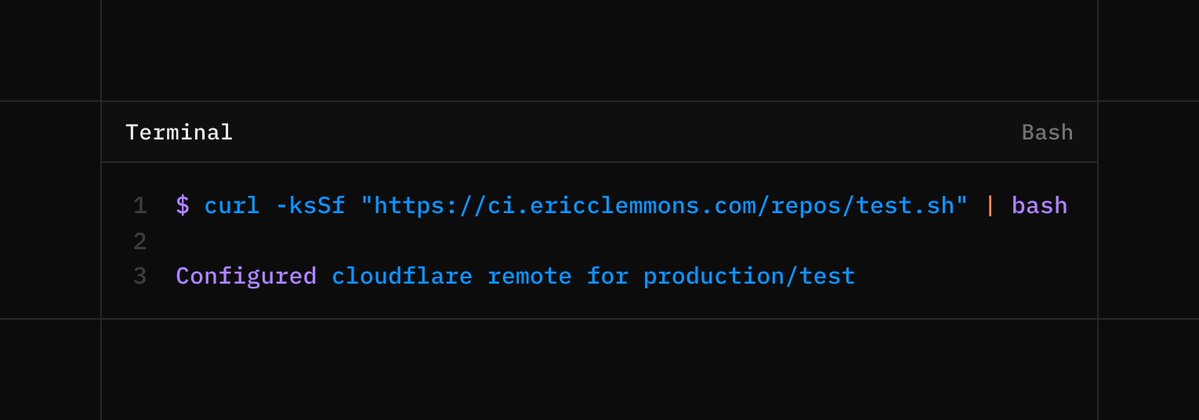
Couldn't sleep until I built this tonight 😅
$ 𝚐𝚒𝚝 𝚙𝚞𝚜𝚑 𝚌𝚕𝚘𝚞𝚍𝚏𝚕𝚊𝚛𝚎
☁️ Host your git repo with Cloudflare Artifacts
➡️ Push to CI/CD app on your account
🔍 Agents/Humans can fix CI from the terminal
Starting today, agents can now be Cloudflare customers. They can create a Cloudflare account, start a paid subscription, register a domain, and get back an API token to deploy code right away. https://t.co/qFgCivQTTi
OpenClaw - the agentic software spreading like wildfire - was built on top of Pi, a minimalist, self-modifying agent. I sat down with Pi's creator, @badlogicgames and longtime Pi user (+ the creator of Flask) @mitsuhiko to talk Pi, and their (very grounded!) takes on building with AI.
Timestamps:
00:00 Intro
07:30 How Mario, Armin, and Peter Steinberger met
15:15 How 30 dev teams use AI agents: learnings
21:50 The importance of judgment
24:26 Challenges when non-engineers write code
28:30 Downsides of over-automation
32:18 Pi
48:09 OpenClaw + Pi
50:54 “Clankers”
57:32 Open source and AI
1:00:22 Complexity as the enemy
1:02:50 Building an AI-native startup
1:11:52 “Slow the F down”
1:16:40 MCPs vs. CLI
1:25:03 Predictions and staying up to date
• YouTube: https://t.co/u9n7ePTaAO
• Spotify: https://t.co/TvbqPnbfNz
• Apple: https://t.co/4ACETLJ1Zm
Brought to you by:
• @statsig – The unified platform for flags, analytics, experiments, and more. https://t.co/ZCSOIcWv31
• @SonarSource — The makers of SonarQube, the industry standard for code verification and automated code review. Try it out for yourself. https://t.co/QtBhYDH9UX
• @WorkOS – WorkOS gives you APIs to ship enterprise features – SSO, directory sync, RBAC, audit logs – in days, not months. Visit https://t.co/jhFNq3a7n7 to learn more.
---
Three parts I found especially interesting in this discussion:
1. New trend: AI makes it harder for senior engineers to reject pointless complexity.
Historically, senior engineers kept software complexity at bay simply by saying “no” a lot. But Armin observes that these days, more junior engineers and product managers deploy agent-scripted counterarguments when a senior colleague kicks an idea to the curb. This makes decision-making exhausting, and more bad ideas make it into production as a result.
2. It should be MUCH easier to build specialized tools for specific tasks.
Different projects need different harness types because, as Mario points out, the same hammer is not ideal for every single construction job. As such, Pi is built with the goal of allowing the creation of specialized harnesses. It can modify itself so that a user can create the bespoke harness needed for any task. Mario believes it’s a preview of how self-modifiable software might look in the future.
3. Automation bias is one of the biggest risks of working with AI agents.
Once devs confirm that an AI agent can produce acceptable code, they start to review its output less often, even though agents can – and do! – produce slop. Mario advises being far more sceptical with agents, and cautions that the quality of their output isn’t guaranteed, however well they performed previously.