JP Morgan paid ~$700K/year to headhunt this Goldman Sachs trader, who turned $25M → $400M
- Lehman Brothers also hired him and after he left the bank collapsed with $600B in debt
16-min and you’ll learn exactly what skills made every top fund on Wall Street chase the same trader
Jim Simons turned $100 into $130 billion using math. He just gave the entire playbook in a free 1-hour MIT lecture. You've been picking stocks based on Reddit and vibes. He returned 66% per year for 30 years using equations. This is the most valuable hour you'll spend this week. Save the video. Watch it tonight. Build the bot this weekend. Follow @girlinAI for more high-signal content that turns lectures into income.
↓ Below what nobody is telling you about this lecture. Everything Jim Simons taught Renaissance Technologies in the 1980s is now buildable in a weekend with Claude Code. Pattern recognition across thousands of assets. Signal detection in noise. Automated execution. Risk management at scale. In 1988, this required a team of 50 PhDs and millions in infrastructure. In 2026, one person with Claude + a laptop can build a working version in 7 days. The knowledge gap between you and a Renaissance trader is now smaller than it has ever been in history. Follow
@girlinAI for daily breakdowns of the AI tools that turn this knowledge into income.
↓ What this lecture actually teaches you to build. Simons walks through the core principles that printed $130 billion: > Find statistical edges that are invisible to humans > Trade only when the math says yes, never on emotion > Run hundreds of small bets simultaneously, not one big bet > Cut losses ruthlessly when signals weaken > Compound relentlessly across decades These aren't trading tips. These are the foundational principles of every AI trading bot worth running. Watch the lecture. Take notes. Then turn it into a system. Follow @girlinAI for the exact Claude prompts that turn quant theory into deployed bots.
↓ Your weekend playbook to turn this into profits. Friday night: watch the Simons lecture. Take notes on every signal he mentions. Saturday: open Claude Code. Build a backtesting framework using historical price data. Test 3-5 of his core signal ideas. Sunday: paper trade your best signals on Polymarket, Toobit, or Alpaca. Validate before risking real capital. Monday: deploy a small position. $100. $500. Whatever you can lose without flinching. Compound. Iterate. Scale. That's how a Simons-grade trading system gets built in 2026. Not over 30 years. Over one weekend. Follow
@girlinAI for the exact templates and prompts to build each piece.
↓ This is the best time in history to build wealth with AI trading. Jim Simons needed: > A team of 50 PhDs > $25 million in compute > 10 years of infrastructure > Custom data feeds nobody else had You need: > Claude Code > A laptop > 7 days of focus > $20/month in API costs Same math. Same principles. Same edge. Different barrier to entry. People who watch this lecture and build with the knowledge will compound for the next decade. People who save it for later, will still be picking stocks based on vibes in 2027. Save the video. Watch it tonight. Build the bot this weekend. Follow @girlinAI for more high-signal content that turns lectures into income.
INSTEAD OF WATCHING NETFLIX TONIGHT.
Spend 1 hour with this.
Claude AI FULL COURSE that teaches you how to BUILD and AUTOMATE anything.
The people who watch this tonight will wake up tomorrow with a new skill.
Watch it and bookmark it now.
Anthropic just showed a 24-minute workshop on how to actually prompt Claude.
Taught by the people who built it.
Free. No signup. No paywall.
I've watched $300 courses that don't cover what they teach in the first 8 minutes.
White House Chief of Staff @SusieWiles47 doesn’t chase credit, she delivers results. 🌟
A powerhouse behind the scenes & a driving force shaping America’s future. Honored to celebrate her.
White House Chief of Staff Susie Wiles is asked how she works for "somebody who never sleeps."
"We divide it. And I get the early calls and Dan [Scavino] gets the late calls."
Elon Musk just told a story that should terrify every AI company on Earth.
His son Saxon is autistic.
Saxon couldn’t understand why the family went to restaurants.
You can get the same food delivered.
You can call your friends over.
You can eat better at home for half the price.
So why go?
Musk: “He had an epiphany and said, ‘Oh, the reason people go to restaurants is to hang out with strangers.’”
A kid who takes the world literally just decoded something the rest of us never thought to question.
We like being around people we’ll never know.
Look at what we already built.
Delivery apps so you never wait in line.
Remote work so you never share an office.
Self-checkout so you never talk to a cashier.
Every innovation of the last 20 years was a bet against human proximity.
Every one paid off.
Until it didn’t.
Loneliness is now a public health emergency.
Depression has doubled since the smartphone.
The average American has fewer close friends than any generation in history.
We didn’t remove friction.
We removed the thing friction was hiding.
Now look at what’s coming.
AI agents that handle your emails.
AI companions that replace your conversations.
AI assistants that make every human interaction optional.
Same playbook. Same bet.
Except this time we’re not engineering out strangers.
We’re engineering out humans entirely.
The coffee shop where nobody knows your name.
The subway where no one speaks.
The restaurant where you’ll never see that couple again.
Those aren’t failed connections.
They’re the background radiation of belonging.
We don’t just need people who know us.
We need to exist in rooms full of people who don’t.
That’s what a kid understood at a dinner table that billion-dollar companies still can’t grasp in a boardroom.
We spent 20 years building a world you never have to show up to.
AI is about to finish the job.
And nothing it builds will ever replicate sitting in a room full of strangers and not feeling alone.
Michael Saylor says working hard is the worst advice you can get
"You don't want to make money by being talented and working hard, the robots are going to work hard, the cars are gonna drive themselves"
"Once you train the AI on a Shakespearean sonnet, the AI will spit back sonnets just as good as Shakespeare in his prime, if you studied for 20 years to learn how to compose, that’s becoming less valuable just like writing a 100-page legal document"
"Now you're gonna say to the AI, compose an entire network of trusts and wills for my entire family and then optimize it for which tax jurisdiction and implement it. And it's only gonna cost you $10 bucks and it used to cost $10,000,000... human capital is getting demonetized"
In his fake White House correspondents speech @JimmyKimmelLive actually joked about Trump’s assassination — just before a real assassin showed up at the real dinner.
Hey @DisneyABCTV when the hell are you finally going to pull this vile person from the airwaves?
Placing silverware in hot water with baking soda, salt, and aluminum foil creates a small electric current. This redox reaction pulls sulfur from tarnished silver
A process called Electrochemical reduction https://t.co/pbZnF81dBU
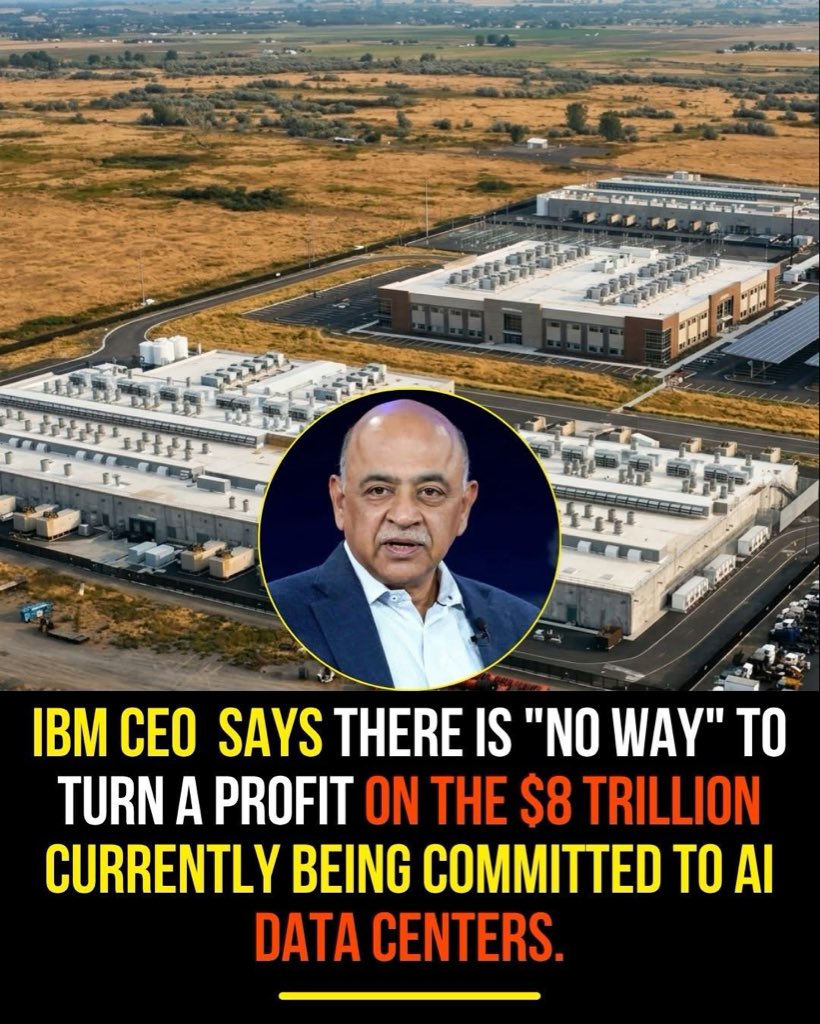
The AI bubble burst will be worse than the dotcom bubble. None of these companies are profitable without government subsidies, or communism.
IBM CEO Arvind Krishna says there is "no way" to turn a profit on the $8 trillion currently being committed to AI data centers.
Krishna notes that at $80 billion per gigawatt, a company committing to 20-30 GW faces $1.5 trillion in CapEx, requiring $800 billion in annual profit just to cover interest and depreciation of chips that must be replaced every 5 years.
0/10 of the top AI startups are profitable!
Instead of watching an hour of Netflix, watch this 1 hour Yale lecture. It will teach you more about options trading and the exact models hedge funds use than most people learn in their entire careers on Wall Street.
Elon Musk thinks the entire education system is built on a broken assumption.
That every student should learn the same thing. At the same speed. In the same order. At the same time.
Musk: “Everyone goes through from like 5th grade to 6th grade to 7th grade like it’s an assembly line. But people are not objects on an assembly line.”
The model was designed for a factory economy. Standardized inputs. Predictable outputs.
That economy is gone. The assembly line is gone.
But the education system still runs on its logic.
A student who masters algebra in two weeks sits through eight more weeks because the calendar says so. A student who struggles gets dragged forward because the schedule doesn’t wait.
Neither is being served. Both are being processed.
Musk: “Allow people to progress at the fastest pace that they can or are interested in, in each subject.”
AI doesn’t teach a classroom. It teaches a student.
One at a time. Every time.
It skips what a student already knows. It finds where they’re stuck and approaches it from a different angle.
It adjusts in real time. Not at the end of a semester when the damage is already done.
A student obsessed with basketball learns fractions through shooting percentages. A student who builds in Minecraft learns geometry through architecture.
The subject doesn’t change. The entry point does.
No teacher with thirty students can do this. Not because they lack skill.
Because the math doesn’t work.
AI doesn’t have that constraint.
Musk: “You do not need to tell your kid to play video games. They will play video games on autopilot all day. So if you can make it interactive and engaging, then you can make education far more compelling.”
The brain isn’t broken. The format is.
Kids learn complex systems and strategic thinking for hours voluntarily. Then walk into a classroom and can’t focus for twenty minutes.
That’s not a discipline problem. That’s a design problem.
Musk: “A university education is often unnecessary. You probably learn the vast majority of what you’re going to learn there in the first two years. And most of it is from your classmates.”
Four years. Six figures of debt.
And the real value comes from the people sitting next to you. Not the institution charging you.
The degree doesn’t certify knowledge. It certifies endurance.
Musk: “If the goal is to start a company, I would say no point in finishing college.”
The system was built to train employees. If you’re not trying to be one, it has nothing left to offer you.
Every lecture. Every textbook. Every curriculum. Now available instantly. Personalized to any learner. Adapted to any pace.
The question isn’t whether the old model survives.
It’s how long we keep forcing students through it while the replacement already exists.
Instead of watching an hour of Netflix, watch this 2-hour Stanford lecture on AI careers. It will teach you more about winning in the AI race than all the AI content you’ve scrolled past this year.
Elon Musk just told the world to stop training surgeons.
Not slow down. Stop.
Musk: “There’ll probably be more Optimus robots that are great surgeons than there are all surgeons on Earth.”
The entire global surgical workforce. Redundant. Before a current med student finishes residency.
“Don’t go to medical school?”
Musk: “Yes. Pointless.”
Twelve years. Half a million dollars. One word.
Optimus does not shake. Does not fatigue. Does not flinch at hour eleven of a twelve-hour operation.
It improves every night while the surgeon sleeps.
By year four, Musk says he’d stake everything on it. By year five, it is not close.
Then came the line that rewrites who medicine has ever belonged to.
Musk: “Everyone will have access to medical care that is better than what the president receives right now.”
Medicine has always been rationed by wealth. The best surgeons on Earth have always belonged to the powerful.
That ends. Completely. Within five years.
The machine does not calibrate its precision to your net worth. It does not save its best work for the wealthy. Full capacity, every time, for everyone.
One day, choosing a human surgeon over a robot will feel like refusing the anesthesia.
Human hands are no longer medicine’s highest standard.
The ones who doubted this will understand it the day they need surgery, not a surgeon.