Pie is going to get a lot larger. Endless possibilities in types of markets, variations in how they resolve, and who they serve best. And these are markets that, like crypto and unlike equities, can be exported globally with little extra effort, which increases the SAM significantly. Any quickly growing market will invite more competitors, but that also means the product itself has more staying power. As Peter Thiel says, competition is for losers.
Yesterday CME said they were going to launch sports related options and futures. Today IG Group buys Underdog. Both Kalshi and Polymarket had their best months ever in June primarily with massive WC volumes. And I’ve seen actual institutional hedging using sports event contracts on both Poly and Kalshi.
Seems clear the market for sports event contracts is going to get far bigger, and the institutional players are paying attention. This isn’t just about gaming, there are broad uses here that will get much bigger than people realize. Excited to see how this keeps evolving.
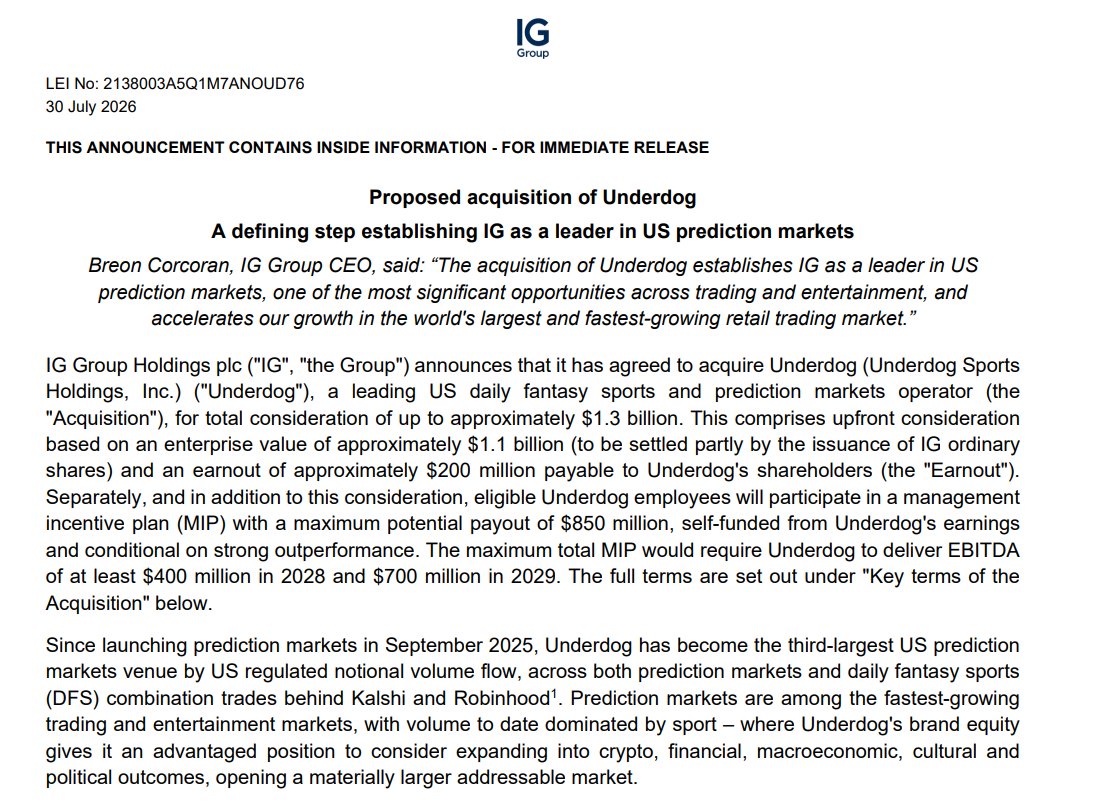
Sheesh, U.K.-based trading provider IG Group has announced it is buying DFS/prediction market operator Underdog for around $1.3 billion.
"Underdog has become the third-largest US prediction markets venue by US regulated notional volume flow..."
Yesterday, Dragonfly filed a comment letter supporting the CFTC’s proposed framework for prediction market event contracts.
We support the Commission’s case-by-case review framework, including its structured procedures and settlement-focused test for determining when a contract “involves” a particular activity. We also support the Commission’s proposed definition of “gaming” in § 40.11(b)(1), rather than the alternative structural formulation discussed in the proposal.
In addition, we support a public-interest analysis that recognizes the full range of benefits prediction markets can provide, including information aggregation, hedging and pricing utility, responsible innovation, and fair competition.
We appreciate the Commission’s thoughtful work and this opportunity to comment. Clear rules will protect market integrity while allowing responsible innovation in US prediction markets.
As Cuy says here, "it's like a new era of fintech". And people are still really underselling the broader opportunity here, it's not just about cards, it's about modernizing the entire banking stack.
@LDrogen It’s going to make >$250mm globally at the box office. With streaming sales it’ll probably get close to break even. And Emily blunt will probably get a lot of awards buzz. But agree it was quite forgettable and at times incomprehensible.
@AlbernDr Love Denis’ movies. Maybe even like them better. But Nolan is just so great at the craft itself. It’s like watching Spielberg with mastery over more tools
I heard another theory today was that they don’t want to allow pure payments businesses be run out of the trust charters (Erebor / Augustus are full charters and most of the others who have been given trust charters are doing it for issuance reasons) and therefore they’ll need to reapply as a full charter if they want to do pure transaction banking. But I think that will be news to Coinbase and some of the others in the application process if so.
Quite interesting to see WISE get their OCC trust charter application denied. The statement from WISE relating to the change of Fed Master Account access on its face makes sense, but the denial specifically calls out concerns relating to compliance and AML, last year's consent order, and the experience and ability of mgmt to right the ship.
It's possible this is just specific to their situation and the master account assumptions, but will be interesting to see how, if at all, this changes the market for the funding of de novo banks and stablecoin related trust charters, which has been an extremely frothy area of VC these past 18 months, and many of whos businesses and mgmt teams arguably have the same concerns as were raised against WISE.
Interesting but not unexpected to see $WISE has has had its initial national trust bank charter denied. The application was submitted in June 25. Historic regulatory issues have impacted the application. WISE will resubmit. IMHO probably another 18months ?
https://t.co/D9GaKXPwub
@HunterQThompson I don’t think that’s true in, say, a lot of business. But today we actively have people making decisions that are against their financial self interest, sometimes materially so, to be at the center of the conversation.
It’s incredible how deeply this golden age of influencers we are currently experiencing warps incentives. The entrepreneurs, investors, journalists/writers and government officials all more outwardly crave the same things that previously just your typical more unabashed influencer cared about. Attention is more broadly replacing money as currency even for those who are theoretically singularly monetarily incentivized (like investors).
And it’s changing, quickly and at the highest levels, what people optimize for when they build companies, how people engage with others across business, what investments are made, how topics get covered, and even how we legislate and govern. It’s exasperating the monoculture and herd behavior while disincentivizing original thought, research and decision making. Every word is written, picture is taken or decision is made with an eye towards not “what is true or I believe or good” and instead towards “what do I think will resonate and go viral”.
But it probably won’t be lasting, because at the end of it all you’ll need tangible and sustainable returns, results and economics to persist. And while sometimes things can truly be self fulfilling prophecies, there is a real gap that is creating obvious dislocations.
Buyer beware feels like a more important disclaimer, across all areas of the economy, than ever before.