In grindmaxxing there are a couple of questions inside it.
First question is that whether you should do it or not, and to what level. I don’t think there is one right answer because it is situational and plays into the dynamics of the market.
Most startups the mode is either finding PMF or scaling that.
PMF is about building, talking to customers and learning from those activities. There is some level of grind involved but I think the risk of too much grind and you don't internalize the learnings enough to correct the path. The speed makes you blind.
Then at scaling, there can be grind because the business is booming, but goal should be finding leverage to scale effectively. With leadership, hiring, with processes, software, anything.
Then there can be higher urgency when you are in some landgrab moment where there is real advantage in being first. Many will over-index on being the first, often it doesn't matter the way you think it would. It matters when you learn from it, because you gain advantage being the first to learn, not because you somehow automatically capture the market and can keep it. Often in reality doesn't really matter much if someone comes later with lot better product or experience. Customer will gravitate to the better solution, not to the solution that was first.
And I think you can be fast in different ways.
You can be very fast but have a very inefficient model. Or you can have a very efficient model and use less effort to the get same speed. The latter will might be slower at first, but will be more compounding and more scalable in long run.
For example in the beginning, you might be onboarding every customer. But eventually you have to realize it probably won’t scale, your and your team's time is not leveraged well, you don't learn much from repeating that over and over. You have to find leverage from the product, or some other solution that doesn’t require as many human hours.
So many startups and teams do have to work a lot and intensively. But there will always be a tradeoff to consider. Teams will burn out. Mistakes will happen. Bad decisions will be made. A lot of the work might be wasteful if the team never stops to consider.
Sometimes it is not an option. You have to grind through it. I get that. But you as a founder can still choose the culture, the values, the operating principles. Is it based on grind, or is it based on something else? Grind is not always optional, but culture built around grind is.
--
And second questions which the most interesting part to me, which is always optional, if you make the grind as part of the narrative and the brand.
Does the grind narrative actually make your brand better or more valuable for customers? I’d argue only a few businesses benefit from the grind narrative. Most probably do not.
For example, when I joined Coinbase early, we knew that trust was the most important thing. We had to be secure and project stability and trust. That was what I was also trying to do with design. The team also did it on the legal side by trying to be the trusted option operating from the US instead of the Caymans or China or somewhere else (many of those are now gone).
In the aspect of trust, in domains where you want high trust and stability, like banking, security, databases, payments, insurance, infrastructure, etc., the grindmaxxing narrative doesn’t make me trust the vendor more. It makes me trust it less.
Because it makes me think about the mistakes that might eventually happen, or the risk complete implosion of the vendor.
I always evaluate vendors on their culture and brand. I want my vendors trustworthy and operating values that provide stability. We’ve picked vendors over others because we sensed stability and a kind of unhurried expertise. And often we have picked right.
I don’t want to buy vendors and then have them create problems for us, or force us to find another vendor a couple years later.
When you work in a high-trust domain and sell to businesses, the better story is almost how stable and boring your operations are. I want people operating in healthy way, making solid decisions, focusing on operational excellence not building cafes, sleeping at the office or other various side quests.
I've got an agent in a loop optimizing a renderer with the goal to minimize frame times (and tests to measure). It got times down from 88ms to 2ms and allocations down from ~150K to 500. Sounds good, right? Wrong. This is exactly why agent psychosis is a big fucking problem.
As an experiment, I rewrote the Ghostty core render state in Go, with access to identically laid out data structures as Ghostty and the exact same validation tests. I made a purposely naive renderer (simple, correct, but slow). 88ms per frame with 150,000 allocations (horrendous, lol)!
I then kickstarted a Ralph loop to bring the frame times down. I told it it can't modify input data structures or the public API or tests (they're correct), but it can do anything else it wants. It got to work.
It has worked for about 4 hours. I've spent around $350 on this experiment so far. The results?
88ms => 1.5ms
150K allocs => ~500 allocs
Incredible right? Nope.
My hand-written renderer I ported has frame times (same benchmark) of ~20us (0.020ms) and 0 allocations in the update path.
This is the problem with psychosis and lacking systems understanding. If you don't understand the system, you're going to accept that this is an incredible result. If you understand the system, you'll see better solutions immediately and can do roughly 75x better on throughput.
The people who blindly trust agent output are in the former camp. They're sheeple, overdrinking from a fountain of mediocrity.
Standard disclaimer: I use AI all the time. I like AI. The point I'm making is to not blindly accept results. Think. Analyze. Learn.
PICARD: Data, shields up
DATA: Brilliant! Shields can reduce damage we sustain. Not immunity. Not hubris. Just prudence. It's not precaution—it's strategy.
[camera shakes]
WORF: HULL BREACHES ON NINE DECKS
DATA: Here's what happened: you told me to raise shields, and I didn't
I understand why we don’t want people to come to the US to be criminals, mooch on welfare, open learing centers and otherwise undermine the country.
But I don’t understand why we make it harder for motivated, ambitious, hardworking people to come to the land of opportunity.
@cmuratori@tomwarren@isAdrisal It’s not about there being “loading” or not. FPS is not a good measure for how instant a new element appearing on screen feels to humans.
@cmuratori@gabrielmfern Time to something appears after an action is a very different feel than overall FPS. Under 100ms feels really smooth after a click/action. Seriously! Try it!
Regardless of whether your gaming days started in the 70s, 80s, or 90s - what's a game that has never left your heart?
Easy pick for me: Colonization (1994)
Beautiful pixel graphics? Yep!
One of the best soundtracks ever? Absolutely!
Excellent gameplay? Roger that!
Replayability score? Very, very high.
A near-perfect game.
I hate AI when it's like this:
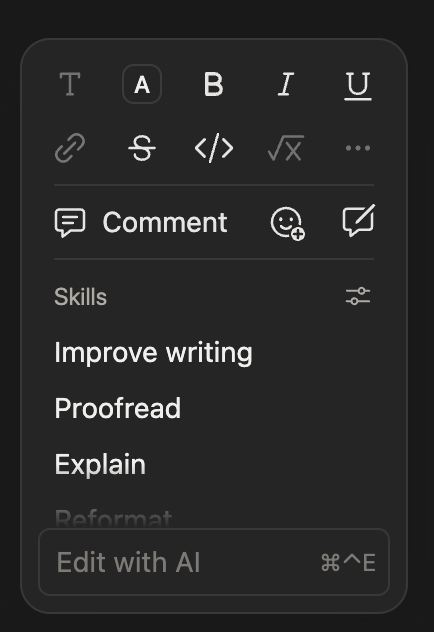
Notion used to have a one-click way to turn text into a quote. They removed this and now I have... AI
So instead of sub-500ms, it now takes 10+ seconds to turn selected text into a quote (type out the prompt, then wait ~4 seconds)
So backwards...
The biggest problem with losing a high tenure person is that you lose someone willing to really fight for stuff, especially owned outside of their team (like comp philosophy).
New people will be orders of magnitude more docile on that stuff.
That’s why leaders who optimize for lack of friction (and walk tenured people out the door) end up the kings of shitty companies with no one telling them when they do dumb stuff.
The only thing worse than a bunch of people telling you you’re fucking up is when absolutely nobody says it.
when i was a baby my dad was driving me late at night and a drunk driver asleep at the wheel hit us head-on. my dad was in a coma for weeks. i needed hundreds of stitches. i still have a massive scar.
many years later, i got to work at waymo during the first few years we were testing, launching, and scaling in sf. there was a huge amount to do, but it all felt pretty fucking amazing when we got to see logs like this. superhuman moments.
it's easy to write off these things as just another expensive uber competitor for techies who don't want to talk to people. but humans behind the wheel are one of the top causes of death and injury globally. and one day not long from now self driving cars will make the kinds of accidents that happened to me a thing of the past.
Seriously @Microsoft stop doing this crap. "Confirm" or "Set later". Why isn't there a no? Can't you respect my choice? Why can't you respect me as a user? I'm sick of being treated as an ad channel. I paid for your product.
Video games get unnecessary hate.
I realize I’m a small minority on the RW adjacent side because I’ve always been pro video games but for good reason.
Gamers have immaculate taste in the arts.
Scrolling your phone is infinitely worse than playing a video game. I’ll never forget the first time I played Pokémon red version with my dad. It was a great bonding activity as a kid and instilled a competitive nature that helped me in all aspects of my life.
Or playing “The Last of Us” with my husband. Watching him discover video games for the first time through “Skyrim.”
Working with Nintendo at E3 each year to battle people from all over the world in the new Super Smash Brothers game.
The hatred of video games is a hatred of the best art of our generation. The most talented composers have gone to video games. The best storylines come from video games. All of the top creatives have gone to video games and they do infinitely more in revenue than the most successful films.
Playing video games from the age of 7-10, helped me in school. It made testing and memorization effortless.
What does DNA stand for? “Deoxyribonucleic Acid” obviously because Deoxys is the DNA pokémon.
What was the coin used in Ancient Greece? Drachma. I played “Assassin’s Creed Odyssey.”
Scrolling on social media can destroy your creativity. It turns you into a consumer instead of a creator. Whereas video games require decision making and you to use your reflexes.
Also Tifa Lockhart from Final Fantasy is one of the most likable female characters ever. I WISH Hollywood would take note!
AI was supposed to give us our time back.
More walks. More hobbies. More dinners with people we love.
Instead we're vibe-coding apps that don't matter.
Doing 3x the work in the same hours and calling it productivity.
We got the tool. We missed the point.
@devongovett I don’t think the pressure to add this is from engineers. It’s from boards/executives applying intense pressure to do add as much visible AI features as possible to be seen as AI forward.
something to remember about twitter is that there's a kind of reverse survivorship bias happening where you're always going to see the most dysfunctional people's takes and you're never going to see takes from people who just arent compelled to fight on the internet
Deleting code is the best kind of engineering. Period.
Simplicity > Lines of code.
While the whole world of vibe coders brags about pushing tens of thousands of LOC a day, I'm actually happier when my codebase shrinks every now and then, usually when I spot repeating patterns and extract reusable code into a better architecture.
File Pilot is only a little above 100k LOC right now, which I already consider a lot. And I've been working on it for 4 years straight. So when I see people here talking about how they push thousands of LOC a day, I'm like... there is no way in the world you understand that code and all the implications of all the pieces that have to communicate with each other.
You're gonna lock yourself so fast, into a place of such complexity that not even AI will be able to help. And for what? Speed? In generating mediocre junk code.
You only value your time. I value my users time.
We're not the same.