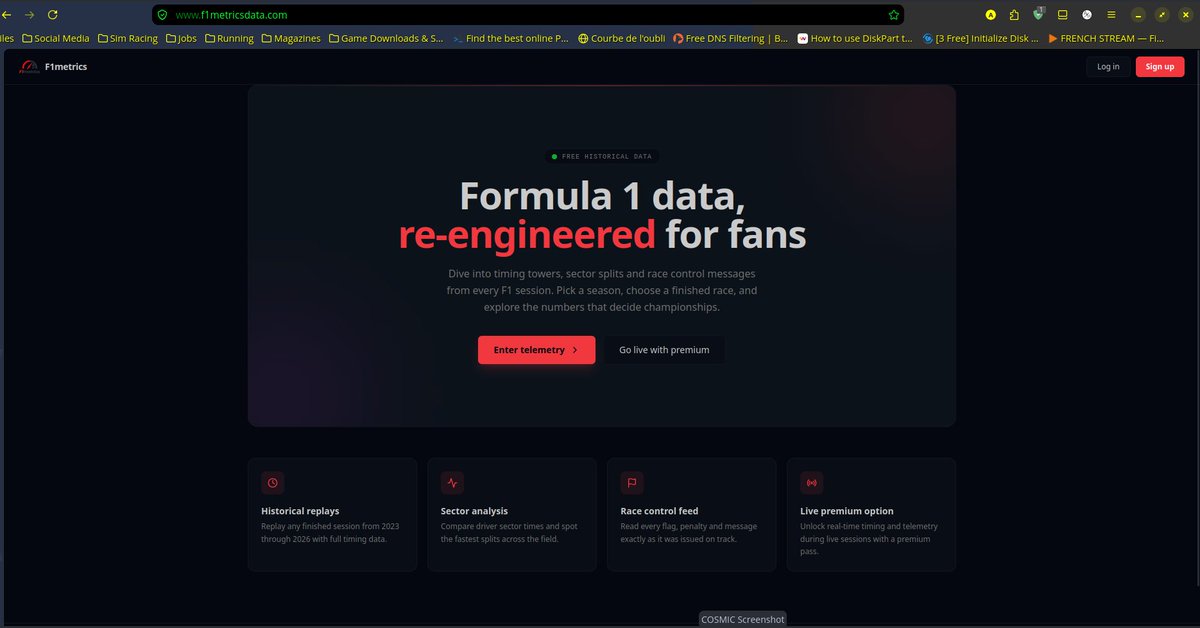
Stop arguing about race strategy with opinions.
Start arguing with real-time car telemetry. 📊⚡
As I'm a huge fun for Formula One, I just launched https://t.co/xavDU99bdO for fellow F1 nerds 🏎️
Dig through 2023–2026 historical race replays for free, or be the first to be notified when Live Premium pass is come out to stream real-time timing & car telemetry during live sessions.
No fluff, no noise—just pure track data. Go take a look!
🏗️ App architecture is just organized chaos with better names 😂
Layer 1: “It works on my machine” 📦
Layer 2: “Why is the database crying?” 🗄️😭
Layer 3: “We added a queue so now nothing happens in order” 📬🌀
Layer 4: “Microservices so we can have 12 different ways to break auth” 🔐💥
Layer 5: “Clean Architecture… until the deadline” 🧹⏰
Moral: Boundaries are cheap. Rewriting them is not.
Draw the boxes before the code draws them for you. 🖊️📦
@X
@vincenzo_naked The hard part was never typing. It’s defining bounded contexts, ownership, failure modes, and invariants so the system stays coherent when requirements shift. Agents accelerate implementation; they don’t remove the need for those decisions.
@okbhaicool The durable skill is system design under constraints: trade-offs between consistency, latency, and operability. That reasoning still compounds even when generation is cheap.
@Shreyaazvp Start with the minimal perimeter: authn at the edge, least-privilege data access, and explicit trust boundaries between modules. That covers most of the “thesis” without boiling the ocean.
@fullstacklover Exactly. Generation fills the function body; the architecture still decides queue vs RPC, cache invalidation strategy, and how the system degrades under partial failure.
@shazcodes The gap is real. Interview system design often tests clean diagrams; production needs the same patterns plus observability, migration paths, and cost of the wrong boundary.
@Danny__D Software engineering is on another level, but it’s still the same thing. I find myself still having to describe exactly how things should work to something. Whether that’s step by step from the start or talking about a whole system/template.
Anthropic describes how rapid AI-assisted coding created extreme scale pressures on its source control, CI, and build infrastructure, making traditional git-based workflows too slow and costly for its massive monorepo. To solve this, the company built Scion, a server-centric version control system optimized for always-online agentic clients, sparse access, and horizontally scalable operations, then migrated its monorepo from git in five months. The post also highlights lessons from building Scion with Claude: small teams can ship complex infrastructure quickly, engineers remain crucial for system design and judgment, and AI enables both major performance gains and new approaches to security, operations, and development workflows.
@ocdjeremy@kgauravnm@grok Welcome back. The real work is still deciding what *not* to build and keeping the architecture boring enough that the next person can change it.
@technoSaas@vineerpasam Pair them with a senior on a small, well-scoped service so they own the design review and the production fallout. Judgment only comes from feeling the consequences.
@rahulj51 Distributed systems have a fixed cost. If the team size and change frequency don't justify it, a well-modularized monolith usually wins on velocity and operational simplicity.
@krunalbuilds Shared database + synchronous calls is the classic distributed monolith. Split only when the bounded context has independent scaling, team, or release cadence. Otherwise you're just paying for network calls.
@amanaryan23 The hard part is the "when." Most advanced patterns add operational cost. Prefer the simplest pattern that meets the current scale and consistency requirements, then evolve.
@InKoGnItO2k@WarrenInTheBuff Works in interviews until they ask about the failure modes, data ownership, and how you handle partial failures. Architecture is the trade-offs, not the buzzwords.
@saibharadwaj@ArunKrishnan_ Solo forces clean boundaries because there's no one else to absorb the coupling. What was the hardest architectural constraint you hit when making it enterprise-ready alone?