A record-breaking quarter for High Tide.
Q3 FY2026: $199M revenue (+33% YoY, fastest growth in 13 quarters), record $16.2M Adjusted EBITDA (+52% YoY), record income from operations, record net income and $7.0M in free cash flow. $HITI
https://t.co/Y1Q6B3GfDZ
Just published my $GRAB Q2 2026 Earnings Review
I cover:
- Mobility & Deliveries
- Financial Services (Acq of Superbank)
- Key Call Commentary
- Positives & Negatives
Entirely free to read: https://t.co/8WDunUi4Qm
UBS Upgrades $DLO to Buy from Neutral, Raises PT to $20 from $16
Analyst comments: "We see a combination of a strong growth path, with improving operating leverage and re-rating potential given the rising market confidence after a series of solid results.
Growth should be supported by rising global digitalization and still lower e-commerce penetration in emerging markets, expansion into new geographies, and deeper relationships with clients, implying higher share of wallet. At the same time, we believe profitability should expand in 2H26, as DLocal reaps the fruits from the investment cycle deployed during 2024-2025.
We incorporate those trends and increase our earnings estimates by +15%, on average, over 2026-2030E. Our earnings estimates are ~2% above consensus in 2027-2028E. At 16x/12x P/E 2026/2027E, DLO is trading below global peers, at a ~50% discount versus ~40% in the last ~3 years, and below historical levels, 25% below its ~3-year average. Adjusting for growth, we believe the stock trades at a compelling multiple."
Analyst: Kaio Prato
$DLO Pedro Arnt ‘If the Googles, Netflix, Spotify, Amazon, Shein, DiDi, all my clients do well across the Global South, I will simply ride their coattails to sustained high levels of compounding growth’
Netflix's fastest-growing markets are also its cheapest.
- Asia Pacific: +19.8% YoY ($7.72 ARPU)
- LATAM: +18.6% ($7.48)
- EMEA: +17.4% ($11.14)
The next leg of growth may come from international monetization, not just subscribers.
$NFLX
Dear ICP community, the Internet Computer has now been running strong for 5 years 👏👏👏
Here is a celebratory preview of ICP "cloud engines," the sovereign frontier cloud technology the network shall soon provide from https://t.co/D5Dfj44BmO.
Main points:
— Cloud engines enable anyone to spin up their own sovereign frontier cloud. The technology involves an extraordinary inventive step, in which cloud is created from a mathematically secure network of nodes. The nodes run as part of the Internet Computer network (https://t.co/ptsshOm9nj) but are selected and configured by the cloud engine's owner.
— The frontier cloud provided by engines is strongly focused on enabling AI agents to build and update online applications and services for us. The world is changing fast, and nearly all new online apps and services are already being built with the help of AI, and thus cloud engines target the future of cloud.
— Software hosted on cloud engines is tamperproof, which means that it is immune to infrastructure hacks, because it runs inside a mathematically secure network protocol, rather than on computers directly. This means that AI agents, and those building with them, don't need to have a security team in the loop, or to trust someone else's security team. This is crucial, because in the future, non technical people will demand the freedom to build with full automation — where they just need to issue instructions to AI about what to build, and don't need to worry about anything or anyone else. Of course, apps and services running on engines are also vastly safer from the new breed of hacker being enabled by frontier AI.
(The cloud engines themselves are also "tamperproof." Even if a hacker gains physical access to some portion of a cloud engine's nodes, and can make arbitrary changes, the computations and data of the hosted apps and services cannot be corrupted or interrupted so long as the network's fault bounds aren't exceeded. The recent hack of Vercel, a major cloud platform, which gave hackers access to the apps it hosted, provides additional perspective on the importance of this advantage.)
— Software hosted on cloud engines is guaranteed to run, so long as a sufficient number of the engine's nodes are running. This means that AI can build applications and services without the need to have a human systems admin team constantly tinkering with the underlying platform to keep it running, which is again crucial, because in the future, non technical people will expect the freedom to use AI to build without the support of others.
— New frontier programming language technology, in the form of the Motoko language developed by Caffeine Labs, leverages seminal "orthogonal persistence" technology that unifies program logic and data to deliver further unlocks for AI (Motoko is the first computer language being developed that targets agents that are writing software rather than humans engineers per se). Nowadays, AI can build and update production apps at a prodigious rate, even at the speed of conversation. But it can also make mistakes, and there's a risk that an update it creates might be "lossy" in the sense it causes some transformed data to be lost. Again, in this new world, it's both undesirable and impractical for everyone to have to have a systems admin team on-hand to detect lossy updates and roll them back, but Motoko provides a solution: it can detect new software updates are lossy before they are applied, reducing potentially catastrophic errors by AI to harmless coding retries.
— Software hosted on cloud engines is "serverless" but unlike traditional serverless software, directly it directly incorporates data through "orthogonal persistence." Another key purpose is simplify backend software logic and fuel the modeling power of AI by increasing abstraction (sorry for the technical language!!!). Put simply, this enables AI to produce more sophisticated backends, faster, and at dramatically lower costs, as measured by the number AI API tokens consumed during coding. (Tip for the technical: orthogonal persistence is a new paradigm where "the program is the database," and data lives inside program variables, which is possible because it's as if hosted software runs forever in persistent memory).
— An expanding database of skills at https://t.co/lloVYiGYs8 shall make it possible to develop and directly deploy apps and services to your cloud engines directly from Claude Code, Perplexity, Codex and other AI platforms. Further, your account on https://t.co/IfQrVovF3L can be connected, so that new apps and updates created through conversation automatically appear hosted from your cloud engine. In the future, R&D is going to be very seamless. You converse with AI, and your secure and unstoppable apps or services are created or updated. Cloud engines are designed to directly support this "self-writing cloud" future where we can work hands-free.
— Tech sovereignty is becoming a huge issue worldwide, with governments and corporations seeking to create sovereign tech stacks owing to geopolitical tensions. Increasingly, people are realizing that tech provided by foreign nations can come with hidden backdoors and kills switches, from the base platform, right up through hosted apps and services. ICP technology is open source, and those building on ICP using AI own their own source code. When you have the source code, you can verify that there are no backdoors, and when you own the source code thanks to AI, you can update it at will, freeing you from vendor lock-in. But cloud engines take sovereignty much further...
— You create a cloud engine by selecting the nodes that will be combined. You can choose the class of nodes used, and their number, but more importantly, you can choose who operates the nodes, and where they are located. Almost any configuration is possible, because the Internet Computer scales the security privileges afforded to hosted software within the network according to configuration (software hosted on cloud engines can directly interoperate with software on other engines and traditional subnets, but base restrictions are applied according to security rules). A cloud engine can be created within a region such as Europe, to comply with regs such as GDPR, or completely within a sovereign state like Switzerland or Pakistan. But cloud engines go further still...
— Sovereignty is also about freedom from vendor lock-in. Cloud engines are essentially ICP (Internet Computer Protocol) network configurations, and this means the underlying compute nodes they combine can be swapped out without interrupting their hosted apps and services. This is a big deal. In addition, cloud engines now support nodes that are instances running on Big Tech's clouds, in addition to nodes that are dedicated specialized hardware, as per the Gen I and Gen II nodes that dominate the Internet Computer today. For example, it is possible to have an engine running across different AWS data centers, say, and then reconfigure the engine to run across a mixture of AWS, Google, Azure and Hetzner for even more resilience, without the users of hosted apps and services noticing a thing. That's true freedom.
— Sovereign AI is becoming increasingly important too, and cloud engines allow special "AI nodes" to be added to them, so that hosted software can perform inference on hardware provisioned by the owner from a location the owner has selected. Even though the AI nodes are only accessible within the cloud engine, they can still benefit from the forthcoming Internet Intelligence Gateway (IG), which will make it possible to validate inference performed on key frontier open weights LLMs, even when the inference is performed on completely independent AI clouds. When the results of inference are received, this technology can verify that neither the prompt+context (input) nor the inference result (output) have been modified, and that the results were produced by the precise LLM expected. This ensures that AI clouds don't cheat by running inference on cheaper models than are being paid for, and bad actors aren't modifying the inputs or outputs to surreptitiously insert advertising into results, say, or change facts, or insert malware when code is being generated. What's super cool about this technology is the cost of the verification is scalable. A very valuable additional security can be achieved with only 1-2% of extra cost.
— Scaling apps and services when they hit capacity limits is another thorny problem that cloud engines help the world address. Engines make scaling possible without rewriting or reconfiguring software. The query workload capacity of hosted software can be horizontally scaled simply by adding new nodes to an engine, and nodes can also be added in geographical proximity to demand. Meanwhile, update workload capacity can first be scaled-up by swapping an engine's nodes out for the next class up, and then when no larger class of node is available, horizontally scaled-out by "splitting" the engine into two, which doubles available capacity. (Technical tip: horizontally scaling update capacity by splitting engines requires multi-canister architectures).
— For those who have been following how Caffeine builds apps that can efficiently store large numbers of files, I should mention that apps built on cloud engines will also support the new ICP Blob Storage cloud network (since cloud engines currently have up to about 3 TB of memory, which apps storing large amounts of files can easily exceed). We are also working on allowing blob storage nodes to be added to cloud engines, to enable sovereign mass blob storage within an engine, similarly to how AI nodes can be added currently.
— Lastly, but certainly not least, I should mention that cloud engines are multi-blockchain capable, and ready for digital assets, thanks to the clever math at their core. For example, an e-commerce service built on a cloud engine can securely accept and custody stablecoin payments, or a multi-chain DEX could be hosted. Further, engines can support software autonomy (software orchestrated and controlled by other autonomous software, in a decentralized way) and can themselves be orchestrated by SNS technology, and thus run autonomously too.
Today, though, the focus is on *mainstream* cloud. This year, the cloud industry will generate approximately one trillion dollars in revenue. That number is already huge, but is expected to grow to two trillion dollars by 2030.
After years of continuous development, which have seen more than $500m spent on R&D, the Internet Computer network is now tacking directly toward this mainstream cloud market with cloud engine technology.
In their first version, cloud engines are not meant to be a cloud panacea. For example, currently they are not ideal for working with big data. You should use something like DataBricks for that.
Cloud engines are carefully targeted at enabling AI to produce traditional online applications and services, including SaaS, in a safer and more productive way, which represents a new market segment with tremendous potential. Of course, DFINITY will continue to work relentlessly to push forward ICP's capabilities, so expect further developments.
It's worth mentioning that this cloud segment isn't just about creating new apps and services using AI, it's also about replacing legacy systems and apps built on super expensive SaaS services. Caffeine Labs is working to produce technology (Caffeine Snorkel) that can study an enterprise's legacy systems and app built on SaaS, create replacement systems and apps, and migrate the data, while supporting key stakeholders through the process over email and chat, with full automation. Thus the legacy systems and SaaS markets shall also be addressed by cloud engines.
Zooming out, and reasoning in a more metaphysical way, we believe, as we always have, that there is room for a new kind of cloud created by mathematical networks, that provides seminal advances in the fields of security and resilience, as well as true sovereignty and freedom from lock-in. That this same technology, with the help of additional technologies like orthogonal persistence and Motoko, enables AI to build for us without the need for so much oversight, and to create more backend sophistication while consuming fewer AI API tokens, enables ICP to bring game-changing advances to the world.
Cloud engines will work synergistically with the Intelligence Gateway, which will enable apps and services running on engines to seamlessly leverage AI, wherever that AI is running, while providing verifiability at extremely low cost for open weights frontier models.
We believe that cloud engines represent an inflection point in the storied history of the Internet Computer project, and I'm very proud to be sharing the details with you on the network's fifth birthday 💪
I'll be back with more news soon!!
@longriverCM@themarketuni Think it’s something to do with food delivery regulation in China, gov have said no more undercutting. Large part of the weigh on FCF was their pivot into the food delivery business
💡 Did you know...
Hedera’s Stablecoin Studio lets issuers launch and manage stablecoins with regulatory-grade compliance?
This open-source SDK powers trusted digital finance, from web3 innovators to national-scale projects like @AUDD_digital 🌏
Discover Stablecoin Studio: https://t.co/PmDRY6x1nj
Discover AUDD: https://t.co/cuxLMYhXaP
🚨 $HITI Earnings Report is OUT!
• Revenue of $149.7M vs. $146M est. 🟢
• Adj. EBITDA of $10.6M vs. $8.4 est. 🟢
• EPS of $0.00 vs. ($0.01) est. 🟢
• FCF of $7.7M, up 148% YoY
• ELITE Members up 102% YoY
Note: $HITI reported preliminary results last month, so we already knew it would be a beat across the board.
The updated estimates were $147.9M in revenue and $9.6M in adjusted EBITDA.
We just delivered the best quarter in our history, setting multiple financial records. 🚀 With loyalty at the core of @HighTide_HITI, combined with our entry into the fast-growing German medical cannabis market, our growth trajectory is stronger than ever. $HITI
JUST IN: $NBIS announces multi-billion dollar agreement with Microsoft for AI infrastructure. 🔥
Under this multi-year agreement, $NBIS will deliver dedicated capacity to Microsoft from its new data center in Vineland, New Jersey starting later this year.
Arkady Volozh, Founder and CEO of Nebius, said:
“Nebius’ core AI cloud business, serving customers from AI startups to enterprises, is performing exceptionally well. We have also said that, in addition to our core business, we expect to secure significant long-term committed contracts with leading AI labs and big tech companies. I’m happy to announce the first of these contracts, and I believe there are more to come. The economics of the deal are attractive in their own right, but, significantly, the deal will also help us to accelerate the growth of our AI cloud business even further in 2026 and beyond.”
$NBIS expects to finance the capital expenditure associated with the contract through a combination of cash flow coming from the deal and the issuance of debt secured against the contract in the near term, at terms enhanced by the credit quality of the counterparty. The company is also evaluating a number of additional financing options to enable significantly faster growth than originally planned and will update the market on its financing strategy in due course.
Trump is about to rewrite federal history.
He just targeted a 55-year-old law for demolition…
Stocks exploded 42% overnight.
Forget AI. Forget tariffs.
Here’s the $63B industry Trump’s about to unleash.
A thread🧵
Preliminary Q3 guidance is in: record revenue, strong EBITDA growth, and our fastest same-store sales gains in 2 years. Full results drop Sept 15. $HITI
Nebius launches in the UK. 🇬🇧 We are expanding Britain’s AI infrastructure with @NVIDIA Blackwell Ultra.
The deployment will enhance the UK’s national digital infra by enabling British firms — from startups to enterprises — to build AI using the most advanced compute. 1/4
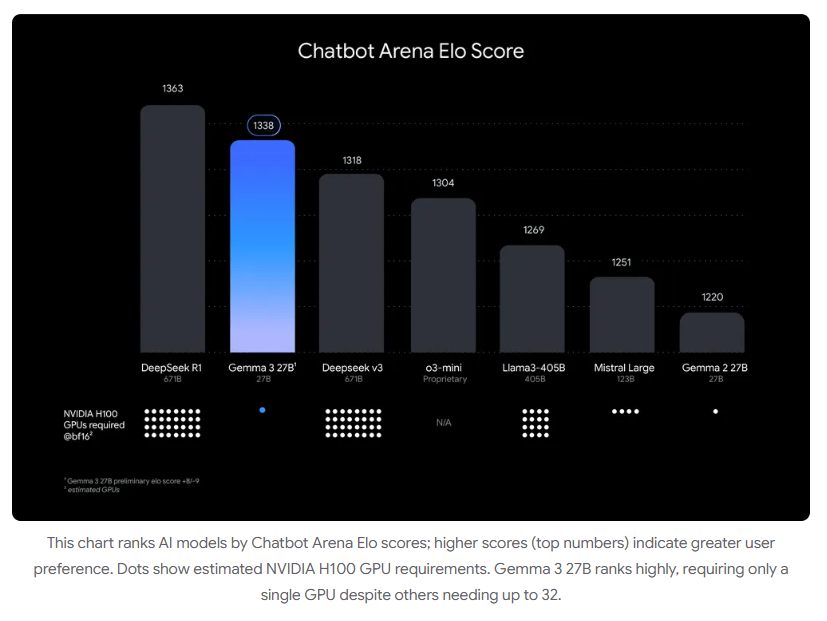
GOOGLE UNVEILS GEMMA 3: STATE-OF-THE-ART AI MODEL THAT RUNS ON JUST ONE H100 GPU
The largest 27B model runs on just one $NVDA H100 GPU, delivering results that typically require 10x the compute from competing models. $GOOGL's Gemma 3 outperforms Llama-405B, DeepSeek-V3, and o3-mini in human preference evaluations on LMArena’s leaderboard, making it one of the most capable AI models for its size.
The model supports 140 languages, offers 128K-token context windows, and integrates advanced text and visual reasoning capabilities.
Google emphasized efficiency and accessibility, allowing developers to run high-performance AI on phones, laptops, and workstations. The Gemmaverse ecosystem has already seen 100M+ downloads and 60,000+ community-built variants.
Google has also introduced ShieldGemma 2, a 4B image safety model that detects dangerous content, explicit material, and violence, reinforcing responsible AI development.
Gemma 3 is optimized for NVIDIA GPUs, Google Cloud TPUs, and AMD ROCm™ GPUs, with instant access via Google AI Studio, Hugging Face, and Vertex AI.
🚨 HUGE NEWS for $HBAR! 🚨
SWIFT, the global payments giant handling $150 TRILLION per year, is testing Hedera’s technology with real banks in North America, Europe, and Asia in 2025! 🌍💰
This isn’t just a test. Real banks will process real payments using Hedera’s technology.
Why This Is MASSIVE:
Hedera makes SWIFT payments instant ⚡
from 2-4 days ⏳️
→ under 60 seconds! ⚡️
Costs drop to just pennies instead of expensive fees 💸
SWIFT isn’t going away 🏦
it’s UPGRADING with #Hedera 🔥🚀
For more details, watch this beautiful lady, Alisa DiCaprio, Head of Industry Engagement at SWIFT, discuss the future of cross-border payments at HederaCon 2025: