Before you sleep, ask Allah to remove any form of delay in your life. Marital, career or academics. may Allah remove it.. Kun faya kun. Remember when Allah intends some work to be done. He just say Kun (Be) and It is done already. Never stop believing in miracles
With Senator Gatchalian securing 13 votes, the petition filed by the Cayetano Bloc before the Supreme Court seeking to declare the June 3 session, Gatchalian’s election, and the subsequent reorganization of the institution null and void has been rendered MOOT AND ACADEMIC.
It is DISMISSIBLE for lack of justiciable controversy.
The #SupremeCourtPH will continue its oral arguments tomorrow, June 9, 2026, at 9:30 a.m., on the consolidated cases of:
•G.R. No. 271059 (Lagman v. Congress of the Philippines);
•G.R. No. 271347 (Pimentel v. Bersamin);
•G.R. No. E-02472 (Filipinos for Peace, Justice and Progress Movement Inc. v. House of Representatives); and
•G.R. No. E-04036 (Erice v. Senate)
Listen to the live audio stream:
YouTube: https://t.co/KqSYa9fKDH
Facebook: https://t.co/K92e77vRwt
#GAAOralArgs
Here’s the latest from the Supreme Court of the Philippines, June 5, 2026:
•SC resumes oral arguments in petitions on consolidated GAA cases
•SC rejects trademark registration for similar “W” logos
•SC kicks off 125th anniversary commemoration activities
•SC joins Pride Month celebration
Consolidated GAA Cases: https://t.co/72howVgSWU
Full text of G.R. Nos. 262551, 266971, 275314 (Starwood Hotels v. Oceanic Empire Limited): https://t.co/i8KSEZWFWa
#SupremeCourtPH
#SCphUpdates
Our issues today might be the topics of the bar exams this year or next.
1. Impeachment of a Vice President
2. Rules of Succession in the Executive Department
3. Terrorism Financing
4. Transfer of PhilHealth funds to National Treasury
5. Unqualified Courtesy Resignation
This file is intended to prepare for the Bar Examinations while simultaneously enabling them to remain informed of current legal, political, economic, and social developments. Let us help each other by updating the file.
https://t.co/d4TUUyQNBQ
If you're taking the bar ths year, this is a great opportunity to review jurisprudence and apply it to real life
Avelino Case for Constituting a quorum
Trillanes Case for Coercive jurisdiction over those in police custody
Vallacar Case for fugitive disenfranchisement doctrine
EXPLANATION
Why Avelino vs Cuenco 1949 is enough for a quorum of 12
Normally, the Senate has 24 senators, so quorum is 13.
Senate PH Rule II says that for Senate officers: they are elected by “majority vote of all its members.”
So if all 24 are counted, 12 is not enough.
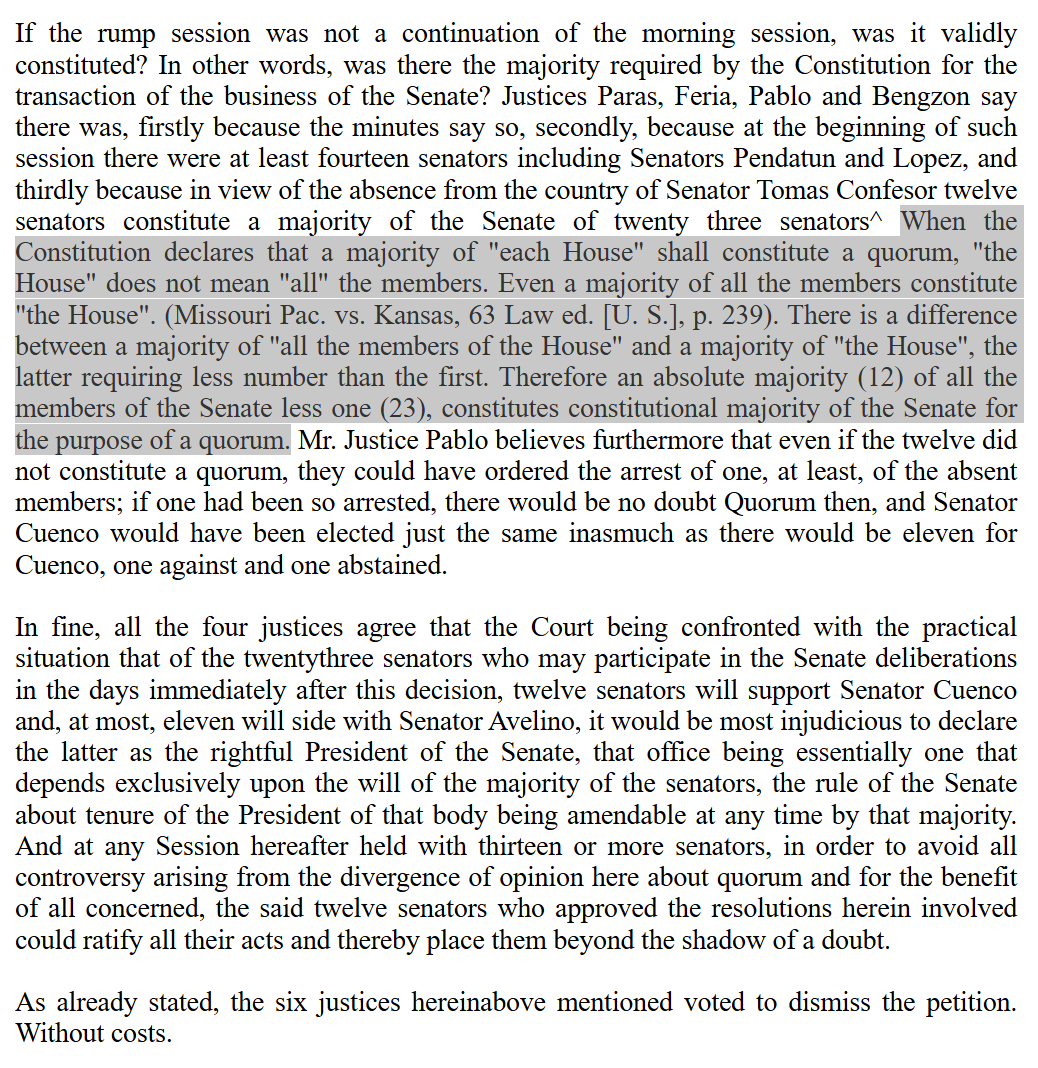
But the anti-Cayetano camp’s argument comes from Avelino v. Cuenco, 1949.
In that case, the Supreme Court accepted the idea that because one senator was outside the country and could not participate, the Senate could be treated as having only 23 participating members. That made 12 a majority.
The Supreme Court said that “an absolute majority (12)” of the Senate “less one (23)” could be quorum, and Justice Feria explained that the count may be based on “actual members or incumbents” who are not incapacitated or outside the Senate’s jurisdiction.
Applied today: if Jinggoy Estrada is unable to participate because he is arrested, they can argue the working Senate is 23, not 24.
So 12 becomes quorum under Avelino logic.
Now add the Cayetano issue.
A Senate President is not the owner of the Senate.
The Senate Rules say the Senate normally meets at 3 PM on weekdays, unless the Senate decides otherwise.
If a session is postponed, the Senate President must consult the Majority and Minority Leaders. And the Senate President cannot just suspend or adjourn a session by himself without a motion or resolution approved by senators present, except in the specific postponement situation.
So if Cayetano refuses to preside or tries to stop the chamber from functioning, the anti-Cayetano camp can say - the chair cannot kill the chamber.
That is also consistent with Avelino v. Cuenco, 1949.
In that case, the Senate President abandoned the chair and did not attend.
Worse, Cayetano not only was absent, he did not designate a Presiding Officer either - the Senate is not functioning.
The anti-Cayetano senators continued, and the case records say the deliberate abandonment made it necessary for the remaining members to continue “in order NOT TO PARALYZE the functions of the Senate.”
So the anti-Cayetano camp’s legal theory is basically this:
(1) The Senate is bigger than Former SP Cayetano.
(2) If he refuses to preside, and enough senators are present, the Senate can still function.
(3) If Jinggoy cannot participate, Avelino gives them an argument that 12 is quorum.
(4) Once quorum exists, the Senate can act on its internal organization, including committees per the Senate Rules.
They are on stronger ground when reorganizing committees, because committees are part of Senate internal organization.
Rule X says permanent committees are formed by the Senate after organization, including the Committee on Rules (take notice, yan ang unang call to motion ni Sotto).
So what did Cayetano did wrong?
Essentially by refusing to attend the Senate or any of the presiding officers (ie: Former Pro Tempore Legarda, and Former Majority Leaders), the situation became more and more similar to Avelino v. Cuenco, 1949.
The former Majority could even argue that Avelino v. Cuenco, 1949 is a "special circumstance" . However, the similarities between then and now became more apparent with the former Majority leaders absence and made the arguments of the anti-Cayetano camp stronger.
With this, the new Majority got their quorum and they rearranged leadership.
So why only the leaderships and not the actual Senate Presidency?
So the pro-Cayetano camp can ask: "If you truly have quorum, and the majority of all members, why not also elect a Senate President?"
Short answer: Because of the Constitution.
The Constitution makes electing a new Senate President more sensitive because it specifically requires a “majority vote of all its respective Members” for that office.
The Constitution then separately says each House may choose “such other officers as it may deem necessary.”
For Senate President:
The Constitution itself sets the rule. The Senate President must be elected by “a majority vote of all its respective Members.”
For President Pro Tempore and other officers:
The Constitution does not give a specific voting threshold. It only says each House may choose “such other officers as it may deem necessary.” (Sec. 16)
It also says each House may determine its own rules.
That is where Senate Rule II comes in:
the Senate used its rule-making power to say its officers, including the President Pro Tempore, Secretary, and Sergeant-at-Arms, are elected by majority vote of all members.
LOGICAL DIFFERENCE:
So the Constitution does not dictate the definition of "all members" for other Senate officers - only for the Senate President.
Thus, the dictation and definition of "all members" lies on Senate Rules per the Constitution Sec. 16, "...as they deem necessary..."
But with Avelino v. Cuenco 1949 coming in...
The Senate PH has already defined "majority of all members" to be "active members of the Senate - that could participate"
In the ruling,
Justice Feria said the count may be based on the Senate’s “actual members or incumbents,” excluding those unable to discharge their duties because of death, incapacity, absence from jurisdiction, or other causes making attendance impossible (ie: arrest).
Feria treated the Senate as having 23 actual members, so 12 became a quorum and majority.
Text from Avelino v. Cuenco, 83 Phil. 17 (1949), which the new Senate leadership relies on for the position that their 12 Senators are sufficient to constitute a quorum.
https://t.co/1jg2CPIFvV
Tener la cara hinchada no siempre significa grasa.
Muchas veces es inflamación o retención de líquidos causada por estrés, sal o mala alimentación.
Estos alimentos ayudan a desinflamar tu rostro.
#1 Pepino 🥒.
Arafah is coming. It's time to be "delusional" in your Dua. Ask Al-Wahhab for the impossible. Hazrat Suleman (AS) asked for a kingdom that no one else could ever own. If He can give a kingdom to him, He can rewrite your entire destiny. Be greedy, ask for everything
Newly uploaded pleading in current cases involving public interest:
G.R. No. 278747 (Rodrigo Roa Duterte and Senator Ronald Dela Rosa v. Hon. Lucas Bersamin, et al.)
Petition for Certiorari and Prohibition with Prayer for TRO/Injunction
- Extremely Urgent Supplemental Manifestation with Motion: https://t.co/xgbRxPociu
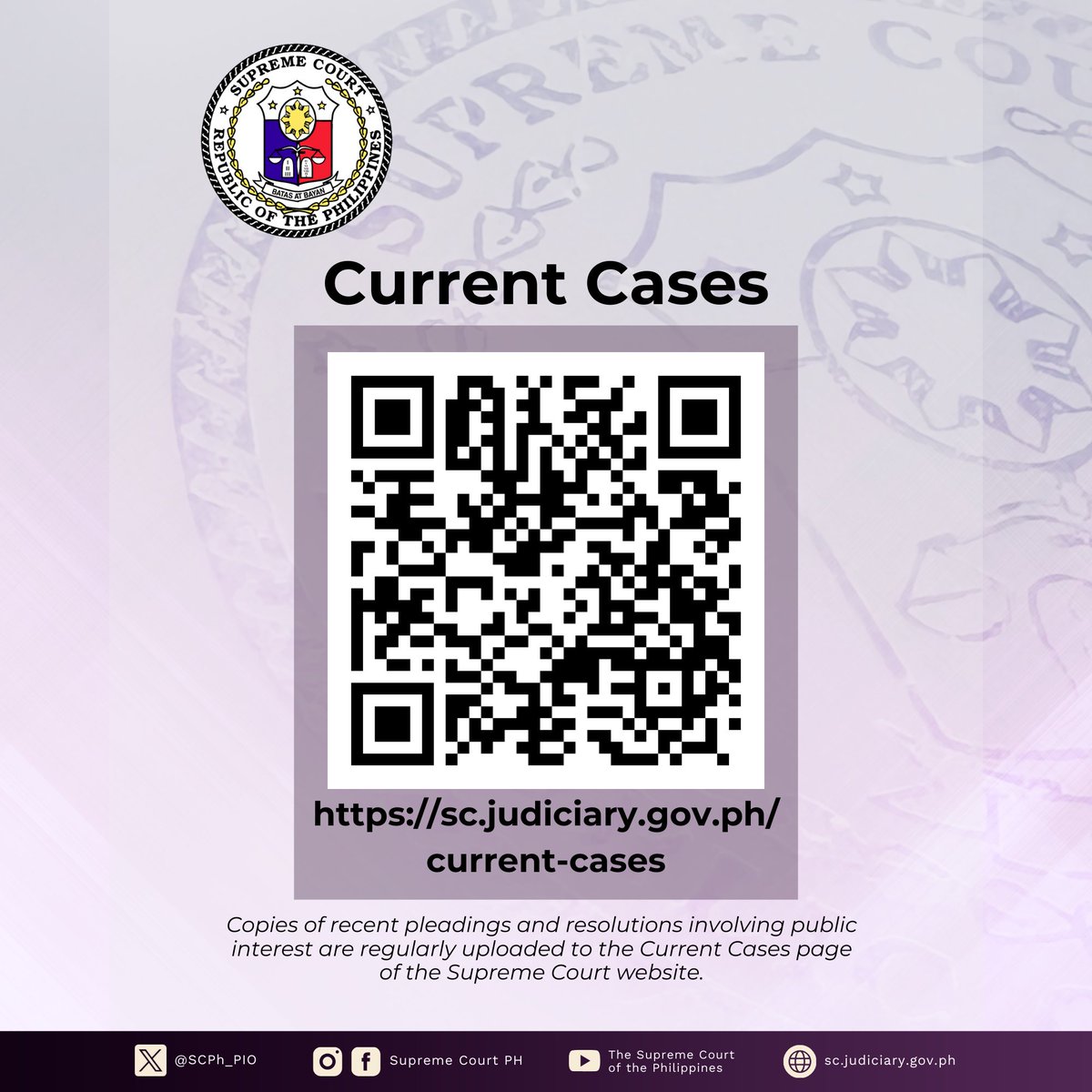
Copies of recent pleadings and orders in cases involving public interest are regularly uploaded to the Current Cases page of the #SupremeCourtPH website. SCAN the QR Code for the latest uploads.
Disbarred o tinanggalan ng lisensya ng #KorteSuprema ang isang abogado dahil sa paggamit ng pekeng Mandatory Continuing Legal Education (MCLE) compliance number sa kanyang mga isinumiteng pleading.
Sa isang Per Curiam na Desisyon, tinanggal ng En Banc ng Korte Suprema sa pagka-abogado si Atty. Jose R. Hidalgo (Atty. Hidalgo) dahil sa dishonest conduct o hindi tapat na asal na lumalabag sa Code of Professional Responsibility and Accountability (CPRA).
Nagsilbing abogado si Atty. Hidalgo para sa defendant sa isang kaso ng malicious prosecution na nakabinbin sa Branch 153 ng Regional Trial Court (RTC) sa Lungsod ng Biñan. Sa sagot na inihain niya para sa kanyang kliyente, isinama ni Atty. Hidalgo ang kanyang MCLE compliance number na hinihingi sa mga abogado.
Nagsampa ng motion to expunge ang abogado ng nagrereklamo para burahin ang sagot ni Atty. Hidalgo mula sa mga rekord dahil hindi siya sumunod sa mga kahingian ng MCLE. Kalakip ng nasabing mosyon ang isang Sertipikasyon mula sa Tanggapan ng MCLE na nagsasaad na hindi nakadalo sa MCLE si Atty. Hidalgo mula sa unang compliance period hanggang sa kasalukuyan.
Sa pagtanggal ng lisensya ni Atty. Hidalgo, iginiit ng Korte Suprema ang Canon II ng CPRA na nag-aatas sa mga abogado na kumilos nang maayos (propriety) at panatilihin ang imahe ng kaayusan sa personal at propesyunal na pakikipag-ugnayan, maging tapat at magalang, at itaguyod ang dangal ng legal na propesyon alinsunod sa pinakamataas na pamantayan ng etikal na pag-uugali.
Sa ilalim ng Canon III, hinihingi din sa mga abogado na itaguyod ang Konstitusyon, sundin ang mga batas ng lupain, at isulong ang paggalang sa mga batas at prosesong legal.
Sinabi ng Korte Suprema na nilabag ni Atty. Hidalgo ang mga Canon na ito at sinabing ang gawain ng paglalagay ng maling impormasyon sa mga pleading na isinampa niya ay nagpapakita ng bad faith o masamang hangarin at kawalan ng katapatan, at nagpapakita ng lantarang kawalan ng paggalang sa mga hukuman at sa mga panuntunan nito.
Pinatawan si Atty. Hidalgo ng PHP 35,000 na multa para sa willful disobedience o sadyang pagsuway dahil sa hindi pagpansin sa atas ng IBP na magsumite siya ng sagot at isang verified position paper.
Basahin ang press release sa https://t.co/RI6Booz3rU.
Basahin ang Desisyon sa https://t.co/gBAtMLfOv0.
Sumunod sa Credit Attribution Policy ng SC PIO: https://t.co/F48RF1vtzZ.
#SupremeCourtPH
#SCphTranslations