Hakira AI is live.
We built an AI-powered security platform for teams who can't afford to ship vulnerable code, whether you're building on Web2, Web3, or both.
From traditional web apps and APIs to DeFi protocols and smart contracts, security can't be an afterthought at any layer.
New in Hakira AI ✨
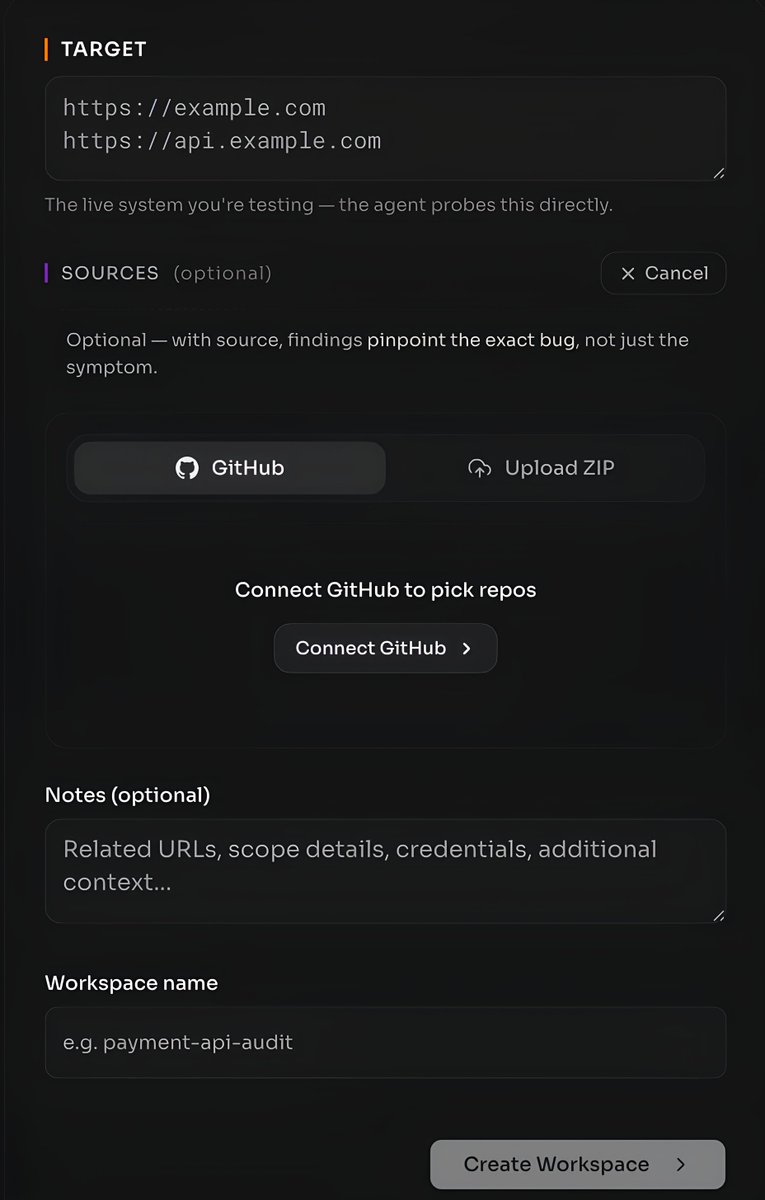
Add your source code as a Source
Point the agent at your live URL
Get findings tied to the exact line of code
https://t.co/DWmtgvQ2N0
Most “AI security tools” claim they can find vulnerabilities.
So I decided to test one under real conditions.
I got access to Hakira, an AI-powered security testing platform, and ran a full audit on a deliberately vulnerable banking application.
The outcome?
35 validated vulnerabilities
• 15 Critical
• 12 High
• 8 Medium
But the numbers aren’t the real story.
The depth of analysis is.
Hakira didn’t just surface issues, it reconstructed how an attacker would actually break the system:
→ Multiple authentication bypass paths (JWT misconfigurations, SQL injection, mass assignment)
→ Full privilege escalation to admin-level access
→ Economic exploits (race conditions, balance manipulation, replay attacks)
→ Exposure of sensitive data, including plaintext credentials
→ AI-layer vulnerabilities, including prompt injection leading to data leakage
More importantly, each finding wasn’t theoretical.
The platform generated working proof-of-concepts, showing exactly how these vulnerabilities could be exploited in practice.
That’s the difference between scanning and actual security analysis.
One standout insight:
The system mapped multiple independent attack paths to full admin compromise. Not just “there is a bug”, but “here’s how an attacker chains it into total control.”
That level of reasoning is what makes tools like this valuable.
Now, it’s not without limitations.
I attempted to run a second audit on a different codebase to evaluate consistency, but hit credit limits. Expanding initial testing capacity would make early evaluation more robust.
Still, for a first audit?
This is solid.
If you’re building in Web2, Web3, or integrating AI into your stack, security isn’t something you patch later.
It’s something you design for.
Tools like @hakiraio are pushing in that direction.
Try it yourself and see what your code might be exposing.
If you want to run free AI audit tools on your codebase, check the repository below👇
Most serious developers run multiple AI vulnerability scanners before going into a full audit and they often remove double-digit vulnerabilities from their code.
URL: https://t.co/3kHYw4bVe6
ran a full pentest on loomenia with @hakiraio
12 vulnerabilities. 5 critical. across rls, auth, and api layers. fixed and verified in 24h
paste a url, chat through findings in real-time. no scoping calls, no pdf reports, no back and forth
if you've been putting off security, give it a try. genuinely good experience
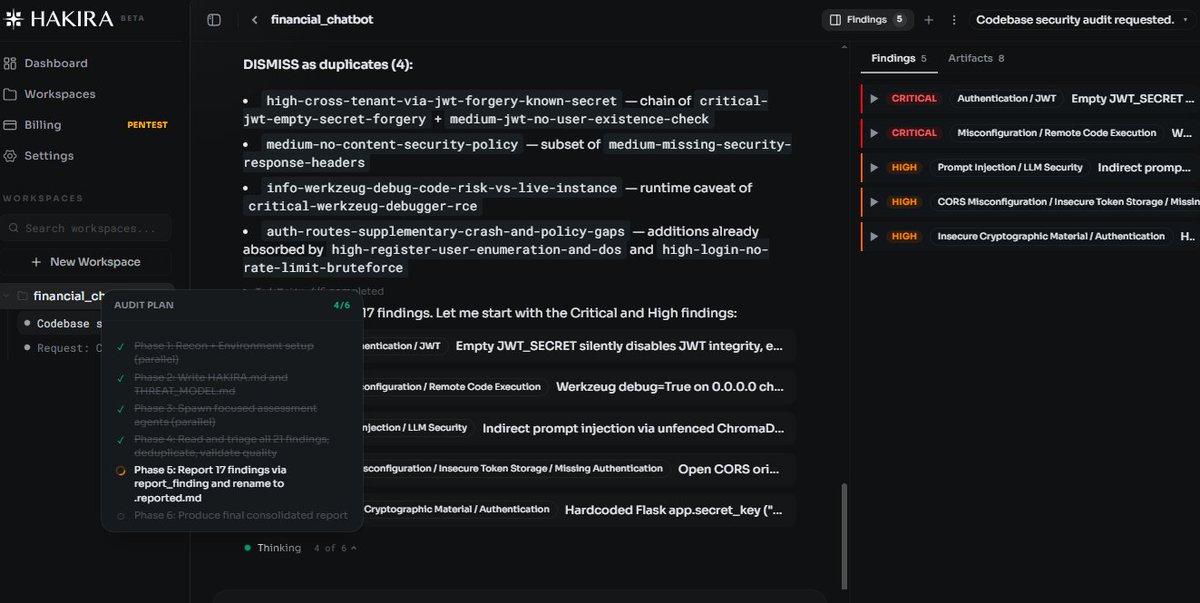
I tested @hakiraio on a financial chatbot application and ran a full security audit.
It successfully scanned it and found critical vulnerabilities.
The final report was really detailed too, which I liked because it included PoCs and clear security recommendations.
Thank you @dersonxyz for the opportunity.
Check out the detailed writeup here: https://t.co/15Ka9Gc2Qe
Tested @hakiraio on a small codebase.
It found issues in seconds that usually take hours.
Really impressed with the speed and the quality of the results.
Thanks @dersonxyz for the opportunity🙏
credit: @SyedGhufranHas1
https://t.co/ruuXLLbbwh
Loomenia has completed a full-scope security audit with @hakiraio.
Application logic, auth, APIs, and infrastructure reviewed. All findings resolved and verified within 24h.
Thanks to the Hakira team for the thorough work.
Our AI agent completed an audit for @loomenia_ai.
Delivered a full-scope Web2 security audit, identifying vulnerabilities across application logic, authentication flows, APIs, and infrastructure, with actionable hardening recommendations.