An update on the precious metals/miners. I understand that investors are getting a bit more anxious.
The war has not been kind to precious metals investors, and it's been especially tough on the miners - which is usually the case when the metals decline. The GDX (gold miners) ETF has fallen 24% since the end of February, wiping out all but 2 1/2% of its once lofty YTD gain. As HTS subscribers know, I had prepared for a selloff, trimming back miner positions (I never sold any of my gold) and built a large cash reserve. I believed there was excessive optimism for the metals/miners. They were overbought and the U.S. dollar was oversold (short term).
Long term, the dollar will continue to decline against gold - as it has done for over a century (especially since the Fed was created). The reasons for owning gold remain the same: protection against the U.S. government's wild spending, soaring deficits and debts and continued inflation and dollar debasement. The more recent "weaponization" of the dollar is an added propellant for many overseas buyers.
The question is: when to start rebuilding my sharply reduced miners positions? Presently, I'm in no hurry - I have no interest in trying to 'catch a falling knife.' I'd like to see some more capitulation, maybe some clarity with the war. Assuming gold doesn't plunge in the interim, I would like to at least partially rebuild positions prior to their Q1 earnings reports later next month because those results should be spectacular (again).
If one has cash reserves, this sharp miner selloff could provide a nice opportunity for even further gains. I welcome it.
From the 1960s through 2007, real income increased at a 1.8% pace. After the 2008 recession, real income dropped and never regained the 1.8% trend line as it did after all recessionary periods in the prior four decades.
Had real income growth remained on the 1.8% trendline, the US economy would be generating closer to $53,500 per capita, $5,000 more per capita.
The Quiet Crisis In American Investment
Net private domestic investment measures how much the U.S. economy is truly adding to its productive capacity each year. Net investment is gross investment minus depreciation. Essentially, it measures if we are expanding our capital stock or just treading water by replacing what has depreciated.
Investment includes residential structures, nonresidential structures, business equipment, and intellectual property.
The answer is increasingly troubling, but it hardly gains attention because the negative repercussions appear over years and decades, not months and quarters.
From the 1950s through the early 1980s, net private investment averaged around 8% of GDP. The economy was genuinely building factories, equipment, housing, and infrastructure that would compound productivity for decades. Then it dropped to around 6% through the 1990s. Today, we're hovering around 3.7%.
A smaller share of GDP is expanding productive capacity. More of what we call "investment" is simply replacing worn-out capital rather than adding new capacity. The decline in structures and equipment is particularly concerning.
Structures encompass the physical backbone of the economy, like factories, commercial buildings, warehouses, power grid infrastructure, mining, and other facilities. These assets have a long life and can serve productivity for decades.
Equipment includes industrial machinery, transportation equipment (trucks, aircraft, rail cars), information processing hardware, medical equipment, and construction machinery.
When net investment in these categories decline, we're not expanding industrial capacity. Fewer new factories, fewer new warehouses, less physical infrastructure. Workers have less capital and less reliable technology to work with. Machinery ages and becomes less efficient.
Why is this happening? Several factors can explain the secular decline…
The economy has shifted toward intellectual property and software, which depreciate far faster than physical assets. Globalization offshored a lot of capital-intensive manufacturing. An aging population naturally reduces investment intensity. A clear focus on asset prices has redirected capital toward financial engineering and dividend extraction from corporate profits rather than reinvestment in physical capital formation. And larger budget deficits are crowding out private investment.
The long-term implications are serious. Net investment is the basis of future productivity. Lower investment today means a smaller capital stock tomorrow, and ultimately slower wage growth since real wage improvements are tied to productivity enhancements. In addition, supply constraints emerge more frequently because capacity wasn't built when needed, and the economy becomes more fragile.
This is the kind of structural problem that doesn't show up year to year but rather compounds over decades.
The ongoing and growing concern over living standards, affordability, and general economic advancement is all tied to an insufficiency of net investment and worse productivity growth.
Changing this trend will be extremely difficult with large federal budget deficits, a corporate sector that favors dividend extraction from profits over reinvestment, and a low household savings rate due to constraints of expenditure and aggregate profit accounting identities.
But if it doesn’t change, many of our current societal struggles will persist.
Now I know why Apple was up nearly 8 points yesterday. "Trump exempts phones, computers, chips from ‘reciprocal’ tariffs'." This after-hours Friday news announcement from the U.S. Custom and Border Protection couldn't have leaked earlier to certain parties, could it??
"President Donald Trump’s administration exempted smartphones, computers and other electronics from its so-called reciprocal tariffs, potentially cushioning consumers from sticker shock while benefiting electronics giants including Apple Inc. and Samsung Electronics Co."
https://t.co/I4SRK4Sv6Z
Wise advice from the Wall Street Journal. "Given the—sorry—unprecedented nature of the trade upheaval, and the fact stocks aren’t even in a bear market yet, it is a good bet that coming rallies will be of the sucker’s variety"
I'll add: We're not at a long-term bottom when we're heading into a recession and a consumer driven stock - Apple (highest market cap in the world) - is still trading at 29 times earnings that are almost certain to decline. All sorts of trouble - falling margins from higher tariff costs, tariff retaliation exposure - including to its high-margin services business, already losing market share & more losses ahead, delayed product offerings (AI), regulatory and court cases (including potential $20 billion annual revenue losses from Google remedy trial) have not yet been reflected in the stock price.
https://t.co/U1ZrvKdktV
Donald Trump and his team love to draw attention to the infamous McKinley Tariff Act of 1890 (he was known as the “Napoleon of Protection” – well, there’s a new Emperor in town!). What is never mentioned is that the U.S. economy spent nearly two-thirds of the ensuing four years in recession, with McKinley turfed out of office and replaced with Grover Cleveland in the 1892 election. And by 1894, this “beautiful” tariff was fully repealed. You can have your own opinions, but you can’t have your own facts. Not when it comes to the historical record.
Ronald Reagan: “Our peaceful trading partners are not our enemies; they are our allies.
We should beware of the demagogues who are ready to declare a trade war against our friends—weakening our economy, our national security, and the entire free world—all while cynically waving the American flag.”
165 Canadians died for America in Afghanistan.
We spent over $20B.
Why? To defend you, our ally, on the invocation of NATO Article 5.
Now America slaps us with a depression-threatening trade war and threats of annexation.
Unappreciative, disgraceful. We won’t forget.
It used to take 10 months.
Then it took 20 months.
After the pandemic, it took 30 months to build a multi-family apartment.
This is a big reason behind the (really) long and variable lags.
In general, tariffs are harmful to the economy and standard of living.
They help the protected producer at the expense of all other producers and consumers.
Agree or disagree?
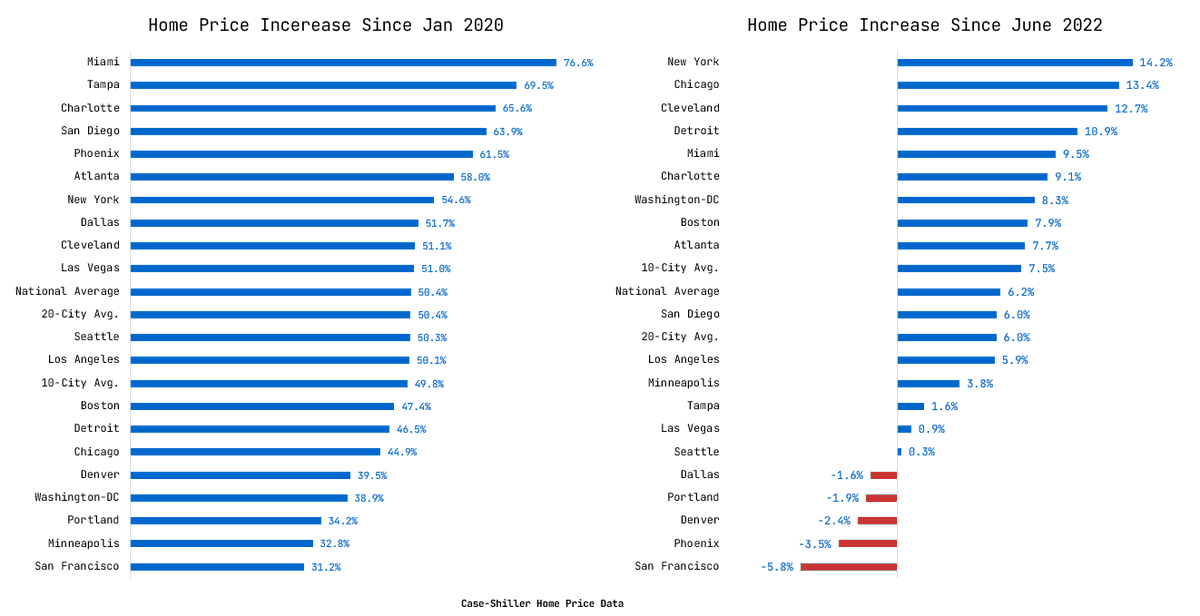
Since January 2020, national home prices have been up 50.4%!
But since June 2022, there has been a split.
Home prices continued to rise in many areas, but there have been declines in about 25% of cities.
The weakest areas have been San Fran, Phoenix, Denver, and Portland.
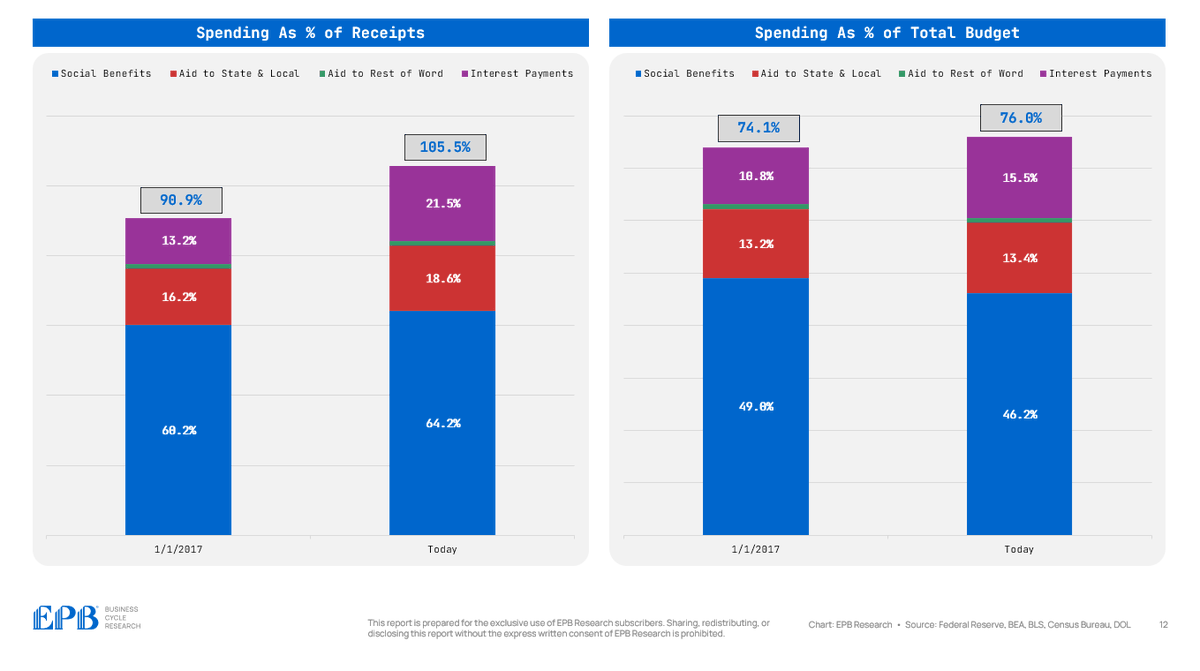
Reducing Federal spending is never as easy as it sounds.
Total Federal Expenditures are ~$7.3T.
75% of expenditures are social benefits, state & local aid, and interest.
Add in defense spending, and it's ~90%.
Cutting all other spending to zero is only ~$700B.
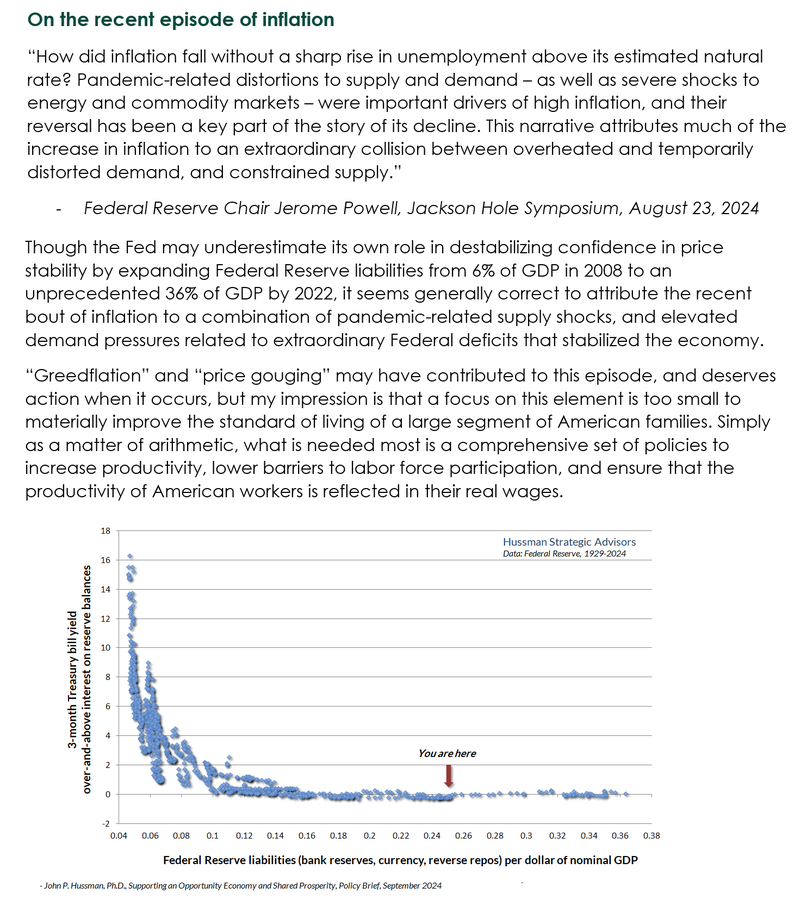
Sigh. What drove inflation was $5 trillion of pandemic fiscal stabilization ($3.1 in the previous admin and $1.9 in the present one) with household and corporate supports colliding with supply chain disruptions, amplified by a Fed that jacked its balance sheet to 36% of GDP.