📌 What is "Contingency Argument"?
بسم الله الرحمن الرحيم
The Most popular Atheist of the subcontinent, Javed Akhtar, is unaware of one of the key arguments of Theism.
I will try to present the Contingency Argument in a way that even our Desi Atheist and an ordinary layperson can grasp it.
●When we see a plant, it has a specific shape, size, and colour. The reason for this is that its environment and conditions made it the way it is.
So when we see something with specific characteristics, we naturally demand an explanation for why the thing is "the way it is".
🔰Science is based on a principle known as PSR, the "Principle of Sufficient Reason".
When scientists saw a ball falling to the ground, they began searching for an explanation: why did the ball fall that way, why did it go downward and not in any other direction, and so on.
This is what PSR means: when we observe something with specific features or behavior, we try to find the explanation behind why it is "the way it is".
Another example is the human being. When scientists reflected on the fact that humans have a specific shape, height, and size, they concluded that there must be an explanation or reason behind it. As a result, they proposed various theories.
Anything that has specification, or that could have been otherwise, requires an External explanation. This principle is called PSR.
When we observe a new event in our galaxy, we do not abandon our reasoning and say there must be no explanation behind it. Instead, we believe that there is an explanation, based on PSR.
Therefore, science itself is grounded in PSR, as it generates curiosity and the search for answers.
Anyone who denies PSR would ultimately have to reject science as a whole.
So, If things could have been different but are the way they are, then there must be a reason and an explanation for why they are the way they are.
🔰So, a thing that has specification (Susceptible to Disassemble) or could have been otherwise is known as a Contingent thing.
Contingent things require an explanation for their specification and existence, since they could have been non-existent.
Therefore, contingent things require an explanation.
📗Academically, Contingent things are "Susceptible to Disassembly," meaning they can be taken apart, and they have "Arbitrary Limits".
🔰Now let us consider the universe.
Does it have specific characteristics? Can it be rearranged in a different way? Is it possible that it might not have existed? The answer is YES.
Hence, the universe is CONTINGENT, and using PSR, it requires an explanation for "the way it is".
📛Now one may say that there are infinite contingent things.
🔰1. The Problem of Infinite Regress
Imagine you want to shoot a bird. You ask permission from your brother to shoot it. Similarly, your brother asks his elder brother, the elder brother asks another brother, and this continues infinitely.
Would the you ever be able to shoot the bird? The answer is NO, because the chain of permission would be infinite.
But if he does shoot, then it would entail that the chain stops somewhere; there must be a first permission giver.
■Now applying this logic to the universe:
If the universe has a cause, and that cause has a cause, and that cause also has a cause, and this continues infinitely, will the universe exist?
The answer is NO, because the chain of causes would be infinite.
But the universe does exist; therefore, it entails that there must be a first cause.
■ Applying this to contingency:
A plant depends for its specifications on its atmosphere; the atmosphere depends for its specification on the Earth; the Earth depends on the solar system; the solar system depends on the galaxy; the galaxy depends on the universe; the universe depends on the multiverse. If this chain were infinite, the plant would not have existed, because the chain of dependency would be infinite.
📒Part 1/3....
My beloved brother, Since you replied to my comment, which was directed at a beloved brother who, out of his love for the Prophet ﷺ, began "cursing" and making "takfir" of Dr. Nasser, I assumed you shared his position. However, since you have clarified that you do not support "cursing" or "takfir" in this context, it seems that we are not in much disagreement.
May Allah bless you .
@Imoggachev@DengGarang45 It is a humble piece of advice: before making a comment, please "steelman" the other person's position. This is from the Sunnah.
May Allah grant you Jannatul Firdaus.
My beloved akhi,
You are absolutely right that "being harsh" is not identical to "being unjust."
However, I hope you would agree that being harsh in a manner that is not in line with the principles of Islam can amount to being unjust.
So, how do we determine whether "cursing" and "takfir" in this context are merely harsh or actually unjust?
If they are in line with the Islamic principles governing cursing or takfir, then they would be considered just. However, if they are not, then they would be unjust.
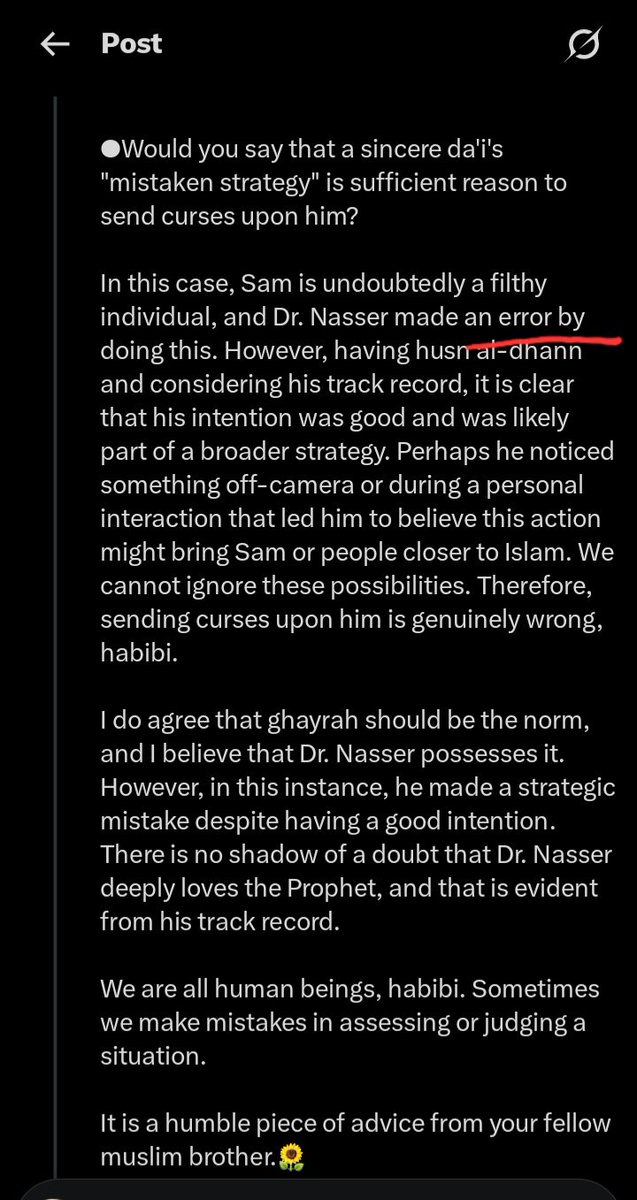
Q1: Would you say that a sincere da'i's "mistaken strategy" is a sufficient reason to send curses upon him?
Q2: Where there are "genuine possibilities" for a mistake, is that sufficient grounds for takfir according to the usul of takfir?
Please reflect on these questions. If the answer to either of them is "No," then such actions would fall under injustice.
We are all human beings, habibi. Sometimes we make mistakes in assessing or judging a situation.
Think about it, my brother.
May Allah bless you.
Alhamdulillah, @ImranHussein87 I just watched this friendly debate on a very important topic that may have significant implications for the future.
Alhamdulillah, Sheikh Yasir Fasaga presented a strong case for the possibility of extraterrestrial life from a Qur'anic perspective, including the possibility of their gathering with humans on Earth. However, Sheikh Fahad's argument in favor of the jinn hypothesis appears to be more in line with the inference to the best explanation.
Although the two positions are not necessarily contradictory, when it comes to the current UFO phenomenon, Sheikh @tasleemfahad argument seems more robust and carries greater explanatory weight.
May Allah bless You all & @SapienceOrg !
https://t.co/nMxB9ISpxF
"Allah is the ally of Umar ibn al-Khattab in this world and the Hereafter".. Saudi Heritage Commission announces discovery of rock inscriptions bearing the name of the second Rightly Guided Caliph
🔴 Saudi Heritage Commission announces discovery of a rare rock inscription in Al-Mahad Governorate in the Medina Region
🔴 The inscription includes the phrase: "Allah is the ally of Umar ibn al-Khattab in this world and the Hereafter"
🔴 Heritage Commission: The discovery is among the important testimonies to early Islamic history
🔴 The Commission added that the inscription was written in the Hijazi script, one of the oldest Islamic Arabic scripts
🔴 Researchers view that the discovery enhances the documentation of Umar ibn al-Khattab's religious and historical symbolism
Dear, Where did I talk about the "existence of God"? 🤦♂️ How on earth can you deduce that a text discussing inscriptions, secular historians, isnād-cum-matn analysis, stylometry, the science of hadith, fragments, and manuscripts is about the "existence of God"?
It seems that everything I said went over your head, my brother!
Instead of addressing my response, you brought up another point regarding the issue of prayer.
●Well, it is preserved. It can even be traced in NON-Muslim sources. For example, we can look at an early source called T’ung Tien, a Chinese Tang court work on history and geography. It contains a description of Kufa by a Chinese soldier who was taken prisoner during the Battle of Talas in 751. He spent years among Muslims in Iraq and Iran before returning to China in 762.
One of the observations this Chinese soldier recorded about Kufa which was the Abbasid capital at the time (Baghdad was not built until the 760s) was that Muslims prayed FIVE (5) times a day.😊
So, even early non-Muslim sources debunk what you are saying, let alone the Muslim sources.
●Regarding the Shia-Sunni issue, merely because there are many "sects" or competing theories does not entail that the truth cannot be found. By that logic, the existence of multiple scientific theories in fields such as quantum mechanics would mean that truth is unattainable. Therefore, you are committing a fallacy.
●As for Hadith, I already addressed that in my first response, which you seem to have ignored.
It is my humble request that, before entering into such a discussion, you at least acquire some knowledge of the subject.
Recent inscriptions that have been discovered indeed provide strong evidence for the veracity of Islam and its historical claims. They are sufficient to dismantle many of the foundational assumptions of Orientalist scholarship. This is not the first time such evidence has emerged; in the past, numerous early hadith fragments have been discovered that challenged and overturned various Orientalist theories.
Moreover, modern secular academics such as Harald Motzki, who was raised in a Catholic family, utilized methodologies such as ICMA (Isnad-cum-Matn Analysis) to trace hadith traditions back to their actual historical periods, thereby refuting many Orientalist assumptions regarding their origins. Other approaches, including stylometric analysis, have likewise provided evidence against several Orientalist claims.
Furthermore, when one studies the science of hadith in depth, it becomes increasingly more clear that what has been transmitted to us has been preserved with remarkable rigor. Last but not least, numerous Qur'anic manuscripts have been discovered that date back to the earliest period of Islam, some even to the lifetime of the Prophet ﷺ. These discoveries have once again dealt a significant blow to Orientalist narratives.
Therefore, claims that Islam is merely a later development, or that hadith literature was systematically back-projected onto earlier generations, have not only been seriously challenged but, have been decisively undermined by the cumulative weight of historical, manuscript, and textual evidence.
Note : I have not even mentioned the other theological and metaphysical arguments and evidences.
Dear, Where did I talk about the "existence of God"? 🤦♂️ How on earth can you deduce that a text discussing inscriptions, secular historians, isnād-cum-matn analysis, stylometry, the science of hadith, fragments, and manuscripts is about the "existence of God"?
It seems that everything I said went over your head, my brother!
Instead of addressing my response, you brought up another point regarding the issue of prayer.
●Well, it is preserved. It can even be traced in NON-Muslim sources. For example, we can look at an early source called T’ung Tien, a Chinese Tang court work on history and geography. It contains a description of Kufa by a Chinese soldier who was taken prisoner during the Battle of Talas in 751. He spent years among Muslims in Iraq and Iran before returning to China in 762.
One of the observations this Chinese soldier recorded about Kufa which was the Abbasid capital at the time (Baghdad was not built until the 760s) was that Muslims prayed FIVE (5) times a day.😊
So, even early non-Muslim sources debunk what you are saying, let alone the Muslim sources.
●Regarding the Shia-Sunni issue, merely because there are many "sects" or competing theories does not entail that the truth cannot be found. By that logic, the existence of multiple scientific theories in fields such as quantum mechanics would mean that truth is unattainable. Therefore, you are committing a fallacy.
●As for Hadith, I already addressed that in my first response, which you seem to have ignored.
It is my humble request that, before entering into such a discussion, you at least acquire some knowledge of the subject.
Recent inscriptions that have been discovered indeed provide strong evidence for the veracity of Islam and its historical claims. They are sufficient to dismantle many of the foundational assumptions of Orientalist scholarship. This is not the first time such evidence has emerged; in the past, numerous early hadith fragments have been discovered that challenged and overturned various Orientalist theories.
Moreover, modern secular academics such as Harald Motzki, who was raised in a Catholic family, utilized methodologies such as ICMA (Isnad-cum-Matn Analysis) to trace hadith traditions back to their actual historical periods, thereby refuting many Orientalist assumptions regarding their origins. Other approaches, including stylometric analysis, have likewise provided evidence against several Orientalist claims.
Furthermore, when one studies the science of hadith in depth, it becomes increasingly more clear that what has been transmitted to us has been preserved with remarkable rigor. Last but not least, numerous Qur'anic manuscripts have been discovered that date back to the earliest period of Islam, some even to the lifetime of the Prophet ﷺ. These discoveries have once again dealt a significant blow to Orientalist narratives.
Therefore, claims that Islam is merely a later development, or that hadith literature was systematically back-projected onto earlier generations, have not only been seriously challenged but, have been decisively undermined by the cumulative weight of historical, manuscript, and textual evidence.
Note : I have not even mentioned the other theological and metaphysical arguments and evidences.
Subhanallah, Damn, I just watched a random video, and it truly turned out to be marvelous. The brother really annihilated Grifter Avery.
The way he framed the question was so effective that any sincere person would seriously reflect on it.
[According to the Bible, if someone preaches a false god, then he cannot be a true prophet & how would people distinguish between a false god and the true God unless they already have knowledge of the true God? Therefore, the message of Jesus should be consistent with and in line with the concept of God that was preached before him by true prophets]
He (muslim) said:
"So now, when you look at this precept, I want you to imagine that you are in first-century Judea. The Israelites have stones raised over Jesus' head, and they are about to stone Him.
I want you to tell me: what would Jesus point to in the Torah—the first five books—to make them stop?
I want you to say:
'I am Jesus. I am on the ground. Wait! Look at Genesis, chapter 18. It's talking about me. Don't stone me!'
'Oh, thanks for the verse.'
'Bring it on.'"
Since the Bible is a compilation of different books, and Christians claim there is continuity between them, the brother asked about the continuity of the most central doctrine of Christianity..the divinity of Jesus..in the Old Testament, beginning chronologically with the first five books of the Bible. However Grifter Avery completely failed to establish that continuity.
Its worth Watching🔥
https://t.co/jFyubX6MyR
@Kryptotajeer@Deenresponds@muslimorthodoxy@korrathetaymi@dawahxdialogues@DrMaleekk@dawahxdialogues@SeerahDawah
السلام عليكم ورحمة الله وبركاته
My beloved Akhi,
It is true that, ideally, it is the family's responsibility to take care of their own members. However, there are many situations in which the family itself is poor, lacks sufficient resources, or is unable to provide assistance. In some cases, family members may even view the person as a burden and choose not to help.
In such situations, there is a kind of responsibility upon fellow Muslim brothers who have the ability and resources to assist.
The Prophet ﷺ taught us that if our neighbor sleeps hungry, we bear a degree of responsibility. Likewise, we are one Ummah; when one part of the Ummah suffers, the rest should feel that pain as well.
Habibi, I believe we would both agree that Islam is not merely an individualistic or family-centered religion. In many matters, we have communal obligations toward one another.
Regarding Brother @IjazTheTrini, he has provided "sufficient information" in the past that establishes his trustworthiness. Moreover, his expertise in "Biblical textual criticism" is genuinely beneficial for many students of knowledge. Despite his illnesses and difficulties, he continues to contribute to academic da'wah to the best of his ability.
Given all of this, I believe it is valid to say that those who possess the means, resources, and ability to support him should do so if they know his situation. Otherwise, it is possible that Allah may question them in Day of Judgment regarding their ability to help and their failure to do so.
Regarding the term "shaming,"
My beloved Akhi, I think this is a very strong word that does not necessarily reflect the reality of the situation. Yes, this Ummah contains a great deal of goodness and khayr, but we also have areas that require improvement. One of those areas is "helping others sincerely for the sake of Allah".
I am sure we would both agree that there are many good scholars, Muslims, and even madrasas that struggle to meet their basic needs, while many people who have the means to help choose not to contribute. Pointing this out can be viewed as "constructive criticism" rather than shaming.
I believe your intention is good, and this is merely a humble piece of advice from your fellow Muslim brother.
جزاك الله خيرًا
May Allah bless you and whoever that Noble brother is. He supported you, and you also supported him by allowing him to help, for perhaps that act of kindness will become a means of relief for him on the Day of Judgment.
SubhanAllah, it is a beautiful example of "Mutual Support" and brotherhood for the sake of Allah.
May Allah accept it from both of you, shower you with His mercy and blessings, make your good deeds heavy on the Scale, and grant you, that brother, and whoever is connected to this goodness the highest levels of Jannatul Firdaus. Ameen. 🤍
Sometimes all that is needed is a simple conversation to clear up confusion. Unfortunately, nowadays many people find it difficult to sit down and talk to one another openly and sincerely.
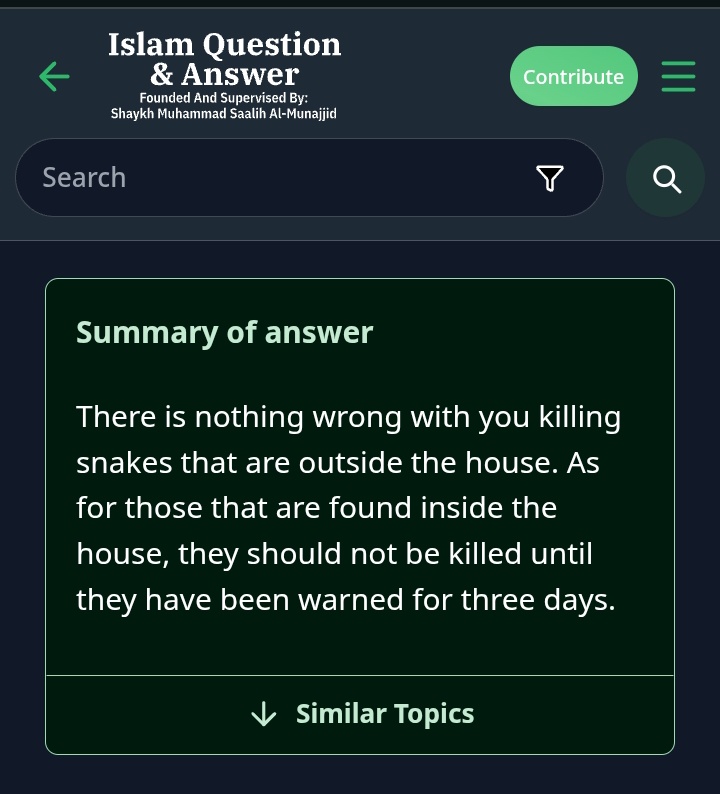
There is a hadith that instructs us to warn/ask a snake three times before killing it.
Even though, based on appearance, experience, and empirical observation, a snake is ordinarily just an animal, Islam still teaches us to take precautions because there remains a "SLIGHT possibility" that it could be something else. Therefore, we are instructed to act carefully rather than hastily.
In the case of Beloved brothers like @abdul_now, the empirical evidence, and their apparent conduct point in the opposite direction. The brother has consistently demonstrated sincerity, invested significant effort in his work, and provided a great deal of beneficial academic content free of charge. His track record gives strong reason to think well of him.
So why should we approach him with suspicion or negativity? If we are encouraged to exercise caution because of a "mere" possibility in one case, then it seems even more appropriate to maintain a good opinion of someone whose actions and history "overwhelmingly" indicate sincerity and goodness.
That's why Our beloved brother @BroHajji should draw a clear "demarcation" between "whom to trust" and "whom not to trust". If we paint the entire town with the same brush, then the very purpose of his mission to expose grifters and dishonest individuals will be undermined. So He should provide that "toolkit" or set of "criteria" for distinguishing between trustworthy and untrustworthy individuals.
May Allah bless brother Abdul !
May Allah ease all of your affairs and grant you strength, patience, and steadfastness through every difficulty.
The hardest part is being away from family. Even thinking about it gives goosebumps. People often speak about different kinds of pain, but nothing..nothing..comes close to living far away from the people who are your whole world. Living far from your family slowly breaks you, quietly, every single day.
I am not sharing this to create worry or sadness, but so that people can truly understand the urgency of the situation and appreciate why support and contributions can make such a meaningful difference.
May Allah open doors of ease for you from places you could never imagine. May He bless your rizq, protect you from every hardship, grant you success in this life and the next, keep you with your family upon goodness, place barakah in your time and efforts, keep your heart firm upon faith, and make every sacrifice you make a means of elevation in His sight.
May Allah grant you happiness after every hardship, relief after every difficulty.
Sometimes all that is needed is a simple conversation to clear up confusion. Unfortunately, nowadays many people find it difficult to sit down and talk to one another openly and sincerely.
There is a hadith that instructs us to warn/ask a snake three times before killing it.
Even though, based on appearance, experience, and empirical observation, a snake is ordinarily just an animal, Islam still teaches us to take precautions because there remains a "SLIGHT possibility" that it could be something else. Therefore, we are instructed to act carefully rather than hastily.
In the case of Beloved brothers like @abdul_now, the empirical evidence, and their apparent conduct point in the opposite direction. The brother has consistently demonstrated sincerity, invested significant effort in his work, and provided a great deal of beneficial academic content free of charge. His track record gives strong reason to think well of him.
So why should we approach him with suspicion or negativity? If we are encouraged to exercise caution because of a "mere" possibility in one case, then it seems even more appropriate to maintain a good opinion of someone whose actions and history "overwhelmingly" indicate sincerity and goodness.
That's why Our beloved brother @BroHajji should draw a clear "demarcation" between "whom to trust" and "whom not to trust". If we paint the entire town with the same brush, then the very purpose of his mission to expose grifters and dishonest individuals will be undermined. So He should provide that "toolkit" or set of "criteria" for distinguishing between trustworthy and untrustworthy individuals.
May Allah bless brother Abdul !
May Allah ease all of your affairs and grant you strength, patience, and steadfastness through every difficulty.
The hardest part is being away from family. Even thinking about it gives goosebumps. People often speak about different kinds of pain, but nothing..nothing..comes close to living far away from the people who are your whole world. Living far from your family slowly breaks you, quietly, every single day.
I am not sharing this to create worry or sadness, but so that people can truly understand the urgency of the situation and appreciate why support and contributions can make such a meaningful difference.
May Allah open doors of ease for you from places you could never imagine. May He bless your rizq, protect you from every hardship, grant you success in this life and the next, keep you with your family upon goodness, place barakah in your time and efforts, keep your heart firm upon faith, and make every sacrifice you make a means of elevation in His sight.
May Allah grant you happiness after every hardship, relief after every difficulty.