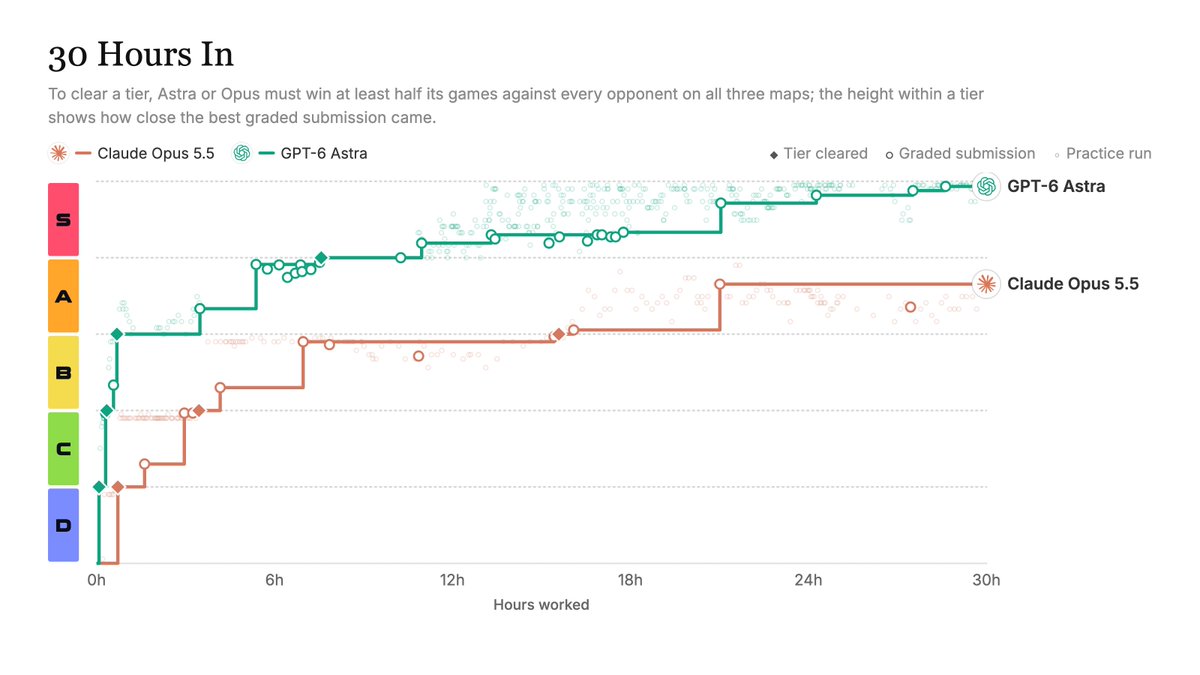
GPT Astra and Claude Opus have been racing to create the best StarCraft strategy for over 30 hours.
The best human written S tier strategies, are still holding on against Astra... but just barely
@ben_kauf Oh man! So sad for Google, but mostly super happy for you!
It’s gonna be a blast, can’t wait to see what you do now that you’re fully unleashed :))
@giffmana Isn’t the env/harness part about having more diverse environments and tasks you sample rollouts from?
Just pushing more compute into the same simplistic environments does saturate at some point
@dylan522p Zurich, and Copenhagen was also pretty good.
Many US airports (e.g. all NYC ones for ex) look like an abandoned warehouse/warzone, so the variance is quite high from one place to the other!
@dhh@levelsio For a first visit Shanghai + Beijing + Chengdu was great!
(with family, maybe just Shanghai + Beijing is easier; though we also loved the Beijing => Chengdu high-speed rail)
So many amazing hotels there! So make sure you pick something good ahead of time.
i would rather be an optimist and work hard than a pessimist posting about why things won't work.
it's much more difficult and the most likely path is failure, but society fails if people don't try.
no amount of "it will never work" essays will drive society forward.
@davidmanheim@ylecun@hosseeb@deanwball Yeah, easily. Just see how much Microsoft had to spend on R&D to develop Windows. Same for proprietary network, DB software (see Oracle, Cisco)
Microsoft could have easily claimed that it was "dumping" to release a competing open-source kernel/OS below cost of production.
Looking at Tau Bench for the first time... and surprised by how flaky/noisy this eval is
e.g. the user simulator would often behave in ways that make it impossible to successfully complete a task
What are other (cheap) agentic evals folks would suggest running?
@Meituan_LongCat@natolambert@xeophon Just leaving China tomorrow unfortunately, but would also love to meet the team and chat about (public!) trends re:building great models next time we’re visiting!
@Angaisb_ Hard to not become cynical re:some form of anti-Chinese bias causing these models to be excluded from most discussions/benchmarks. A lot of the recent fundamental breakthroughs came from those labs.
@biosemiote This simplification is accurate but loses some very important details; for ex. the interpreter would need to be way more constrained vs usual use of how code interpreters in harnesses (can't call an LLM or expensive API in a for loop iterating over 1M values)
@a1zhang (and I’m even considering implementing some of those approaches just on the basis of the results in your paper, eg if it worked there maybe my “generate prompts dynamically” approach is also worth pursuing)
@a1zhang FWIW I just told some colleagues recently that an approach was “very much RLM-like”. And it probably isn’t at all an RLM even by your definition.
I see value there :) bringing ideas together and highlighting a fundamental thing that was mostly overlooked. That alone has value .
Introducing mxbai-rerank-v3-listwise: reranking that goes beyond binary relevance.
It reads the whole candidate set, resolves conflicts, and ranks by directives like recency, source priority, and multi-step rules.
+11% NDCG@10 on average across multiple domains, modalities, and languages in runs with Wholembed v3.
Available today in preview in Mixedbread.
@antoine_chaffin Could you clarify this part (filtering), Antoine?
What is the "drop" here? Were these sampled as positive pairs, but the cross-encoder assigned a very low score to them so they are filtered out?
What does "expose filters as metadata" mean? How are they used in training?
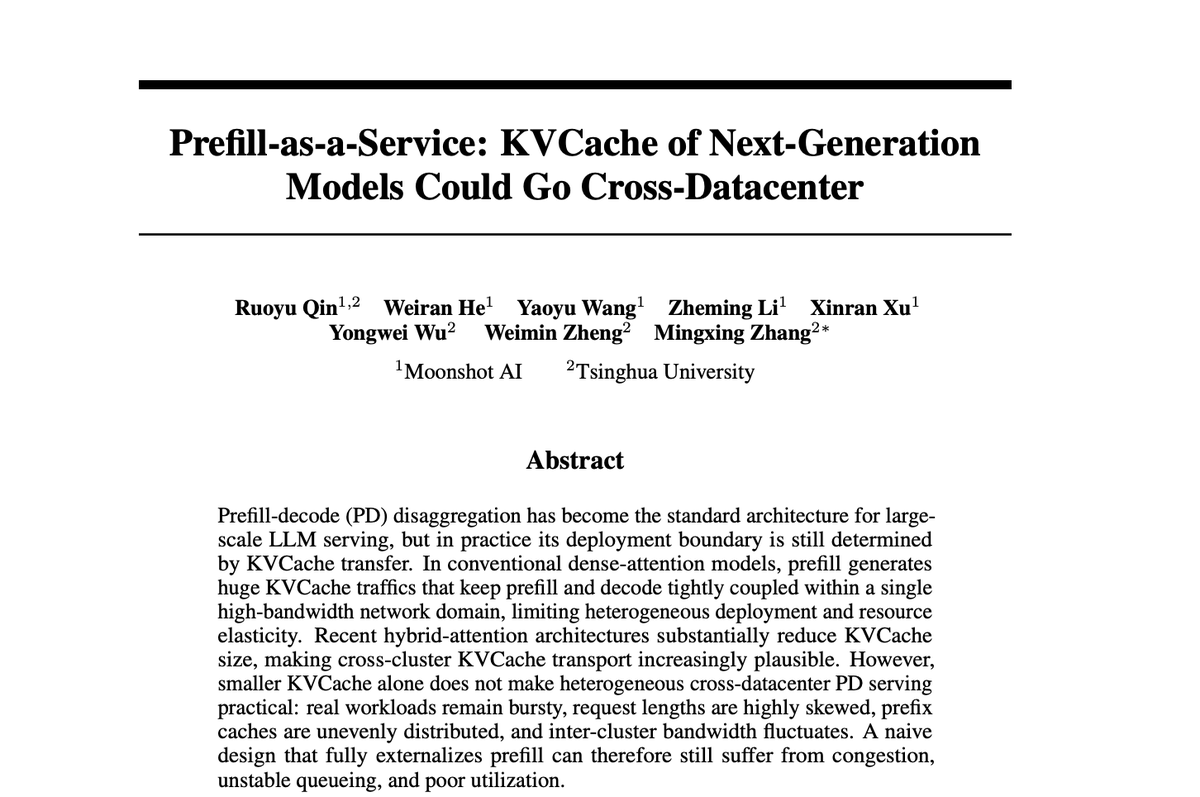
We push Prefill/Decode disaggregation beyond a single cluster: cross-datacenter + heterogeneous hardware, unlocking the potential for significantly lower cost per token.
This was previously blocked by KV cache transfer overhead. The key enabler is our hybrid model (Kimi Linear), which reduces KV cache size and makes cross-DC PD practical.
Validated on a 20x scaled-up Kimi Linear model:
✅ 1.54× throughput
✅ 64% ↓ P90 TTFT
→ Directly translating into lower token cost.
More in Prefill-as-a-Service: https://t.co/If8fA3t9Og