Interviewed a Senior Backend Engineer today.
Knew payments, Stripe, REST APIs, webhooks — all of it.
Then I asked:
"A user clicks 'Pay Now.'
Their internet cuts out for 2 seconds.
They click again.
Your server processes both requests.
The user is charged twice.
How do you prevent duplicate charges — without asking the user to do anything differently?"
Silence.
Your turn:
User clicks twice ❌
Server processes both ❌
Double charge ❌
User did nothing wrong ❌
How do you make your payment API safe against this? 👇
(Stripe has a name for this solution — do you know it?)
A guy bought a $1,500 Samsung TV 3 years ago.
He watched Netflix. He watched YouTube. He thought the picture looked fine. He assumed that's just what a TV looks like.
His friend, a home theater installer who calibrates TVs for a living, walked into his apartment and looked at the screen for 5 seconds.
"You're watching everything in demo mode. The motion smoothing is on. The eco dimmer is cutting your brightness by 40%. Your TV is taking a screenshot of your screen every 30 seconds and selling your viewing data to advertisers. And you're watching a $1,500 panel in the same picture mode Best Buy uses under fluorescent lights to make TVs pop on a showroom wall."
He changed 9 settings in 12 minutes.
The picture looked like a different television. The soap opera effect disappeared. The colors became natural. The TV stopped spying on him.
Here's every setting he changed 🧵
If I had to replace my entire engineering team with AI in 2026, I would not hire a single developer.
I would set up these 10 GitHub repos.
1. OpenHands
Replaces your junior developers. An autonomous software engineer that reads GitHub issues, writes the fix, runs the tests, and opens the PR. 65K+ stars.
repo → https://t.co/kqap76TDuB
2. Aider
Replaces your mid-level dev. A terminal pair programmer that edits multi-file codebases, auto-commits to git, and works with any LLM.
repo → https://t.co/FB24VY6vf0
3. Cline
Replaces your VS Code teammate. An autonomous agent that lives in your editor, navigates files, runs commands, and ships features end-to-end.
repo → https://t.co/hjjDVgiRd3
4. Claude Task Master
Replaces your project manager. Turns a product spec into a tracked task list and keeps the agent on rails across long builds.
repo → https://t.co/0xYzJpSX4z
5. CrewAI
Replaces your tech lead. Coordinates multiple AI agents with defined roles, responsibilities, and handoffs. Already used across the Fortune 500.
repo → https://t.co/0xohE065sD
6. LangGraph
Replaces your architect. The orchestration layer every production AI system is being built on in 2026. Stateful, durable, observable.
repo → https://t.co/bzVBn9uecV
7. n8n
Replaces your ops hire. 400+ integrations, native AI nodes, self-hosted. Every internal tool and workflow your team used to build from scratch.
repo → https://t.co/hdycABGGc1
8. Coolify
Replaces your DevOps engineer. Self-hosted Heroku and Vercel. Git push to deploy, auto SSL, databases, 280+ one-click services.
repo → https://t.co/N5Fk22qraT
9. PostHog
Replaces your QA and data team. Product analytics, session replay, feature flags, A/B tests, error tracking. All in one repo.
repo → https://t.co/ULaoYj7oKE
10. Chatwoot
Replaces your support hire. Live chat, email, WhatsApp, all from one inbox. Self-hosted and AI-assisted out of the box.
repo → https://t.co/AC5NpocnFg
A 10-person engineering team in 2022 could ship what one founder ships now with these 10 repos.
That is not a prediction. It is what is already happening at every AI-first startup in 2026.
Pick one. Replace one role. Ship one feature. That is how you start.
100% free. 100% open source.
Vercel charges $20/seat/month.
Netlify charges $20/month.
Heroku killed its free tier entirely.
And if you go over your bandwidth? Surprise bills. Sometimes thousands of dollars.
There is an open-source alternative to all three. For $0.
It is called Coolify. 53,000+ stars on GitHub.
You install it on any server you own. A $5 VPS. A Raspberry Pi. An old laptop. Anything with SSH.
Then you deploy everything:
- Static sites
- Full-stack apps
- Databases
- APIs
- 280+ one-click services (WordPress, Ghost, Plausible, n8n, Supabase, and more)
Here's the wildest part:
It does things the paid platforms charge extra for.
- Free SSL certificates, auto-renewed
- Automatic database backups to S3
- Pull request preview deployments
- Real-time server terminal in your browser
- Push-to-deploy from GitHub, GitLab, Bitbucket
- Server monitoring with Discord/Telegram/email alerts
No vendor lock-in. All your configs live on your server. If you stop using Coolify, everything still runs.
The $20/month you pay Vercel? That is per seat. A 5-person team pays $100-500/month depending on usage.
With Coolify on a $5 Hetzner VPS, that same team pays $5/month. Total.
Apache-2.0 licensed. Self-hosted. Free forever.
100% Open Source.
(Link in the comments)
> Claude writes the code.
> Supabase runs the backend.
> Vercel handles deployment.
> Namecheap gets you a domain.
> Stripe collects the money.
> GitHub tracks your code.
> Resend sends the emails.
> Clerk manages auth.
> Cloudflare handles DNS.
> PostHog tracks analytics.
> Sentry catches errors.
> Upstash powers Redis.
> Pinecone stores your vectors.
> OpenAI / Anthropic for AI brains.
> Railway for extra compute.
> LemonSqueezy for global payments.
> Framer / Webflow for landing pages.
> Canva for instant design.
> Figma for UI.
> Notion for docs.
That’s your entire “tech stack.”
No office.
No investors.
No 20-person team.
Just WiFi, a laptop, and execution.
You can literally build a $10k/month startup from your bedroom in 2026.
It’s not that deep.
Ship.
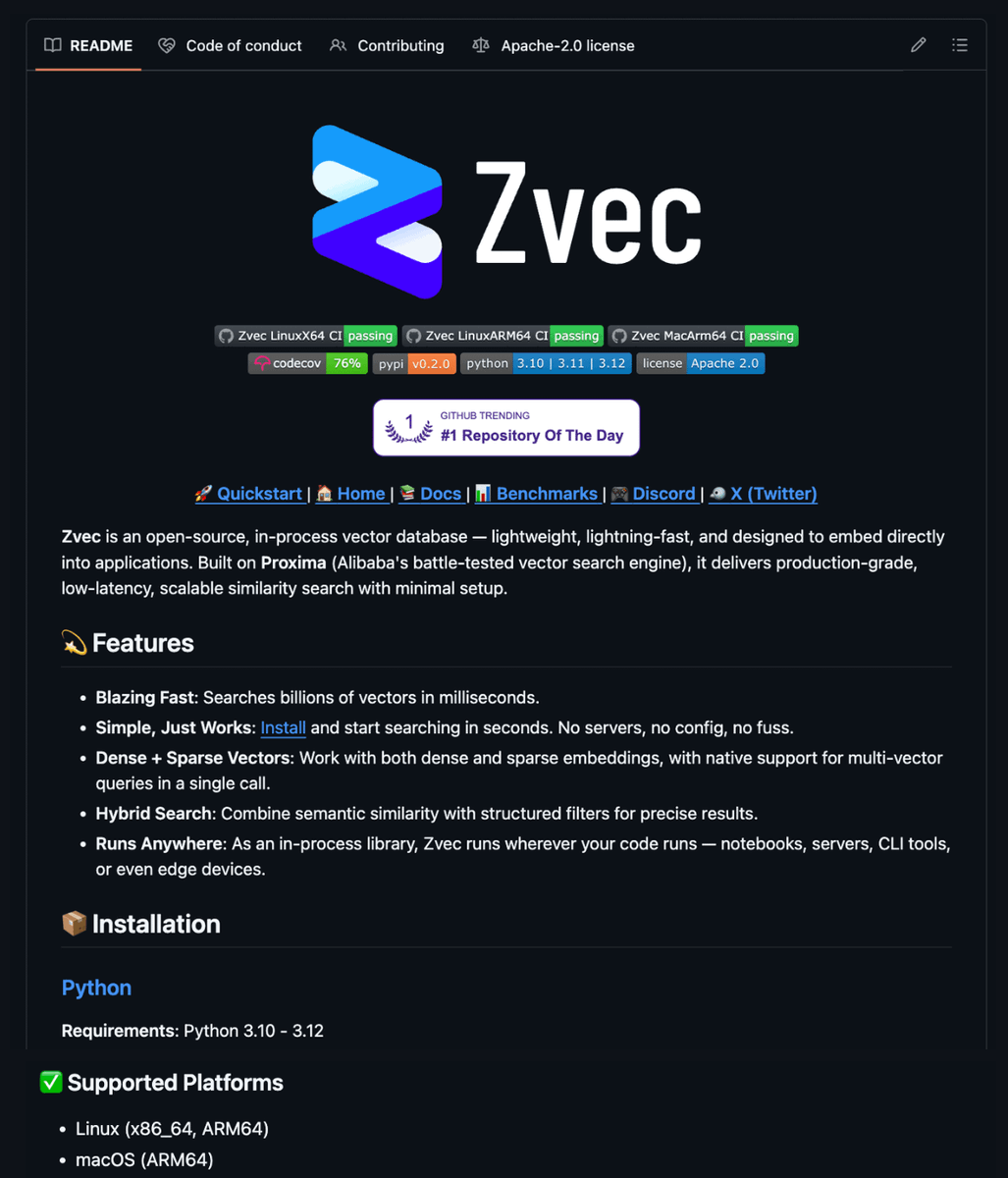
🚨 Holy shit... Alibaba just dropped a vector database that runs inside your app.
It's called Zvec and it runs directly inside your application no server, no config, no infrastructure costs.
No Docker. No cloud bills. No DevOps nightmare.
Built on Proxima, Alibaba's battle-tested vector search engine powering their own production systems at scale.
The numbers don't lie:
→ Searches billions of vectors in milliseconds
→ pip install zvec and you're searching in under 60 seconds
→ Dense + sparse vectors + hybrid search in a single call
And it runs everywhere:
→ Notebooks
→ Servers
→ Edge devices
→ CLI tools
100% Opensource. Apache 2.0 license.
This is the vector DB the RAG community has been waiting for production-grade performance without the production-grade headache.
Link in the first comment 👇
Low-key websites I quietly rely on
1) https://t.co/FDnurfhwge
Gives you a brutally clear learning path for roles like frontend, backend, DevOps, etc
No fluff, just “learn this → then this → then this”.
2) https://t.co/1xhB1Us0oz
An online playground to quickly test HTML, CSS, JS without setting up anything locally
Perfect for quick experiments and debugging ideas
3) https://t.co/d80zVxq6TY
A collection of reusable React hooks with real use cases
Saves time and helps you avoid rewriting the same logic again and again
4) https://t.co/UgqeLiqese
Concise cheat sheets for languages, frameworks, and tools. Ideal when you forget syntax and don’t want to read a 20-minute blog
5) https://t.co/OehnjnfVix
Turns messy JSON into a clean visual tree
Makes understanding large APIs and configs way easier than staring at raw text
6) https://t.co/mcMPeqEFWJ
Lets you generate and preview color palettes instantly
Useful when you want decent UI colors without guessing or copying blindly
7) https://t.co/9yEsuJrWCB
Build, test, and debug regex step by step with explanations Honestly, the fastest way to stop hating regex
8) https://t.co/7eM95WZ8cJ
Shows how big an npm package really is before you install it
Helps you avoid bloating your app with “tiny” libraries
9) https://t.co/Za87baZsBk
Tells you which CSS/JS features actually work across browsers Essential before using shiny new features in production
10) https://t.co/YeYh94AX4R
Google’s own diagnostics tools for DNS, email, headers, and network issues
Surprisingly useful for debugging real-world problems
👉 Which one of these do you already use and which one did you not know existed?
This will retire 90% of RAG systems with dignity (and a sad song playlist). Powered by DSPy: If you're still building "text in, text out" chatbots that only perform blind vector and text searches, you're not gonna make it!
My team just dropped Elysia, and it's not just an incremental successor to Verba… It's a whole rethink of how we interact with our data using AI.
𝗪𝗵𝗮𝘁 𝗶𝘀 𝗘𝗹𝘆𝗶𝘀𝗮?
An open-source platform for building agentic RAG architectures. It learns from your preferences, intelligently categorizes, labels, and searches through your data, and provides complete transparency into its decision-making process.
The long & exciting feature list:
• 𝗧𝗿𝗮𝗻𝘀𝗽𝗮𝗿𝗲𝗻𝘁 𝗗𝗲𝗰𝗶𝘀𝗶𝗼𝗻-𝗧𝗿𝗲𝗲 𝗔𝗴𝗲𝗻𝘁𝘀: Elysia’s core is a customizable decision tree, and it visualizes its entire reasoning process, showing you why it chooses a specific tool or path.
It enables advanced error handling, self-healing from failed queries, and prevents infinite loops. You can also add custom tools and branches to build complex, state-aware workflows.
• 𝗗𝗮𝘁𝗮 𝗔𝘄𝗮𝗿𝗲𝗻𝗲𝘀𝘀: Before it even attempts a query, Elysia performs a full analysis of your data collections. This eliminates the blind search problem plaguing most RAG systems and allows for far more complex and accurate query generation.
• 𝗗𝘆𝗻𝗮𝗺𝗶𝗰 𝗗𝗮𝘁𝗮 𝗗𝗶𝘀𝗽𝗹𝗮𝘆𝘀: Your RAG pipeline shouldn't be limited to text, right? That’s why Elysia analyzes each query's results and chooses the best way to display them, from tables and charts to product cards and GitHub tickets. It also features a comprehensive data explorer with search, sorting, and filtering capabilities.
• 𝗛𝘆𝗽𝗲𝗿-𝗣𝗲𝗿𝘀𝗼𝗻𝗮𝗹𝗶𝘇𝗮𝘁𝗶𝗼𝗻 𝘃𝗶𝗮 𝗙𝗲𝗲𝗱𝗯𝗮𝗰𝗸: It uses your positively-rated queries as few-shot examples to improve future responses. This allows you to use smaller, faster models that perform like larger ones over time, cutting costs without sacrificing quality for most use cases.
• 𝗖𝗵𝘂𝗻𝗸-𝗢𝗻-𝗗𝗲𝗺𝗮𝗻𝗱: Elysia chunks documents at query time. It performs initial searches on document-level vectors and only chunks relevant documents on the fly, storing them in a parallel quantized collection with cross references for future use.
𝗧𝗵𝗲 𝗦𝘁𝗮𝗰𝗸
Elysia is built from scratch on Weaviate, using its native features like named vectors, a variety of search types, filters, cross references, quantization, etc. It uses DSPy for LLM interactions and is delivered as a production-ready application via FastAPI, serving a NextJS frontend as static HTML.
Also available as a Python package via pip:
𝗽𝗶𝗽 𝗶𝗻𝘀𝘁𝗮𝗹𝗹 𝗲𝗹𝘆𝘀𝗶𝗮-𝗮𝗶
Type: 𝗲𝗹𝘆𝘀𝗶𝗮 𝘀𝘁𝗮𝗿𝘁
Connect your Weaviate cluster and go explore what’s possible.
My original artwork versus the one they feed my artwork to Ai to recreate it instead of hiring me to make it..
Cuba check mana satu clue ada artwork aku dalam ai art tu, sekilas tengok dah tahu.
Seriously why haha what a joke.
Let's talk about a classic system design journey.
Your app is getting popular, but the database is getting slow. You correctly identify that heavy read traffic is the problem. You add read replicas.
The database load drops. You celebrate.
A week later, users start complaining about their changes "disappearing."
What happened?
🧵
AI NEWS: Google just dropped an Edge AI Gallery to bring open-source AI models to smartphones
Plus, more news from ElevenLabs, Resemble AI, DeepSeek, Sakana AI, Hume, and Tencent.
Here's everything you need to know: