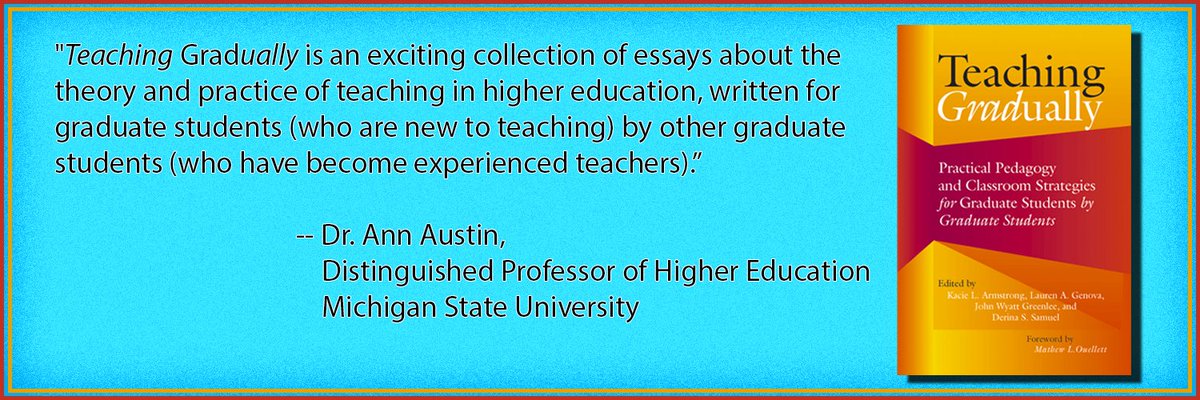
#TeachingGradually is out now! Want to help your students take more effective notes? @HamidTurker and I had a lot of fun contributing a book chapter on how to teach and support note-taking in college classrooms. @StylusPub@CTICornell
Thanks again for a fantastic talk and all the time you spent chatting with the students. This kind of opportunity is so rare that we appreciated it enormously. I'm very thankful to have been the student organizer and host for this year's Neisser Lecture with you as our speaker.
This was such a breath of fresh air! Thanks so much for an amazing day, @CornellPsychDpt & Human Development. Was absolutely lovely speaking to faculty and students. Thanks for the brilliant conversations! 😊
@prokraustinator@LittlePrimate @theromansandler I always tell my students that we already have excellent brain-computer-interfaces and that it's called 'a body'. By the end of the semester, they realize I was only half joking and that all the relevant tech and performed tasks aren't as spectacular as they first believed.
@annefleurdd De technologie die ze hebben is niet zo boeiend, alles wat we tot nu toe hebben gezien kan al zo'n 20 jaar. Zijn claims over je bewustzijn downloaden e.d. daarentegen zijn onzin en inderdaad Theranos-like.
@roselyddon The academic job market may not be great, but you can ensure to pick up skills during your PhD that'll also position you well for non-ac jobs. And there's no shame in leaving the PhD if you realize it's not your thing. Go for it!
@bfrxc @bayesianboy After a lifetime of experience with/through a physical body, a consciousness with only a nervous system would probably be a fate worse than death.
@daisyldixon Nice! I had the honor of holding him up during a crowd walk in Amsterdam when they were touring StS. Probably would've freaked my Mom out, so I took her to a Roger Waters tour instead. Hope yours enjoyed AFI!
Our paper in preparation addresses the messiness of neuroscience's use of the term "representation" and puts it in philosophical context. Would love to hear what some other people think who think a lot about brains!
https://t.co/OdzuZlIgVF
with @KordingLab@benlansdell
Our new PNAS paper looks at how events with similar structure are represented in the brain. Medial temporal lobe and frontoparietal cortex form reduced-dimensionality representations, with a neural geometry that aligns events with the same structure. @NealWMorton@PNASNews
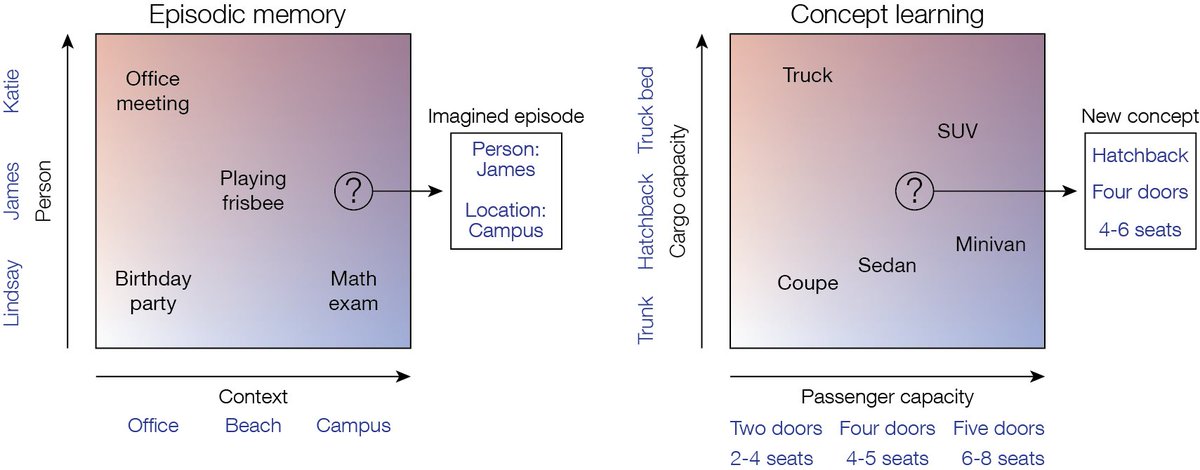
Our new review looks at how cognitive maps in hippocampus, entorhinal cortex, and medial prefrontal cortex support both episodic memory and concept learning. These cognitive maps may support imagination of both future episodes and novel concepts. https://t.co/kVhy8UVozu