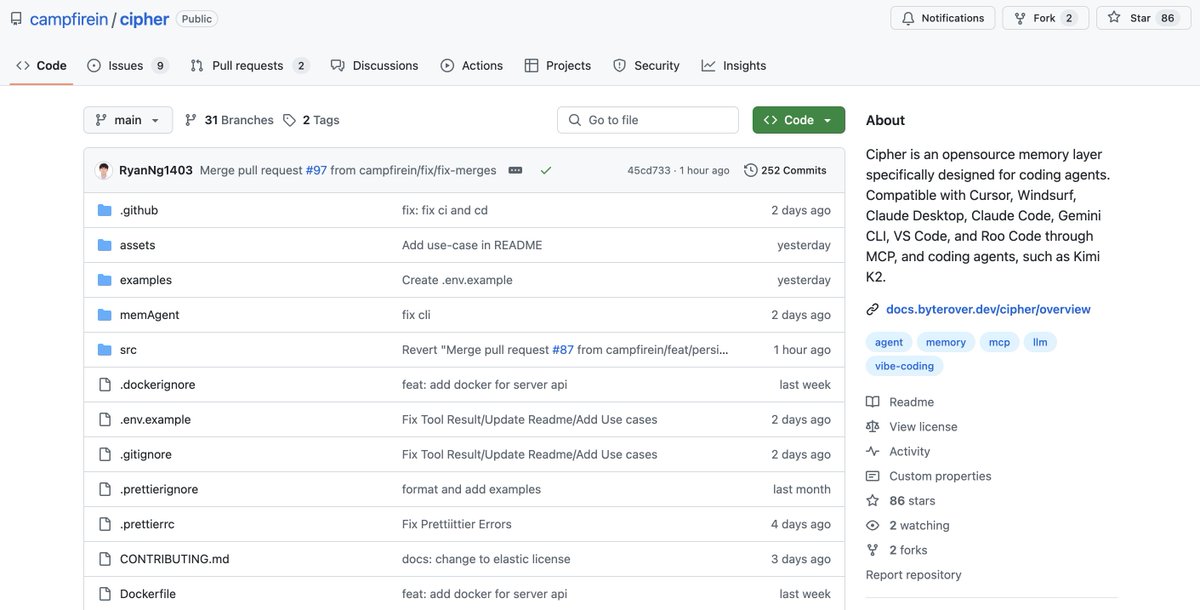
Our team just cooked Byterover's Cipher - an opensource memory layer specifically designed for coding agents on AI IDEs.
Compatible with Cursor, Windsurf, Claude Desktop, Claude Code, Gemini CLI, VS Code, and Roo Code, Kimi K2, Kiro through MCP.
👉https://t.co/nPjsb1LIPI
Memory Skill for OpenClaw with 26k+ users in 1 week🚀
OpenClaw's memory system is broken by default.
It requires curating massive MEMORY.md files or relying on duplicate-heavy generation. Hours are wasted tuning, and massive amounts of tokens are burned.
It's time to stop. So we built the memory skill to solve that prob
Here is our superpower ⚔️
🎯 Top #1 market accuracy (92.19%) after 8+ months of intense architecture iteration
🧠 The ultimate solution to keep the timeline, facts, and meaning perfectly in place
☁️ Local & Cloud + Version control
⚡ Super easy setup
You’re probably using Claude Code wrong.
Not your fault — 90% of devs waste thousands of tokens every day without noticing.
Here are 3 advanced context engineering tricks that make Claude feel like a senior engineer, not a confused intern.
This One Feature Makes Claude Code 2.0 UNSTOPPABLE
We rebuilt a ChatGPT-style UI using Claude Sonnet 4.5 in Claude Code 2.0.
But here’s the twist: we stored our UI component memory in both
https://t.co/AHFVHt96Au and the Byterover Memory Layer — to see which works better.
The result?
👉 https://t.co/AHFVHt96Au is fine for notes inside a file.
👉 But Byterover retrieves, versions, and curates memory across your whole project. It also takes us less space in the context window
Perfect for building consistent, long-lived apps.
Watch the demo 👇
@ByteroverDev This is exactly the right way to think about it. The "brain" shouldn't be locked inside the "body." An abstraction layer for AI context is the endgame.
Let's start composing agent's context from files and tools.
- Import (.md files) → ready-to-use memory
- Connect Linear → real-time context sync
With Byterover's context composer, you can quickly, compose coding agent's memory directly from your internal files and collaboration tools.
Today, we will walk you through how, step by step 👇
Let us know what you think!
Update: 19+ new MCP servers added on Byterover's Context Composer Tool.
Now you can enrich coding agent's context directly from more:
- Github: your projects, PR, issues
- Jam: bug reports, feedback.
- Hugging Face: models, datasets.
- Linear: issues, and projects.
And many more.
Make Codex CLI remember!
By popular request, we just made Byterover play nice with Codex CLI.
You can now switch to Codex CLI with agent losing context of what you had in previous IDE.
No need to reexplain tasks, project context.
Here is how 👇
Most teams know Byterover as “Git for AI memory.”
But memory alone isn’t our only focus. Agents also need the right tools to use it.
That's why we added 15 specialized agent tools in Byterover Memory MCP.
Help your agents maximize values of your stored context:
- Onboard with project handbooks
- Manage plans & tasks
- Structure projects into modules
- Reflect to reduce hallucinations
Refer 2 real use cases below 👇
GitHub Copilot is powerful but it forgets across sessions.
Here is how to solve it with an agentic memory layer 👇
How many times have you had to reintroduce on Copilot:
- Your role in the team
- Project context
- Ongoing tasks
This breaks your flow and slows you down.
With Byterover’s agentic memory layer plugged into Copilot, all this get solved:
- Keep agent's context across sessions
- Share memories with your team
- Manage memories like Git - create, update, rollback, resolve conflicts
👇 Watch this full walkthrough video that covers:
1- The problem with Copilot’s memory
2- How Byterover solves it with persistent, version-controlled, team-shared memory layer
3- A step-by-step guide: set up Byterover on Copilot in just 2 minutes
Git transformed how dev teams manage code.
ByteRover is transforming how they manage AI memory.
Introducing a walkthrough of our "Git for AI memory" on Byterover.
��� Create, update, rollback memories
✅ Resolve memory conflicts
And after all, maintain persistent context of coding agents across your team.
We believe that dev teams should be able collaborate on AI memories just as what they do on code.