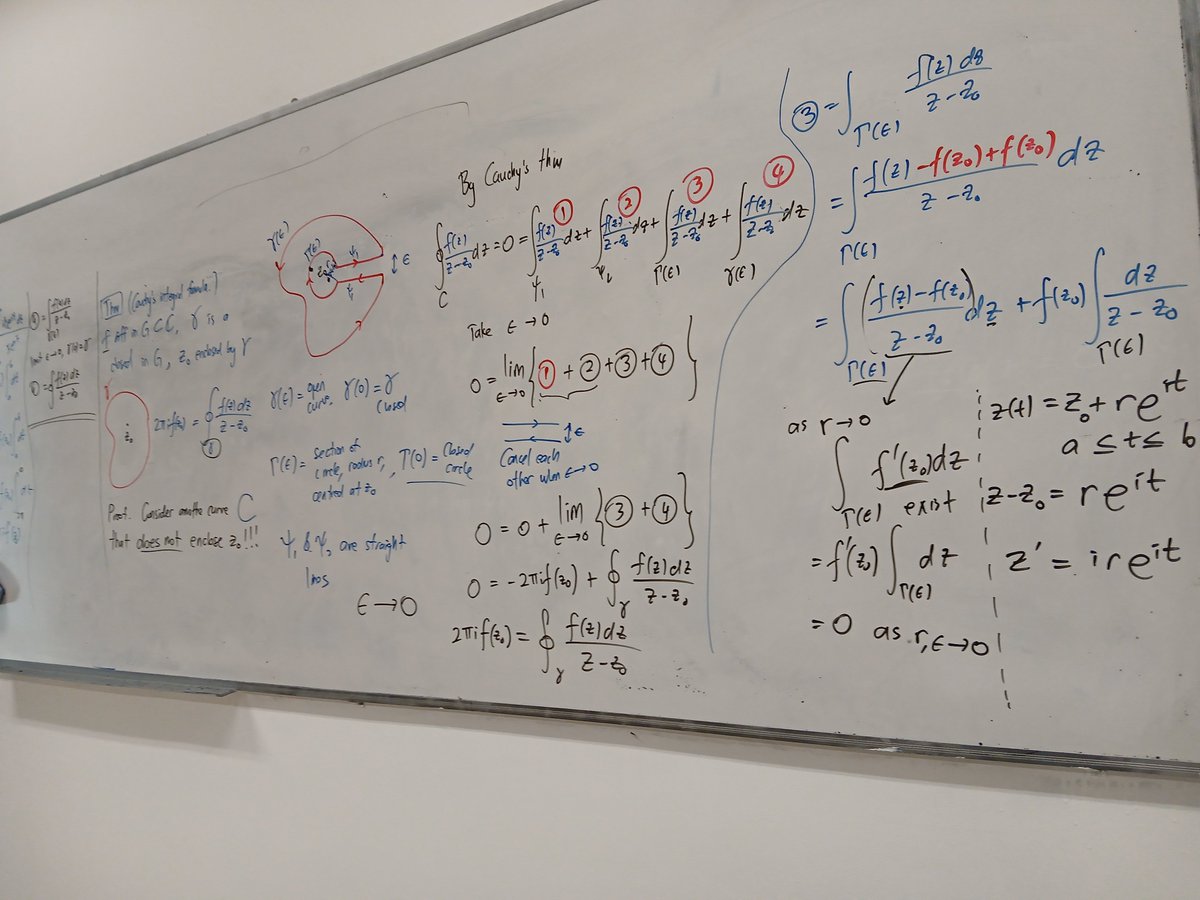
Nikola Veselinov, a 17-year-old Bulgarian mathematics prodigy from Sofia, developed a groundbreaking new theorem.
He proved that certain meromorphic equations f(x)=af(x) = af(x) = a
cannot be solved using elementary functions when the function has infinitely many critical values.
Combining topology, symmetry, and Galois theory, his work generalizes classic unsolvability results. At Regeneron ISEF 2026, the 17-year-old won the $75,000 Young Scientist Award and first place in Mathematics. This historic achievement for Bulgaria highlights his exceptional contributions to pure mathematics as a high school student.
this is f*cking insane, Claude Code agents turned a reading list into a lab you can run in your browser
Boris Cherny (creator of Claude Code) gave 12 agents 64 research papers and one assignment: build a browser lab where readers can rerun the experiments
pick a fluid simulation, change the conditions and watch how the result changes
switch methods while keeping the same scene. inspect the equations, code and measurements beside the animation
give each group a specific job:
→ readers extract equations, assumptions and experimental settings
→ builders turn the methods into runnable code
→ reviewers compare outputs against the papers
→ interface agents build the controls for exploring each experiment
a simulation can look convincing while producing the wrong answer
reviewers check whether it preserves mass, stays stable and matches the paper's measurements before accepting the implementation
every experiment has to show:
> the claim being tested
> the conditions used
> the difference from the reference result
> the details still needed to verify it
the lab covered 11 methods across 28 reference scenes. seven matched the selected reference results within the stated tolerances; four stayed marked for further review
give Claude Code your paper collection, then ask:
"Turn these papers into an interactive browser lab
1. Extract implementable methods, equations and experimental settings. Attach page references and flag missing details
2. Assign independent methods to separate agents. Use shared inputs and measurement tools so the results can be compared
3. Have reviewers check each implementation against the paper. Record discrepancies and keep unverified results clearly marked
4. Build controls for changing parameters, comparing methods and opening the code behind each result"
start with one paper and reproduce one reference experiment before adding more agents
include the inputs, dependencies and checks so the next reader can rerun it from a clean checkout
watch the agents at work below
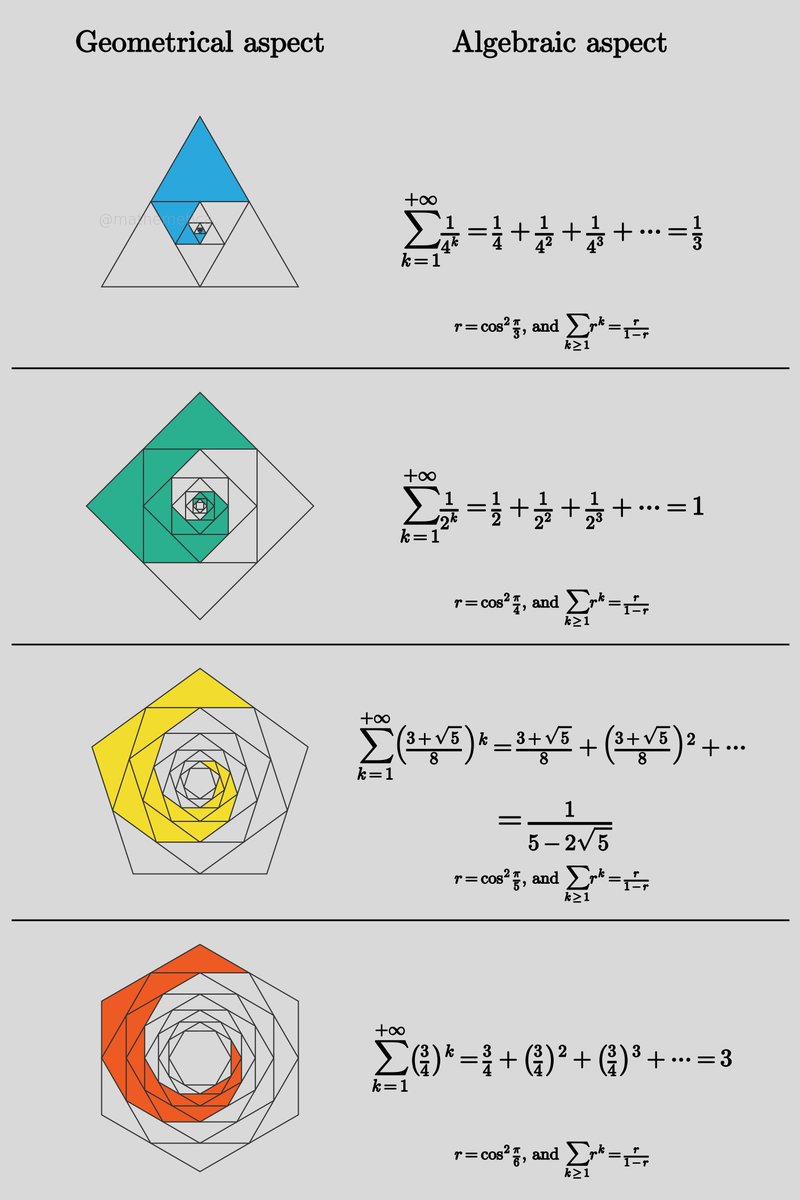
A regular polygon is a geometric series you can draw.
Join the right vertices and a smaller copy sits inside, scaled by cos²(π/n). The triangle uses 1/4, so the blue regions run 1/4 + 1/16 + 1/64 + … = 1/3. The square uses 1/2 and the spiral fills the figure exactly. The pentagon uses (3+√5)/8; the hexagon uses 3/4 and the sum reaches 3.
Each time the shaded areas total r/(1−r). The picture is the closed form.
You do not need to step outside the universe to determine whether space is curved. Geometry can reveal it from within: even the angles of a sufficiently large triangle behave differently in positively curved, flat, and negatively curved space.
In cosmology, the FLRW metric describes these possibilities through the curvature parameter k. The deeper idea is that the large-scale geometry of space can, in principle, be inferred from measurements made entirely by observers living inside it.
A twist is a rotation whose angle grows along its own axis: Tₓ(s) turns the point (x, y, z) about the x axis through the angle sx.
The face x = 0 stays put, each slice x = c turns rigidly through sc, and edges along the axis bend into helices. With s = cos θ and side 2, the far face swings through ±2 radians, about ±115°.
The map is not linear, yet its Jacobian has determinant 1 everywhere, so the twist keeps volume.
@WOS_Global I play this game 301 day. But I don't have any constant city skins. They are amazing. But too expensive! You guys must consider all kind of players.
The four partials ∂u/∂x, ∂u/∂y, ∂v/∂x, ∂v/∂y, assembled into a single determinant, record the infinitesimal area distortion of a smooth map (x, y) ↦ (u, v).
A rectangle of sides dx and dy is carried, to first order, onto the parallelogram spanned by the images of the coordinate axes; the signed area of that parallelogram is exactly (∂u/∂x ∂v/∂y − ∂u/∂y ∂v/∂x) dx dy. The same quantity converts one double integral into another and vanishes at the points where the map ceases to be locally invertible.
Carl Gustav Jacob Jacobi gave the first systematic treatment of these functional determinants in 1841.
PHYSICS ALL IN ONE:
A little bit of everything, from projectile motion and optics to electricity and radioactivity. So many different things to understand, all under one subject.
Why do atoms, planets, and 3D cameras all ignore x, y, z?
A point is just a distance r from the origin plus two angles: θ down from the z-axis and φ around it.
x = r sinθ cosφ
y = r sinθ sinφ
z = r cosθ
r = √(x² + y² + z²)
θ = arctan(√(x²+y²)/z)
φ = atan2(y, x)
Graphics, quantum orbitals, robotics, and planetary maps all use this because radial distance and rotation are the degrees of freedom that actually appear.
Cartesian axes are convenient. Spherical coordinates are often the ones nature already chose.
In 1961, Rolf Landauer showed that erasing one bit of unknown information requires at least
Eₘᵢₙ = kBT ln 2
of heat dissipated to the environment. At 300 K, that lower bound is about 2.9 × 10⁻²¹ J per bit.
The deeper idea is simple: erasing information increases the entropy of the surroundings.
🚨 Matematikçilerden yapay zekâ şirketlerine çok sert bir manifesto geldi:
Aralarında Terence Tao, Peter Scholze, Maryna Viazovska, June Huh ve Cédric Villani’nin de bulunduğu 25 Fields Madalyalı matematikçi, yapay zekâ şirketlerinin matematiği “benchmark” uğruna problem çözme yarışına çevirmesinin bilime zarar verebileceği konusunda uyardı. 👇
🧠 Mesajlarının özü şu: Matematikte önemli olan sadece bir problemin cevabını bulmak değil. Büyük problemler, nesiller boyunca yeni yöntemlerin, fikirlerin ve kavramların geliştirilmesini sağlayan “deniz fenerleri” gibi çalışıyor. Bir problemi çözmek, çoğu zaman asıl değerli olan şeyin sadece son noktası.
🤖 Fakat yapay zekâ şirketleri açısından başarı ölçütü çok daha farklı: “Kaç zor problem çözdük?” Eğer modeller ünlü problemleri art arda, devasa hesaplama gücüyle ve anlaşılması güç ispatlarla çözmeye başlarsa, matematikçiler bu problemlere ulaşmaya çalışırken keşfedecekleri fikirleri, yan yolları ve yeni teorileri geliştirme fırsatını kaybedebilir.
📚 Üstelik bir matematiksel sonucun gerçekten bilime dönüşmesi, yalnızca “ispat doğru” demekle bitmiyor. O ispatın aylarca, bazen yıllarca tartışılması, sadeleştirilmesi, başka çalışmalarla bağlantısının kurulması, yeni yöntemlerinin ayrıştırılması ve sonunda öğrencilerin bile öğrenebileceği bir bilgiye dönüştürülmesi gerekiyor.
⚠️ Matematikçilerin korkusu şu: Eğer AI sistemleri bu sürecin son ürününü saniyeler içinde seri üretmeye başlarsa, doğru cevapların sayısı artarken matematiksel anlayış azalabilir.
Yani elimizde milyonlarca doğru teorem olabilir ama onları gerçekten “anlayan”, neden önemli olduklarını bilen ve bunlardan yeni fikirler üretebilen insan topluluğu giderek zayıflayabilir.
🎓 Manifestoda çok güzel bir nokta daha var: Matematiğin en değerli iki kaynağının öğrenciler ve fikirler olduğunu söylüyorlar. İkisi de zaman, sabır, tartışma ve insan etkileşimiyle gelişiyor. Bir öğrenciye zor bir problem vermemizin amacı sadece doğru cevabı bulması değil; o problemi çözmeye çalışırken matematikçi hâline gelmesi.
🌍 Ve uyarıları sadece matematikle ilgili değil.
Aynı sorun yazarlarda, sanatçılarda, bilim insanlarında, programcılarda ve belki de yakında bütün toplumda karşımıza çıkabilir:
Eğer yapay zekâ bize yıllarca eğitim aldığımız işlerin “son ürününü” anında verebiliyorsa, o eğitimin bize kazandırması gereken düşünme biçimini nasıl koruyacağız?
🔬 Bu matematikçiler yapay zekâya karşı değiller. Tam tersine, AI’ın matematiksel araştırmayı inanılmaz hızlandırabileceğini kabul ediyorlar.
Ama soruları şu:
Yapay zekâyı bilimi hızlandırmak için mi kullanacağız, yoksa bilimin neden yapıldığını unutacak kadar hızlı sonuç üretmek için mi?
We’re sharing a solution to the Navier-Stokes Millennium Prize Problem, one of the deepest problems at the frontier of mathematics.
The proof was produced by a group of agents, using an OpenAI next-generation model significantly more capable than GPT-6 Astra.
The problem concerns whether the description of smooth three-dimensional fluid motion modeled by the Navier-Stokes equations can break down. It has remained unresolved for roughly 90 years.