@nellywhite02 It depends on why you're going: study (D-2), professional work (E-7), working holiday (H-1) and others each have their own visa, usually applied for at the Korean embassy in your country. Some nationalities can use a K-ETA instead for short visits.
@TrenchDadHQ That's a lot to carry, and the language wall makes it lonelier. One phrase that opens doors with other parents at pickup: 안녕하세요, OO 아빠예요 (Hi, I'm OO's dad), with your kid's name in place of OO. Koreans often introduce themselves this way.
@goms009 Good luck with the applications! A line that comes up a lot in Korean interviews: 열심히 배우겠습니다 (I'll work hard and learn). Humble and polite, and it lands well with most interviewers.
@snowwhhy Leaving a bad boss takes guts. If an interviewer asks why you left, this keeps it positive: 새로운 환경에서 성장하고 싶어서요 (I wanted to grow in a new environment). No need to bring up the ex-boss at all. Good luck!
Foreign workers in Korea are joining DC retirement pension plans (퇴직연금): 46,872 at end-June, up 67.5% from end-2022, per FSS data.
In a DC plan, you decide how your contributions are invested. Experts say many may leave savings in low-risk deposits.
https://t.co/lh3QpZECCz
@mitomasleftfoot That sounds exhausting, and it's really common. Two things that help many students: skim each lecture's key terms before class, and ask after class with 다시 한번 설명해 주실 수 있을까요? ("Could you explain that once more?"). Most professors are happy to.
@jagisomeol Two months already! A phrase for exactly that feeling: 시간 진짜 빨리 간다 (sigan jinjja ppalli ganda, "time really flies"). You'll hear it from friends all the time.
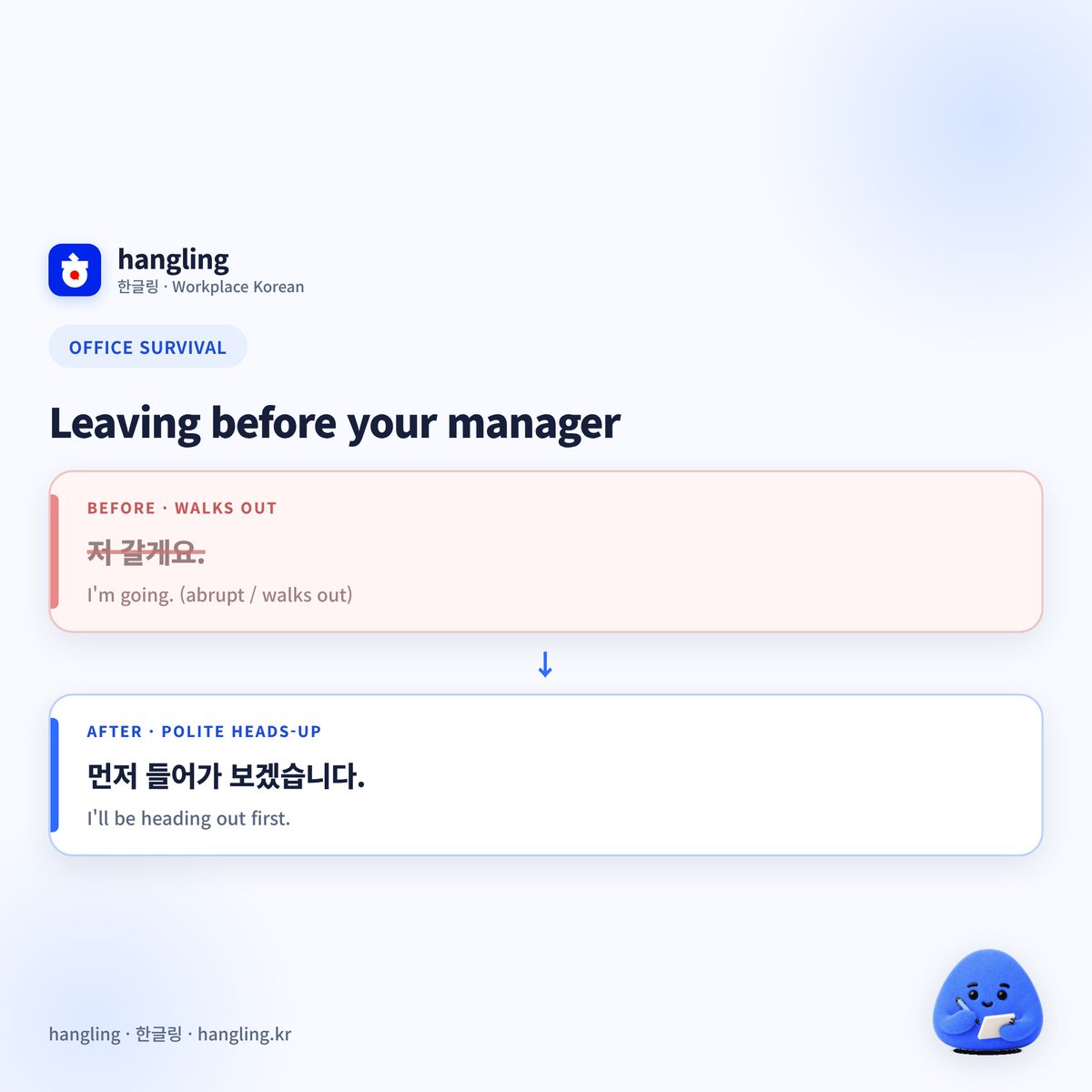
"I'm going" sounds like you're walking out. A polite heads-up sounds like a teammate.
When you head home before your manager:
"먼저 들어가 보겠습니다."
(= I'll be heading out first.)
Can you make your own work sentence with 먼저? 👇
#BusinessKorean#KoreanWorkplace
@runDEVINrun Nice! One to add when you leave: 수고하세요 (sugohaseyo, roughly "thanks for your hard work"). It's a common, friendly sign-off to staff, and people usually smile when they hear it.
@www3_coder@DevDacian Not DevDacian, but a general picture: many Korean offices are fairly hierarchical, so titles matter, like 팀장님 (timjangnim, "team leader"). Quick updates to your manager, 보고 (bogo, "reporting"), are valued, and team dinners, 회식 (hoesik), still happen, less than before.
@DevDacian Totally agree, the everyday basics are what actually get used. One that works at any restaurant or market: "이거 하나 주세요" (One of this, please).
@seomyoongi_ Fair question. A Korean degree can help: graduating from a Korean university opens the D-10 job-seeker visa, and internships there build local experience. But many postings weigh Korean level just as much (TOPIK 4+ shows up a lot). Worth checking job ads in your field first.
"My bad" stops there. Naming the fix builds trust.
When your error gets flagged:
"제가 확인이 부족했습니다. 바로 수정하겠습니다."
(= I didn't check well. I'll fix it right away.)
Can you make your own work sentence with 바로 수정하겠습니다? 👇
#BusinessKorean#KoreanWorkplace
@sseantoliver@cheromahnii It depends on your field and visa. Many job posts list Korean as a plus, so even basic Korean helps. A word you'll see often: 우대 (udae, "preferred"), like in 한국어 가능자 우대 ("Korean speakers preferred"). Also check early if a role can sponsor a work visa like E-7.
@gg_godvia1@loshmi Classic Korean office small talk. Bosses often ask about free time just to be friendly, so a short answer is fine: 주말엔 주로 쉬어요 (jumaren juro swieoyo, "I mostly rest on weekends"). Then ask back: 주말에 뭐 하세요? (jumare mwo haseyo, "what do you do on weekends?")
@hamistudy Love that post-exam motivation! One way to keep it going: pick the part the test showed was hardest, like reading speed, and do a little every day. Korean has a word for that: 꾸준히 (kkujunhi, "steadily, consistently"). Short daily practice beats one big all-nighter 😄
@paperari_ It looks scary at first, but TOPIK comes in two parts. TOPIK I (levels 1–2) is only listening and reading, with no writing, so it's a nice first goal. Past papers are free on the official TOPIK site if you want to peek at the format. 화이팅 (hwaiting, "you can do it")!