🔥🚨LATEST: This Home Development company has been facing thousands mixed feelings towards their announcement stating all of their houses will be made with Bible verses integrated into them.
As a recovering private equity associate, this is actually stunning to see (especially watch minute 1:41)
I used to get these extremely heavy files with infinite data that would take many days to make sense of, and I would spend hours and hours writing infinite =SUMIFS
Now you can actually go 0 to 95% of the way there in 30 minutes, with a perfectly linked model that anyone can take over
A private equity associate is still very much needed because you need someone knowing what you are looking for and pushing the tool in the right direction, but the joke that knowing shortcuts is a waste of time is slowly becoming reality
This is also a perfect representation of how valuable a smart associate becomes and how there will be progressively less room for mediocrity
By the way, if you have not already, try Shortcut and you will be surprised by how well the formulas are written
Marc Andreessen on how Michael Ovitz dismantled a 90-year-old industry by questioning a single assumption nobody else thought to challenge:
Ovitz started CAA in the mid-70s, walking into an agency business that had been around for decades doing vaudeville bookings and music halls. The people running it had had generations to settle into "the best way to do it." They had arrived at a set of practices that nobody questioned.
One of those practices was the morning staff meeting. Marc explains:
"At every agency, they would have their staff meeting in the morning at 9:00 AM and they would basically share whatever information was going to get shared at the agency at that point. This studio wants a script to do, he wants to do a crime thriller and here's the script and whatever. The staff meeting would go from 9:00 AM to 10:00 AM. And then at 10:00 AM, they would start calling their clients."
Ovitz looked at that and made one decision: move the meeting up two hours.
"So of course Michael's like, alright, well, we'll have our staff meeting at 7:00 AM. We'll be done at 8. Between 8:00 and 9:00, we'll call all the clients. By the way, we won't just call our clients, we'll call their clients."
Marc paints the scene:
"Imagine you're Paul Newman and you've got some agent you've been working with for 20 years and your agent calls you at 11:00. And it's like, I've got this great role. And you say, the guys at CAA called me about that three hours ago. And your agent's like, they don't represent you. And Paul's like, yeah, isn't it great? Isn't that fantastic?"
Rinse and repeat 1,000 times. To the client, the choice becomes obvious.
The deeper lesson is about who runs companies long enough to challenge their own foundations. By the time Ovitz showed up, the founders of the legacy agencies had been gone for decades. The people running them were managers, not founders. As Marc puts it:
"The thing a manager never does unless they're under duress is reconsider fundamental assumptions. They hate that. That's not the whole point of running something big. You don't have to do that. You get to run the big thing at scale. You don't have to go in and reinvent it from scratch. That sounds like a nightmare."
So you end up with embedded assumptions that made sense in 1930 or 1970 and just don't anymore unspoken, unquestioned, sitting there for anyone willing to go back to first principles.
Ovitz didn't outwork an industry by being smarter about talent. He outworked it by being the only person in the room willing to ask why the meeting was at 9 instead of 7. The competitive edge was hiding in plain sight, protected by nothing but inertia.
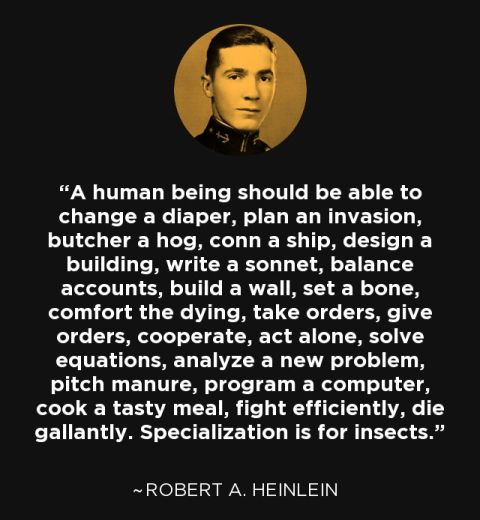
In 1973, Robert Heinlein put a line in a novel I've never been able to shake.
In Time Enough for Love, a character who's lived 2,000 years rattles off a list of what a human should be able to do (change a diaper, plan an invasion, butcher a hog, build a wall, program a computer and so on)
It ends with: "Specialization is for insects."
The thing about Heinlein is he lived an incredibly varied life that embodied the “competence across domains” principle.
He graduated from the Naval Academy, served in radio comms aboard aircraft carriers, ran for California State Assembly, worked as a Navy engineer during WWII … and then became one of the most influential science fiction writers of the 20th Century.
I've found it useful to learn enough across different areas that I'm not completely stuck when something goes wrong.
I can write software, weld, read wiring diagrams, paint a wall, retile a bathroom, change a propane tank, run financial models, fix a toilet, plant a tree, maintain beehives, invest across asset classes, do 10 pull ups, run a marathon.
None of this makes me a mechanic, or an electrician, or a farmer, or an athlete of course. But it does make me a guy who's slightly less useless in more situations than he used to be. And that adds up over the years.
When a deal comes across my desk, I can run the numbers myself instead of taking someone else's word for it. When a piece of equipment breaks, I can take a stab at fixing it. When I need to play pickup basketball with my sons, I can hold my own.
You can essentially collapse the whole quote to “become a well-rounded person who can figure stuff out”.
It’s not like you’ll be great at everything.
But you can become someone who’s not completely dependent on others for every single thing that breaks.
Elite feeder schools dominate Ivy League admissions and have long served as the primary pipeline for both old money and new money students. These are the institutions where America’s most elite families send their children to prepare for their future roles in society — far beyond mere education.
Roughly 20 high schools consistently send more students to Ivy League colleges than most others combined.
America’s wealthiest families have long funneled their children into these schools, many of which have been reliable Ivy League feeders since the 1600s and 1700s.
Robert Greene ha vendido +20M de libros estudiando una sola cosa:
por qué unas pocas personas encuentran su propósito y la mayoría muere sin descubrirlo.
Tuvo una charla de 3 horas con Huberman sobre propósito.
Te lo resumo en 7 pasos:
1. Vuelve a tu infancia
On July 5, 2024, after nearly 30 years as a working economist and market analyst, I launched Meadowdale Capital. My fund has achieved a 589.0% absolute return in 19 months.
Here’s how I did it.
One of the greatest gifts of pursuing an entrepreneurial career is how it forces you to to overcome two of life’s most destructive forces—fear and pride
You do this by having a bias towards action + a willingness to be wrong but learn
Good one from @BrentBeshore!