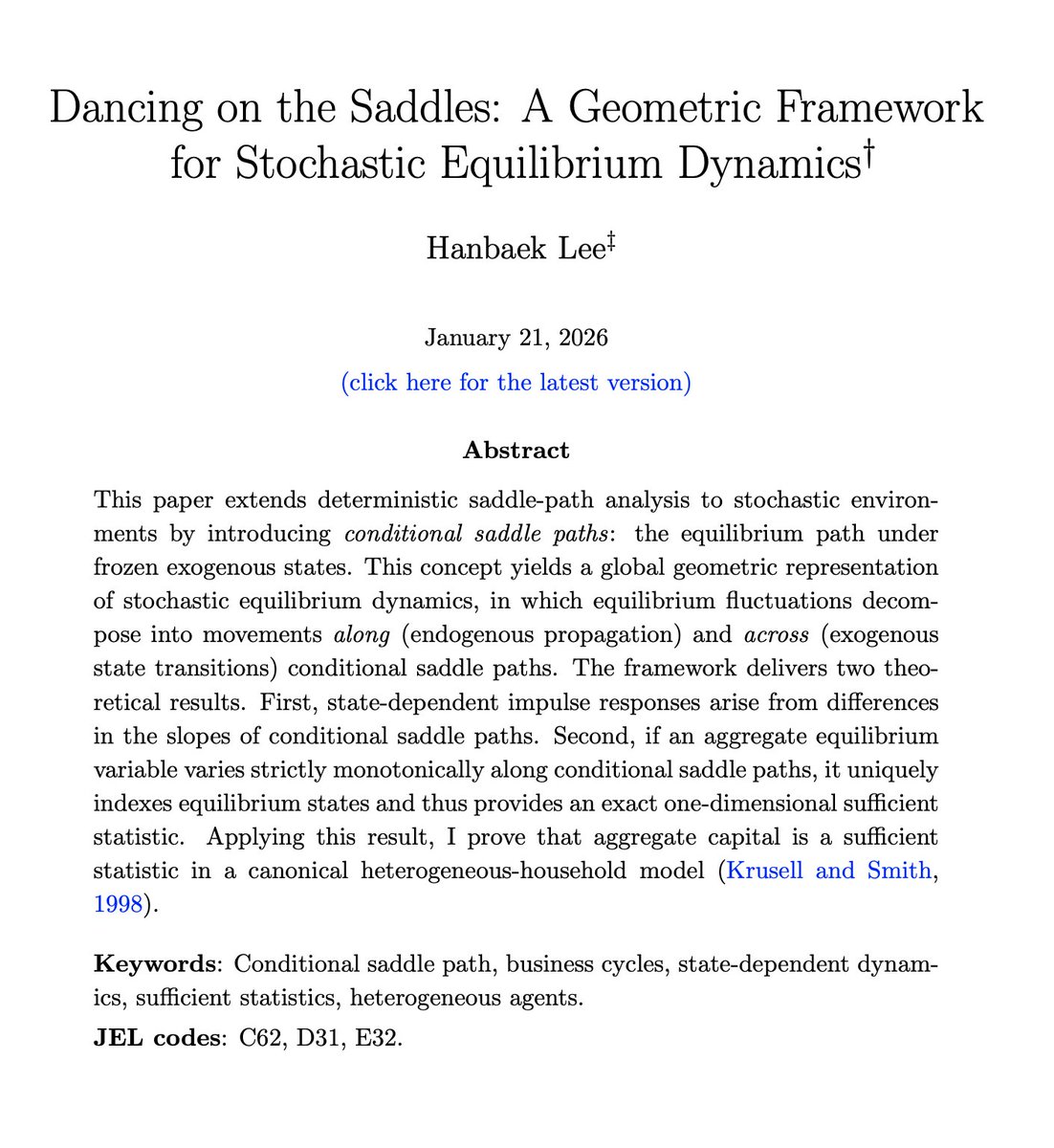
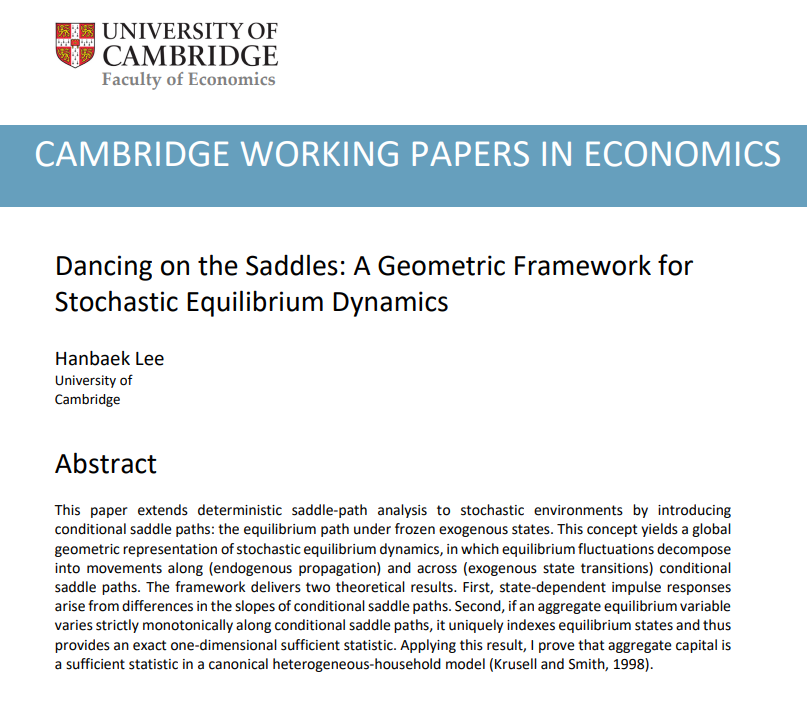
🚨 New working paper: 🕺 Dancing on the Saddles
1/ Solow and Ramsey-Cass-Koopmans gave us phase diagrams to visualize growth dynamics.
But we lack a systematic counterpart for stochastic environments. I extend saddle-path analysis by introducing "conditional saddle paths."
Forthcoming article "Striking While the Iron is Cold: Fragility after a Surge of Lumpy Investments" by @HanbaekLee@EEANews@OUPAcademic
Teaching materials available: https://t.co/tCzfSWh4Lu
https://t.co/jvS1LuP5eT
The VFI-Toolkit can now solve models with heterogeneous agents and aggregate shocks. Still in beta. It relies on Hanbaek Lee’s Matched-Expectations Path algorithm @vfitoolkit@HanbaekLee
👇
https://t.co/ghNIcKVEo9
@mean_field_zane Hi @mean_field_zane, I've been working on a related angle (endogenous cycle frequencies pinned by market-structure primitives): https://t.co/KE57yUHFnr
Comments are welcome!
What is the stochastic counterpart to the Solow/Ramsey phase diagram? NEW WP by @HanbaekLee@CamEcon : “conditional saddle paths” give a geometric characterization of aggregate fluctuations and explain why K works in Krusell–Smith. ➡️https://t.co/cda8UdqAF2
#econtwitter
Thanks, Pontus! @pontus_rendahl Yes, very related. Your work derives an aggregate LoM from structure in individual policy rules (linearity in k ⇒ a parametric aggregate mapping / AR-type LoM for K). In my language, that’s the kind of setup that makes the conditional saddle path extra tractable and can push the regime-to-regime “gap” toward being close to state-independent (i.e., the geometry becomes close to a translation/parallel shift).
🚨 New working paper: 🕺 Dancing on the Saddles
1/ Solow and Ramsey-Cass-Koopmans gave us phase diagrams to visualize growth dynamics.
But we lack a systematic counterpart for stochastic environments. I extend saddle-path analysis by introducing "conditional saddle paths."