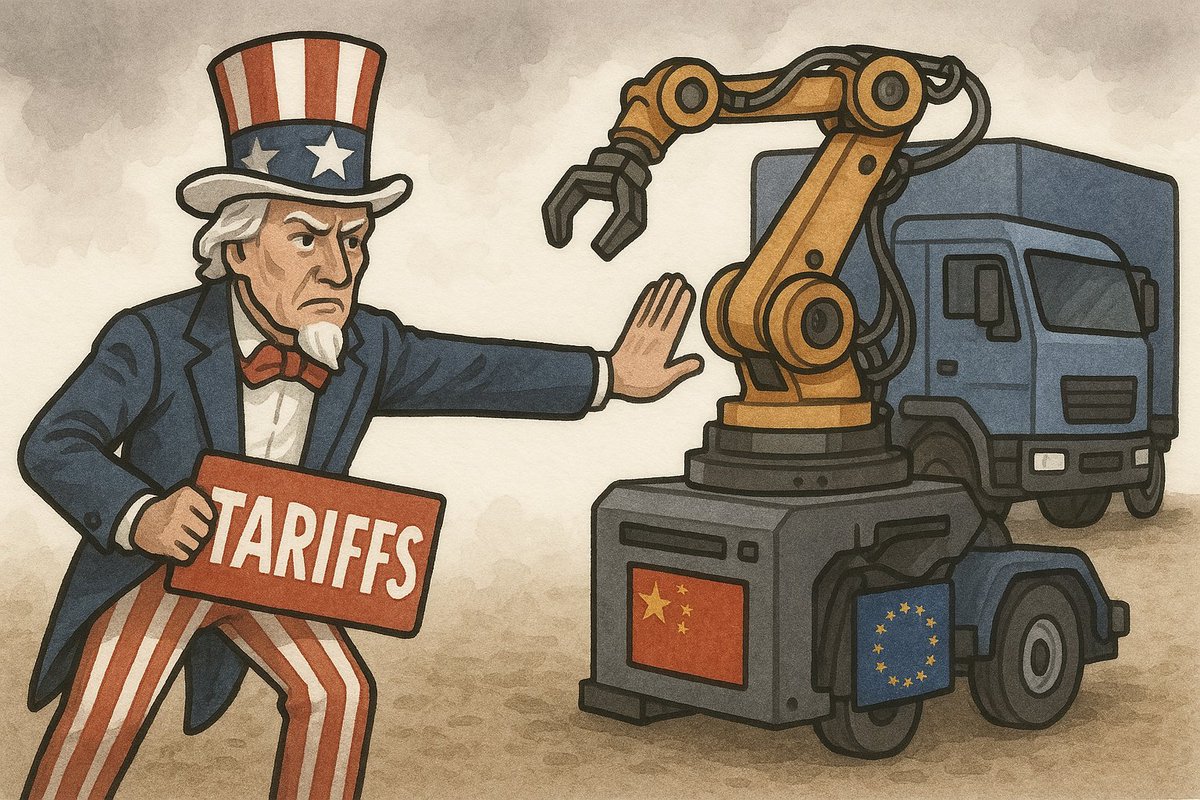
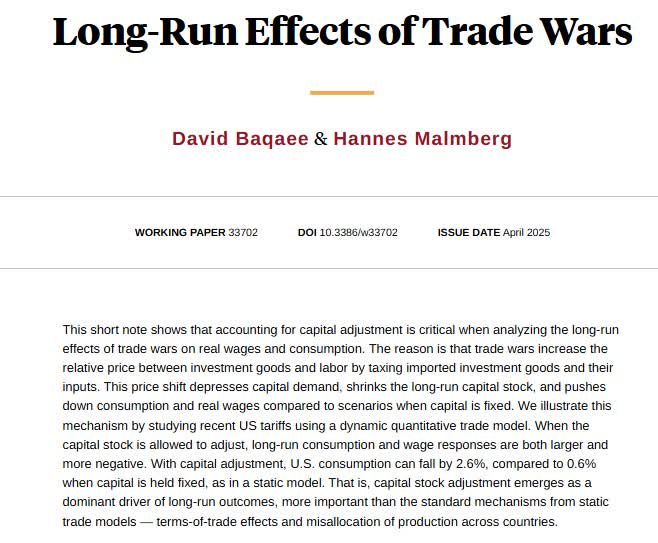
What are the long-run consequences of trade wars on real wages and consumption? In a new note, @DBaqaee and I show that capital adjustment matters a lot. Trade barriers raise the cost of investment goods, capital stocks shrink, and so do consumption and wages.
@Afinetheorem@alexolegimas My reading is that most tests need to hold the task constant. In this case, ceiling effects naturally dampen inequality. The inequality instead comes when high-skilled agents suddenly can insource lots of tasks and get synergy.
@lugaricano By this standard, the EU gets it backwards, arguably enforcing regulatory harmonization more than actual free trade. Envision, say, the AI adoption patterns with national regulations and truly free service trade!
@lugaricano Free trade furnishes elastic demand, which means that superior technology raises rather than reduces factor demand. Thus, if the area of free trade exceeds the area of regulatory jurisdiction, the technology blocking equilibrium crumbles. https://t.co/mOHycnlxZC
@BrianCAlbrecht@lugaricano However, the best model might be that the government imposes a labor cost to acquire a quota, with heterogeneous costs for foreigners and domestic people. This correctly predicts positive rents flowing to domestic people which are able to snap up a quota on the cheap.
@BrianCAlbrecht@lugaricano Interesting question! One test: what's invariant under changes to other things? If the barrier is language in legal documents, I guess costs are invariant and it's a wedge. If the barrier is "whatever it takes to keep them out", quantities are invariant and it's a quota.
@paulnovosad Similarly, dramatically raising the probability of having my parents and then myself living to 95 in good health would be extremely, extremely, valuable.
@paulnovosad This is especially true for professionals. On the material side, I wouldn't mind too much being an academic in Minneapolis in 1900.
But only extreme wealth could compensate for risk of kids dying, losing friends pre-60 to infections, and suffering debilitating toothache.
Tariffs raise the price of investment goods relative to labor and depress the long-run capital stock, reducing long-run real consumption and wages, from @Dbaqaee and @hannesmalmberg1 https://t.co/fWGfwTYGE7
@GuthmannR@StefanFSchubert I wonder if there's something funky going on with price indices in the service sector. Quality-adjustment is conspicuously hard there, so if you do high-quality stuff there you might be screwed over by the ICP.
@StefanFSchubert@GuthmannR So if Japanese buy as many cars as Americans, they either have a higher budget share or go for smaller cars, not because they earn more.
@StefanFSchubert@GuthmannR According to OECD (https://t.co/TiIiCfGqRr), average annual salaries are 4.9mn yen, while annual salaries in the US are $80,115. I.e., a Honda CR-V costs 85% of a Japanese salary and and 40% of a US salary.
@labenz Surprisingly dumb when I tried it. I wondered if the issue with your example was the picture and gave a formal encoding. It reasoned it through and missed spectacularly..
@gmiller@jessesingal Given that the administration does not accept orders to stay a deportation to an El Salvadoran prison, and claim it is impossible to get people back, lack of due process here means a right to arbitrary imprisonment. Why not "an administrative mistake" with a US citizen as well?
@gmiller@jessesingal Lots of stuff to reduce litigation costs. E.g., offer plea bargins for people to accept offer straightaway and require bond posting / detention if they ask for trial.
And even if you're willing to lower due process requirements for deportations, labor camps are another beast.
@Simon_Mongey@SorryToBeKurt (And again, not against wedges in general, just saying that once you decentralize in multiple ways, it helps understanding the role of decentralization strategies. E.g., exogenous wedges = endogenous quotas and vice versa.)
I hope this paper breaks the tyranny of wedges.
E.g, why is density low in Palo Alto?
Wedge-speak: as-if "tax" on construction, invisible in accounting.
Quota-speak: quota on construction, with rents to people with quotas.
Liberation day from uninterpretable abstraction!
Many distortions can be seen as implicit or explicit quotas that fix quantities independent of prices—think local content rules, zoning laws, H-1B caps, capital controls, or missing markets.
In a new paper, @DBaqaee and I analyze such quotas in general equilibrium. 1/5
@Simon_Mongey@SorryToBeKurt I guess my take is that if we have a concept that invites misinterpretation to the extent that we constantly have to remind others and ourselves not to misinterpret, things that expand our conceptual toolbox can be very valuable.