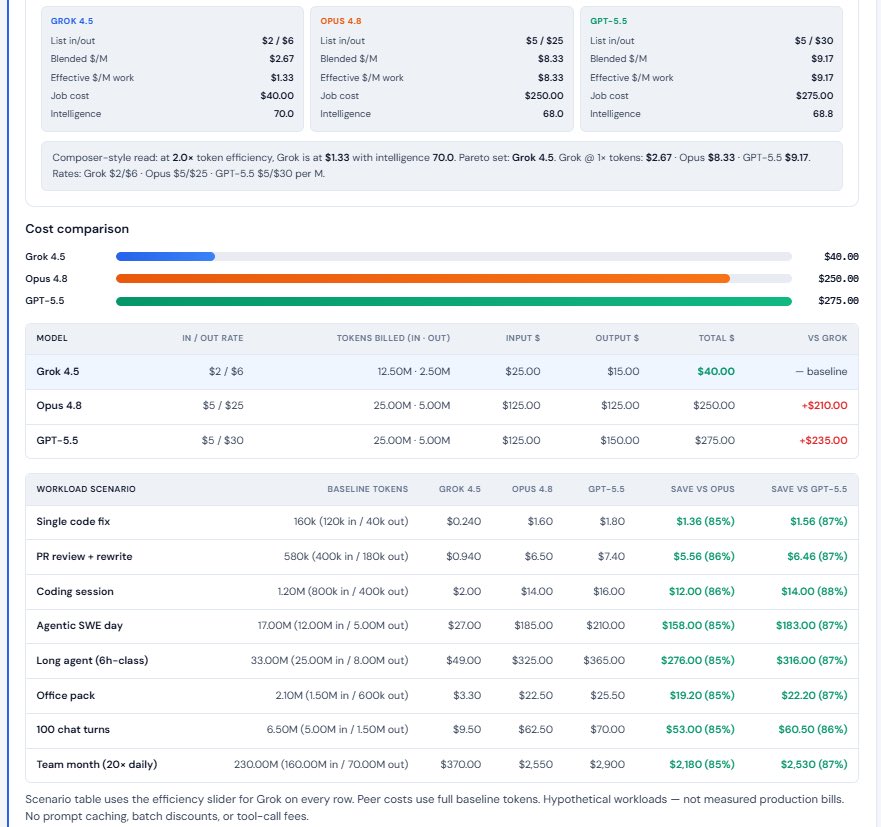
Grok 4.5.
Pareto dominant for coding by the numbers.
We will see on the all-important vibes.
Instinct is the benchmarks are likely directionally accurate given the stated focus on real world utility.
@CJHandmer I think that one of the biggest levers we have to exercise agency (or impart the ability to exercise agency in children) is to have/teach an effective process for short circuiting the power that we allow fear to have in our decision making process.
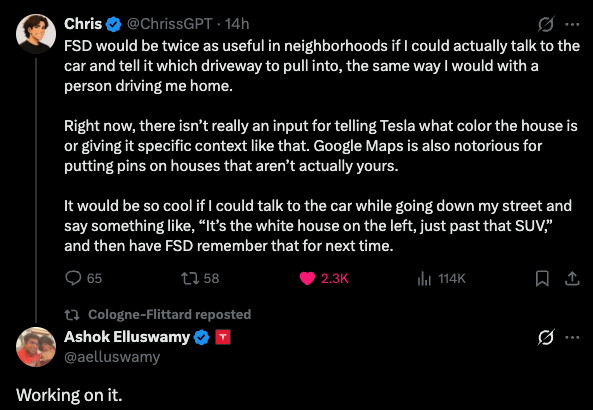
Ashok has an incredible track record of delivering on his commitments.
If he says they're working on it, that's a big deal.
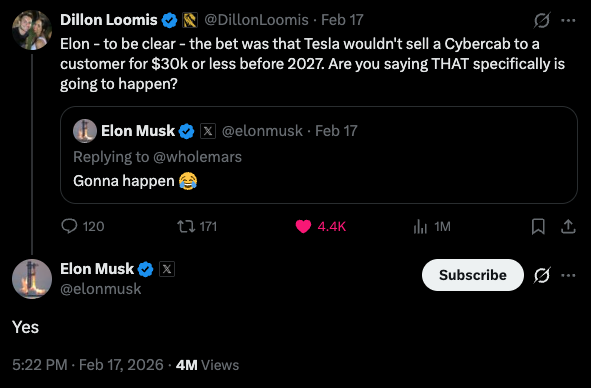
It's not a deadline, but it is the obvious next goal post.
@mikepat711@elonmusk@MKBHD IDK. Maybe. Maybe not.
All it would take is a delivery event to a few handpicked buyers.
So I'm not counting Elon & Tesla out yet.
I still think @elonmusk should sell the first Cybercab directly to @MKBHD and they should make an official collab video of the delivery, review, and head shaving.
Maybe Elon should even join him in the head shaving and they can use it as a fundraiser for charity.
What do y'all think?
FSD v14 Lite is now rolling out to AI3 early-access customers. Based on the feedback, will rollout to more customers over the next few weeks.
This build distills the driving behavior from AI4’s v14 series into both the camera and compute config of AI3. It includes destination options and speed profiles on city roads, but more importantly significantly improved safety.
We hope you’ll enjoy it, once the build ships wide.
@MattsterT3@OpenAI@AnthropicAI Token efficiency will definitely be one of the areas where real engineering work will be required, but not insurmountable task once the data becomes available.
This is the MOST DEVASTATING development in the fight against AI totalitarians ever.
It makes "the Deepseek moment" look like child's play.
In a world where closed source labs like @OpenAI, and @AnthropicAI collude with the USG to create a cartel of central planning for cutting edge models, this brilliant end around promises to upend everything that the AI monopolists (looking at you @DarioAmodei) are working towards.
The problem with 1 super powerful frontier MoE model is that it has a single throat to choke.
This leads to inescapable internal handwringing (ie. Anthropic), as well as external handwringing (ie. CCP and USG) that inevitably gates frontier AI access to us, the unwashed compute plebs.
The dominant thinking in the sovereign AI community up to this point has been mere imitation of the closed source frontier labs.
Big, monolithic MoE models made entirely in house by a single lab, just with openweights and maybe open training protocols.
Then add in a pinch of quantization and a dash of local hardware for good measure.
And since none of these companies have the resources of closed source frontier lab, their models are always behind.
It's an almost guaranteed recipe for failure. And even if it did work, it still suffers from the single throat to choke problem.
The answer?
Mixture of AGENTS (MoA).
A standardized framework for combining DIFFERENT MODELS from DIFFERENT LABS into one ultra powerful synthetic model. Think of it like the Voltron of AI models.
In this context, individual models with distinct strengths become subcomponents of larger, integrated system of AI that is far more capable than any monolithic model could ever hope to be.
And since no one company is responsible for the performance/capability of the whole open MoA ecosystem, there is no single throat to self-censor or choke by force.
As this approach matures, different labs can specialize in individual capabilities that can be contributed to disaggregated MoA ecosystem, allowing a whole host of startups and open source AI labs to pool their resources and talents in the battle against centralized AI planning.
And the beauty of this approach is that it doesn't matter one bit if the individual labs or models that contribute to and/or participate in the MoA ecosystem are open source or closed source.
Both approaches are welcome.
Everything is composable, and the operation of master synthetic model is resilient to single points of failure at the individual model/provider level.
Screw the AI commies!
Reseize the means of reasoning.
Power to the people!
Thank you @NousResearch for your tireless work to bring the full power of frontier AI to the masses.
The strongest models are gated and access is granted only to a select few.
Hermes Agent now exposes MoA presets as virtual models, giving you capabilities beyond the publicly available frontier: 8% higher than Opus 4.8 and 11% higher than GPT 5.5 on our upcoming benchmark.
This is the MOST DEVASTATING development in the fight against AI totalitarians ever.
It makes "the Deepseek moment" look like child's play.
In a world where closed source labs like @OpenAI, and @AnthropicAI collude with the USG to create a cartel of central planning for cutting edge models, this brilliant end around promises to upend everything that the AI monopolists (looking at you @DarioAmodei) are working towards.
The problem with 1 super powerful frontier MoE model is that it has a single throat to choke.
This leads to inescapable internal handwringing (ie. Anthropic), as well as external handwringing (ie. CCP and USG) that inevitably gates frontier AI access to us, the unwashed compute plebs.
The dominant thinking in the sovereign AI community up to this point has been mere imitation of the closed source frontier labs.
Big, monolithic MoE models made entirely in house by a single lab, just with openweights and maybe open training protocols.
Then add in a pinch of quantization and a dash of local hardware for good measure.
And since none of these companies have the resources of closed source frontier lab, their models are always behind.
It's an almost guaranteed recipe for failure. And even if it did work, it still suffers from the single throat to choke problem.
The answer?
Mixture of AGENTS (MoA).
A standardized framework for combining DIFFERENT MODELS from DIFFERENT LABS into one ultra powerful synthetic model. Think of it like the Voltron of AI models.
In this context, individual models with distinct strengths become subcomponents of larger, integrated system of AI that is far more capable than any monolithic model could ever hope to be.
And since no one company is responsible for the performance/capability of the whole open MoA ecosystem, there is no single throat to self-censor or choke by force.
As this approach matures, different labs can specialize in individual capabilities that can be contributed to disaggregated MoA ecosystem, allowing a whole host of startups and open source AI labs to pool their resources and talents in the battle against centralized AI planning.
And the beauty of this approach is that it doesn't matter one bit if the individual labs or models that contribute to and/or participate in the MoA ecosystem are open source or closed source.
Both approaches are welcome.
Everything is composable, and the operation of master synthetic model is resilient to single points of failure at the individual model/provider level.
Screw the AI commies!
Reseize the means of reasoning.
Power to the people!
Thank you @NousResearch for your tireless work to bring the full power of frontier AI to the masses.
The strongest models are gated and access is granted only to a select few.
Hermes Agent now exposes MoA presets as virtual models, giving you capabilities beyond the publicly available frontier: 8% higher than Opus 4.8 and 11% higher than GPT 5.5 on our upcoming benchmark.
NHTSA: Pedals Are So 2025! Tesla Semi Variants, Starlink & Zoox Exposed | Tesla Beat #149 w/ @sjvtesla@futureaza Guest @hanscnelson https://t.co/KmHibIxX7K
This statement is ONLY TRUE IF you omit the hidden cost of the value of the training data that you surrender to Anthropic & OpenAI by using Opus 4.8 &/or GPT-5.5.
For a lot of applications, that IF makes it a no brainer to use GLM-5.2.
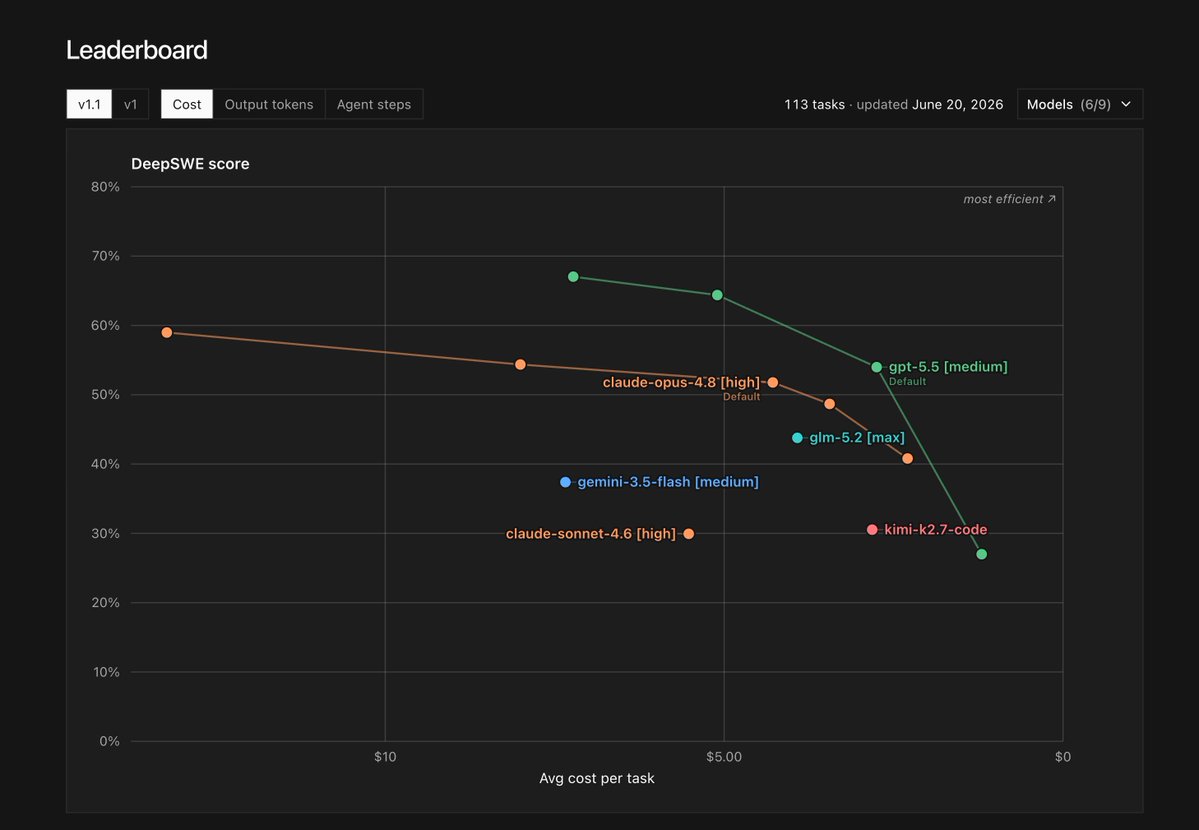
I see a lot of people hyped about GLM-5.2. Rightfully so! Having an open weight model surpass GPT-5.4 and every Gemini model is dope.
That said - it's not cheap. Both Opus 4.8 and GPT-5.5 set to "medium" are cheaper and smarter than GLM-5.2