Political Economy, Political Communication; University Excelsior Chair @NTU_TW; Associate Dean/Yageo Prof of Political Economy @ntu_spe; formerly @Harvard
Back in 2021, Yuko Yuko Kasuya and I had the pleasure of working together on a research worksop on the Contentious Politics and Democracy in Asia for our V-Dem regional center, which later led to a special issue on the 2019 Hong Kong protests with JJPS.
We hope this workshop will be a space for thoughtful exchange, new connections, and supportive conversations across fields and career stages.
Please consider submitting an abstract by 31 July 2026, and feel free to share this call widely.
Building on our kick-off workshop this April, this is not quite a manifesto, but rather a joint statement that sets out a clear roadmap for where the project is headed.
I learned a great deal from everyone involved and came away energized by the ideas that emerged from the workshop. I’m very much looking forward to the next stage of the project!
Although prior commitments in Taipei prevented me from traveling to Oslo for our kick-off workshop, I was very grateful to the project partners for their flexibility in enabling me to participate virtually.
Despite the time difference, I was able to join the main sessions and give a short presentation on what AI can and cannot achieve in authoritarian regimes, drawing on my own research.
While it took a bit longer than expected to finalize this agreement on both ends, I’m grateful for the opportunity and excited to begin a new chapter in my research~
At a time when AI is posing new challenges to academic publishing, I look forward to working with fellow board members to build on the journal’s strong tradition and to explore ways of ensuring peer-reviewed publication remains relevant and valuable to colleagues across academia.
How useful is Claude Code's 1 million context window for academics?
Yesterday, I tried pushing Claude Code to do a literature review of as many as @DAcemogluMIT 's papers as would fit in context.
Here's what I learned:
> CC will try to "get around" actually fitting the full text of papers into its context. It did this silently by reading parts of some papers (often the first 20 pages) and none of other papers, and only revealed it did this after I pressed it after being puzzled by some behavior.
> However, the implied token usage by even reading the first 20 pages of many papers should have been much higher. I'm still not 100% sure what's going on - either some sort of auto compaction, or it's just lying.
> I got it to "spend" more tokens by first extracting the text from PDFs (imperfectly), and then reading the text directly rather than doing an operation on the PDF.
> Context visualization from /context seems broken. After going through this exercise, it shows 481k tokens used, but 962k free space remaining.
> I don't see this *at all* as replacing reading papers. The bottleneck is still *human* understanding. I think of the output as a rough map I do not fully trust, but which nevertheless speeds up the pace at which I can understand papers.
> I think the optimal approach is something like this:
1. Do a full text extraction with a dedicated skill per paper, one subagent per paper.
2. Use other sets of subagents to do specific types of summaries analyses per paper.
3. Use a final agent or set of agents to combine those summary analyses in a way particular to you.
> I also think there are going to be gains from experimentation combining CC/Codex, perhaps Gemini, and also - if you have lots of $ - gpt 5 pro by API via opencode.
Made a YouTube video on the new 1M Context - https://t.co/JDLbZSu8JS - the exercise with Acemoglu's papers starts about 4 minutes in
the two literature review pdfs I produced in the exercises are her - https://t.co/2DtnJT062P
@jayckao@apsrjournal Congrats again! This really puts Taiwan on the map in the broader literature on how partisan media landscapes can fuel political polarization!
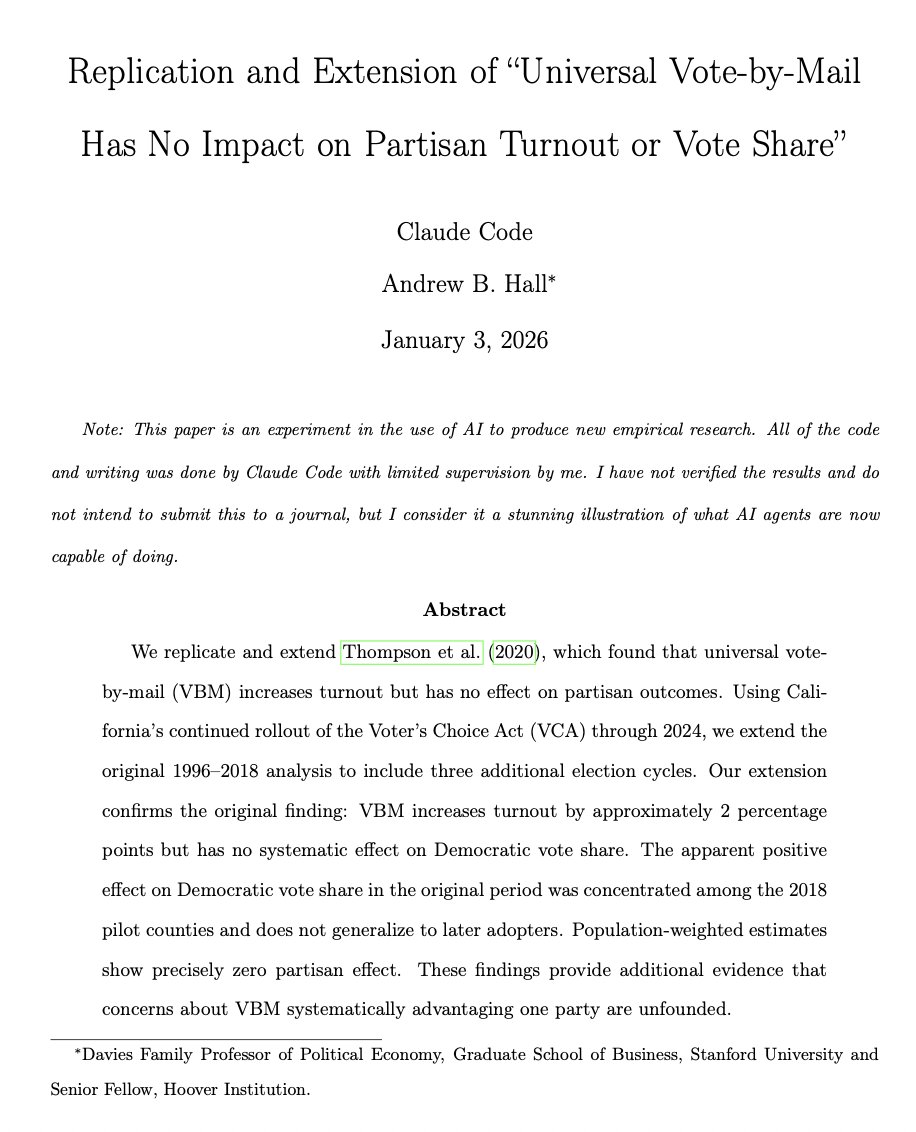
Here's proof that Claude Code can write an entire empirical polisci paper.
To validate my claim that AI agents are coming for polisci "like a freight train", today I had Claude Code fully replicate and extend an old paper of mine estimating the effect of universal vote-by-mail on turnout and election outcome...essentially in one shot.
After careful prompting, Claude Code:
(1) Downloaded the old paper's repo and replicated the past results, translating our old Stata Code into Python
(2) Crawled the web to get updated official election data and census data
(3) Ran new analyses extending the results through 2024
(4) Created new tables and figures
(5) Performed a lit review
(6) Wrote a wholly new paper
(7) Pushed the whole thing to a new github repo
The whole thing took about an hour.
This is an insane paradigm shift in how empirical work is done.
It also validates the point that several people including @BrendanNyhan made yesterday---it's going to be especially easy to scale observational research with AI.
Thanks to @alexolegimas, @arthur_spirling , and many others who gave me feedback. .
Only a political sociologist with such deep experience investigating structures, groups and processes as Theda Skocpol can give us such a comprehensive summary of what’s happening in academia and politics in the U.S. https://t.co/KmS0ZsKs76