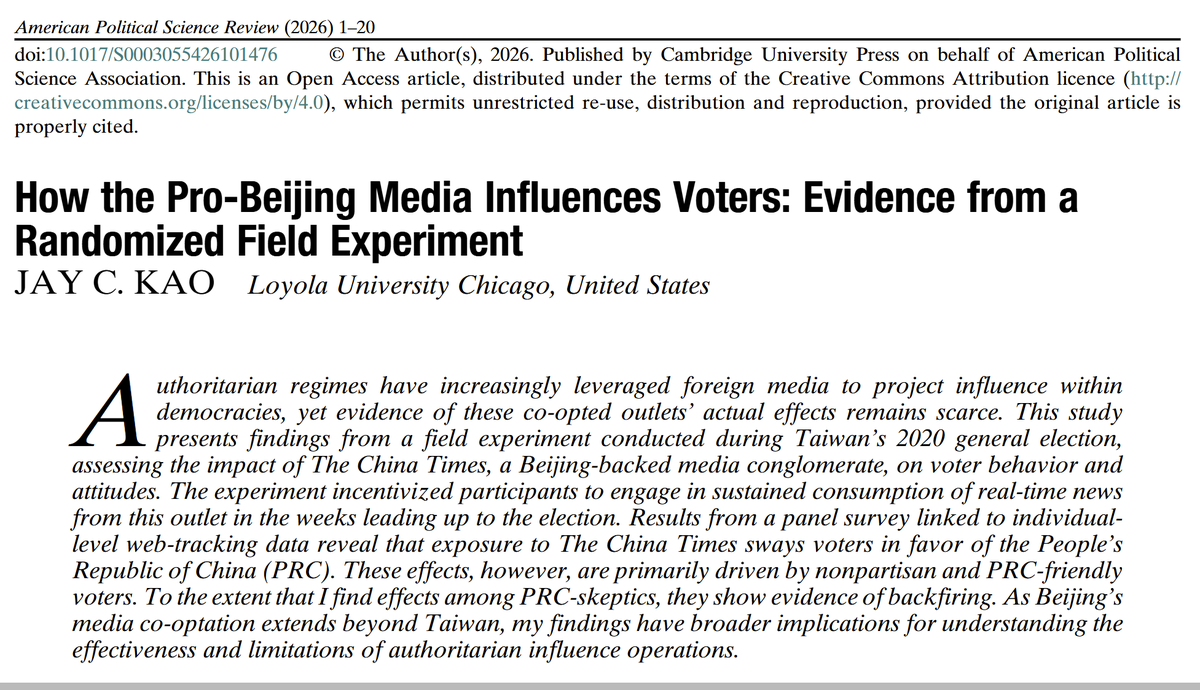
Very excited to share that my paper, "How the Pro-Beijing Media Influences Voters," is now live at @apsrjournal. I examine how a major Beijing-backed outlet affects voter behavior and attitudes in Taiwan. Happy to see Taiwan on the pages of APSR!
Article: https://t.co/cBv361ekVO
Do elite colleges help talented students from modest backgrounds join the social elite or help incumbent elites retain their positions?
NEW in the American Economic Review, by Andrés Barrios-Fernández, Christopher Neilson, and Seth Zimmerman: https://t.co/KvjCwvYlWN
New @AnthropicAI post on how social scientists use coding agents. Political scientists lag economists, but rely on agents more than psychologists and sociologists do. Productivity gains are not translating into journal submissions.
https://t.co/aaC5mouhI6
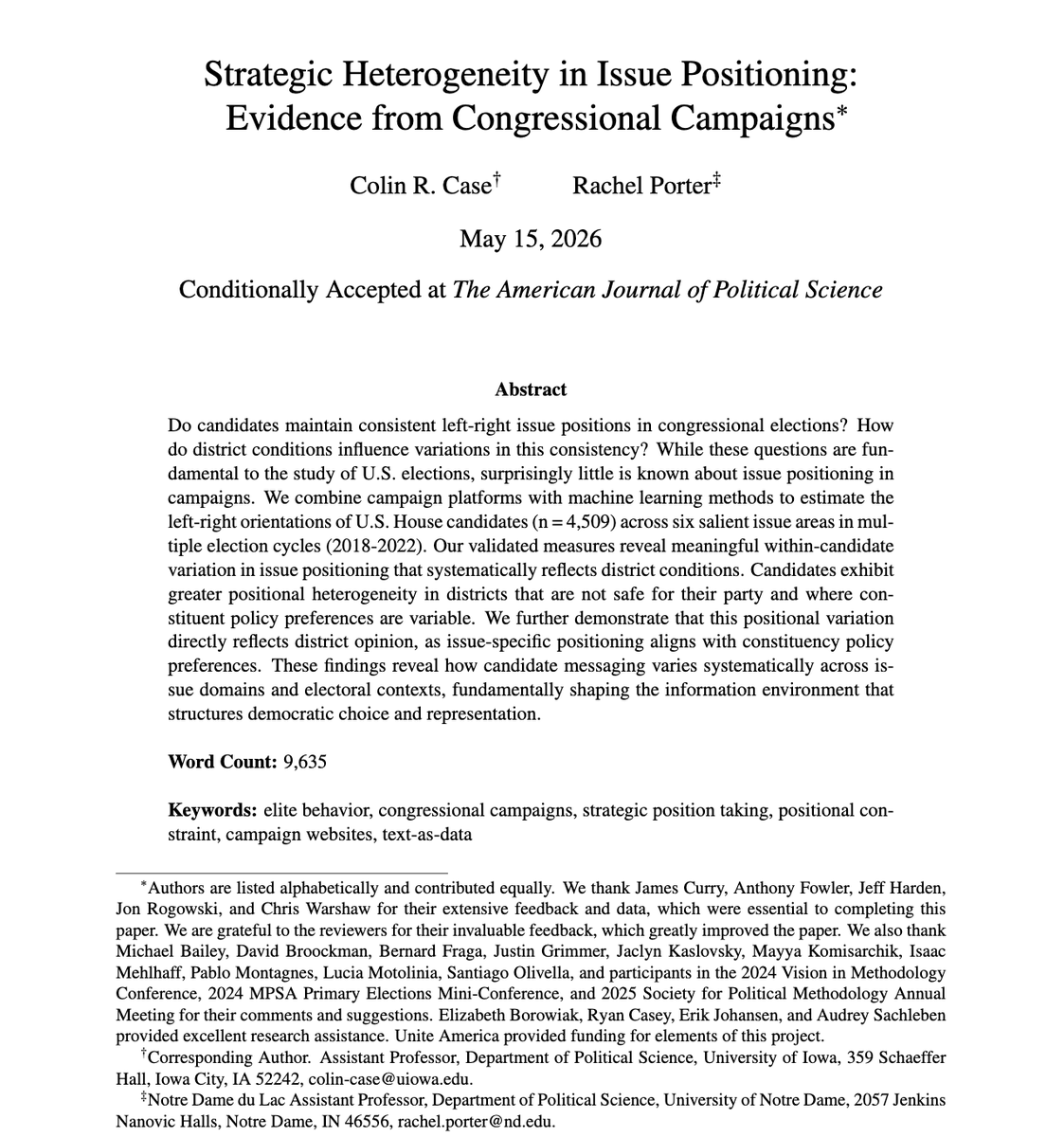
Very excited that my paper with @colinrcase has been conditionally accepted for publication at @AJPS_Editor!
Using our CampaignView data, we produce measures for candidates' left-right positioning across six salient issue areas
Big takeaways below ⬇️⬇️
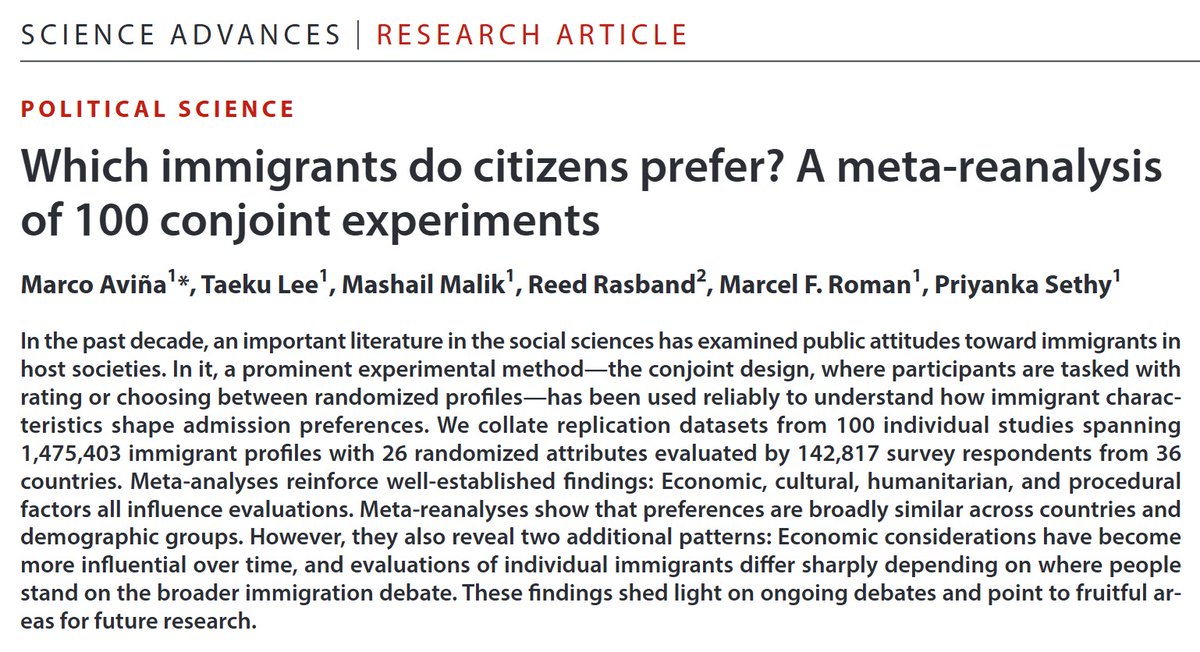
NEW in @ScienceAdvances, after 3 years of work with a great team:
We review and meta-analyze 100 immigrant conjoint experiments in 36 countries.
Immigration preferences are surprisingly similar across people and countries, but changing over time and structured by politics.
🧵
I made a public guide for preparing social science replication packages 📦
It includes prompts for Codex/Claude Code 🤖
https://t.co/X6apuxJRfY
Please repost if this might help researchers preparing replication materials.
I was talking to an economics Assistant Professor today frustrated with the profession. A few years into his job and he's struggling with the last mile of his papers & trying to get them published in the right places. He said it'll get better. The problem: he's only partly right.
🚨The Toronto Political Behaviour Workshop is back for its 12th edition! Join us on Nov. 13–14, 2026, at @UofT! We welcome paper/poster proposals on any topic in political behaviour, broadly defined!
📅 Submission Deadline: July 11.
Apply here: https://t.co/LK1CEFrxoG
Read our chapter here! https://t.co/p9OmT4W29O
The key claim: "AI is more likely to reinforce existing patterns of [information] exposure and behavior than it is to transform how people understand and relate to the political world"
(with @jenjpan, @aasiegel, and @YamilRVelez)
New Faces in Chinese Politics Conference
MIT, September 1-2, 2026
Application materials due by May 22, 2026
We invite advanced PhD students and post-doctoral fellows who study Chinese domestic and international politics to apply for the sixth New Faces in Chinese Politics Conference at MIT on September 1-2, 2026, just before the APSA annual meeting in Boston. The New Faces in Chinese Politics Conference is an opportunity to get feedback on job market papers and job talks with peers, conference co-organizers, and invited senior scholars.
The papers should be based on original, rigorous research, employing quantitative or qualitative methods. The in-person conference is open exclusively to job market candidates for the 2026 job market. Successful applicants are fully funded for travel, lodging, and food.
Applicants must submit a curriculum vitae, a full job market paper or dissertation chapter (for chapters, we would prefer an empirical chapter with a short summary of the theory), and a letter of support from the dissertation committee chair. Application materials are due by May 22 via email attachment to [email protected]. Applicants should put their full name in the subject heading of the email.
The letter of support should be emailed separately to that address and should endorse the applicant’s decision to be on the job market in 2026, with the subject heading including the full name of the applicant.
Fiona Cunningham, University of Pennsylvania
Iza Ding, Northwestern University
Taylor Fravel, Massachusetts Institute of Technology
Melanie Manion, Duke University
Yuhua Wang, Harvard University
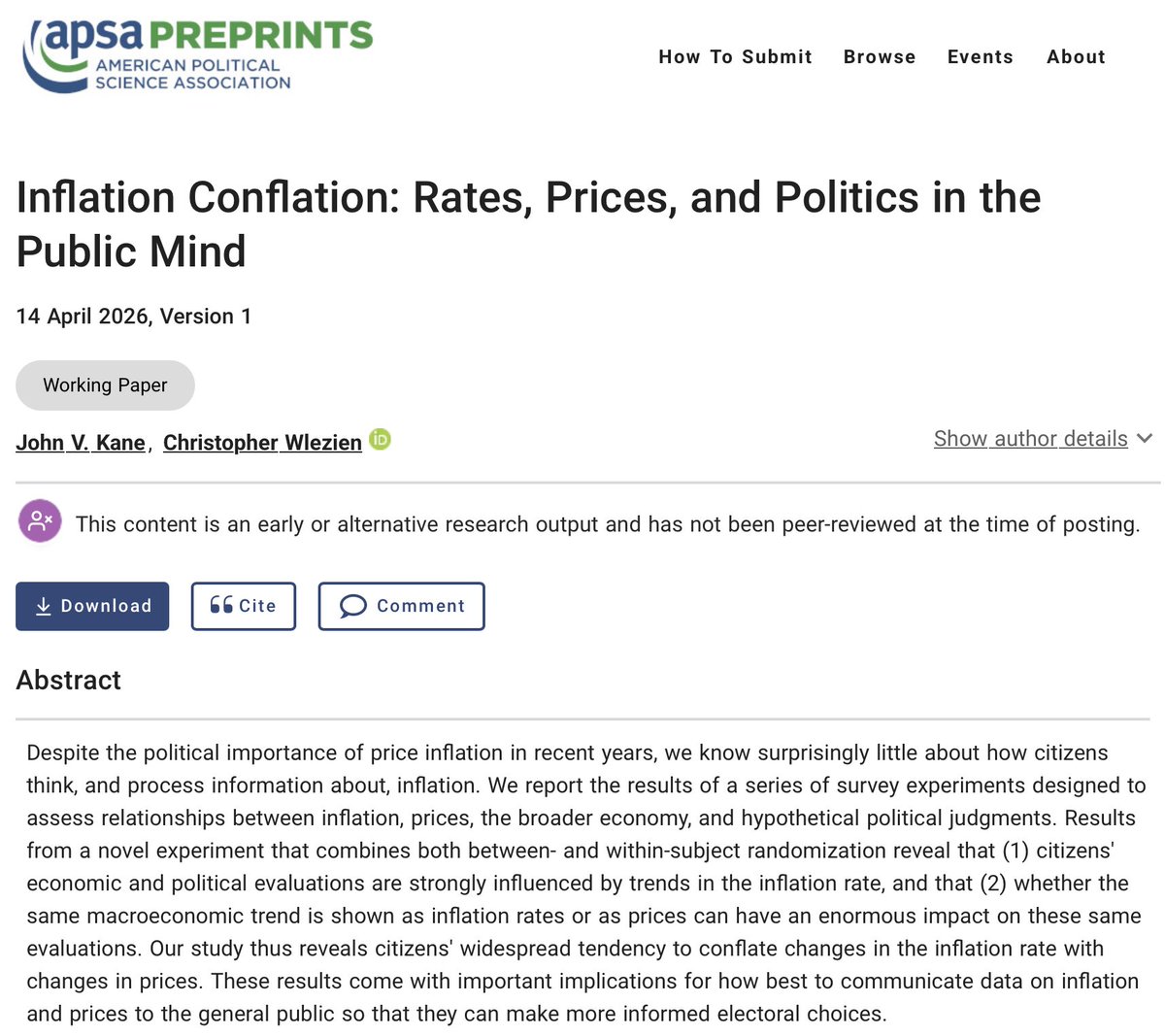
🚨New working paper w/ the legendary @CBWlezien!
Lots of talk about inflation & voters' political views. But how well do voters actually understand info about inflation?
We find that a majority conflates changes in rates w/ changes in prices. This has important consequences...
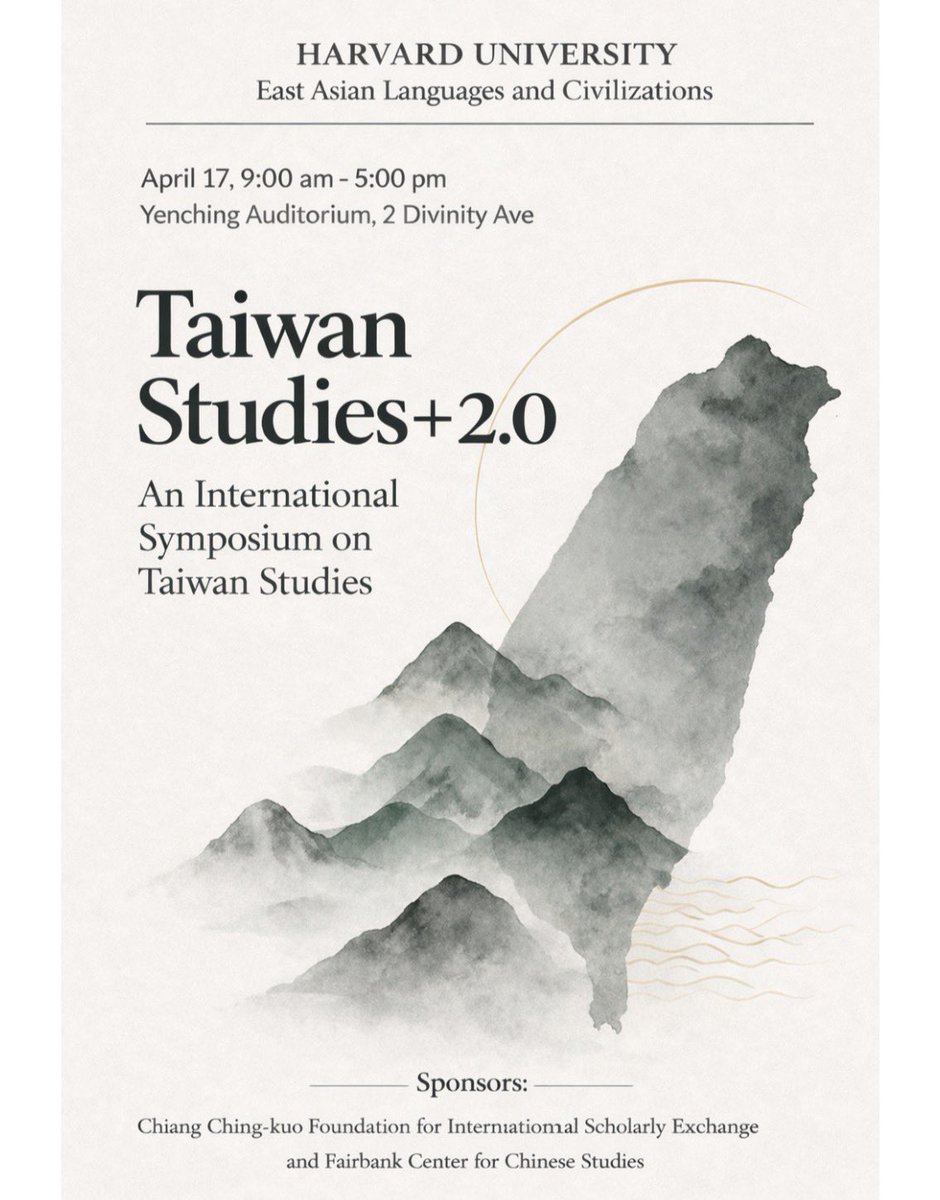
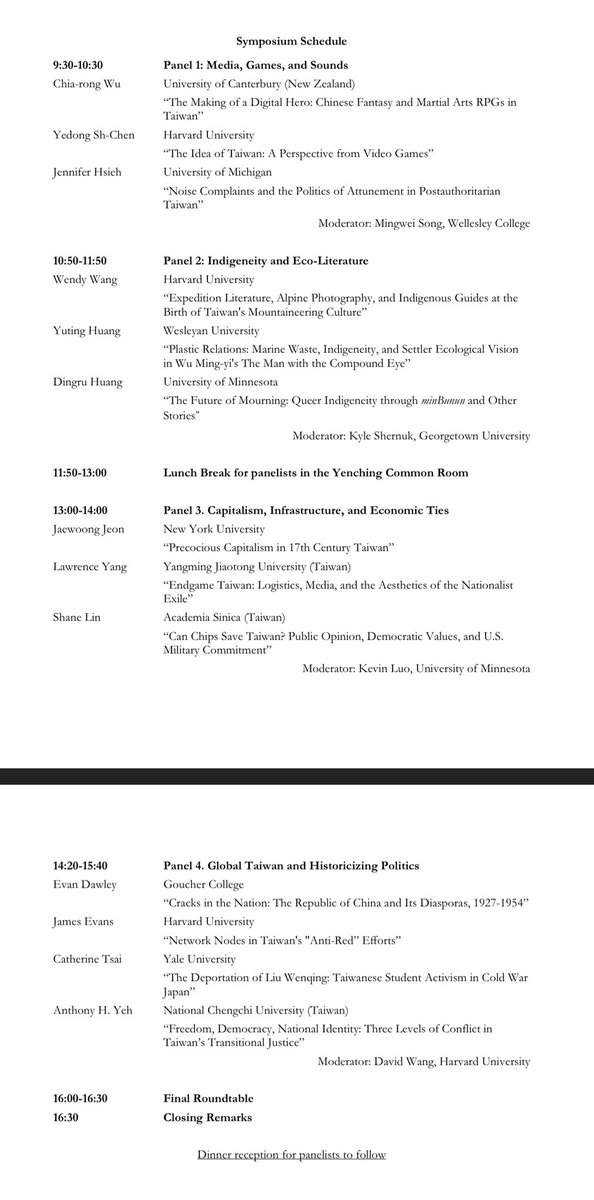
Looking forward to being a part of the unofficial ‘Harvard Taiwan Week’ this week, ending with a full day Friday symposium (4/17) that Kyle Shernuk, Yedong Chen, and yours truly have put together - and convened by David Wang. Hope to see you there!
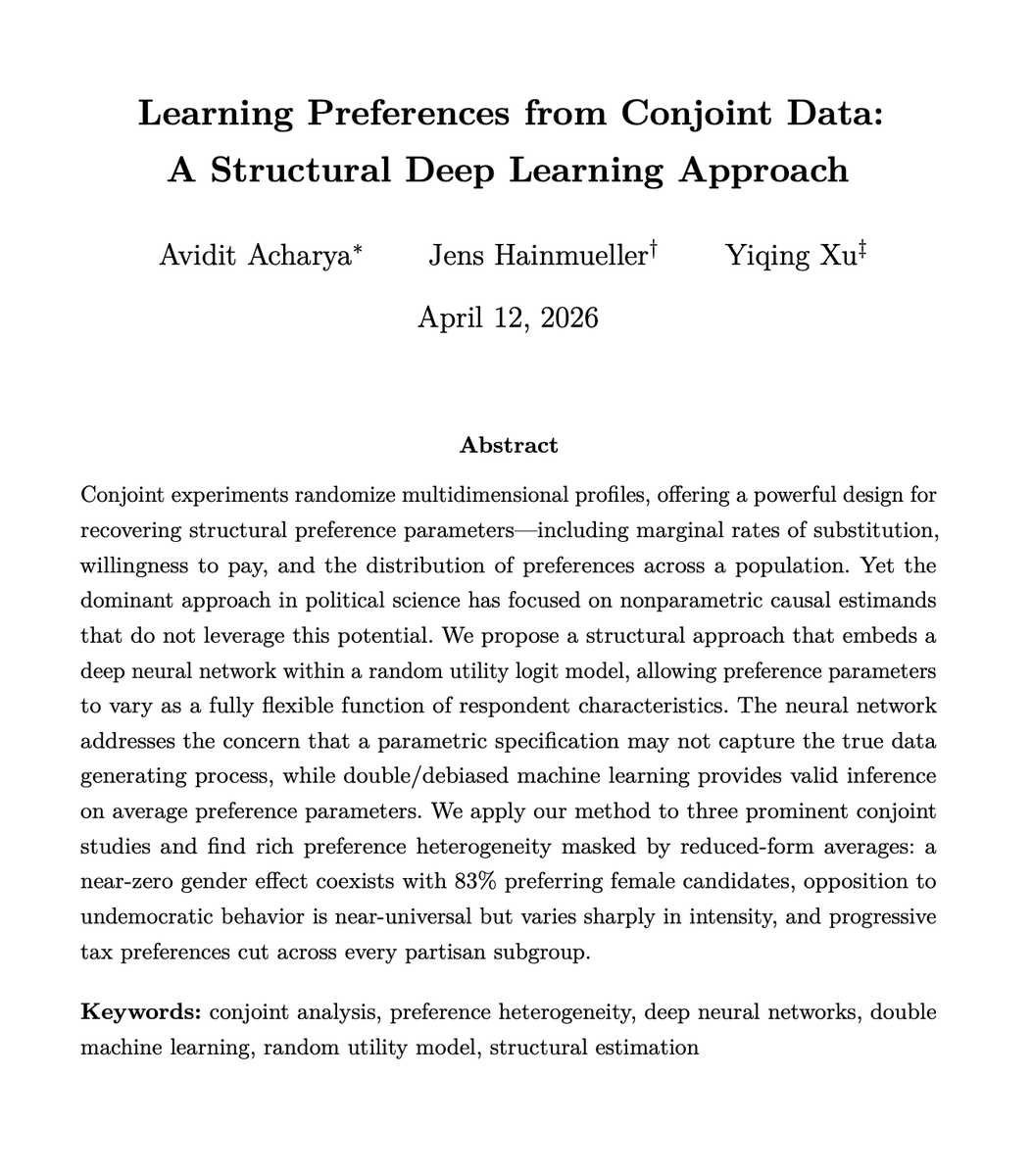
🧵**Structural Conjoint**
New paper with Avidit Acharya and Jens Hainmueller:
“Learning Preferences from Conjoint Data: A Structural Deep Learning Approach.”
We show how to recover interpretable structural parameters from conjoint experiments, combining a random utility model with double-debiased machine learning (DML).
Paper: https://t.co/aygvFyizDT
Major update: **interflex** v1.4.0 (CRAN)
- Support various DML estimators
- Support discrete outcomes
- Support group average treatment effects (discrete moderators)
- Major refactoring to improve code efficiency
- User manual rewritten
Check it out: https://t.co/8Ccckcy2lP
Many thanks to Tianzhu @Maple_Optboy
and @statsclaw for making this happen.
New study out in Nature Human Behaviour: 37 million US users were exposed to deceptive networks on Facebook & 3 million on Instagram during the 2020 elections—roughly 15% and 2% of active users. 🧵
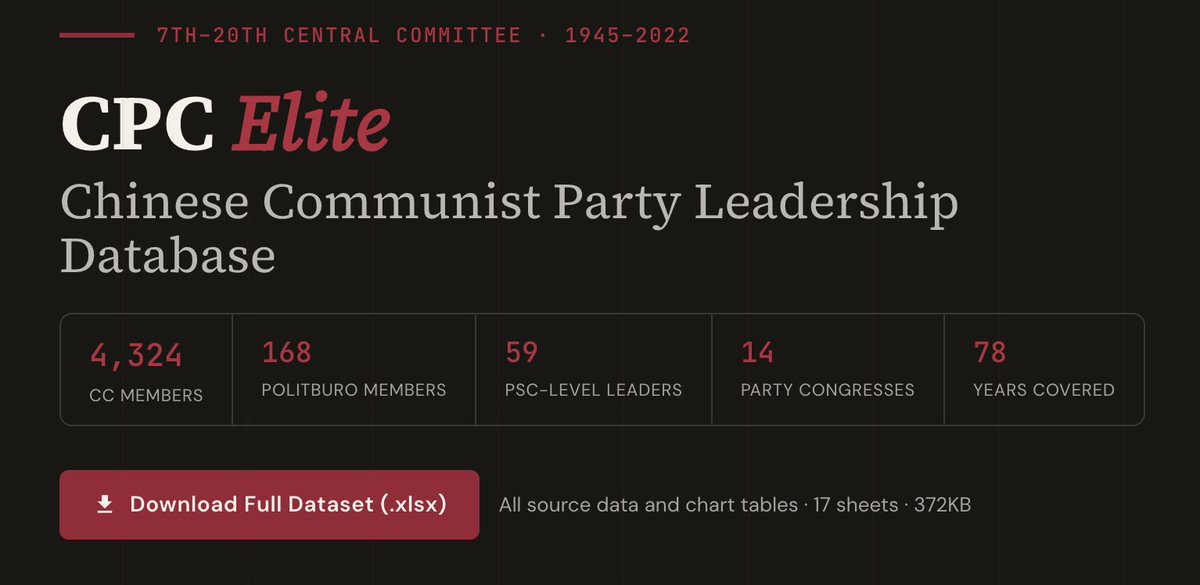
An open source website on the Chinese Communist Party elite, with data visualizations. Every Central Committee (4,324), Politburo (168), and PBSC member from 1945–Present.
All data available for download, as promised. Link and some standout charts below🧵










![BrendanNyhan's tweet photo. Read our chapter here! https://t.co/p9OmT4W29O
The key claim: "AI is more likely to reinforce existing patterns of [information] exposure and behavior than it is to transform how people understand and relate to the political world"
(with @jenjpan, @aasiegel, and @YamilRVelez) https://t.co/TiFYeKkUzx](https://pbs.twimg.com/media/HHurWwXWsAY8fZ0.png)