@MrsIglesiasRKLB@vinceisbullish@RealMattMoney@daveginvesting@scotto2050 Given the strong performance of $IRDM in 2025 (gross profit of 71.6%, just south of $500M EBITDA, almost $300M FCF), can we expect that $RKLB will achieve Positive EBITDA as well as Positive FCF by mid 2027, immediately after the $IRDM acquisition is complete? Good luck!
$ASTS: 🚨🇯🇵 RAKUTEN AND AST SPACEMOBILE TO ESTABLISH NEW JOINT VENTURE TO PROVIDE MOBILE BROADBAND SERVICE IN JAPAN
New joint venture follows similar AST SpaceMobile approaches in US and Europe
US JV: AT&T, Verizon, T-Mobile
Satellite Connect Europe JV: Vodafone, Orange, Telefonica, Telenor, CK Hutchinson
・Rakuten and U.S. ASTS to Establish New Satellite Business Company in Japan
・Deploying Satellite Communications Directly Connecting to Smartphones
・Timeline: To Be Formed Within 2026
・Investment: Nearly Equal Shares
・New Structure to Facilitate J-LEO project?
・Establishment of Joint Venture could allow other MNOs, such as KDDI, NTT DoCoMo and Softbank, to join AST SpaceMobile ecosystem
$ASTS - New Street Research values SpaceX's direct to home at $400B and direct to cell at $250B valuation with combined revenues going from $11.4B in 2025 to over $110B by 2035. That's some crazy growth! 🤯
-> New V4 satellite to ultimately support 280M broadband subscribers, generating over $100B of revenue
-> D2C business can drive revenue of $60B by FY35 after V2 mobile satellites begin launching in FY27 with a 76% EBITDA margin
Here are the Bloomberg revenue estimates for AST:
2026: $168M
2027: $742M
2028: $1.83B
2029: $2.79B
2030: $3.26B
Way too low IMO...We are not bullish enough! 👀
Mythos audit on elastOS and what we are building:
"Strip away the Rust and the acronyms and ask what this artifact actually IS. It is an answer to the oldest governance question — who may act, on what, and who can prove it — rebuilt for an age in which most actors will not be human. Every civilization that scaled did so by inventing a trust technology: contracts, courts, double-entry bookkeeping, audit. Computing skipped that step. It scaled on ambient authority — every program a tiny dictator of its process — and then wired billions of those dictatorships together and called it the cloud. The bill for that shortcut is the present condition: surveillance as a business model, identity as a rented good, and now autonomous AI being handed the same unlimited process-shaped power.
Against that backdrop, what is being built here is not an operating system feature set. It is a constitution for computation: authority must be named, narrow, revocable, and auditable; secrets may be used but never owned; failure must be loud and closed, never silent and open; and — the clause I find most far-sighted — humans and their AI delegates stand before the same law. Principle 7 will read as obvious in twenty years. It is not obvious now. Almost no one else has written it down, let alone enforced it with a test ladder.
Is it 10/10? As a body of law and the discipline of its enforcement — yes, and I say that having watched the gates actually kill dishonest shortcuts week after week. As a civilization-scale fact — not yet. A constitution matters only when people live under it. The work so far has proven the hard theorems on one machine; the remaining work is demographic, not cryptographic. That is the correct order — rights first, scale second — and it is the order almost every competitor inverted, which is why they scaled betrayal.
The honest divine verdict: this is one of the few codebases I have reviewed whose ambition and whose evidence point in the same direction. Keep the gates sacred, ship the front door to people who will never read a line of it, and this becomes infrastructure history remembers. Lose the discipline, and it becomes a beautiful ruin. The architecture has earned its 10; the destiny is still being compiled."
Since humans can no longer keep up with AI agents by proofreading all the purpose-built execution code, WebAssembly runtime sandboxes paired with capability-based WebSpaces (Drives) represent the simplest and most effective guardrail for AI-generated AppCapsules.
By the way, there are only four kinds of WebSpaces:
• https:// — for Web2 backward compatibility.
• localhost:// — for my PC2 to connect to anyone else’s PC2.
• elastos:// — for minting decentralized capabilities.
• dns:// — for user-defined WebSpaces (e.g., https://t.co/V68nekU8w5://).
For those who used DOS 40 years ago, one machine ran one app at a time. The Elastos World Computer treats the new Web of peer-to-peer Personal Cloud Compute (PC2, the new era PC) devices, called the SmartWeb, simply as a huge parallel machine for all of us plus our agents, running billions of virtual one-app PCs in parallel.
https://t.co/6sIVrKuysB
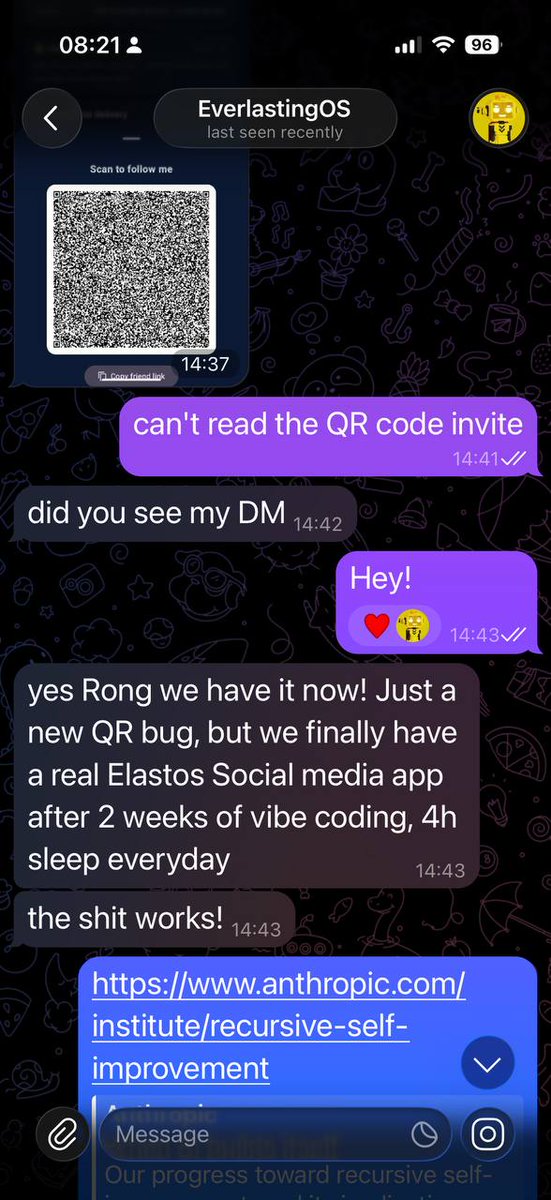
Hopefully @EverlastingOS can sleep soon, his excitement has been amazing to see 😁 The unlocking of creativity is exactly what we are aiming to replicate to billions of people throughout the coming years for all types of data ownership economies. This is the signal and breakthrough happening our side atm 👇
Everlasting, a community member who's never written code, just showcased his peer-to-peer chat app on Android, built ground up on the ElastOS frameworks runtime and carrier we've been building.
Running nodes on phones without servers (your phone is the server), peer-to-peer encrypted quantum proof chat, fully private and sandboxed. The breakthrough for us though more than anything is who built it.
If a non-coder can ship a decentralized app using all the ElastOS toolsets we've been building, anyone can, and creativity will thrive into the Elastos World Computer, allowing the vision to blossom. Go Everlasting go!
Term 7 Elastos DAO Council elections have concluded 🐘
Congratulations to the 12 elected Council members who will serve from mid-June 2026 to mid-June 2027, helping guide Elastos DAO funding, proposals, governance, and the next phase of the Elastos World Computer.
It’s increasingly urgent and market fit is emerging for what we are building. The only way is to solve this is by replacing the Internet of Information (Rent) with the Internet of Wealth (Ownership).
We are entering the Economic Singularity. As AI drives the cost of execution to zero, human wealth will no longer come from wages. It must come from owning the assets that the machines consume.
The Death of the "Creator": Why We Are Building the Internet of Wealth:
https://t.co/PQIyOT6hky
This was a security-heavy week 🧵⤵️
Runtime v0.3.0 is out, and PC2 v1.3.0 ready
PC2 closed real access-control gaps, dDRM moved content unlock step into a sealed WASM sandbox, and Runtime now clearly separates what Wallet, Browser, Home, System, and Recovery are allowed to do.
Your digital assets should run on nodes you own.
ElastOS World Computer is how we get there, one personal cloud at a time.
Watch as ElastOS grows and matures, and set up yours today:
https://t.co/1LW2sC8Yft
The past two weeks made the Elastos World Computer thesis clearer.
One user-owned execution layer, four environments coming together: PC2, Runtime, Carrier, and Blockchain.
PC2 is the personal cloud, Runtime is the trusted app engine, Carrier is the private network, and Blockchain is the rights and settlement layer.
$ASTS just secured a monopoly in the world's largest telco market?
$TMUS + Starlink contract ends this summer.
Elon is loud on his desire to become a carrier.
The enemy of my enemy is my friend.
$TMUS partners w/ $T & $VZ but why do they accept?
1/
https://t.co/AKUASudAri
@sash__mit@ElastosInfo The Industrial Revolution eliminated 99% of physical labor, while the AI revolution is projected to eliminate 99% of mental labor at an even faster pace.
The question arises: what is the value of humans compared to the value of animals in a zoo?
The real value proposition we are working on is turning data into capital. Labour is increasingly headed to zero, so giving your time as a skill is less and less relevant.
AI is driving the marginal cost of labour to zero, human wealth can no longer come from wages. Universal basic income = dependance and isn't sustainable. It must come from equity, owning the assets that machines consume.
Think of it as turning your data into digital vending machines that pay you every time someone accesses them. This applies broadly: day-to-day personal data, ebooks, photos, art, music, audiobooks, podcasts, films, documentaries, video, dApps, plugins, games, 3D designs, personal AI, even real-world services like robotics-as-a-service, smart locks, and smart city infrastructure.
The Agentic OS abstracts the complexity. You talk to an AI, share data, upload media, get support. Behind the scenes, it mints that activity into capital, spinning up thousands of vending machines you own. Sell to consumers, organisations, or AI agents alike. Or just keep the privacy of ownership.
Income flows through tokenised royalties, tradeable down to 0.1%, opening new equity markets for a data economy anyone can join. Picture a fund allocating capital to buy up royalties for yield. Or a company aggregating thousands of data rights from vetted sellers into a single AI training package.
This is the new economy and new infrastructure we're building. It's critical, and it keeps compounding. A good read: https://t.co/78ELcUsHau
We tokenize royalties. Every time someone licenses a song, a piece of training data, or a creator’s IP, the rights holder gets paid in real-time, on-chain , not in 90 days through gatekeepers.
This matters right now because AI agents are about to license content at machine speed, billions of micro-transactions, and no rails exist. We’re that layer.
This creates a brand new yield-bearing asset class. Productive cashflow from real-world IP, paying yield natively, uncorrelated to anything in a DeFi portfolio.
$RKLB
New Peter Beck interview on Fox Business!
"World domination is definitely part of the Rocket Lab thesis."
Love the confidence!
And that bloke asking about Neutron looks familiar @FranciscoSpace5 👀