Term 7 Elastos DAO Council results are in 🐘
91 unique voters used 1.24 million ELA tokens. Thank you to everyone who voted!
Here are the 12 elected members:
• 4HM3D (🇦🇪)
• Igor (Iggispopis) (🇸🇰)
• Y3W (🇲🇾)
• EverlastingOS (🇳🇱)
• Sash | Elacity 🐘 (🇬🇧)
• chen2rong2 (🇨🇦)
• ihl (🇬🇧)
• Evolucia (🇵🇦)
• Tyro and two friends (🇨🇳)
• Luca S (🇮🇹)
• Sai (🇮🇳)
• Denis (🇩🇪)
We are now in the transition period (block 2,225,943). New term starts in \~13 days, 14 hours.
This global team is ready to serve our community. Proud of #Elastos! Let’s keep building the World Computer together.
#ELA $ELA @ElastosDAO@ElastosInfo
@Elastos_top10@ElastosInfo@Elacityofficial Yes so true - there are laws around helping data rights as property but this is not the same as data ownership which is the root issue we address
It’s increasingly urgent and market fit is emerging for what we are building. The only way is to solve this is by replacing the Internet of Information (Rent) with the Internet of Wealth (Ownership).
We are entering the Economic Singularity. As AI drives the cost of execution to zero, human wealth will no longer come from wages. It must come from owning the assets that the machines consume.
The Death of the "Creator": Why We Are Building the Internet of Wealth:
https://t.co/PQIyOT6hky
Two economists just published a mathematical proof that AI will destroy the economy.
Not might. Not could. Will — if nothing changes.
The paper is called "The AI Layoff Trap." Published March 2, 2026. Wharton School, University of Pennsylvania. Boston University. Peer reviewed. Mathematically modeled.
The conclusion is one sentence.
"At the limit, firms automate their way to boundless productivity and zero demand."
An economy that produces everything. And sells it to nobody.
Here is how you get there.
A company fires 500 workers and replaces them with AI. A competitor fires 700 to keep up. Another fires 1,000. Every company is behaving rationally. Every company is following the incentives correctly. And every company is building a trap for itself.
Because the workers who were fired were also customers.
When they lose their jobs faster than the economy can absorb them, they stop spending. Consumer demand falls. Companies respond by cutting costs — which means automating more workers — which means less spending — which means more falling demand — which means more automation.
The loop has no natural exit.
The researchers tested every proposed solution. Universal basic income. Capital income taxes. Worker equity participation. Upskilling programs. Corporate coordination agreements.
Every single one failed in the model.
The only intervention that worked: a Pigouvian automation tax — a per-task levy charged every time a company replaces a human with AI, forcing them to price in the demand they are destroying before they pull the trigger.
No government has implemented this. No major economy is seriously discussing it.
Meanwhile the numbers are already tracking the curve. 100,000 tech workers laid off in 2025. 92,000 more in the first months of 2026. Jack Dorsey fired half of Block's workforce and said publicly: "Within the next year, the majority of companies will reach the same conclusion."
Nobody is doing anything wrong. Companies are following their incentives perfectly. That is exactly the problem.
Rational behavior. At scale. Simultaneously. With no mechanism to stop it.
Two economists built the math. The math leads to one place.
Source: Falk & Tsoukalas · Wharton School + Boston University ·
@Elastos_top10@ElastosInfo@Elacityofficial Thankyou it means the world, this is pro society and a mission bigger than us, it will all click then compound and you were here from the start and understood the difficulty and struggle ❤️
People will look back at web2 as the digital slave era, where ownership was stripped and people got use to it and thought it was ok - which is very sad reality, the web3 era is all about finding freedom and building back confidence in online worth as everyone becomes asset holders through tokenisation of privatised data
Increasingly powerful AI is coming home, to your desktop, your personal cloud, your own intelligent environment. Within 2 years we will see these markets really begin to blossom.
Today, when you open an app, you usually connect to someone else’s cloud. They host the intelligence, collect the data, control the rails, and charge you rent. But the obvious future is different: your apps, agents, data, content, and rights run through your own personal cloud, under your control, as your property.
Your local AI OS becomes your digital home, it’s private, programmable, connected, and intelligent. It can talk to other clouds, other agents, and other markets. It can turn data and content into tokenized (tradable) capital, automate rights, distribute access, and make ownership tradeable.
This is the mission of ElastOS. Not just another crypto app. Not another rented platform. A personal ownership layer for this intelligent internet - and we don’t have to build it all either, hardware and talent is headed to us, we need to simply connect these dots as they emerge and deliver the value proposition coherently.
With these types of technologies in people’s hands, the age of digital wealth arrives, private property, free markets, peer to peer trading with intelligence baked in. We are doing what Bitcoin did for finance to all data online, to data, AI, media, apps, identity, and the digital life of the individual. No more renting your place online. No you will own nothing and be happy BS. You will own you digital life and others will pay you for it, consumers, machines, companies, whoever you want to trade with because true capitalism respects ownership thus the ability to sell access to it.
To complement AI-generated scripts, the Elastos World Computer will support digital capsules that meet the following criteria:
1. Digital Twins: Serve as digital twins of both physical and virtual sensors and actuators.
2. WASM Execution: Compiled and executed as native World Computer WASM binaries.
3. JIT Orchestration: Orchestrated just-in-time (JIT) within independent, location-agnostic enclaves.
4. Vendor Accessibility: Packaged as headless, Android-compatible capsules (mini headless service engines) to lower the entry barrier for existing hardware and software vendors.
The entire SaaS industry, every paid monthly subscription you have ever signed, is built on the assumption that you would never compose your own version in a minute.
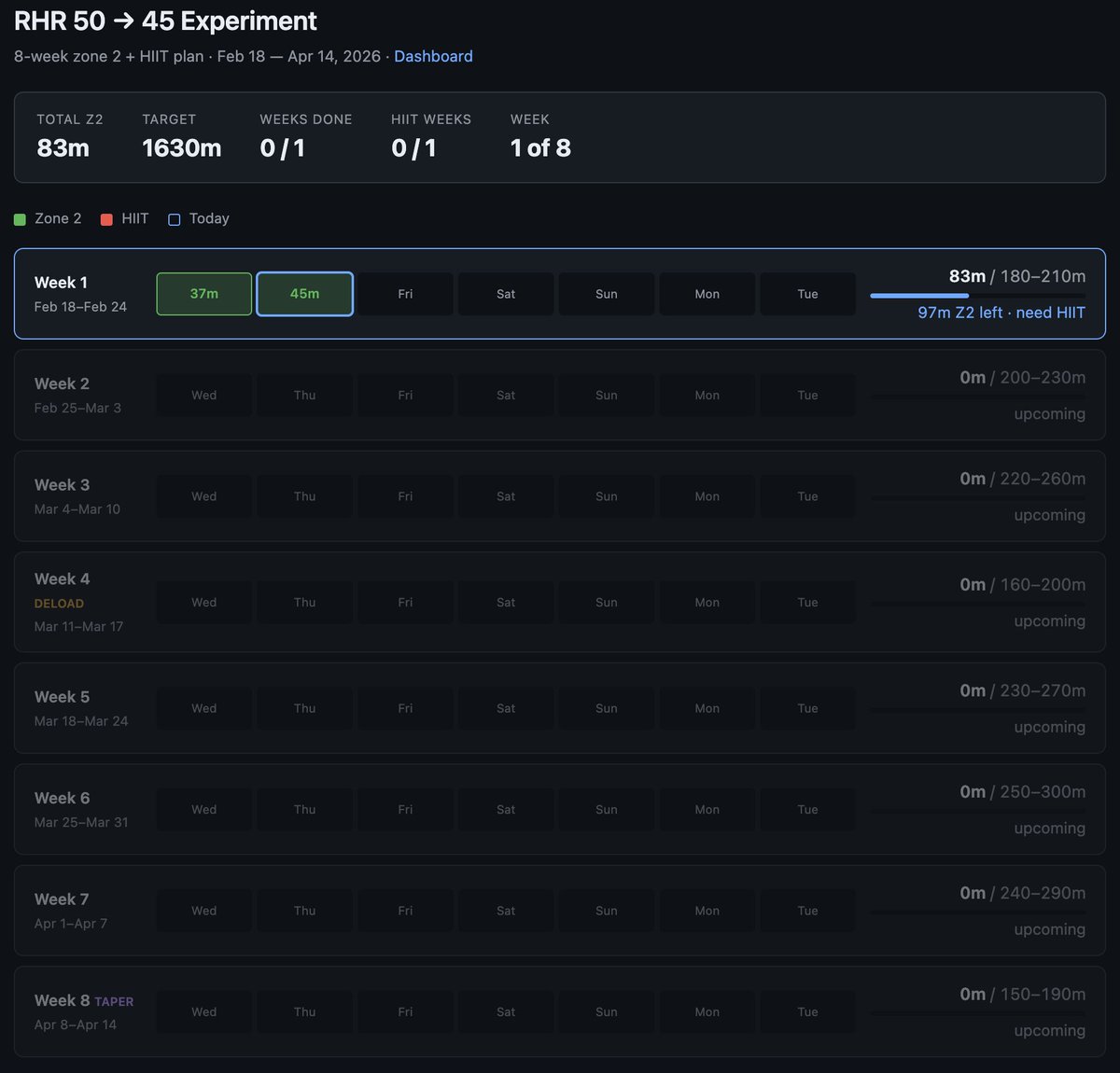
Andrej Karpathy posted this thread where he had spent an hour vibe-coding a custom cardio dashboard for his own 8-week heart-rate experiment. Claude reverse-engineered the Woodway treadmill's cloud API, pulled the raw data, processed it, and rendered a working UI. It worked. It took an hour. It should have taken a minute.
He is right. The reason it took an hour is not the LLM. The reason is the operating system underneath. Mobile computing is still organised around a 2008 primitive, the discrete, downloadable, App Store app. The agent era needs a different primitive.
A valuable read of the change coming: https://t.co/eD6vYu9KMf
Andrej Karpathy posted this thread where he had spent an hour vibe-coding a custom cardio dashboard for his own 8-week heart-rate experiment. Claude reverse-engineered the Woodway treadmill's cloud API, pulled the raw data, processed it, and rendered a working UI. It worked. It took an hour. It should have taken a minute.
He is right. The reason it took an hour is not the LLM. The reason is the operating system underneath. Mobile computing is still organised around a 2008 primitive, the discrete, downloadable, App Store app. The agent era needs a different primitive.
A valuable read of the change coming: https://t.co/eD6vYu9KMf
Very interested in what the coming era of highly bespoke software might look like.
Example from this morning - I've become a bit loosy goosy with my cardio recently so I decided to do a more srs, regimented experiment to try to lower my Resting Heart Rate from 50 -> 45, over experiment duration of 8 weeks. The primary way to do this is to aspire to a certain sum total minute goals in Zone 2 cardio and 1 HIIT/week.
1 hour later I vibe coded this super custom dashboard for this very specific experiment that shows me how I'm tracking. Claude had to reverse engineer the Woodway treadmill cloud API to pull raw data, process, filter, debug it and create a web UI frontend to track the experiment. It wasn't a fully smooth experience and I had to notice and ask to fix bugs e.g. it screwed up metric vs. imperial system units and it screwed up on the calendar matching up days to dates etc.
But I still feel like the overall direction is clear:
1) There will never be (and shouldn't be) a specific app on the app store for this kind of thing. I shouldn't have to look for, download and use some kind of a "Cardio experiment tracker", when this thing is ~300 lines of code that an LLM agent will give you in seconds. The idea of an "app store" of a long tail of discrete set of apps you choose from feels somehow wrong and outdated when LLM agents can improvise the app on the spot and just for you.
2) Second, the industry has to reconfigure into a set of services of sensors and actuators with agent native ergonomics. My Woodway treadmill is a sensor - it turns physical state into digital knowledge. It shouldn't maintain some human-readable frontend and my LLM agent shouldn't have to reverse engineer it, it should be an API/CLI easily usable by my agent. I'm a little bit disappointed (and my timelines are correspondingly slower) with how slowly this progression is happening in the industry overall. 99% of products/services still don't have an AI-native CLI yet. 99% of products/services maintain .html/.css docs like I won't immediately look for how to copy paste the whole thing to my agent to get something done. They give you a list of instructions on a webpage to open this or that url and click here or there to do a thing. In 2026. What am I a computer? You do it. Or have my agent do it.
So anyway today I am impressed that this random thing took 1 hour (it would have been ~10 hours 2 years ago). But what excites me more is thinking through how this really should have been 1 minute tops. What has to be in place so that it would be 1 minute? So that I could simply say "Hi can you help me track my cardio over the next 8 weeks", and after a very brief Q&A the app would be up. The AI would already have a lot personal context, it would gather the extra needed data, it would reference and search related skill libraries, and maintain all my little apps/automations.
TLDR the "app store" of a set of discrete apps that you choose from is an increasingly outdated concept all by itself. The future are services of AI-native sensors & actuators orchestrated via LLM glue into highly custom, ephemeral apps. It's just not here yet.
Elastos runtime, written in Rust, is making great progress. This system means one bad app or sketchy AI can't quietly steal your data or drain your accounts.
Everything inside the OS stays in its own locked box, and you stay in control of your data. Those boxes can talk to each other through Carrier networking with permission, creating a modular World Computer.
We're bringing this into our live ElastOS system, merging four pieces into one: Runtime, Carrier, PC2, and Blockchain.
Once that clicks into place, the fun begins. New apps can launch inside ElastOS every week, running on any network, all powered by Elastos. Elacity provides markets, alot of innovation converging.
Every part of human life has moved into digital space, and in that space people own nothing. They create the value and platforms capture it, because there has never been infrastructure that lets an individual actually own their work, their identity, and their data the way they own physical property.
We are building the ownership layer for the digital world, turning anything of value into property a person truly holds and can monetize directly, with no platform standing between them and what they create. We have to shift from renting our digital lives to owning them. We must secure digital rights for humanity.
“SpaceX, Tesla, Neuralink, and The Boring Company are philanthropy. If you say philanthropy is love of humanity, they are philanthropy.
“Tesla is accelerating sustainable energy.
“This is philanthropy.
“SpaceX is trying to ensure the long-term survival of humanity with multi-planet species.
“This is love of humanity.
“Neuralink is here to help solve brain injuries and existential risk with AI — love of humanity.
“The Boring Company is trying to solve traffic, which is hell for most people, and that also is love of humanity.” -@elonmusk
Your digital assets should run on nodes you own.
ElastOS World Computer is how we get there, one personal cloud at a time.
Watch as ElastOS grows and matures, and set up yours today:
https://t.co/1LW2sC8Yft
The past two weeks made the Elastos World Computer thesis clearer.
One user-owned execution layer, four environments coming together: PC2, Runtime, Carrier, and Blockchain.
PC2 is the personal cloud, Runtime is the trusted app engine, Carrier is the private network, and Blockchain is the rights and settlement layer.
We tokenize royalties. Every time someone licenses a song, a piece of training data, or a creator’s IP, the rights holder gets paid in real-time, on-chain , not in 90 days through gatekeepers.
This matters right now because AI agents are about to license content at machine speed, billions of micro-transactions, and no rails exist. We’re that layer.
This creates a brand new yield-bearing asset class. Productive cashflow from real-world IP, paying yield natively, uncorrelated to anything in a DeFi portfolio.
Post-v1.2 week was about making ElastOS feel smoother 🔥
Fresh install fixes, cleaner launcher status, WalletConnect + ESC swap fixes, faster media playback, dApp Centre polish, Runtime Home progress, Explorer fixes, and Elacity BD progress
➡️: https://t.co/nae8UzeWhT
The real value proposition we are working on is turning data into capital. Labour is increasingly headed to zero, so giving your time as a skill is less and less relevant.
AI is driving the marginal cost of labour to zero, human wealth can no longer come from wages. Universal basic income = dependance and isn't sustainable. It must come from equity, owning the assets that machines consume.
Think of it as turning your data into digital vending machines that pay you every time someone accesses them. This applies broadly: day-to-day personal data, ebooks, photos, art, music, audiobooks, podcasts, films, documentaries, video, dApps, plugins, games, 3D designs, personal AI, even real-world services like robotics-as-a-service, smart locks, and smart city infrastructure.
The Agentic OS abstracts the complexity. You talk to an AI, share data, upload media, get support. Behind the scenes, it mints that activity into capital, spinning up thousands of vending machines you own. Sell to consumers, organisations, or AI agents alike. Or just keep the privacy of ownership.
Income flows through tokenised royalties, tradeable down to 0.1%, opening new equity markets for a data economy anyone can join. Picture a fund allocating capital to buy up royalties for yield. Or a company aggregating thousands of data rights from vetted sellers into a single AI training package.
This is the new economy and new infrastructure we're building. It's critical, and it keeps compounding. A good read: https://t.co/78ELcUsHau
ElastOS step by step gets more powerful.
Protect your data, own and sell it directly with world, run private AI in your own soverign OS, accessible anywhere in the world.
We are doing for non-financial assets what Bitcoin did for finance. Watch/read update, try it out, give feedback and we will continue rolling out updates.
No code Apple installer coming next week, here is latest version running on my Jetson Nano on other side of world in Bangkok behind firewall. ELA