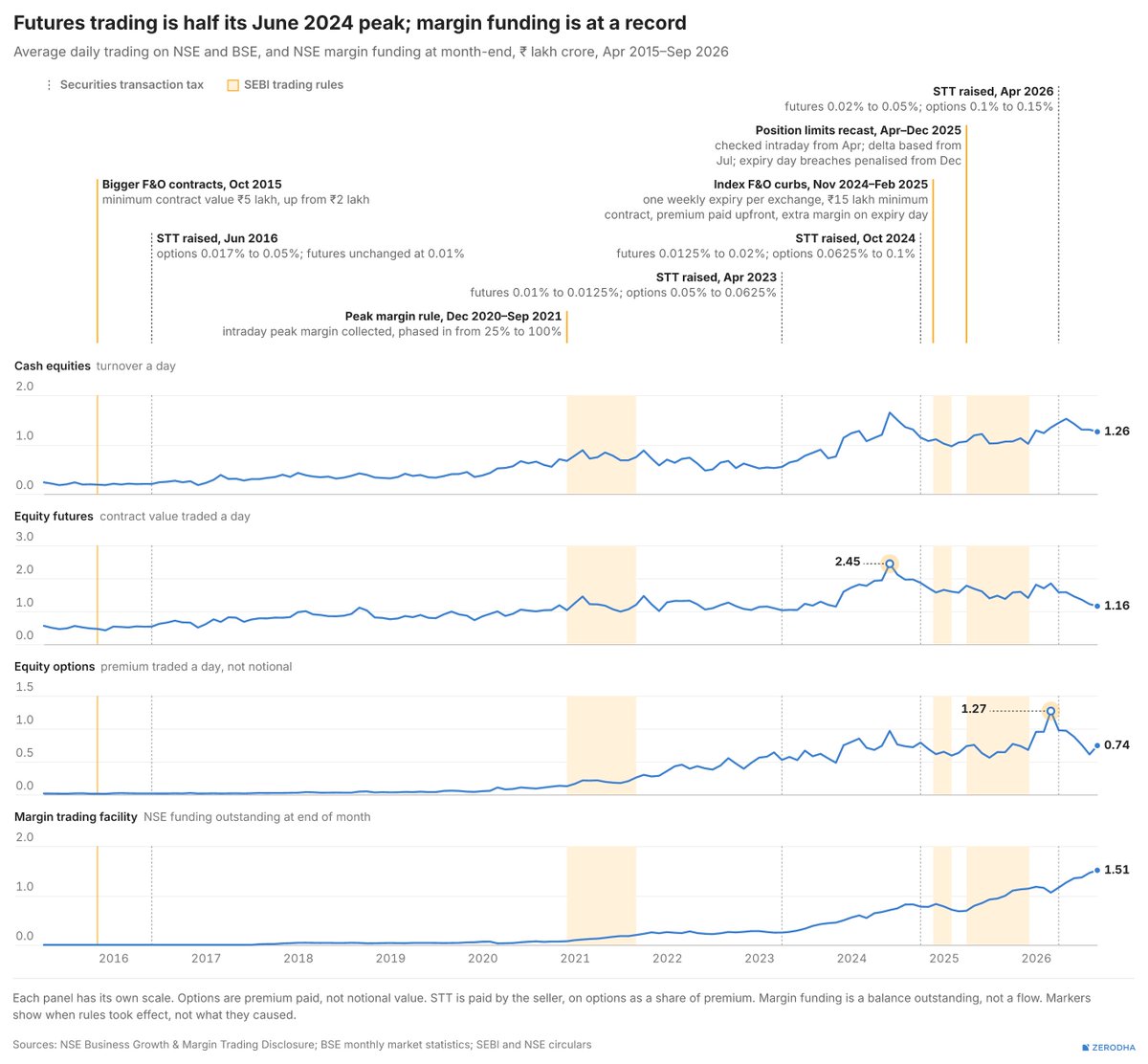
India has 8.7m equity-derivatives traders. 97% of index-options turnover happens within a week of expiry. I think some of that short-horizon, leveraged behaviour will carry into global perpetual markets. The thesis behind BharatLiquid: https://t.co/ksvEymRzzV
@Nithin0dha Came to a similar conclusion when I took a look at SEBIs market wide data. Although this piece is less about trading costs and more an analysis about market trends / behaviours.
https://t.co/h2X1d3Ey2k
India has 8.7m equity-derivatives traders. 97% of index-options turnover happens within a week of expiry. I think some of that short-horizon, leveraged behaviour will carry into global perpetual markets. The thesis behind BharatLiquid: https://t.co/ksvEymRzzV
Across Zerodha, here’s roughly the percentage of individual traders who are profitable:
- Futures: ≈50%
- Option sellers: ≈40%
- Option buyers: ≈10%
- MTF: too early to tell, considering it’s a new product
One of the unintended consequences of increasing STT and all the other measures to curb F&O speculation is that they may have pushed traders toward even riskier trading behaviour.
Yes, in theory, losses from buying options are limited to the premium paid. But buying options repeatedly, more often than not, ends with traders losing more money over time than trading futures or selling options. This is not to say that trading futures or selling options is low-risk. It’s a relative comparison.
There are a few reasons why options buying has become so popular.
Most traders don’t realise this, but STT is already one of their largest costs. As STT on futures increased steadily over the years, trading activity migrated from futures to options. Today, options are about 90% of all F&O trading activity.
At the same time, larger contract sizes have made trading futures and selling options more expensive in terms of the margin required. Buying options, on the other hand, is cheaper because it only requires the premium. Hence, more retail traders are buying options.
The other big factor is weekly expiries. Earlier, traders mostly traded monthly expiries. As more contracts started expiring every week, trading effectively became 0-day options. Traders began thinking in days rather than weeks and betting on price moves over increasingly short horizons.
All of these factors have also led to significant growth in MTF, or margin trading facility. With MTF, traders can borrow against eligible stocks and hold positions for extended periods. But MTF is long only.
The intent behind increasing STT, contract sizes, and all the other measures may have been to discourage speculation. The unintended consequence has been traders moving to riskier options trades.
This isn’t just about F&O, by the way. These measures also explain the spectacular increase in crypto F&O volumes. Crypto F&O exists in a grey zone where it’s neither legal nor illegal, and traders can get as much as 100x to 300x leverage on many of these contracts. In the last couple of weeks alone, I’ve come across multiple new platforms advertising crypto F&O contracts, including perpetual futures, none of which are regulated. That’s another unintended consequence of these regulatory measures.
The larger point I’m making is that any regulatory or taxation change has second- and third-order effects. These changes fundamentally alter market structure, and not always for the better, as the recent measures show. The risks always show up in the most unexpected places. And they show up especially in market phases like this one, when markets fall or trade sideways, and liquidity starts to evaporate. That shows up as wider spreads, higher impact costs, and a further drop in trading volumes.
This is perhaps one of the biggest challenges in regulating markets. Indian markets are no longer a backwater, the recent bear phase notwithstanding. We need careful thinking about second- and third-order effects, and thoughtful regulatory design and calibration.
@that1618guy Man this is absolute gold. Ty for sharing 🫡. You have been one of the best thinkers re market structure this cycle. Probably my favourite follow this year.
@djangohl@HyperliquidX We'll probably see 100s pop up, but the key to win a "region" imo, is extremely specific knowledge about the local geo/ regs + lobbying power + kick ass GTM.
In any case, HL wins.
Probably a much more interesting trade today. FDV $36M while treasury holds $22M, trading at ~1.6x of RFV. Worth scooping some $NET at these prices if you believe the RH casino revives + $NET revenues and trading volume trends back up again.
$NET is definitely one of the more interesting DeFi experiments right now. Major DeFi summer vibes. But if you’re trying to decide whether to buy it, ignore the headline APY for a second and read this 👇
The entire trade comes down to one question:
Can treasury value per NET grow faster than NET supply?
Think of NET like a tiny country with its own currency. Say the protocol owns $10m of assets and there are 1m NET.
That means NAV = $10/NET. If NET trades at $100, you’re paying $10 for the assets and $90 for future growth. Why would anyone do that?
Because the premium itself helps the protocol grow.
When NET trades far above NAV, the protocol can sell/mint NET in exchange for real assets.
So the loop looks like:
price goes up → protocol raises assets cheaply → treasury grows → backing grows → narrative gets stronger → price goes up
Then add the 5% trading tax.
Every buy and sell pushes value into the treasury.
So:
hype → volume → fees → treasury growth → more hype
Now, that's reflexivity 🤌.
Then you see the giant staking APY and think:
“great, I’m earning 0.45% every 8 hours.”
Not really. Most of that is newly minted NET.
If everyone doubles their token balance while total supply also doubles, nobody became 2x richer.
The number that actually matters is:
TREASURY RFV / FULLY DILUTED NET SUPPLY
If treasury grows 5% but token supply grows 10%, your wallet may show more NET while your economic ownership is getting diluted.
Now add Morpho. $NET holders can take their staked NET, wrap it into wsNET, post that as collateral, and borrow USDG.
The loop:
$1,000 NET → stake/wrap → deposit wsNET → borrow $500 USDG → buy $500 more NET → stake/wrap again
You started with $1,000.
Now you have ~$1,500 of NET exposure, thanks to good old leverage. And the degen version keeps going:
NET → wsNET collateral → borrow USDG → buy NET → wsNET → borrow more USDG → buy more NET
As long as NET goes up, this is gasoline on the flywheel.
Your collateral rises in value, your borrowing capacity rises, and you can keep levering.
But when NET falls, the exact same mechanism runs in reverse.
Example:
You have $1,000 of wsNET collateral and $500 of debt. If NET falls 20%, your collateral is now worth $800. Your debt is still $500. Suddenly your LTV has gone from 50% to 62.5%.
If that hits the liquidation threshold:
liquidator repays your USDG debt → receives your wsNET collateral → sells/unwinds it → more NET hits the market
So the downside loop becomes:
NET falls → LTV rises → liquidations → collateral gets sold → NET falls more → more liquidations
gg looopors.
Important: this does NOT affect someone simply holding or staking NET.
You only get liquidated if you borrow against it. And today the looped market is still small enough that I wouldn’t call this the core risk. But if Loopback becomes popular, it can materially increase both upside reflexivity and downside violence.
This is why I don’t think NET is simply “a Ponzi.”
There are real treasury assets and real value-capture mechanisms. But its market price can still behave like a Ponzi-style reflexive asset.
The protocol could survive perfectly while the token falls 80-90%.
If NAV is $10 and you bought at $100, “backing” does not protect your $100. It protects the first $10.
The other $90 is the growth premium, and premiums can disappear very quickly.
There’s also the pTEAM question.
Management appears to have the ability to acquire NET at a very low strike relative to market price/NAV. If that entitlement expands with supply, it becomes a meaningful dilution overhang.
So would I buy NET here?
Not because of the APY.
Not because “treasury is growing.”
I’d buy only if I believed:
treasury value PER fully diluted NET can compound fast enough to justify the premium I’m paying today.
My rough mental model:
- Near NAV: interesting asymmetry.
- 3-5x NAV: paying for serious future growth.
- 10x+ NAV: making a venture-style bet that hypergrowth + reflexivity keep working.
And that’s really the trade.
NET can be a very good protocol and still be a very bad buy at the wrong price. The question isn’t:
“Is NET backed?”
It’s “What am I paying today for every $1 of underlying value, and how fast can that $1 actually compound?”
P2P in India has a pretty insane failure mode:
You sell ₹1L of USDT.
The buyer sends you ₹1L.
Turns out those rupees are downstream of fraud.
Now ~₹4.5L across 3 accounts is frozen.
You can tell people to stop using P2P all you want. They'll stop when compliant on/off-ramps are actually better.
This is a product problem as much as it is a compliance problem.
I, apparently got drained!!
Lost $4,500 to the Indian government. 💀
In the last 10 days, I’ve lost $4,500, all because I made a $1K P2P transaction through @binance .
A few days ago, I sold $1K worth of USDT through Binance P2P. The buyer turned out to be a scammer, and because of that, the INR amount I received was frozen (put on lien).
I understood everything up to that point, but then the same P2P amount was placed under a lien three times. Basically, my $1K was frozen 3 times in my same account under same UTR and it subsequently got multiple liens in my friends account too, whom I transferred a part of it.
Making it a total of almost ₹4,50,000($4,500) whereas the p2p deal was 1lakh only.
I contacted Indian @Cyberdost , but they had no clear explanation for this. I even transferred some of that money to my second bank account, and that account was also placed under a lien.
I genuinely don’t understand what kind of mathematics the Indian government is using.
I also have legal proof of the $1K earn amount and P2P transaction. In India, Binance P2P is one of the ways people use to trade USDT, yet this is what happens.
Legally, only my $1K amount should have been frozen, but what can I do now.
Absolutely, I’m living in the GOAT country. 🫡
@kidponga@tradexyz Doubt the $45mil is profit / net rev. Assume also that good chunk of revenue was subsidising TVL through back-channel deals or potentially off-chain hedging.
Indian stock exchanges are closed again today. That's three days off while the global economy runs 24/7.
@BL_labs_xyz is our best shot at giving Indian traders markets that stay open when the world does.
🇮🇳 / acc
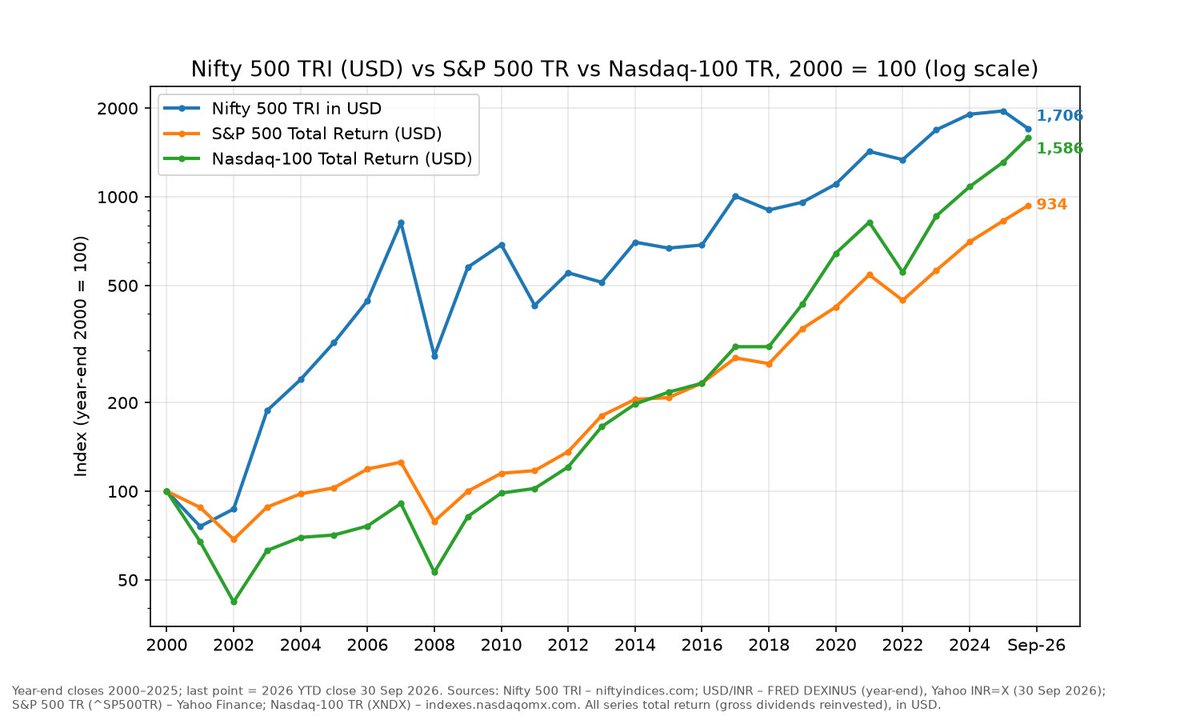
@takuiten Totally fair, I think M2 for a developing country is also a red herring because ofc money supply will go up as the economy grows, we'd be doing it completely wrong if the supply of money wasn't going up.
this^ Currency debasement ≠ inflation either, but fair point on dividends. My worry is less Indian equities vs the rupee, more the rupee vs everything else. The early 2000s were a different India and slightly flattering re NIFTY: hypergrowth while the Nasdaq was digging out of the dot-com crash. Since 2010, Indian equities in USD have trailed the S&P and Nasdaq by ~7–12 pts a year. Since 2020, Nifty 500 in USD did ~9.6%/yr vs ~18% S&P and ~21% Nasdaq.
Chart related (spun up by my grok).