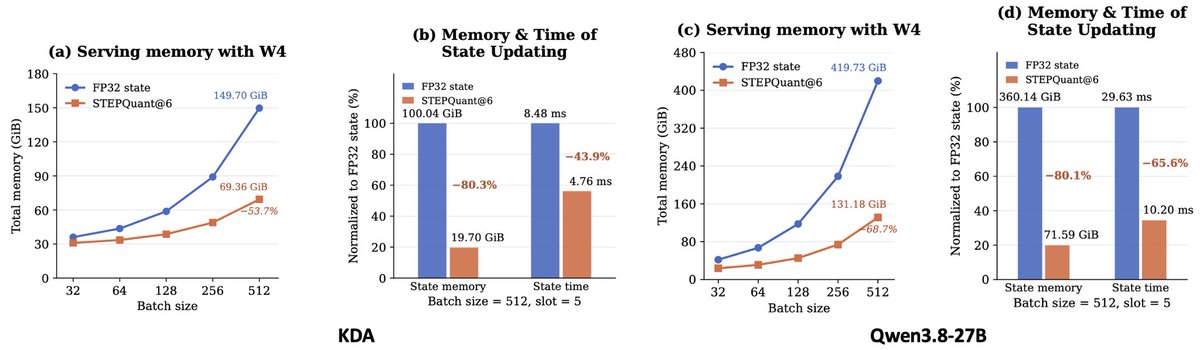
🚀 Introducing STEPQuant for recurrent state quantization in linear attention!
6-bit states → near-FP32 accuracy + >5× compression.
📄 Paper: https://t.co/26ypnLX20f
💻 Code: https://t.co/gNThpQm8Im
#LLM#Quantization
📢 We just released “Efficient Diffusion Language Models: A Comprehensive Survey” + an accompanying Awesome list of efficient dLLM papers!
📌 PDF: https://t.co/rKd5nAvqco
🌟 Awesome list: https://t.co/FPeYf0m7NV
Feedback & PRs are welcome — let’s make dLLMs fast together! 🚀
STEPQuant tackles both dimensions with:
• Lifetime-aware Temporal Bit Allocation
• Key-Row-Aware Dual-axis Fitting
• FP16 pivots for high-risk units
Results:
�� Near-FP32 accuracy at 6-bit
→ >5× state compression
→ Up to 68.7% lower total serving memory
🚀 Introducing STEPQuant for recurrent state quantization in linear attention!
6-bit states → near-FP32 accuracy + >5× compression.
📄 Paper: https://t.co/26ypnLX20f
💻 Code: https://t.co/gNThpQm8Im
#LLM#Quantization
Why is recurrent state quantization hard?
Quantization errors accumulate over recurrent updates — but not equally.
⏳ Temporally, long-lived errors persist across many decoding steps.
📍 Spatially, errors in different state rows have very different impacts on model outputs.
You’ve done real work.
But most of it is hard to see.
DINQ brings your projects, code, and research onto one card.
No self-promotion. Just real signals.
Build your DINQ → https://t.co/IaEtN0Vkab
#DINQ
🚀 🚀 Introducing ARC-Hunyuan-Video-7B, a model that understands real-world short videos with accuracy and speed. The model excels at tasks essential for real-world comprehension—areas often overlooked by general-purpose video understanding models—while matching SOTA performance on broader benchmarks. Key strengths include:
🩷 Temporal Reasoning: Track events over time
🩷 Affective Intent: Spot emotions & sentiments
🩷 Creator Intent: Classify video motivations
🩷 Narrative Comprehension: Decode stories & plots
🩷 Humor/Meme Breakdown: Unpack jokes & references
🩷 Creative Analysis: Gauge originality & innovation
Paper, code, model, demo in comments.
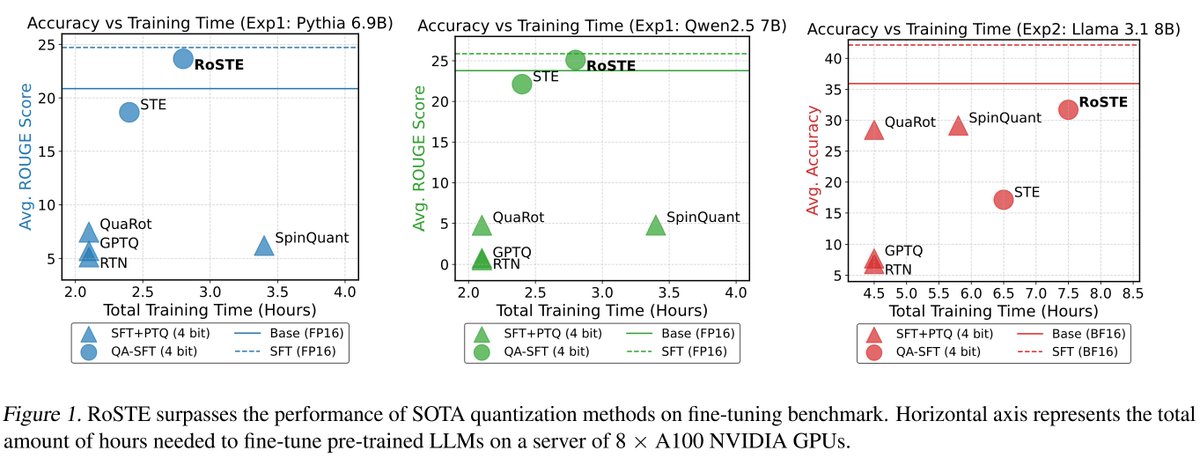
Our new quantization-aware training algorithm RoSTE can fine-tune quantized LLMs and break state-of-the-art benchmark accuracy on 4-bits Pythia, Qwen and Llama models! Thank you @quanwei0 for the great effort👏
Paper: https://t.co/ztc3jUjh7u
Code: https://t.co/UZpq9nyBUk
The engine behind Google DeepMind’s Veo 3?
A powerhouse of engineers:
Abhishek Sharma,
Alina Kuznetsova,
Ali Razavi,
Aleksander Holynski,
Ankush Gupta,
Austin Waters,
Ben Poole,
Daniel Tanis,
Derek Gasaway
… and many more
It takes hundreds of minds — across ML, audio, and software — to build next‑generation video AI.
#DINQ #AITalents
🔬 The HKU team presents ParallelComp: a training-free technique for efficient context length extrapolation in LLMs—from 8K up to 128K tokens—on a single A100 GPU, with minimal performance loss.
📄 Paper: https://t.co/HbKsGN0eqX
💻 Code: https://t.co/T2Au0WEGY1
Is your model faithfully translating math into formal languages like Lean?
⚖ Introducing "FormalAlign"! #ICLR2025
⁉️To address the lack of scalable evaluation in autoformalization, we propose the FIRST method to evaluate semantic alignment between informal and formal languages.
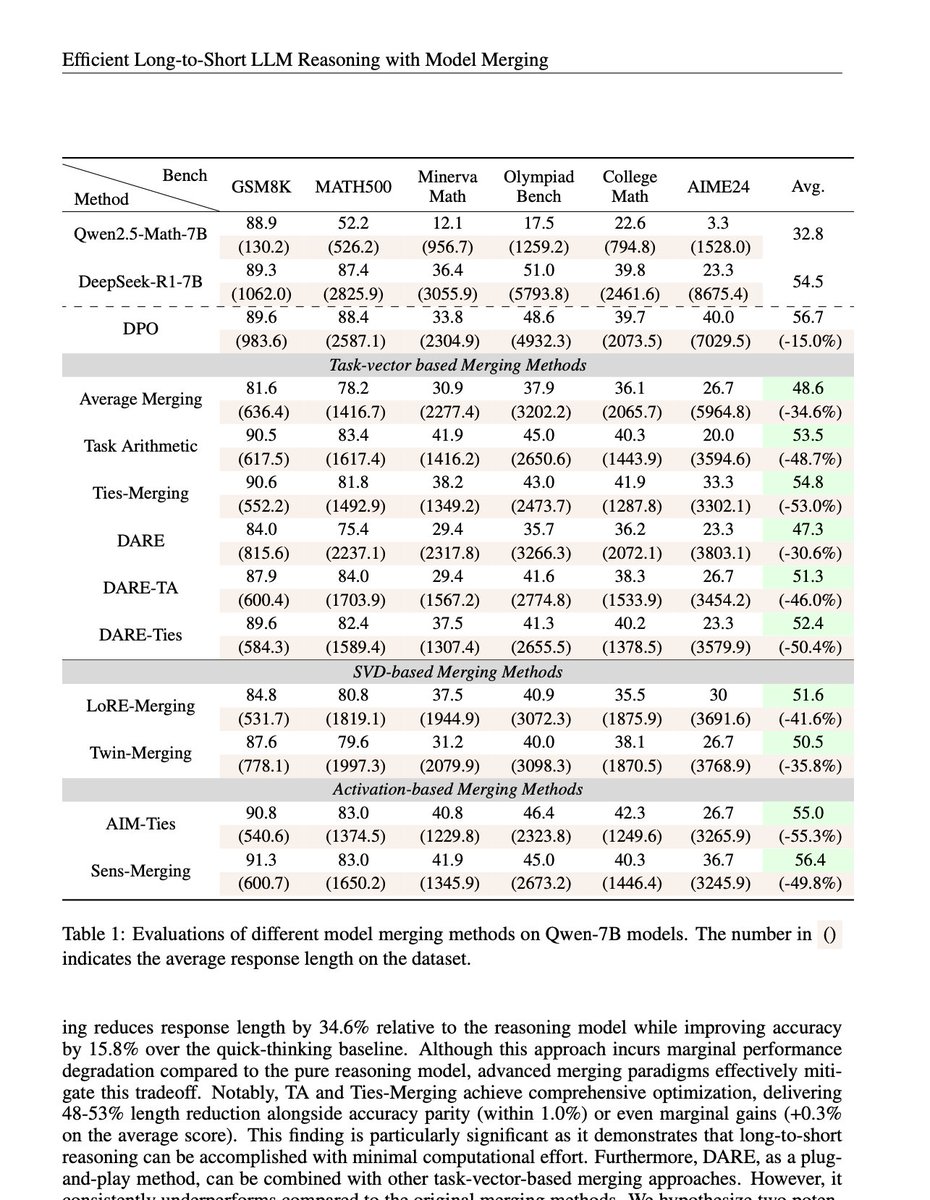
💡Unlocking Efficient Long-to-Short LLM Reasoning with Model Merging
We comprehensively study existing model merging methods on efficient Long-to-Short LLM reasoning tasks, and find their huge potential in the field.
🔥Are we ranking LLMs correctly?🔥
Large Language Models (LLMs) are widely used as automatic judges, but what if their rankings are unstable?😯Our latest study finds non-transitivity in LLM-as-a-judge evaluations—where A > B, B > C, but… C > A?! 🔄
🚀Exciting to see how recent advancements like OpenAI’s O1/O3 & DeepSeek’s R1 are pushing the boundaries!
Check out our latest survey on Complex Reasoning with LLMs. Analyzed over 300 papers to explore the progress.
Paper: https://t.co/k1HGQTA2kN
Github: https://t.co/VpcNVcEBSg
How to achieve human-level open-ended machine Theory of Mind?
Introducing #AutoToM: a fully automated and open-ended ToM reasoning method combining the flexibility of LLMs with the robustness of Bayesian inverse planning, achieving SOTA results across five benchmarks. 🧵[1/n]
RIFLEx
A Free Lunch for Length Extrapolation in Video Diffusion Transformers
TL;DR: Effortlessly extend your video with just one line of code: freq[k-1]=(2*np.pi)/(L*s).