Dissertation chapter finally published! @MishaTeplitskiy@DanielMRomero@agnes. We show that men play the research game much harder than women. It speaks to the phrase "buzz men, warm women". The downside is that savvy players are harder to unplug from the game.
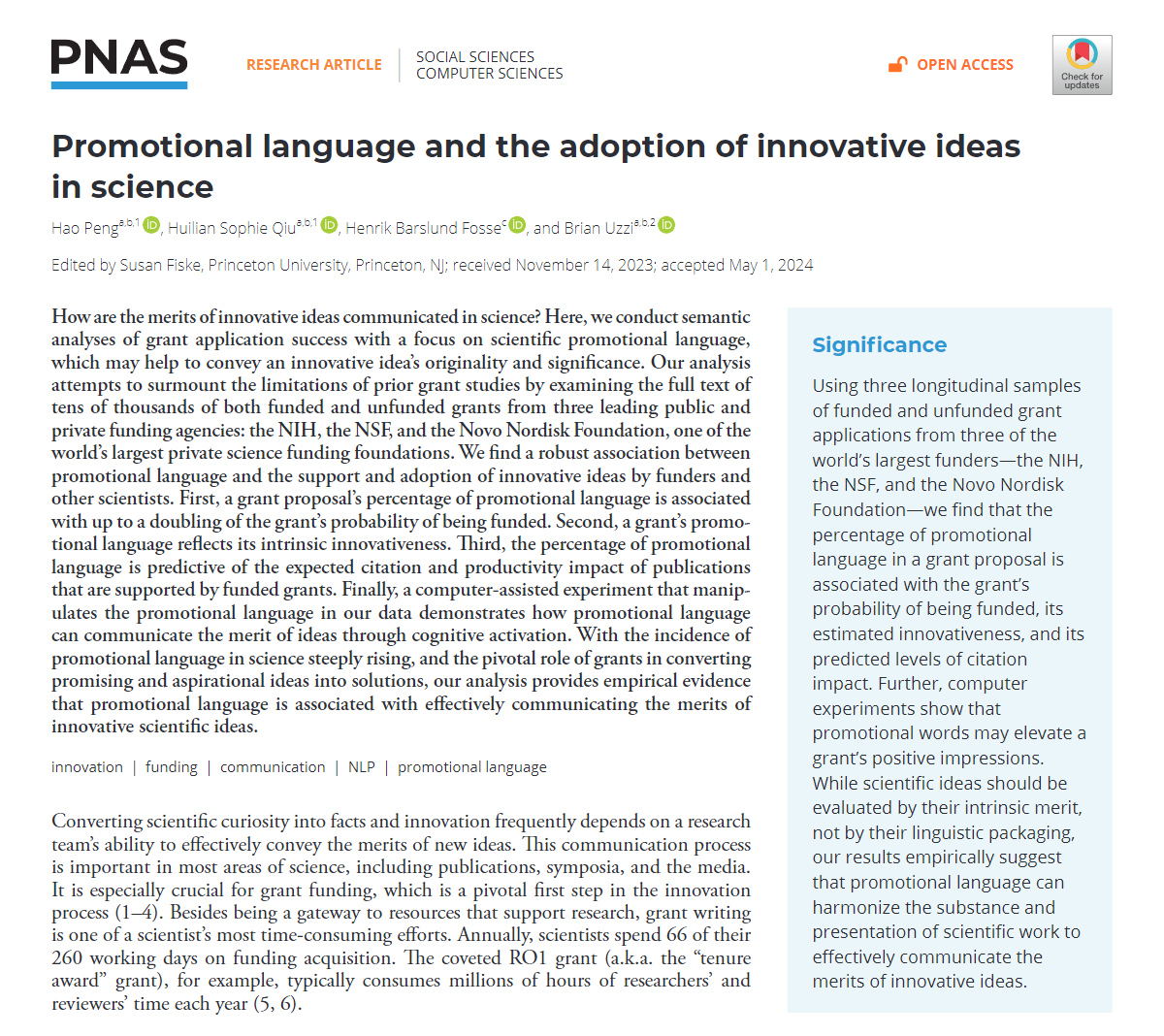
New research from @sophiehsqq@haoopeng@UzziLeadership and colleagues suggests there is an association between promotional language and biomedical grant funding success.
Studies like this mostly compare fraction of faculties to US population. I bet the finding might be different if using the fraction of authors as baseline -- a lay person working in service industry is unlikely to become PI in the first place. People's choice matters.
Innovation really involves two processes: ideation & communication. Our paper finds that promotional words can help to show the merits of good ideas in funding. Scientists need to pay more attention to the communication process to drive innovation success: https://t.co/UGPN91YS2Y
How are the merits of innovative ideas communicated in science? New research in @PNASNews analyzes the relationship between promotional language and the probability of funding, innovativeness, and citation impact. w/ @haoopeng@sophiehsqq & Henrik B Fosse https://t.co/0OpNwrvCbl
“Scientists with East Asian and African names are less likely to be mentioned or quoted in stories that reference their work.” Findings from a study of US based media coverage by @haoopeng@MishaTeplitskiy@david__jurgens summarised by @k_langin https://t.co/sLqtkcdXYj
Scientists with East Asian, African names less likely to be mentioned in news stories referencing their work: says study led by @haoopeng at @NorthwesternU
(study authors note methods of identifying name origins likely led to some classification errors).
https://t.co/1YWmYb7c93
🚨 Is novel research worth doing?🚨
There are serious concerns about slowdown in innovation. Are institutions to blame? In science, does peer review discourage novel work?
Paper with @haoopeng@mrblasco and
@klakhani finds the opposite!
https://t.co/7JunAYqFDt
1/n
"This is striking as we also find that retracted papers are pervasive across mediums, receiving more attention after publication than nonretracted papers even on curated platforms..." A study in @PNASNews using the Retraction Watch Database. https://t.co/UvuuJecuzt
"Overall, this analysis suggests that Twitter readily hosts critical discussion of problematic papers well before they get retracted. These discussions credit voices that are actively helping to improve science-related discussions in digital media." https://t.co/gS4EldYua4
@ashleyscastro Might be one reason why this market has a high fraction of international scholars who may otherwise earn less in their home country. Does this suggest that the US gov robbed us international labor?🧐
In fact, 80% of retracted papers receive no mentions over the 2 months preceding their retraction. Retractions thus have a limited effect on curbing uncritical online discussions of problematic papers!
🚨New Paper Alert!🚨 Excited to share our paper published in @PNASNews with @DanielMRomero and Ágnes Horvát (Northwestern) analyzing multiplatform attention to retracted papers: https://t.co/WzrjQ5mJAA. 🧵1/
Finally, we find that (3) retractions are not effective in reducing attention to retracted papers because they come too late. By the time the retraction is issued, most papers have already exhausted their attention. 6/