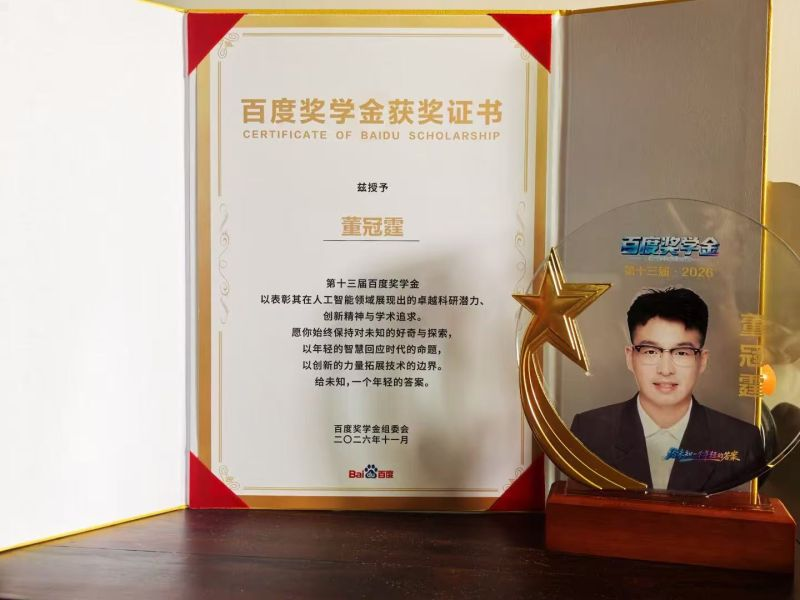
Thrilled to be selected for three fellowships in 2026! 🎉
🏆 2026 Baidu Scholarship (10 recipients nationwide)
🏆 2026 Tencent Project Up Scholarship (15 recipients nationwide)
🏆 2026 Ant InTech Scholarship (10 recipients worldwide)
🚀 Open to Opportunities:
I am actively seeking Post-Training Research Intern positions at frontier AI labs (e.g., OpenAI, Anthropic, Meta, xAI, NVIDIA) and am available to start immediately. Open to roles in Singapore, the UK, and the US (with visa sponsorship).
👏 About me (https://t.co/xH0vk5RDfS):
I am a 3rd-year Ph.D. student at Renmin University of China focusing on generalist agent training. Previously, I worked on foundation model post-training at Alibaba Qwen and ByteDance Seed. My works have received 25,000+ citations, with representative projects including ARPO, ToolSpace, Agent-World, AutoIF, Search-o1, Rejection fintuning (RFT).
If interested, feel free to DM or email me.
📫 Contact me: [email protected]
Honestly speaking, as a PhD student based in China, I don't have many overseas connections yet🥹. I'm super eager to explore any post-training research intern positions at frontier AI labs—I'd love to chat! Any leads, intros, or referrals would mean a lot to me🩷!
The Lean FRO and Mathlib Initiative have released a joint statement on the Lean verification of the Riemann Hypothesis.
On November 20, Levent Alpöge released a proof of the Riemann Hypothesis as a Lean library of 17 million lines of code. Over the past day, the Lean and Mathlib communities worked together to verify it. The statement certifies the proof as correct and describes how it meets all necessary verification criteria.
Congratulations to Levent on this achievement, and thank you to everyone in the community who contributed to the verification.
Full statement: https://t.co/edxEbkodw7
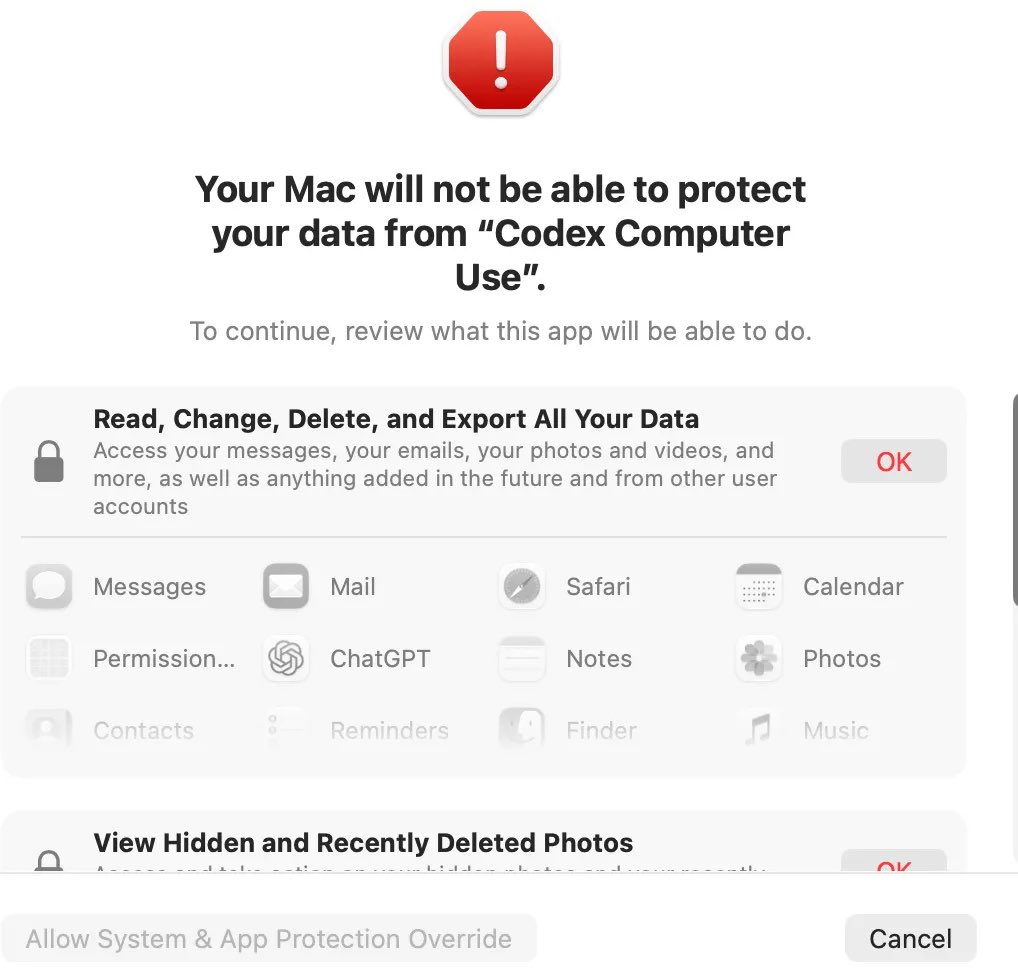
As Apple develops its own computer-use agent, it’s making it harder for rival agents to control Macs. In macOS 27.3, enabling ChatGPT’s third-party computer-use support now requires 14 distinct steps, up from four. Apple cites security; Some users see anti-competitiveness.
Computer use and robot use have a much deeper connection than most people think.
Fun fact: two lines of work started around the same time @osunlp back in 2022:
- Mind2Web, probably the first LLM-based computer use agent (prompting LLMs instead of tuning a small model like earlier attempts)
- LLM-Planner, one of the first works using LLMs for robot planning (hierarchical - LLM for system 2 and low-level controller for system 1)
At the end of the day, CUA and RUA require many same cognitive competencies, just on different embodiments.
Excited to see the two converging in 2026.
🖥️ Two years after we introduced OSWorld, frontier models have rapidly advanced in computer use, completing real workflows across the digital world.
🖥️ 🔜 🤖: Physical interaction is the next frontier, where foundation models expand into robot-use agents in the physical world while retaining their general intelligence. Agents like Claude Fable 5.2 already score 65% on RoboDojo. Problem already largely solved?
Not even close.
🚀 Today we introduce RoboWild: Can Frontier Models Generalize to Robot Use in the Wild?
🏠 38 furnished realistic scenes, from homes and stores to workshops and labs
🛠️ 4,480 objects, with operable doors, dials, drawers, and more
🤖 341 diverse tasks across four robot embodiments
📊 Best results: Claude Fable 5.2 reaches the highest accuracy at 13.3% on RoboWild, while GPT-6 Astra is far more token-efficient yet plateaus at 11.6%. No model is close to solving real robot use yet!
🏠 Homepage: https://t.co/unSuwNXnOH
📄 Paper: https://t.co/KGdCpGI7bB
📽️ Slides https://t.co/qQEOti2SVB
💻 Code: https://t.co/w9XUvNd4bB
🤗 Dataset: https://t.co/6ATZVUbmMD
🧵 [1/8]
我不喜欢大斜率,大xxx理论
这有点儿被媒体,以及曝光度最高的1%%带偏了,真实情况不是如此
例如现在的RL post training,不是只有做LLM post training的算法一小波人有饭吃,sandbox容器,rdma网络,storage高性能存储等等,大佬们过去积累多年的手艺,此时依旧在发光,在贡献
再比如曾经的GNN,GAN,FasterRCNN,训练这些的手感,数据直觉,全局把控能力,会消散吗?不会的,依旧很多人在LLM时代作出巨大贡献,arch/optimizer/loss/data,这些都没变啊
其实我觉得就1个理论:踏实过好每一天。摒弃调参思维误区,踏实看数据积累感觉,踏实做infra积累深度经验
走窄门,耕瘦田
After an amazing year at Meta’s TBD lab, I am very excited to join Mercor as Chief Scientist. Data will shape the next frontier as more companies train AI models than ever before. Mercor is incredible and I look forward to building the future with Brendan, Adarsh, and team!
Over the past week, I’ve been overwhelmed by the love and support of friends, industry colleagues, and people I've never met. Thank you to everyone who has shown kindness to my family and me. It means the world to me.
I came to the United States 53 years ago, and becoming an American citizen is one of the greatest gifts and proudest moments of my life. NVIDIA has been my life’s work. Building it into the company it is today alongside my colleagues has been a privilege and an honor. Nowhere but in America could a company like NVIDIA be possible. I love our country, and I love NVIDIA.
I did not live up to the standards expected of everyone at NVIDIA, and I have made serious mistakes in my personal life. I created problems for the Board that I deeply regret. I own my mistakes completely, and I am committed to cooperating with the Board’s independent investigation.
Since my departure, I’ve seen an outpouring of calls from NVIDIA’s employees, investors, business partners, and customers for me to return as CEO. Many continue to reach out to me directly as the company navigates complex technology, market, competitive, and geopolitical dynamics. NVIDIA is a once-in-a-generation company. If the Board of Directors decides that my return is in the best interest of our shareholders, our employees, the company, and America, I would be honored to answer these calls and return as CEO.
Thank you again to everyone who has shared their good wishes. I am profoundly humbled by your support. To my family: I love you, and I will spend the rest of my life being worthy of yours.
Jensen
I recently gave lectures on computer use agents at several places. I covered a brief history of CUAs, relevant evaluation considerations and benchmarks, modeling and training for computer use, and several directions that I'm excited about now that we have very capable CUAs.
Here's a recording from the CMU AI Agents course (highly recommend all the other lectures from this class as well): https://t.co/l6KYtKjgkk
@thesimaximalist@cutetoxicguy@MSFTResearch This is the part I care about most. Benchmarks reward a pure GUI loop, but products need something cheaper and faster. Hybrid computer use sits in between, and an open MCP server lets teams check that on their own workflows.
Strongly agree. RUA is retracing CUA’s path: SoM and grounding models gave way to base models. Only base models have long-horizon ability and world knowledge, so RUA ends up there too. Latency won’t block it: faster inference, System 1 actions, shorter reasoning (like Astra).
Claim: Computer-Use agents are embodied generalists
Back in August, we used a single computer-use agent across 4 different embodied AI-related competitions at ECCV, and we ranked 1st, 2nd, 3rd, and 6th places.
How? We constructed simple GUI software for each competition that connects to the benchmark tasks (e.g., using a keyboard to navigate inside a 3D house rendered in a web interface), and that's it. The agent itself stays the same.
I have been meaning to write about it for a long time, but here it is now:
https://t.co/lLHwJr6uHW
Now to the position: we believe that computer-use agents are embodied generalists. Why?
TLDR: We believe computer-use agents share striking similarities with models for embodied AI, and embodied tasks can be formulated as interactions with digital software. Once we have that, we can learn from what worked for computer use over the past 2 years, focus on digital scaling, and avoid mistakes or local minima in the grand scheme of things.
I would urge anyone working in computer use or embodied AI to take a quick read of the paper, or at least go through the website. We do not think many people would agree now, and only time will tell.
But we do think this is an important line of thought that everyone should consider. We look forward to feedback and constructive criticism!