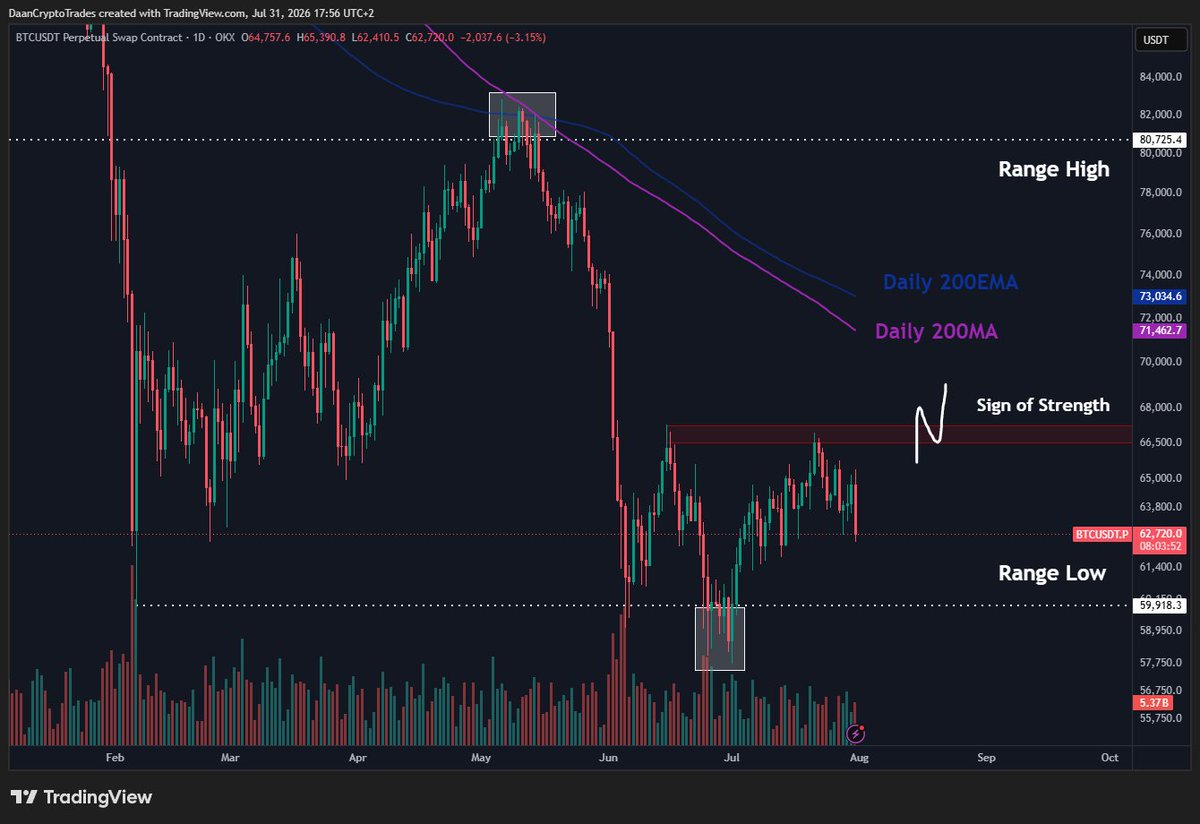
$BTC Still very indecisive price action the past few weeks.
Needs to break the local highs above $67K to get some momentum going.
Until then, the $60K level below is the support to watch.
Anything in between those levels will just be more chop like we've been seeing.
Describing Bitcoin's "governance" is bloody hard. There's nothing to relate it to.
It's anarchy; the closest models are open source projects or religions. But I'd argue Bitcoin has more complex dynamics across more diverse actors.
August will be a learning lesson for many.
Whats strange about soccer: It employs absurd mathematical precision to police offsides, a rule that mostly matters in spirit rather than in strict application. (You just don't want cherrypicking) But its extremely casual about timekeeping, whose literal application matters a ton
Emerging markets are where TradFi takes root.
For early‑twenties investors with smaller balances, this isn’t convenience. It’s first access to global markets.
This is where the door opens.
$10 billion in yield distributed to users since 2019.
From flexible savings to now covered-call strategies with Bitcoin, Binance has quietly built crypto's yield infrastructure.
Full story 👉
https://t.co/pX1rLx9LbP
People say Gen Z speculates. The data says otherwise.
Only 5.9% of their volume is in leveraged ETFs, the lowest of any generation.
The most underestimated cohort is often the most disciplined.
Compute trading, right now, feels a lot closer to the earlier part of the fracking boom (early 2000s) or pre-ETF BTC than a mature commodities market
Clearly a real thing in the long run, but likely something that requires more supply chain stability before hedging costs are brutally optimized
There are a lot of "irrational" or wrong-way premiums that cost many percentage points that far outweigh the 10s-100s of basis points you save with hedging
These premiums can disappear quickly (as we see with both shale and BTC) but when they exist, it is hard to bootstrap a de novo hedging marketplace because participants are spending more on keeping supply alive [BTC basis trades, fracking land purchases/leverage on land] than on lowering risk from variable demand
There are numerous persistent premiums that reflect the non-existence of a stable market clearing price in compute trading:
- price of new powered land > land cost of an existing build
- refurbished A100s/H100s being worth more than list
- cost of refurbishing existing data centers to handle ASICs/Vera Rubin/etc. > cost of a pure new build
- cost of origination + new rate for a new build > refinancing an existing data center loan
In the fracking boom, there were many idiosyncratic, long-term wrong-way financing costs that persisted for years until 'Bakken' and 'Marcellus' were footnotes in a debt arrangement rather than in the name of the SPV
In such a market, owning supply and order flow (proven shale deposits/fresh BTC/proven token demand) is usually better than owning the right to hedge. It is a bit like being a crypto exchange in 2013 — you would have a huge amount of demand if you survived for 4 years, but you were at the whim of your only persistent customer (miners) until that day arrived. And they would bleed you dry via 1000 cuts [remember quanto perps?].
The only thing I see accelerating the visceral need for hedging, much like there was for BTC, is the introduction of a new technology that moves the Pareto frontier and lowers borrowing/refi costs by an order of magnitude
For BTC, that came from wrapped assets, DeFi, and the ETF complex (e.g. IBIT options)
For AI, that seems to be coming from open source models, model routers, and inference providers
Trillion(ish) Dollar Question:
Should we expect the same microstructure that we see in DeFi in the matching algorithm token routing algorithms used to match inference capacity with open source demand?
$BTC Fibonacci retracement levels will always be one of my favourite tools to use.
They work so well on any timeframe. Especially the .618 tends to see a solid reaction on the higher timeframes.
If you can then find confluence with other tools or indicators you usually get a good idea of where to expect bounces.
This high timeframe area was one of those.
Still yet to see a proper bounce of course, but at least the down trend has stalled here for now.
JUST IN: 🇺🇸 White House Executive Director Patrick Witt says "The world’s largest police union and the third-largest asset manager in the world agree: pass the Clarity Act." 🚀
The $BTC Spot ETF outflow streak has recently ended and we've seen almost $1B in net inflows again since the recent lows.
A lot of coins were absorbed and traded around the $60K region so any inflows at this point should have a decent impact on price. As sell supply seems relatively low at this point after all the massive outflows in the weeks prior.
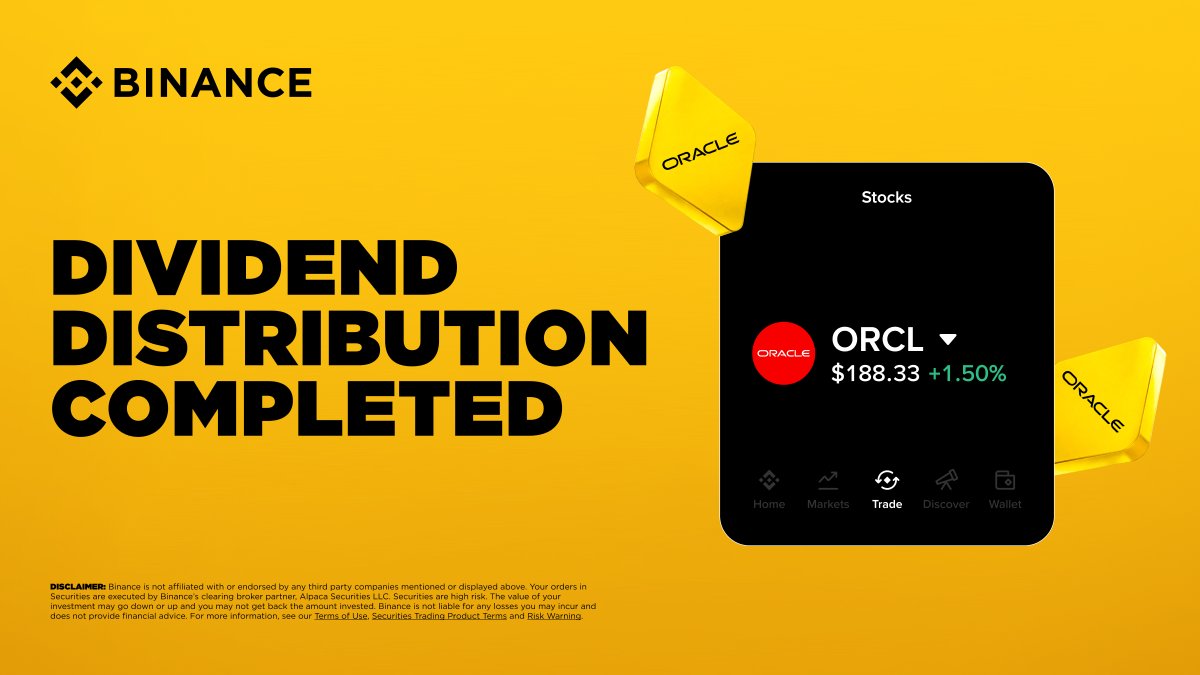
ORCL dividends are now in your Funding Wallet ✅
If you were holding shares before 10 July 2026, your dividend should now be available.
→ $0.50 USD dividend per share
→ Distributed in USDC
Thank you for being part of Binance Stocks. 🫡
Institutional-grade Bitcoin yield, without the custody risk. 🟠
Built by veterans of one of the world's largest structured-products platforms.
Non-custodial. On-chain. Up to 10% APY.
👉 https://t.co/AzfhDM0XSY
Real talk: if any company (in any industry) wants tips for how to expose North Korean sponsored actors early in your hiring process, ping me. We had fun making half a dozen of them squirm just last week!
https://t.co/rFgvHxZ4Kr
One thing I mentioned only in passing in my Fable post is that, for long running tasks, Fable starts to develop its own dialect as its many agents and tasks reinforce themselves and make Claudish language ever more Claudish.
You need to ask it to report out in plain English.
The Open Source Hub returns to Bitcoin Asia with hands-on demos, technical workshops, live presentations, VR experiences, and the builders behind the software that powers #Bitcoin. 👀
Test wallets. Run nodes. Explore Lightning, Nostr, ARK, AI, and more. ⚡️
Come build with us 🫵