An update on our engagement with @Mastercard.
While Cardano was not included in the initial cohort of 85 launch partners, @emurgo_io has been actively engaging with their APAC team to change that and ensure our ecosystem is represented.
Following a leadership transition at Mastercard APAC —where our primary contact moved to EY — we have successfully connected with his successors. They were excited to speak with us and I am pleased to share we are now in the Qualification Stage for the Global Crypto Partner Program.
With the continued support of the Cardano community, I am confident in a positive outcome.
This important:
Please like and share to show @Mastercard the strength of our ecosystem. Mastercard is a global firm.. we need to show them that our inclusion into their Partner Program will make a difference to them. Surely this is an initiative the entire Cardano ecosystem can support! #cardano86
Let's go!!!
#cardano #mastercard @Cardano_CF@Cardano@IOGroup@midnightfdn
USDCx on @Cardano, a USDC-backed stablecoin with seamless access to crosschain USDC liquidity, is now available via Circle xReserve.
With USDCx, enterprises and end users can power payments, lending, trading, borrowing, liquidity provision, and more using a highly liquid stablecoin.
Supported at launch by Cardano DeFi apps @liqwidfinance, @MinswapDEX, and @SundaeSwap.
Key benefits:
✅USDCx is 1:1 backed by USDC held in xReserve
✅Fully interoperable with USDC across supported chains
✅Trust minimized with no third-party bridges required
**For the first 10 days, IOG will be covering all costs for bridging USDC to USDCx on Cardano, helping early adopters get started without fees or friction.**
Learn more: https://t.co/yOA12hJQDk
Just getting started. First CNA to trend above Bitcoin and Ethereum. Midnight makes what it touches better. Adding Midnight to XRP DeFi is going to blow the legacy banks out of the water. Adding Midnight to Bitcoin gives the world Satoshi imagined possible. Adding Midnight to Cardano supercharges our DeFi ecosystem and will 10x the MAUs, Transactions, and TVL as we are first to market with private DeFi at scale.
Welcome to the 4th generation.
$NIGHT launched in December and has since entered the top 100 tokens by market cap.
In this article, we explain how @MidnightNtwrk is redefining onchain privacy through selective disclosure and a dual-token model.
Read the full guide 👇
https://t.co/J0KNgzoUvp
DECENTRALIZATION OF L1 POS BLOCKCHAINS
A COMPREHENSIVE ANALYSIS 2025
ETH | SOL | TRX | ADA | DOT | AVAX | SUI
When the media and influencers, when they talk about decentralization, talk only about the "Nakamoto Coefficient" - yes, it is important. And no, it is not the only parameter of decentralization. That's why we're starting right now.
I must say right away that I will not publish all the calculations here, it would take too much of your time. This is my personal opinion - I do not claim to be 100% true. DYOR.
Let's take as a basis that the total score in the table is 100% = this is the maximum possible decentralization that everyone is striving for. But so far no one has achieved it and probably won't, and I doubt it's possible. That's why even the best decentralized blockchain doesn't have 80%.
This analysis evaluates the decentralization of Layer 1 PoS (Proof of Stake) blockchains through 8 layers, based on the methodology of EDI (Edinburgh Decentralisation Index) - I took it as a basis, but it's not the same (!). Each layer focuses on a specific aspect of the network, using metrics like HHI, Gini, Shannon Entropy, and Nakamoto Coefficient. Importance: In PoS, decentralization reduces risks of attacks, censorship, and failures, increasing resilience. The layer weight reflects its contribution to the overall score (0-100). Below is a brief overview of each layer, with parameters and their importance in evaluating PoS blockchains.
Hardware (5%)
This layer evaluates the concentration of hardware infrastructure (validator hosting) to identify risks of provider failures.
1. HHI by cloud providers: measures concentration across cloud providers (high HHI = risk from dominance, e.g., AWS). Importance: In PoS, a provider failure can stop validators, reducing liveness.
2. Dependency ratio on top providers: share of top-3 providers. Importance: Shows dependence on a few, vulnerable to attacks or downtime.
Software (7%)
Focus on diversity of software clients (node implementations) to avoid bugs in a dominant client
1. Concentr. ratio for top 2 clients: Share of top-2 clients. Importance: In PoS, dominance (e.g., Geth in ETH) risks a fork from an error.
2. Shannon entropy by client shares: diversity of client shares. Importance: high entropy = more alternatives, increases resilience to vulnerabilities.
Network (8%)
Evaluates network decentralization (connectivity) to make the network resilient to DDoS or partitions
1. HHI by ASNs: concentration across autonomous systems (ASNs). Importance: In PoS, high HHI in ASNs (e.g., AWS ASNs) makes the network vulnerable to ISP failures
2. Gini by node peers: Inequality in the number of peers per node. Importance: even peer distribution ensures good gossip, reducing latency and censorship
3. Shannon entropy by node peers: Diversity of peers. Importance: High entropy = network not dependent on a few hubs, improves liveness
Consensus (34%)
Key layer (!) - concentration in block production, determines PoS security.
1. Nakamoto coefficient: minimum number of entities to control >1/3 stake. Importance: Shows attack risk (low NC = centralization).
2. Gini coefficient: stake inequality. Importance: High Gini = concentration, vulnerability to whales.
3. Effect.number validators/pools: effective number of entities (exp(Entropy)). Importance: Accounts for real diversity, balancing raw count.
4. Cost of 33% attack: cost of 1/3 stake attack. Importance: Economic protection in PoS, high cost = low attack feasibility.
5. Shannon entropy: stake diversity. Importance: High entropy = evenness, reduces risks.
6. Herfindahl-hirschman Index: stake concentration. Importance: Penalizes large entities, standard for monopoly risks in PoS.
7. "1-concentration ratio": share of top-1. Importance: shows dependence on one entity.
Tokenomics (24%)
Token distribution and economics, influencing incentives
1. Gini by holders: Inequality among holders. Importance: High Gini = concentration in whales, manipulation risk.
2. HHI by token distribution: token concentration. Importance: High HHI = economic power in few hands, low decentralization.
3. Voter turnout rate: % participation in staking/governance. Importance: High turnout = active community, reduces speculation in PoS.
API Clients (2%)
Concentration of API providers for network access
1. HHI by API providers: API concentration. Importance: High HHI (e.g., Infura dominance) = risk of outage for dApps
2. Dependency ratio: Share of top-3 API. Importance: Dependence on a few = single point of failure for users.
Governance (13%)
Diversity of governance for democracy
1. Shannon entropy by proposals: diversity of proposals by authors. Importance: High entropy = proposals from many, reduces elite control.
2. Gini by votes: Inequality of votes. Importance: High gini = votes concentrated, low participation diversity.
Geography (7%)
Geographical distribution for censorship resilience.
1. HHI by countries: concentration by countries. Importance: High HHI = risk from regional regulations/outages
2. Censorship resistance Index: share in censored regions. Importance: Low index = high censorship risk in PoS.
Why Nakamoto coefficient differs from nakaflow website? The Nakamoto coefficient on "nakaflow io" is higher because they divide pools into multiple node operators (e.g., ETH: Lido - ~500 operators, not 1), which increases the number of entities and NC. This is a more optimistic approach, but it can overstate decentralization if operators are connected (e.g., through cloud). I prefer to consider entities
Conclusion:
This is not "just random numbers" - this is a structured analysis (NC, Gini, HHI, etc.), which help compare chains in terms of security, resilience, and risks (e.g., 33% attack, stake concentration). Usefulness: shows strengths/weaknesses (e.g., Cardano high in distribution, ETH low in NC), but due to approximations (old data for hardware/network, N/A for governance) this is not "final", but indicative. In my opinion, $ADA is the most mature blockchain in terms of decentralization, but there is room for growth. For example, develop alternative Software to reduce concentration. I also see some problems with SOL and ETH, especially in the Governance layer. TRX looks the worst of all. DOT AVAX SUI shows good metrics.
FYI: none of the blockchains paid me for this research, so it's as independent as possible.
What kind of research should I do next? maybe for a complete picture of the blockchain trilemma, it is necessary to consider the scaling and security of PoS blockchains in separate studies.
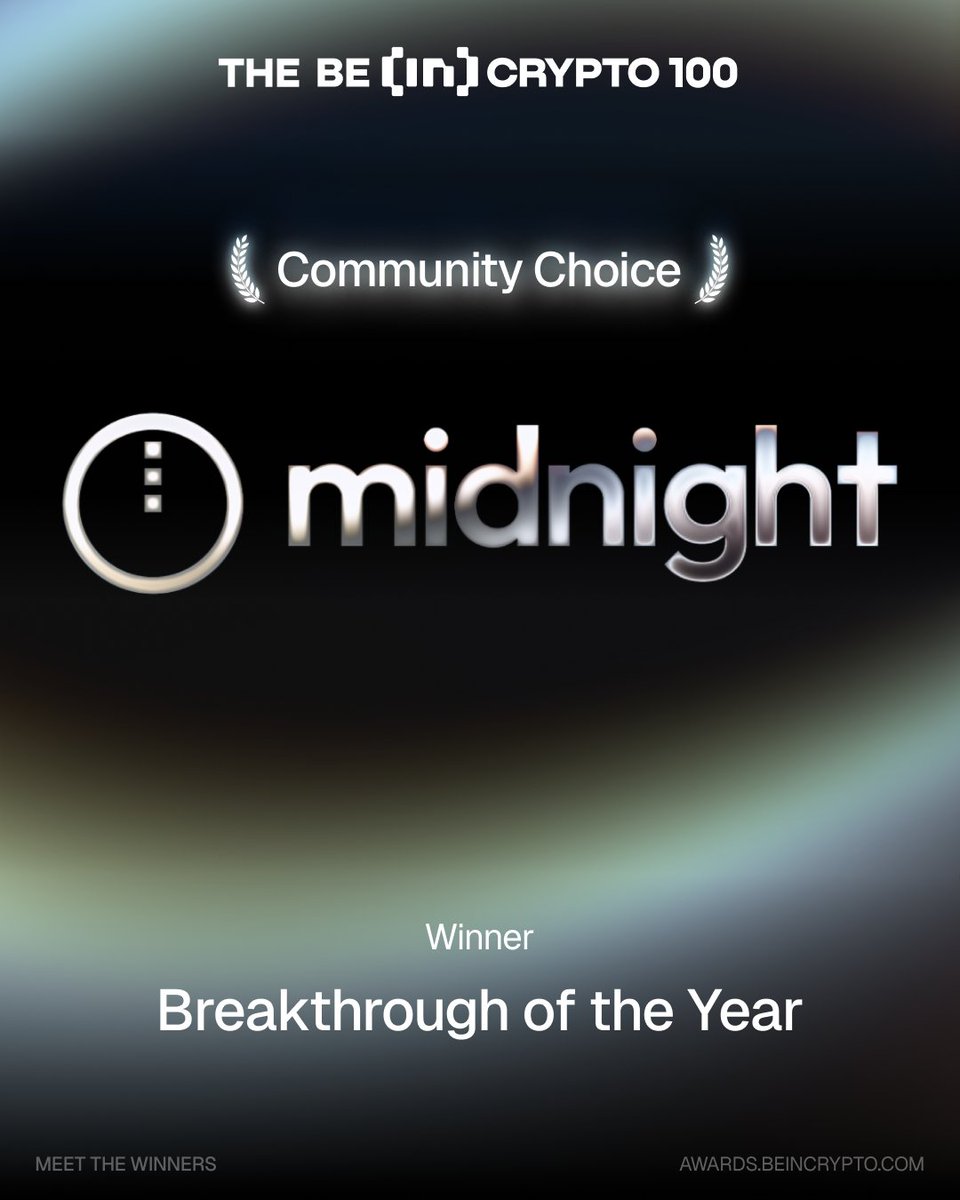
Midnight has been voted @beincrypto's Breakthrough of the Year & this win belongs entirely to the community. 🏆🕛
Thank you to everyone who shared, voted, & continues to support privacy as a fundamental right & what Midnight is building.
It’s been a monumental week, but this is just the beginning. Onwards.
ICYMI: @IOHK_Charles shares how Midnight will accomplish what the first three generations of blockchain couldn’t: privacy that works, identity that scales, and cooperation that accelerates adoption.
Full breakdown below 👇
https://t.co/u1IjhJ4RbP
NIGHT Midnight Project Research
Binance December 9 Alpha
Midnight is a partner sidechain of Cardano (ADA), focused on privacy and compliance. It uses zero-knowledge technology to enable data transactions without sharing user data.
📑 Project Features:
🔸 DUST is used for GAS fees and is continuously generated by holding NIGHT
🔸 Users can selectively disclose transaction information under privacy protection to meet regulatory compliance requirements
🔸 Cross-chain transactions on Midnight do not require users to personally hold NIGHT or DUST
💰 Tokenomics:
🔸 Token distribution consists of 3 phases. After claiming in Phase 1, approximately 25% unlocks roughly every quarter:
▫️Phase 1: Glacier Drop – Multi-chain wallet airdrop (Cardano (ADA) 50%, Bitcoin 20%, other networks 30%)
▫️Phase 2: Scavenger Mine – Redistribution of unclaimed tokens from Phase 1, with a portion reserved for Phase 3
▫️Phase 3: Lost-and-Found – Starting 4 years later, allows originally eligible addresses that missed the Glacier Drop to reclaim a proportional portion of their original allocation
🔸 Total supply: 24 billion tokens; initial circulating supply reported to CMC is 10.8 billion
💹 Project Economic Model:
🔸 When a block is generated, if the block is not fully utilized, a portion of the tokens are transferred to the treasury
🔸 Part of the service fees in cross-chain scenarios are collected into the treasury
💷 Sources of Participant Revenue:
🔸 Run validator nodes and earn block rewards for producing blocks
🔸 Stake NIGHT to node operators (speculated)
🔸 Obtain DUST by holding NIGHT; DUST can be rented out (although DUST cannot be directly traded, the ownership of the holding address can be transferred)
💲 Funding Status:
🔸 None; the official X account only mentions some partners
⚠️ Notes:
🔸 The whitepaper clearly states that NIGHT is non-burnable (no token burning mechanism)
#BinanceAlpha #Midnight
Day 10 Midnight Scavenger Mine Update
Day 10 total solutions was slightly lower than day 9 due to the big difficulty jump yesterday afternoon which makes it a lot harder to find solutions.
Submitted Solutions today are way down on previous days due to the change which would mean higher rewards for todays solutions if it stays on this pace so will be interesting to see if it picks up as the day goes on.
Scavenger Mine just got bigger. 🥳
Following the massive community participation, the total NIGHT allocation for this phase is increasing to 1B NIGHT, distributed evenly across the 21-day period.
This update also applies retroactively, meaning all previous participants will see their allocations increase over 50%, a benefit to those who’ve been part of the Mine from the start.
To close out Scavenger Mine, Day 21 (Nov 19), will be browser-only, giving everyone an increased opportunity to participate as the phase wraps.
Let’s finish strong. More details: 👇
https://t.co/XkfN9ty12z
It's come to my attention that apparently @Cointelegraph's editor in chief refuses to publish a retraction about the story they ran on the alleged ada voucher theft.
Apparently, they will run a story that we are "pressuring them". Telling people to tell the truth about what happened, isn't pressure, it's basic journalistic integrity, which @Cointelegraph lacks at its core.
As an industry, we need to do better and if you run a project in crypto, I'd recommend pulling your ads from cointelegraph, attending their events, and legitimizing them.
Accusing IOG of stealing 600 million dollars is defamation at the highest level. Giving a platform for it without even contacting us and not correcting the record once we have been fully exonerated is equally defamatory and reckless.
@NanoBanana@GeminiApp@nanobanana Create a 1 / 7 scale figurine in the picture, in a realistic style. The figurine is plattered on a computer desk. The figurine has a round transparent acrylic base, with no text on the base. The content on the screen is the Zbrush modeling process of this figurine.