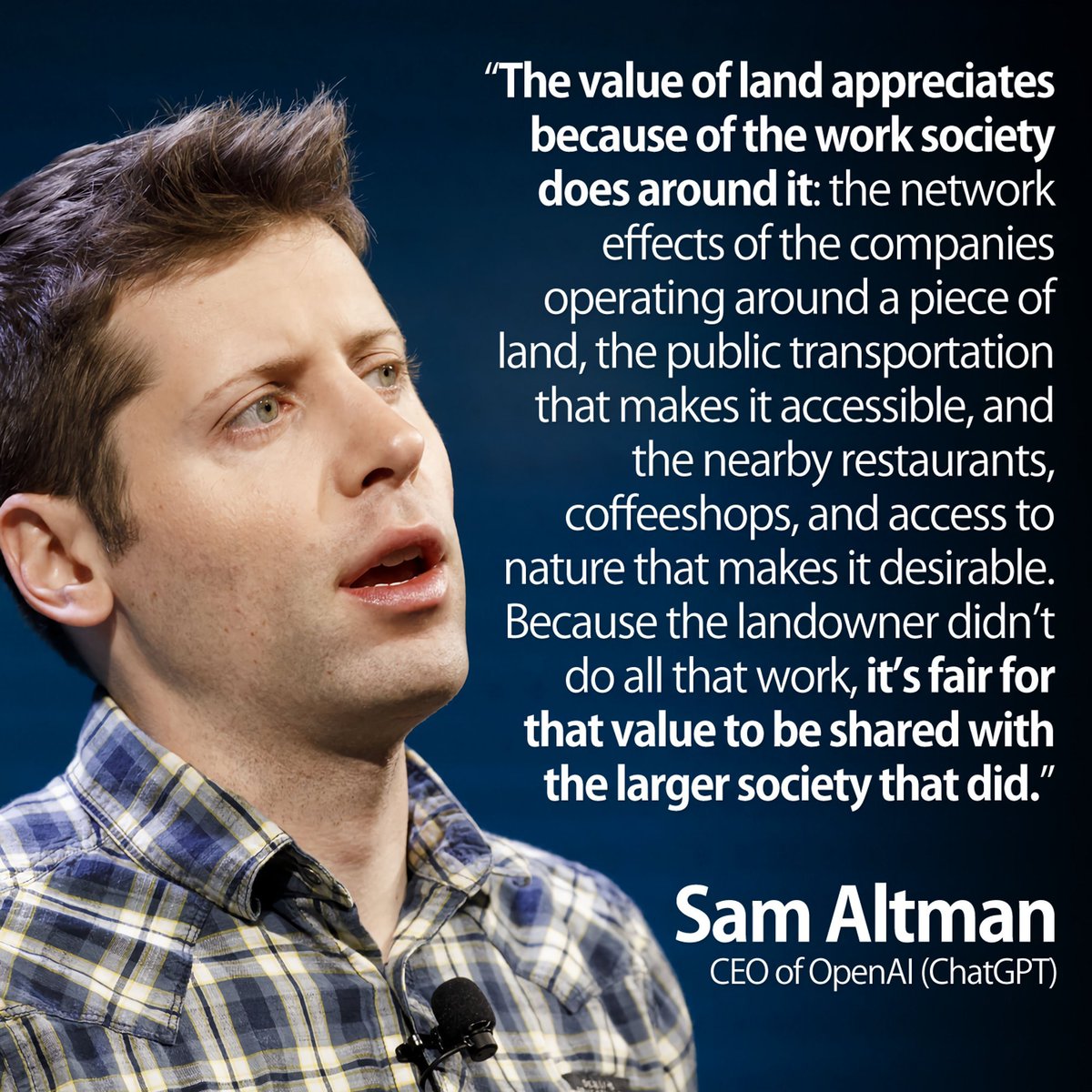
Property rights system that improves fairness, market efficiency, and prosperity via priced network effects. Account managed by independent @RadxChange chapter.
Pls join the Future Art Ecosystems community call to hear about the partial common ownership system that we’ve been developing with @RadxChange and @GravenPrest. We’ll also be making an exciting announcement! RSVP to [email protected] to get the zoom link.
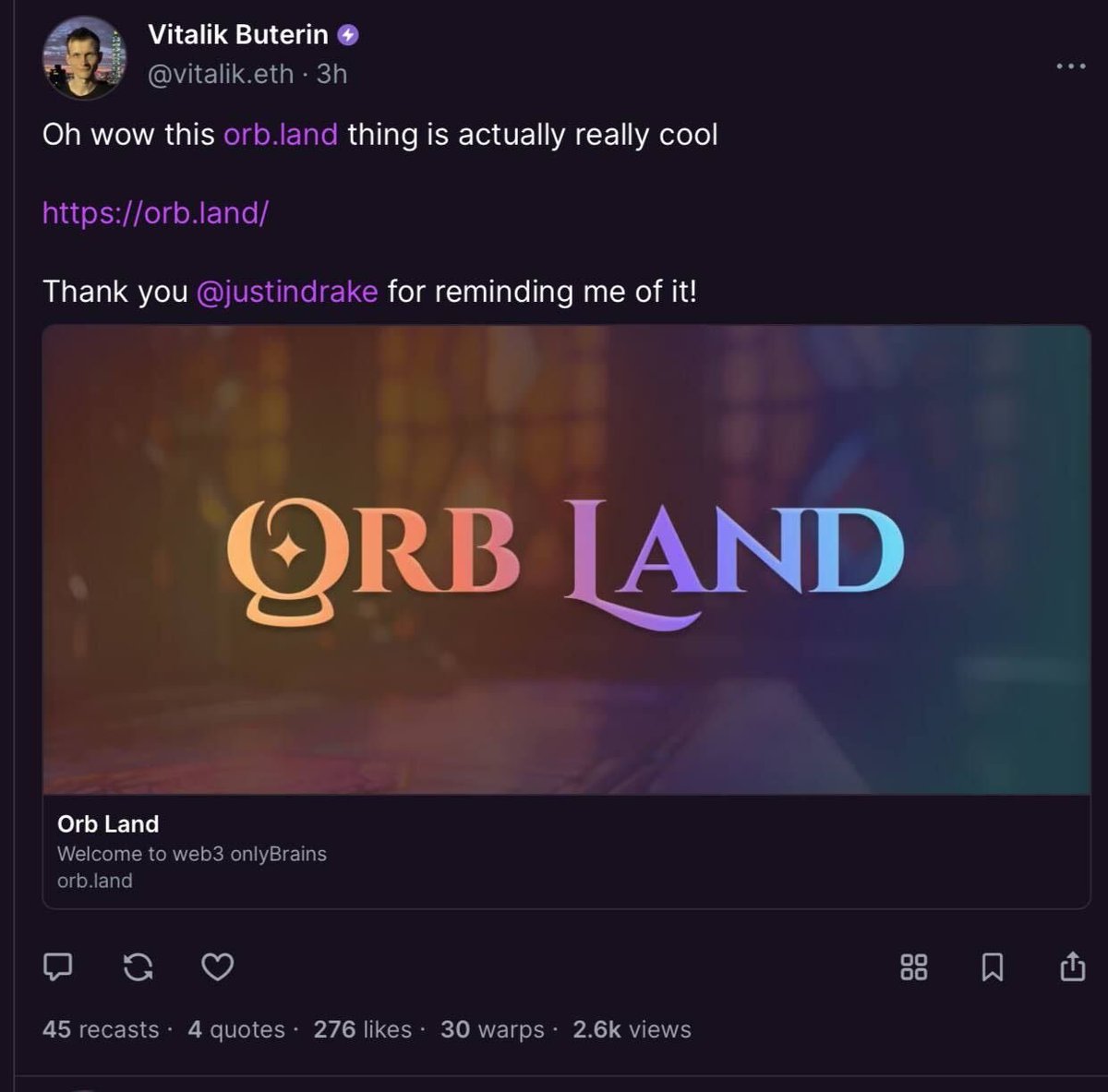
It’s funny that Orb Land (also called “the worst NFT project in history") is catching some eyeballs on this blessed day
The reason this is funny is because unfortunately, we’re *just* on the cusp of unwinding this passion project of mine (and my co-founder @lekevicius!)
Let me tell the story and provide some color
Orb Land started about a year ago as a platform where you can create an “Orb” that allows you to auction off a recurring slice of your time (and the right to it perpetually governed via Harberger taxes)
So far Orb Land has onboarded the following orbers:
1. me
2. @nic_carter
3. @zmanian
4. @tarunchitra
5. @drakefjustin
The project stems from a desire I had to create NFTs with actual utility. I wanted them to resemble usable items that you have in your magic item bag in World of Warcraft rather than just be jpegs you show off. The utility aspect was access to individuals with deep domain expertise. Kind of like a “Call a Friend” lifeline option in “Who Wants to Be a Millionaire”
The questions people ask and the answers orbers give are immutably hashed and stored on the Ethereum blockchain
This is (mildly) interesting for a few reasons. Most recently because it came handy for Justin Drake to prove that he has been transparent about his EigenLayer advisory role prior to being called out on it, with cryptographically verifiable proof onchain.
The basic idea behind Harberger taxes means the Orb is always for sale to the highest bidder and should surface the most meaningful high-value questions, while also allowing orbers to showcase their domain expertise and the demand for it at a dedicated place
You can also see how you could start ranking different orbers based on their weekly rate, giving a highly responsive, fluctuating, competitive market signal for the value of their words (a "PvP factor" that's usually the driver behind many social platforms)
Over the year, we’ve kept making improvements to the platform, like inventing contract upgrade logic patterns that require the opt-in both from orbers and Orb holders, changes to the auction logic and the ability for people to purchase individual question slots rather than buying a whole Orb
However, with our latest onboards we’ve discovered that "soft social enforcement" for orbers to give answers on time was not working. We always knew this would be the case eventually, and have had different economic mechanics prepared for this
The one we felt most excited about was one that would force the orber to stake an NFT inside the orb that they would forfeit to their Orb holder if they miss a deadline. You could imagine having to stake a milady that you lose if you forget/neglect your Orb
But the issue with missed deadlines spoke to a deeper truth about Orbs. Were people really having fun with their orbs? Or did the orbs feel like annoying homework?
One of the aspects of the Orbs that creates an undesirable experience is that both the orber and the Orb holder is a bit stressed out. The Orb holder has to come up with great questions and make the most out of their Orb ownership, and the orber is compelled to answer with unforgiving deadlines. Were Orbs making people more happy or less happy?
I had an actual dream where I was speaking to a beaten up @nic_carter (who usually complains about the "homework" aspect of his Orb) where he said that he'd much rather have an Orb that allowed the highest bidder to fight him in the ring next year than having to answer questions each week
Unironically, I think this may be the key to "Making Orbs Fun Again". The Q&A format is a bit stale. We should allow for a lot more lightweight services to be managed through Orbs, like boxing rights, podcast guest rights, dinners (and one we talk a lot about internally, a "slap-Eric-in-the-face" orb for my haters), more freedom
As the project is dealing with these fundamental questions, we've also been dealing with basic infrastructure dilemmas. Today, all Orbs are deployed as L1 contracts. As the functionality gets more complex, it's no longer always feasible or wise to deploy contracts to L1, so we've been thinking about L2 Orbs
This has thrown me right into the fragmentation pit of Ethereum where I've been deciding between Arbitrum, Base, Blast, Starknet and other L2s to deploy on
The challenging aspect is that neither of these L2s have obvious methods for how to bridge NFTs from the L1 to the L2 (in order to leverage NFT slashing to hold orbers accountable). While it is possible to bridge an ERC721 via the OP Stack, there are no good interfaces for it, and even bridging one via Wormhole takes something like 30 mins. This part of the ecosystem is still underdeveloped
In the middle of dealing with these L2 choices and Orb design decisions I've also come to realize sad fact that I can't give Orbs the love and time they need in order to flourish. Things at @TaprootWizards continue to get more exciting, OP_CAT is dominating the Bitcoin dialogue and I'm for the first time in a long while extremely bullish on the Bitcoin ecosystem
Orb Land thus far has been entirely self-funded. We've not raised through any grants or taken any VC capital. As such, we have the ability to simply pause the project.
This brings me a great deal of pain since for the last year I've been frustrated with the overfocus on infrastructure in the Ethereum ecosystem, and @orb_land has stuck out as a non-ponzi, non-growth-hacky app-layer product with a clear and simple business model (we simply charge a % of Orb revenues, and we can enforce royalties because Orbs have no transfer function)
I wish I could do more for the project, especially now as its getting on more people's radars, but it looks unlikely from here. Thanks for reading if you read this far <3
🎧 Check out our latest full epsiode of RadicalxChange(s). Guest host @margaretlevi interviews @m_t_prewitt on his insights on rethinking ownership, exploring the dynamics of property and liberalism, & how Partial Common Ownership fits in the picture.
https://t.co/i41qg9WJKE
I feel like @thegeoweb is what Decentraland should have been. Private-property-land we already have in real life along with all its negative externalities. Nothing new there.
Props to Geo Web for experimenting with novel partial-common-ownership / georgist / harberger ideas 👏
Today is a huge day on the Geo Web: we’re launching the Streaming Quadratic Funding Pilot w/ @superfluid_HQ & @alloprotocol by @gitcoin. SQF is a novel implementation of QF that is *funded* & *distributed* in real-time.
It’s effectively like running a QF round every second.
OpenAI teams up with Polis co-founder Colin Megill to pioneer a program aimed at integrating public deliberation into AI governance.
@colinmegill@OpenAI@TimeMagazineRS
https://t.co/fz35f0n5es
With awesome partners, we're putting the finishing touches on a "streaming quadratic funding" system.
It will allow us to efficiently & democratically allocate our PCO land market funds to public goods in *real-time*.
It's groundbreaking. And it's only possible in web3 🚀
#張寶成專欄|藏家轉身成為管理者:什麼是「部分共有制藝術」(PCO Art)?
【Column by Zhang Bao-Cheng】Collectors as Stewards: What is Partial Common Ownership of Art (PCO Art)?
@crypto_zysbot@SerpentineUK@glenweyl@RadxChange
https://t.co/2GUbxdUb00
WTF is Partial Common Ownership?
Take a peak, it's 99% done... here's the preview!
https://t.co/dneqctirTg
@romeives pupcakes @thegeoweb@RaidGuild@GDevelopApp - Thank you for your work/ financial & moral support/ opensource software and help throughout!
"It's a beautiful thing for [Harberger Taxes] to just be simple and honest, like that's the dominant Game Theory – be honest about your valuation – and then you've got to go earn your money on top of it." @GravenPrest
https://t.co/c50ZhyiNum
🚨 5 days remaining in the Geo Web's first protocol QF round! 🚨
Get your votes in here: https://t.co/EYxX7SKZBC
The matching pool is funded by the Geo Web's Harberger tax land market!🌱♻️🤯