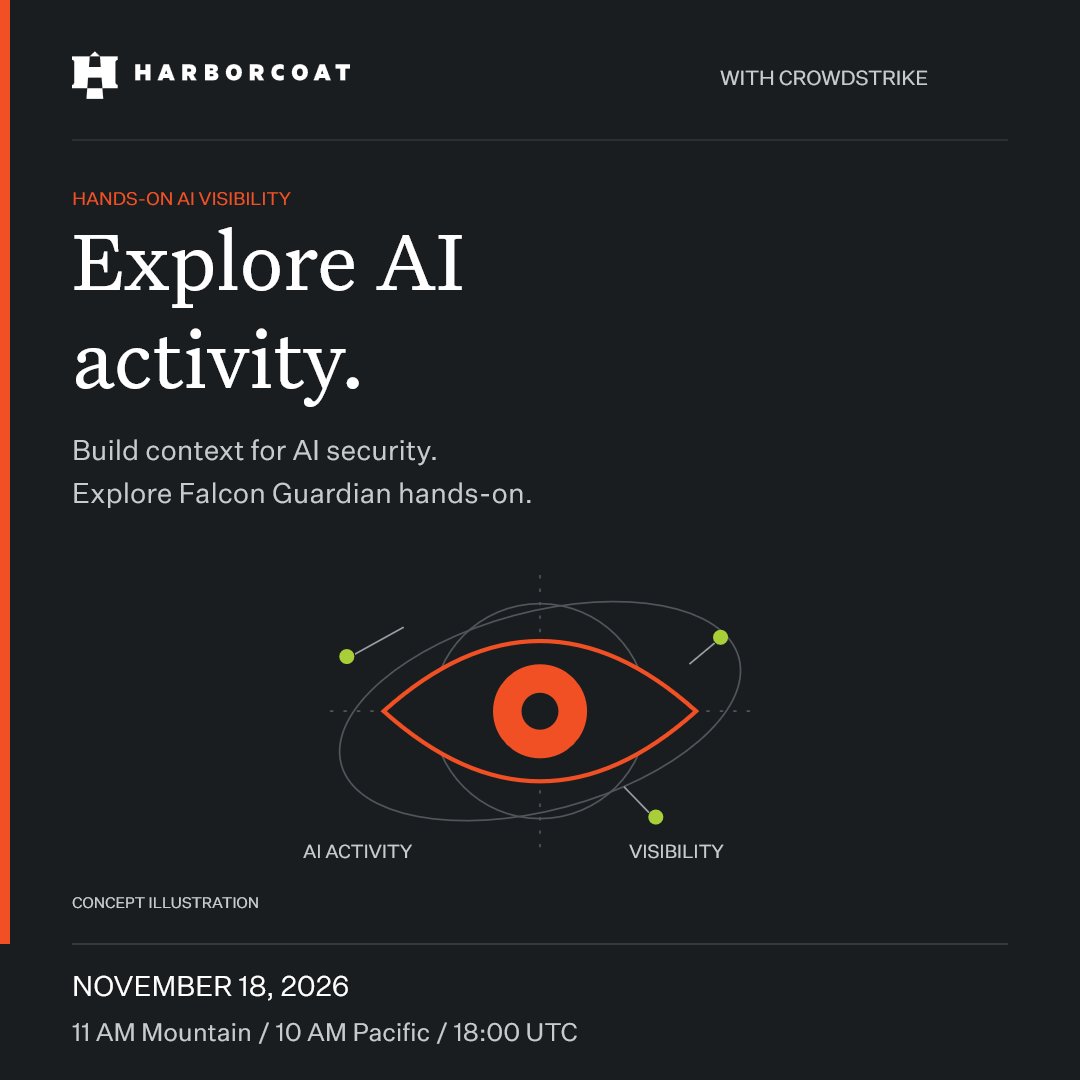
Where is AI being used, and what should your security team investigate? Join Harborcoat and CrowdStrike for a hands-on lab focused on exploring AI activity and visibility into its use.
November 18, 2026
11 AM Mountain / 10 AM Pacific / 18:00 UTC
Register: https://t.co/AGGBAvVuPc
cybersecurity is the new gold rush.
and i genuinely think it will become one of the most in-demand, highest-paying and most talked-about fields in tech over the next few years.
look at what’s happening. supply chains are being compromised, crypto is being targeted, major websites are serving malicious scripts, user data is being exposed, and companies are constantly dealing with vulnerabilities they didn’t even know existed.
the optimajack incident is another reminder that even the biggest companies aren’t immune.
as more of the world moves online, the attack surface keeps growing.
AI is making it easier to build software, but it’s also changing how quickly vulnerabilities can be discovered and exploited.
the demand for people who can actually secure systems, audit code, hunt vulnerabilities, understand attack surfaces and respond to incidents is only going to grow.
everyone wants to build the next big thing.
but who’s making sure it doesn’t get hacked?
imo, cybersecurity is going to be one of the biggest career opportunities of this decade.
Tomorrow we're running a free, hands-on AI Security Lab (virtual, 11:00 AM - 12:30 PM MT / 10:00 AM PT).
Attendees work through a day of simulated employee AI activity and decide what a security team should actually act on. A few spots left if you or someone on your team wants in:
https://t.co/jIqQC5yvGU
The FBI is warning that cybercriminals and state-aligned hackers are using ARTEX, an open-source AI hacking tool, to automate attacks on organizations worldwide.
The tool runs on outside AI models, including Anthropic's Claude, OpenAI's GPT and China's DeepSeek.
Follow: @AFpost
Imagine stealing $6.3 BILLION in just 20 minutes.
And instead of becoming the richest criminal in history, you’re doing it for North Korea.
This is Lazarus Group.
Probably the most dangerous hacking organization in the world.
Their history is insane.
2016
- attempts to steal $1B from Bangladesh Bank
- manages to get away with $81M
2017
- WannaCry ransomware
- hundreds of thousands of computers infected
2022
- Ronin Bridge hacked
- $625M stolen
- attack started with a fake job offer
2024
- WazirX: $235M
- DMM Bitcoin: $308M
February 2025
- Bybit loses $1.46 BILLION
- hackers compromise Safe{Wallet}
- FBI confirms North Korean involvement
October 29, 2026
- a Binance DevOps engineer’s laptop is reportedly compromised
- attackers gain access to internal infrastructure
- 50 EIP-7702 authorizations submitted
one successful authorization is enough
20 minutes later
- $3.79B stolen on Ethereum
- $1.47B in Bitcoin
- $628M on Tron
- $296M on XRP Ledger
- funds drained across 10 blockchains
$6.36 BILLION.
Binance and stablecoin issuers manage to freeze approximately $3B
But the attackers still control 420,000 ETH and 18,270 BTC.
$2.4 BILLION.
According to US authorities, this stolen money helps finance North Korea’s nuclear and missile programs.
We’re talking here about an operation backed by an entire country.
And one compromised laptop may have been enough to make the biggest crypto theft in history.
This is the most serious 48 hours in cybersecurity history.
"Black October" they're calling it
It seems every *hour* there's a new incident, that in a typical year, would be one of the biggest incidents of the *entire year*
SUMMARY OF THE LAST 48 HOURS:
YEAR-LEVEL INCIDENTS (In a typical year, these would be among the biggest incidents of the year):
1. PHP2Shell: a hole in the software behind ~70% of websites. Governments took sites offline.
2. eMudhra: the master keys that prove websites are real were cracked. One was the number 4.
3. California: data on every public school student since 2023 stolen, including disability status
4. Railway: hackers stole customers' secret keys from a hosting platform used by millions of developers
5. Zeabur: 321,810 accounts breached. The company is shutting down.
6. LiteLLM: an AI tool downloaded 3.4 million times a day was poisoned with a password stealer
7. GitLab: a 10-out-of-10 severity hole in every version since 2014
8. Cairn: criminals used an AI hacking tool to break into 100+ companies
9. Ahold Delhaize: hackers knocked the owner of Food Lion and Stop & Shop offline
10. Onamae: malware planted on up to 26,739 customer servers in Japan
MONTH-LEVEL INCIDENTS (In a typical month, these would be among the biggest incidents):
11. Signal: a bug could leave your mic and camera on after you hang up
12. NGINX: 3 critical holes in software running ~1/3 of websites
13. HTTP/3: a single connection can crash 7 of the 10 web server types tested
14. Plex: hackers breaking into home media servers
15. SafePay ransomware: FBI warns it has hit 600+ critical infrastructure organizations
16. Palo Alto: ransomware gangs breaking in through company firewalls
17. Bullhorn: platform used by 10,000+ companies knocked offline
18. Medi-Cal: 970,000 patients' data stolen
19. WordPress: hackers stole a plugin maker's keys and used them to plant backdoors on websites
20. AOMEI: backup software's update server handed out a backdoor
21. Meta Muse: Meta's AI agent exposed users' personal and business secrets
22. Tor: 333 relays hijacked to steal logins
23. TiDB Cloud: database company's cloud breached
Also serious:
24. State Bank of India: India's biggest bank confirms a data breach
25. OVHcloud: hackers slipped a password stealer into a cloud company's official tool
26. Siemens: a software hole being used to spread malware
27. North Korea: state hackers launch a new attack campaign on South Korea
@carlosmcgnarlos@LADWP We have PDG&E, but it is still expensive. Even with a 36 panel solar array on our hill, we were hit with a thousand dollar bill!
Had an "interview" for a blockchain project last week.
Camera was on, we're chatting, and the guy tells me to clone a GitHub repo and run it locally before we go further into the technical round.
I said sure, but first can you do me a favor
hold up 3 fingers in front of your face for me real quick.
He froze.
Didn't move.
Just sat there for a few seconds before the call cut off and he blocked me.
That's when I knew. A real interviewer doesn't glitch out over a random ask like that. A deepfake/AI overlay does.
These "run this repo" scams are getting scary common in crypto and dev hiring right now.
The setup is always the same:
- flattering DM
- real-sounding project
- rushed timeline
- a "quick step" before the call
that's really just remote access or a credential stealer in disguise.
If someone wants you to run code or install something before you've even had a real conversation, that's the whole scam.
Trust the instinct. Stay safe out there.
Just had the creepiest scam ever happen 20 minutes ago.
I got a call from my wife telling me she forgot her wallet and needed the credit card to pay for her gas.
Except my wife was at home with me, and drives a Tesla. Same voice, bit... off, weird cadence but 100% sounded just like her. If she wasn't there, and it wasn't about gas I would have fallen for it.
I entertained it for awhile to get more out of it, I was so confused. Must be some sort of voice deepfake. The responses were too fast for ai, I think it was a voice filter. I wish I had thought to record it.
The future is about to get fucked. Warn your loved ones, do verbal passwords with your kids.
Bit taken aback
The company which leaked data is IDScan. IDScan does not list all of their customers, however some are publicly known. If you have ever used these companies (and provided an ID) your data has been leaked:
- Shell
- AMC Theaters
- DraftKings
- Dutchie
- FedEx
- Hertz
- Chevrolet (General Motors)
- GameStop
- Jack Henry
- MRI (Checkpoint ID)
- Polaris
- Simmons Bank
- LendingUSA
- Circa Resort & Casino
- Planet 13
- Rouses Market
- US Coast Guard Academy
- Caesars Entertainment
- Motorola
Did you know there's a type of phishing attack that defeats MFA completely.
It's called a reverse proxy phishing kit and it's one of the fastest-growing attack techniques in cybersecurity.
Traditional phishing works by using fake login page. you type your password. attacker gets it. if you have MFA enabled, the stolen password alone is useless. attacker gets stopped at the second gate.
reverse proxy is different.
instead of a fake page, the attacker sets up a live proxy server between you and the real website. when you click the phishing link, you connect to the attacker's server. the server connects to the real Microsoft, Google, or Okta on your behalf. it fetches the real login page and serves it directly to you, pixel for pixel in real time.
you're looking at the actual login page. you type your real password. the proxy relays it to Microsoft. Microsoft sends back an MFA prompt. the proxy relays that to you. you approve it. Microsoft sends back a session cookie.
the proxy intercepts the cookie before it reaches your browser.
You're logged in, so is the attacker using the same session.
Tools used: Evilginx, Modlishka, Muraena. all open source. all free. all with pre-built templates for Microsoft 365, Google Workspace, Okta, and PayPal.
commercial versions: EvilProxy, Tycoon 2FA, Mamba 2FA, Starkiller. Sold as subscription services on Telegram.
Reverse proxy phishing surged 139% between September 2025 and March 2026, nearly 1 in 4 phishing links now carries a reverse proxy payload.
18 US universities hit last year. Microsoft 365 campaigns targeting thousands of organizations globally.
The only authentication method that stops this completely: FIDO2 passkeys and hardware security keys. They bind credentials to the real domain. The proxy can't replay them because the credential was never issued for the proxy's domain.
Everything else, SMS codes, authenticator apps, push notifications can all be relayed.
OpenAI HR told Leopold that a major reason for his firing was the memo he'd sent the board warning how broken OAI's security was.
What happened next makes me even prouder to call him a friend.
People may have forgotten, but up until 2024, OpenAI had this secret non-disparagement clause in their off-boarding agreement. If you didn’t sign it, they'd clawback all your equity.
As far as I'm aware, there were only two people ever who didn’t sign it - @DKokotajlo, and Leopold Aschenbrenner.
Of all the researchers who left OpenAI before 2024, who had far more to fall back on, Leopold, all of 22 years old, was one of the only ones willing to refuse the golden handcuffs, and say, "I want to preserve my right to talk about safety and security at OAI.”
We have a lot of disagreements, but he's among the most principled and resilient people I know.
HB 44 is now law in Utah. The Cybersecurity Commission is setting minimum standards for every school district in the state.
On May 29, we're walking through what's coming and how to prepare.
Free for government and education staff.
They were warned by ships and by shore. We warn like crazy, but only a few listen. It's real when we say dangers are lurking in the less tangible things.
Major Frank Prentice was 18 years old when he dropped over a hundred feet off the stern of the Titanic into a sea full of ice.
He survived. This is what he saw.
Prentice worked in the Purser's office.
He was in his cabin at midships when the collision happened. He describes no chaos, no impact, nothing dramatic:
"It was just like jamming your brakes on my car. There was no great impact you couldn't feel. Just a bit of a shudder and she stopped."
That quiet did not last.
As the ship began to sink, Prentice moved through it.
He helped stewardesses into lifeboats who did not know where to go. He helped a woman named Mrs. Clark with her lifejacket. She did not want to leave her husband. He told her the husband would follow on later.
He would not.
On his way back from the lifeboats, Prentice heard the band. They were playing "Nearer My God to Thee" and singing.
He kept walking.
When the end came, he made his way to the stern. He describes it as quiet up there.
By the time he let go, the ship was nearly vertical. He had been hanging onto a board that read "Keep Clear of Propeller Blades."
At the very last moment, he let go and fell.
"I just missed the propellers on the way down."
The drop was over a hundred feet. The water was packed with ice and chunks of berg.
His watch stopped at 2:20 am.
He was not alone in the water at first. Then he was.
"I gave it a long thought when I was on my own and everybody else seemed to be dead round me."
He had two life jackets and a cushion.
He paddled toward a light he could still see from the rockets the bridge had fired. He reached a lifeboat and climbed in.
Mrs. Clark was already there. She wrapped a blanket around him and tried to keep him warm.
Her husband had drowned.
When asked who was responsible for the disaster, Prentice did not hesitate.
He blamed the bridge. He blamed Bruce Ismay, chairman of the shipping line, for pushing Captain Smith to maintain speed through waters they had been warned were full of ice.
"We had warnings that there was ice. We had it from ships and shore, and we went straight ahead as if there was nothing there in our way."
His verdict was simple:
That ship was thrown away.
Prentice was interviewed decades later.
Asked if the memory still haunted him, he said:
"When I'm alone tonight, I still think a lot about it. Can't help it, can you?"
—
Source: @BBCArchive – The Great Liners (1979)
‼️🚨 BREAKING: NSA and Cyber Command chief, Gen. Joshua Rudd, said Mythos "broke into almost all of our classified systems, not in weeks, but in hours."
A week after Washington forced Anthropic to disable its most powerful models, the likely reason is sharpening. According to reports Senator Mark Warner told a hearing that the NSA and Cyber Command chief said the firm's Mythos model penetrated almost all of the agency's classified systems within hours during authorized testing.
That demonstration sits behind the June 12 Commerce Department directive, which barred every foreign national, including Anthropic's own non-citizen employees, from using Fable 5 and Mythos 5, leading the company to pull both for all customers. It is the first time the US has export-controlled an AI model itself rather than the chips behind it.
Anthropic disputes the rationale, calling the cited trigger a narrow jailbreak that other models like GPT-5.5 also exhibit and the recall an overreaction.