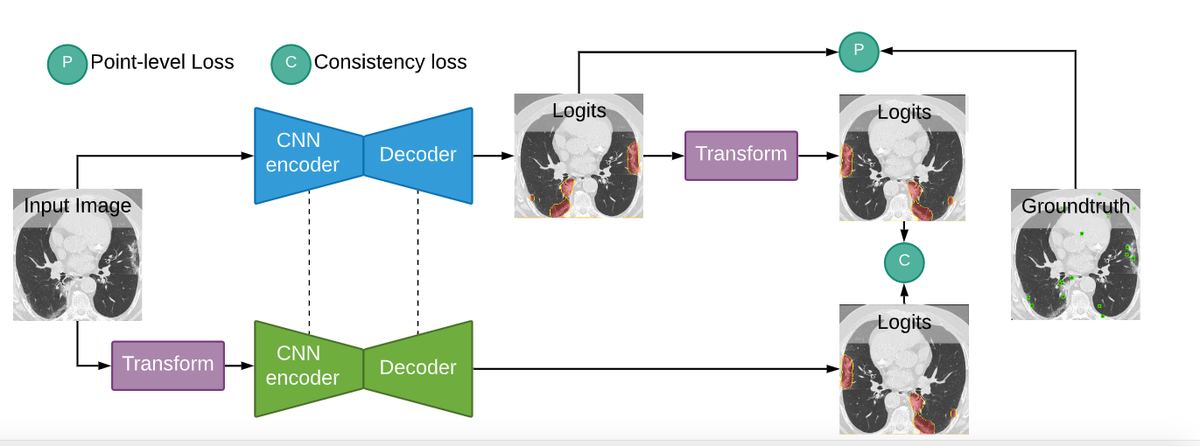
We present a new weakly-supervised method that significantly reduces the cost of labeling of #COVID19 CT-Scans. It trains with a novel consistency loss on point annotations to identify infected regions accurately.
Code: https://t.co/1afMkJMzOb
Paper: https://t.co/yuQigy65TS
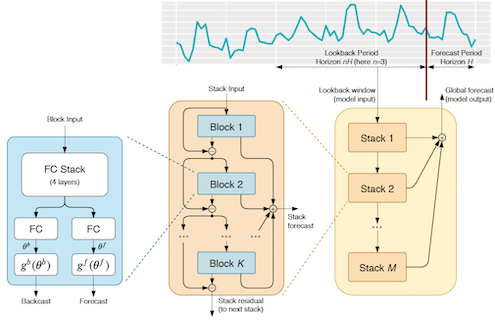
We are happy to release the code to reproduce the results in our N-BEATS paper (https://t.co/cXAiqrwtXh, presented at the ICLR 2020 conference, available at https://t.co/hK1fGjas0o. N-BEATS delivers SOTA univariate forecasting on many benchmarks. #ElementAI#MILA#forecasting
The GPU infrastructure management toolset that Element AI’s researchers have been using internally for 3 years is now a new product. Best way to boost AI research productivity! https://t.co/EF1o1nsRQD
We've trained an AI system to solve the Rubik's Cube with a human-like robot hand.
This is an unprecedented level of dexterity for a robot, and is hard even for humans to do.
The system trains in an imperfect simulation and quickly adapts to reality: https://t.co/O04izt3KvO
Yesterday, Yoshua Bengio gave a lecture on the principles underlying the recent successes of deep learning, its limitations and research directions for advancing AI on a human scale. #AI https://t.co/PjgdnCIQFH
"Researchers from #ElementAI, @MILAMontreal, and @UMontreal have introduced a powerful transfer language model that can summarize long scientific articles effectively, outperforming traditional #seq2seq approaches." 🤔 👇https://t.co/EkTzUuYSKi
It was such a pleasure to host @jaydjenkins from @Google and @HardeepArora from @element_ai at Alpha Go screening and panel in #Singapore yesterday!
They discussed with @TramANguyen from #CFTE how AI and big data are shaping industries and people perceptions
#Fall4Fintech
Human social cognition begins with our theory of mind: understanding that others have beliefs, desires, and goals. In Machine Theory of Mind, we present a neural network that advances machine social cognition, learning to model what drives other agents. https://t.co/brEEa2hkt5
Some new work from the part of Google Brain that works on ml for healthcare: we have encouraging early signs that non-invasive retinal images contain subtle indicators of cardiovascular health that ml models can pick up on, that weren't previously even known to human doctors. https://t.co/tWrL7CyuIJ