I finished @FrontendMasters' "The Hard Parts of Servers & Node.js" taught by @willsentance! It was a comprehensive dive into server-side concepts, equipping me with a deeper Node.js understanding in just the right detail.
https://t.co/pqvuuQPAuM
recommended reading on AI memory:
1. @AnthropicAI: Effective context engineering for AI agents
2. @dbreunig: How Long Contexts Fail
3. @karpathy on context engineering
4. @OpenAI: Dreaming: Better memory for ChatGPT
5. @DhravyaShah: How Instinct's memory works
We just raised an $8M seed round to kill AWS, GCP, and Azure.
Introducing https://t.co/E3LHVE410x, the agent-native serverless cloud.
Your team is shipping code like never before. But you're getting caught up in manual, tedious DevOps work trying to deploy it.
InstaCloud provides the serverless compute that lets your services autoscale, with all the infrastructure managed for you.
Agents branch into complete replica environments when working, keeping prod safe and iteration speed high.
And of course, it all works seamlessly with agents through MCP/CLI.
Get off the traditional, legacy cloud.
Start deploying your services on InstaCloud today.
I Cancelled Spotify.
I cancelled Disney+.
I cancelled Apple TV+.
No more paying every month.
Claude transformed my laptop into a free entertainment center.
Here are 8 prompts to create this system:
RAG AI Engineer interview topics must to study:
1) Chunking: Interviewer will give you a scenario and will ask you which type of chunking strategy you will opt for. For unstructed data it can be paragraph chunking, sentence chunking, recursive based chunking etc. And for Structured data it can be Entity based chunking. And for a PDF which contains Images, tables and text, it could be Document Layout aware based chunking.
2) Retrieval technics: Sementic vs Keyword vs Hybrid, which one to opt for, when and why. How you gonna debug retrievar, how you gonna measure it's accuracy?
3) Retriever metrices: Precision, recall, MRR, hitrate.
4) Embeddings: How embedding models work. Their dimensions, which dimension to opt for and it's tradeoffs.
5) LLM: How you gonna measure the accuracy of the LLM and what are those metrices. Safety Gaurdrails. Ways to decrease cost and latency.
6) Hallucinations: How you gonna reduce hallucination? How you gonna make sure user don't get made up fake answers in return to their query. From where you gonna start debugging?
7) Prompts: How you gonna apply Gaurdrails. How can you reduce the cost here, that is Prompt catching. Types of Prompt Strategies.
8) Cache: How you can reduce the cost of similar query with cache. Types of cache and which one would work in a given scenario.
9) User feedback: Given user feedback and how you gonna improve the system?
10) AI Agents: Ways to integrate AI Agents and their tools in the RAG system and will it improve the system or not and why and how?
Mind You: For most of the questions, there is no One right answer, so you provide multiple options for one question and state your reason.
DM for 1:1 paid consultation session regarding your career.
Drop your comments if you have any query.
Save and Repost.
I hate when VS Code eats up 1GB and takes 7 seconds to start, so I built https://t.co/BcvoimKiLJ, which does the same things in 20MB of RAM and starts in 1ms.
The last time we edited code in an IDE was in 2025, so our IDEs should become read-only but fast.
Give it a shot.
How to be the top 1% of AI Engineer and get hired step by step:
1) 90% of developers in this AI era poses abstract knowledge. They don't have any deep understanding of the tech skills they have kept in their resume.
2) Learn everything from first principles.
3) Apply Top-Down-Depth strategy. Don't try to go for Bottom-Up approch. 4) Start from top, that is building and breaking things. Once stuck, study only that part till down and depth.
5) Take help of Chatgpt to breakdown topics for you in comprehensive and simplify it for you.
6) No need to master maths as an AI Engineer. For applied Engineering, only understanding of Maths is enough, take help or chatgpt, but for Research roles, you need to be very good at maths.
7) Practise DSA till LinkedIn list mid difficulty level to crack any services based and many product based companies.
8) Post project breakdowns on X and LinkedIn consistently.
Comment down your query and I will answer.
DM to get 1:1 consultation.
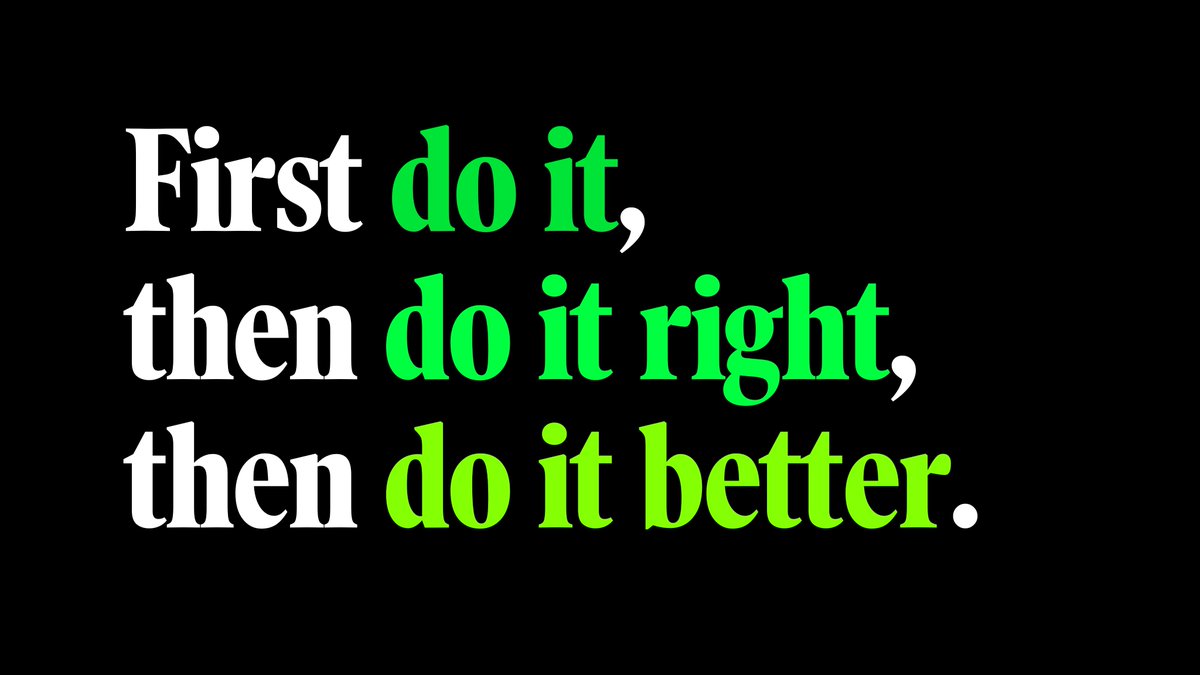
"First do it, then do it right, then do it better."
Just start. The journey to success often begins with a single step, but that first step can be the hardest to take. It's easy to get caught up in the fear of failure or the desire for perfection, but I hope this quote I first shared in 2013 can be a reminder of the importance of simply getting started as we go into 2024.
Just Start Somewhere
"Start slow if you have to. Start small if you have to. Start privately if you have to. Just start." - James Clear
Taking that first step doesn't require perfection or immediate mastery. The key is to overcome inertia and take action, as this action will lead to progress, learning, and (if you’re lucky and consistent) ultimately success.
When you start, you allow yourself the opportunity to grow, adapt, and move forward.
The Power of Starting
Beginning a new project or habit often feels daunting. According to psychologists, we tend to overestimate the pain of starting and underestimate our ability to persist.
However, studies show that "small starts" predict eventual success better than initial enthusiasm or early progress. This phenomenon is known as the fresh start effect - taking the first step energizes us and bolsters motivation.
So focus on starting without putting pressure on perfection. Progress and course corrections will follow.
First, Do It: Embrace the MVP Mindset
Doing it = get the simplest MVP out.
A Minimum Viable Product (MVP) represents the simplest version of a product or idea that allows you to test, gather feedback, and iterate.
By embracing this mindset (just get something done - it's OK if rough, a prototype, a draft), you focus on progress over perfection, understanding that getting something out into the world is far more valuable than waiting for the perfect moment.
Expand Your Comfort Zone
Venturing outside one's comfort zone can elicit fears of failure. Leaning into discomfort not only builds confidence and skills, but research shows it makes us more receptive to learning. Recognize that fear is often the mind's way of urging us to grow. Don't let it stop you from progressing.
Then, Do It Right: Refine and Correct
Doing it right = fix correctness issues.
Once you've taken that first step and put your MVP out into the world, it's time to refine and correct. This stage is about learning from feedback, identifying areas of improvement, and making adjustments accordingly.
It's a chance to iterate on your idea, ensuring that it meets the needs of your audience or customers while aligning with your vision.
Cultivate Curiosity and Resilience
Meeting new challenges with curiosity and resilience makes venturing outside our comfort zone more sustainable and enjoyable. Cultivate curiosity about growth opportunities and your capacity to rise to them. Set mini-challenges to incrementally expand your horizons.
When facing inevitable setbacks, avoid self-criticism and tap into resilience - the ability to recover, learn and continue progressing.
Self-compassion, adaptability and maintaining perspective are key here. With consistent effort, you build confidence in your ability to start, stumble, learn and work toward mastery.
Finally, Do It Better: Strive for Continuous Improvement
"Doing it better = iterate towards an ideal end-state (e.g., make it fast)."
The journey doesn't end with merely doing it right.
The final step is to continuously improve, striving for excellence and growth.
By iterating towards an ideal end-state, you demonstrate a commitment to progress, ensuring that your product, idea, or project remains relevant, innovative, and successful.
Set New Goalposts
As you improve, have a clear idea of when you are “done” or update your goalposts. Elite athletes turn small gains into competitive edges via the aggregation of marginal gains. Identify areas of potential improvement and set measurable stretch goals, from increasing efficiency to enhancing user delight.
Overcoming the Greatest Barrier to Progress
"The greatest barrier to progress is not lack of resources or talent, but fear of failure."
Recognizing that fear of failure is the most significant obstacle in the pursuit of success allows you to confront it head-on.
By acknowledging this fear, you can focus on taking that first step, knowing that once the ball starts rolling, it becomes much easier to keep it in motion.
Remember that starting is more than half the battle. Don't wait until you feel ready, because the perfect moment may never come.
The Bottom Line
Rather than striving for perfect execution, embrace the power of starting - put forth an MVP, soft launch an initiative, or set a milestone. Progress begets motivation. By simply starting, you open the door to growth and innovation. The rest will follow.
Embrace the power of starting and then iterating until you're happy.
🚨 A Netflix engineer just open-sourced the fix for the most expensive problem in AI: wasted tokens
It's called Headroom, and it might be the smartest fix to high token usage
Your agent reads a 10,000-token log file to find one error.
You paid for all 10,000 tokens.
The answer needed 1,200.
Headroom sits between your agent and the LLM and compresses everything before the model sees it.
JSON, code, logs, RAG chunks, each gets its own specialized compressor.
And it's reversible: the originals stay on your machine, so nothing is lost.
The results speak for themselves:
→ Up to 95% fewer tokens
→ Same accuracy on benchmarks
→ Zero changes to your code
Setup takes one minute:
1. pip install "headroom-ai[all]"
2. headroom wrap claude
Done.
Works with Claude Code, Cursor, Codex, and anything OpenAI-compatible.
Everything runs locally, fully open source.
The cheapest token is the one you never send.
🔗 Github repo: https://t.co/6TQM4o18hx
So, are you compressing your context, or just paying the bill?
Two years ago, I struggled to solve basic LeetCode Medium problems. Every new question felt like a completely new puzzle.
Then a Staff Engineer gave me one piece of advice:
"Group your practice by pattern, not by company tag."
My 6-week turnaround:
Week 1: Two Pointers, Sliding Window, Fast/Slow Pointers (Arrays & Lists)
Week 2: Binary Search & Merge Intervals (Search & Ranges)
Week 3: DFS & BFS (Trees & Graphs)
Week 4: Heap & Hash Tables (Lookups & Priority)
Week 5: Backtracking & Greedy (State Search)
Week 6: Dynamic Programming (State Tables)
Once you recognize the pattern within the first 60 seconds of reading a problem, the panic disappears.
Stop telling Claude, "do this."
Stop telling Claude, "write code."
Stop telling Claude, "fix this error."
You're actually treating a senior AI like a junior intern.
Here are 8 prompts you can copy and paste directly:





![BharukaShraddha's tweet photo. 🚨 A Netflix engineer just open-sourced the fix for the most expensive problem in AI: wasted tokens
It's called Headroom, and it might be the smartest fix to high token usage
Your agent reads a 10,000-token log file to find one error.
You paid for all 10,000 tokens.
The answer needed 1,200.
Headroom sits between your agent and the LLM and compresses everything before the model sees it.
JSON, code, logs, RAG chunks, each gets its own specialized compressor.
And it's reversible: the originals stay on your machine, so nothing is lost.
The results speak for themselves:
→ Up to 95% fewer tokens
→ Same accuracy on benchmarks
→ Zero changes to your code
Setup takes one minute:
1. pip install "headroom-ai[all]"
2. headroom wrap claude
Done.
Works with Claude Code, Cursor, Codex, and anything OpenAI-compatible.
Everything runs locally, fully open source.
The cheapest token is the one you never send.
🔗 Github repo: https://t.co/6TQM4o18hx
So, are you compressing your context, or just paying the bill?](https://pbs.twimg.com/media/HRluJqRaMAARkej.png)


