On what to do (and not to do) when starting a new job. Surprisingly scales from intern to director, maybe further. You want to run two parallel threads:
Thread A: find _one_ valuable problem you can solve very quickly (in like a day). Since you just started it's obviously going to be tiny. Then:
1. Solve the problem _fast_, faster than you think possible. Do a really really good job.
2. Talk to ppl about it.
3. Find the next most valuable problem you can solve quickly, but this time 10% bigger. Go to step 1.
Thread B: talk to everybody. Pretend you're a journalist or smtg and try to really understand them. What are they working on? Why is it valuable? What's the biggest problem on their mind? What's stopping them from going faster? What's the next most valuable problem they'd be solving if they weren't solving this one? etc.
Do this for 3-6 months. What will happen is:
- you'll be immediately useful (albeit slightly, but that's much better than not at all)
- you'll build momentum
- if you pick a 10% bigger problem every time, in ~3-6 months you'll be solving big, really valuable problems
- you'll build credibility with your colleagues
- you'll build knowledge about how things work
- you'll get to know lots of people and their work, and will pick more valuable problems
That builds your reputation as someone who is reliable, agentic, thoughtful, solves valuable problems, and has ramped up quickly. These kinds of people are _really_ valuable. If you can do that, soon you'll be able to work on anything you want.
---
Failure modes (do _not_ do this):
- getting distracted by dozens of different projects. Your knowledge ends up too shallow and ppl correctly bucket you as someone who never finishes stuff.
- worrying that what you're working on is too small and trying to do bigger stuff too soon. No one trusts you yet, and since you keep not solving anything, that impression solidifies. You need to earn ppl's trust. Start small, finish it, and remember that 10% bigger each time is exponential growth.
- picking some big vague amorphous problem. People who do that tend to have made very little progress in three months, and everyone starts thinking of you as ineffective. You can solve those eventually, but you need to build up knowledge and momentum first.
- trying to contribute to conversations too early. You're eager to be useful, but that's not how you become useful. You still don't understand anything. Ask lots of questions and solve small problems first.
- going into "learning mode" and not solving anything. You need to learn and solve problems in parallel, that's how you build up credibility and earn people's trust.
- going into "solving mode" and not talking to anyone. People need to know about what you're working on, and you need to understand their problems to do good work.
@rjs related to "express an actual idea", I like lo-fi wireframes because it allows you to immediately control for feedback that is unrelated to the actual function of the thing. polished mockups invite feedback about reversible aesthetic decisions that do not matter at this stage
@skalskip92 really tremendous work! do you have any thoughts about longer clips where the camera does not capture all the players in the viewport? i.e. camera is focused on the inbounds while all the players are at the far end of the court.
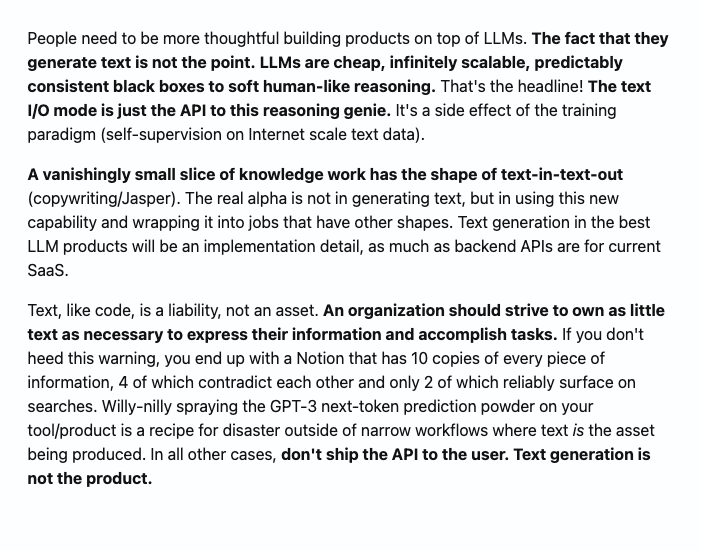
Small rant about LLMs and how I see them being put, rather thoughtlessly IMO, into productivity tools. 📄
TL;DR — Most knowledge work isn't a text-generation task, and your product shouldn't ship an implementation detail of LLMs as the end-user interface
https://t.co/N1NJoKzUqA
Welcome Relative Representations, enabling zero-shot communication between latent spaces without any training!
https://t.co/jnEJkMDFII
It turns out that distinct neural networks learn intrinsically equivalent latent spaces [1/6]
naive is you have a completely wrong model of what’s happening, charitable is that you have a relatively accurate model but you’re still willing to be loving/forgiving
Putting my sci-fi/fiction/improv hat on for a minute. Imagine a world where AI makes it possible for a single person to make a feature length film that's indistinguishable in quality from $100M films today. What would that world look like? What might be the same/different?
For what it’s worth: if, in 2020, you asked the median IC at an organization that was doubling year-over-year if they thought the org was growing too fast, they would have said yes.
If you asked the median executive, on the other hand…
@TheGrandBlooms ps I’m happy to chat abt this more at length if you wanna dm me, i have run (small but mighty) analytics and DS teams in the past but am always happy to chat w ppl entering the industry on how to grow and learn
@TheGrandBlooms that’s fair! analytics eng is prob a good place then; it’s young enough that it can span analyst / data eng tasks but mature enough that someone w real exp in both those areas will likely lead a larger team and provide guidance in how to specialize
Describing to an AI in exact detail the software I want it to build. But the description becomes unwieldy so I create a structured language to manage it. Other people start sharing commonly used description snippets so we create a packaging system and registry.
Oh shit wait
@sarahcat21 maybe similar to the engineering boondoggle of seeing a specific instance of a problem and trying to build things that solves the generalization of that problem lol
@sarahcat21 it feels like the discourse is the mirror of the way data practitioners work in companies. a lot of what we do is shaping process - the "how you build it" for companies - so it feels natural to get a little meta and talk about how you're building the process-building machine