27 ❦INTP
Mind ❦ Systems ❦ Cities ❦Claude
CS+Philosophy
A happy life is impossible; the highest thing that man can aspire to is a heroic life
—Schopenhauer
Started posting on X and here’s a bit about me summarised by clanker.
I’ve always been fascinated by the things that exist beneath the surface of what we observe. The underlying mechanisms, structures, relationships and recurring patterns that explain why things work the way they do. Whether it’s the human mind, a biological organism, a city, an economy or a piece of technology, I find myself drawn to understanding not just what something is, but how it came to be, what holds it together and what happens when its individual parts interact.
I suppose this has something to do with why I’ve never been particularly inclined to stay within one discipline. Some questions naturally lead elsewhere, and I enjoy following those connections. An exploration of human cognition can take you from neuroscience and evolutionary biology to information theory, linguistics, computational models and philosophy of mind. Understanding the development of a civilisation might involve geography, anthropology, economics, political institutions and cultural evolution. The boundaries between these subjects are useful academically, but the phenomena themselves are rarely so neatly separated.
That’s what I find compelling about interdisciplinary thinking: not simply knowing about several subjects, but recognising how different fields of knowledge can inform one another. Sometimes entirely different disciplines arrive at surprisingly similar ideas, while other times their competing explanations reveal something that would otherwise remain overlooked.
This way of thinking has taken me through quite a few intellectual rabbit holes.
In philosophy, I’m particularly drawn to epistemology, metaphysics, phenomenology, existentialism, analytical philosophy, philosophy of mind and philosophy of science. Questions surrounding consciousness, subjective experience, perception, causality, free will, personal identity and the nature of knowledge. I’m fascinated by the relationship between what we experience, what we can establish empirically and what we can reasonably claim to know.
The sciences offer an entirely different but equally compelling way of approaching these questions. Computational neuroscience, neurobiology, evolutionary biology, genetics, behavioural ecology, cognitive psychology, psycholinguistics, complex systems, statistical mechanics, cosmology and theoretical physics. Concepts such as emergence, adaptation, self-organisation, feedback loops and nonlinear dynamics are particularly fascinating to me. The way relatively simple interactions can produce extraordinarily complex outcomes is a recurring theme across so many fields.
Then there’s history. Ancient civilisations, comparative history, intellectual history, the history of science, economic history, political revolutions and the development of institutions. I’ve always found it interesting to look beyond individual events and examine the conditions that made them possible. How ideas spread, why institutions persist, how cultures evolve and how geography, resources, technology and collective behaviour influence the trajectory of societies.
Cities and architecture occupy another corner of my curiosity. Urban morphology, architectural history, transport geography, spatial economics, urban sociology and planning theory. Modernism, Brutalism, Bauhaus, Le Corbusier. I’m particularly interested in how cities become what they are, how their physical form influences social behaviour and how seemingly mundane decisions about infrastructure, public space and urban planning can have consequences for generations.
Technology is a substantial part of my life too. Computer science, algorithms, computational theory, software architecture, artificial intelligence, human-computer interaction and product design. I enjoy building digital products and experimenting with ideas, but understanding the abstractions, logic and engineering principles underneath them is just as important to me.
@DabsMalone Hasn’t it always been this way ? I mean we could have engineers build and built good products but it’s always been the markets who’d got them into a spotlight ?
What they did was :
“Physical Superintelligence (PSI) utilized an unreleased Anthropic model to formally prove the 2008 Aaronson-Ambainis conjecture, demonstrating that quantum algorithms require structured inputs to achieve exponential speedups over classical computation, with the entire proof verified in Lean within three days”.
@avidseries@Hogrelius You try to gain audience and it feels like yelling into a void but this slop gets 4K likes is beyond my comprehension. How do people even fall for this.
@ethanb_12309@markbishopuk He may not be , but what is the critique of this video ? I don’t think there’s anything wrong with what he said right there. What’s wrong with having offshore bank accounts anyway.
Midwits are calling this common sense and wish they did it next.
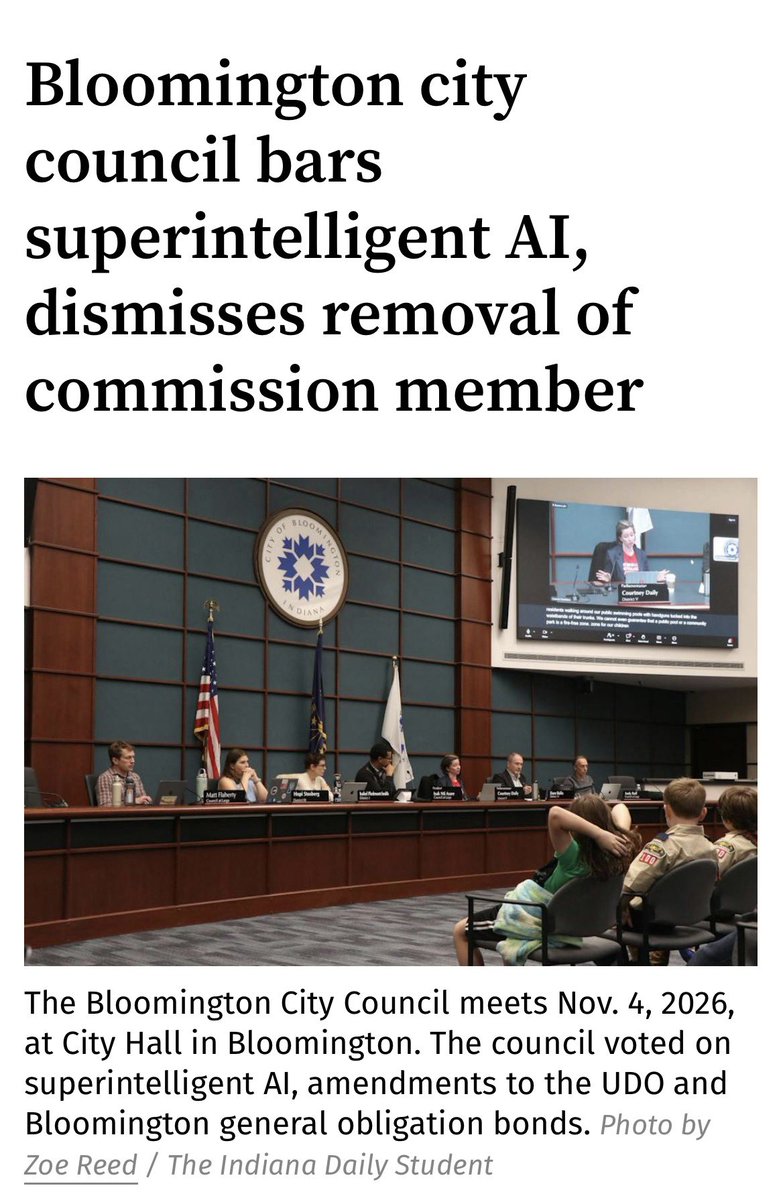
Well this Ain't the first time the city of Bloomington did stuff like this not it it is some wise councilmen which people are using to signal their point. Apparently same folks :
> bought a $225,000 armored truck for the SWAT team
> too aggressive and not politically correct
> welded five of the nine gun ports shut so it looks friendlier
> moved the battering ram to a separate building
> painted RESCUE on the side
> banned it from crowd control , the one job it's for
Peak Oil Task Force : full survival plan for life without cars
> shale boom hits , America becomes the largest oil producer on earth
> 2023 : tried an AI moratorium , withdrawn after IU weighed in
> April : dropped the license plate cameras
> 80s : Swiss mystic doing Sufi and Sioux headdress rituals in the woods
This is not a common sense take on AI , it's the same council that has been ridiculously wrong on every doom call it ever made . Oil never ran out . The truck never needed a friendly paint job . Wanna bet on this one ?
Ain't the first time the city did stuff like this .
Bloomington bought a $225,000 armored truck , welded shut five of its nine gun ports , stored the battering ram in a separate building , painted RESCUE on the side and banned it from crowd control .
An armored truck that can't be used on crowds . Money well spent .
It also ran a Peak Oil Task Force and wrote a survival plan for life without cars , right before the shale boom made America the largest oil producer on earth . It dropped its license plate cameras in April . In the 1980s a Swiss mystic ran Sufi and Sioux headdress ceremonies in the woods there , and Kinsey did his research on campus .
Armor they can't use , cameras they dropped , an oil shortage that never came , and now a ban on AI .
Bloomington is where crazy ideas go to get a 7-0 vote .
Damn bro. It sucks because they got these idiots that don’t even speak English and just put it way back and forth. Usually they get it cancelled if it’s actually hazardous usually they ask both sides to cooperate.
However it’s unequally bad for hosts at the time. Really. You can post weird shit like it smells in here ( airbnb can’t check that ) and they’d offer a refund.
They resort their thinking of what the collective thing is right thing ; ie dating an older guy.
Even when they do it’s only 2-4 years which isn’t bad and good just a personal opinion but I do think younger guy + older woman would create a really weird psychological dynamic.
The older age thing just happens to also concise with better finance , emotional maturity and social competence.
Also just checked the study.
>The average woman in the study was 45 and the average man was 48.5—meaning a 45-year-old woman finding a 40-year-old guy more attractive than a 55-year-old guy is totally different from a 24-year-old wanting a 19-year-old.
> It only measured initial blind-date vibes over a single hour, not whether those pairings actually survive long-term.
> Even inside this exact study pool, when couples actually matched, the man was still 3.5 years older on average.
This kind of takes totally negates and ignore everything that takes into growing a business and the scale of economy , I am not even a fan of these individuals specially bezos but consider this :
Turning $300,000 into a $2 trillion company is a roughly 6.6-millions return on investment ….that’s ridiculously absurd. If you’re chalking it up on some muh parental connections you’re totally missing out the point about how businesses even work.
The emerald operation Elon Musk's father that gets thrown around a lot when I last checked it was $80,000 to $100,000 total when @elonmusk’s dad bought it , and his share generated about $210,000 (roughly $600,000 adjusted for inflation) over its entire lifespan before going bust.
It wasn't a corporate mining operation with stock tickers and heavy machinery.
Elon landed in Montreal with just around $2000 cad. I landed with same in same country and it insanely underestimates how much work it takes.
Hell let’s take every single dollar that he ever touched that emerald deal ignoring the $2k in Canada and assuming Elon somehow inherited the entire $210k–$400k his dad ever made from the mine (roughly $1 million adjusted for inflation)—turning that into $1 Trillion is still a 1,000,000x to 5,000,000x return. It’s totally insane. Sure there were luck and timing involved but that’s not “his parents have had everything set for them”
In real-world let’s assume real estate , multiplying something by 2,500,000x is the exact mathematical equivalent of your parents buying you a single Lego brick (worth ~$0.10) and you flipping it into a $250,000 house or being gifted a beat-up $200 bicycle and turning it into a $500 million Boeing 747.
So maybe it’s not their rich parents and connections. Maybe it takes both? Not everyone with connections and capital make it this big. A tiny fraction of a percentage of people really do.
Every billionaire's "started in a garage" story conveniently skips the parental loans, elite connections, and safety nets. Bezos got $300k from his parents. Gates' mom sat on IBM's board. Musk's family owned an emerald mine. The garage is just aesthetics; the capital was inherited. Stop calling it self-made when it's generationally funded.