I want to know: how do things work; what happens next; what was missed that might be important; and how do we do everything with love, which endures all things.
The US Navy operates a 50,000 acre forest in Indiana whose entire job is keeping one wooden ship from 1797 afloat.
The ship is USS Constitution, still a commissioned warship with an active-duty crew. Cannonballs bounced off her in 1812 because the hull sandwiches a wall of live oak ribs between two layers of white oak planking, nearly 2 feet of solid wood so dense it barely floats. British 18-pounders hit it and dropped into the sea. A sailor yelled "her sides are made of iron" and the nickname stuck.
Here's the problem with owning a 229-year-old wooden ship: you can't buy the parts. Hull planks run up to 40 feet long and 7 inches thick, cut from single white oak trunks. A white oak takes over a century to grow that big. No lumberyard on earth stocks it.
So the Navy grows its own. Constitution Grove at Naval Support Activity Crane holds trees over 100 years old, reserved exclusively for this ship. Foresters there are managing oaks today that will become hull planking in the 2100s. The maintenance plan literally runs on tree time.
Every 20 years or so she enters dry dock and shipwrights swap out rotted timber. After two centuries of this, estimates put original 1797 wood at maybe 10 to 15 percent of the ship. The Navy keeps replacing her plank by plank because Congress mandated her preservation and because she's the only active US warship that has sunk an enemy vessel.
Every other asset in the Navy has a decommission date. This one has a tree farm.
@Angry_Staffer I think it's an acting test. Mike Johnson is pretty good at showing any emotion he thinks is appropriate, but sometimes he can't decide what that should be. Vance can't act at all!
Long COVID brain fog is real — and now, we know what’s causing it.
A breakthrough brain scan reveals the science behind the symptoms.
Scientists in Japan have identified a biological cause behind the cognitive “brain fog” experienced by many Long COVID patients—a breakthrough that could lead to reliable diagnosis and treatment.
A team at Yokohama City University used a cutting-edge brain imaging method to detect abnormal increases in AMPA receptors (AMPARs), molecules essential for learning and memory, in people suffering from Long COVID. These elevated receptor levels, observed using [11C]K-2 PET imaging, were closely linked to the severity of cognitive symptoms and inflammation markers, offering the first clear molecular explanation for the condition.
The findings, published in Brain Communications, show that AMPAR density not only tracks with brain fog severity but also enables near-perfect distinction between affected and healthy individuals—100% sensitivity and 91% specificity. This offers promise for both diagnostic tools and treatments, such as drugs that suppress AMPAR activity. With brain fog affecting over 80% of Long COVID sufferers globally, this research marks a significant step toward validating the condition and accelerating efforts to address it with targeted therapies.
[“Systemic increase of AMPA receptors associated with cognitive impairment of long COVID” by Yu Fujimoto et al., 1 October 2025, Brain Communications]
@OurShallowState@duty2warn If they have real life experience with mentally ill people they will recognize it. If they don't, they are extremely vulnerable to scams, bullying, all kinds of exploitation. I wish our current world was more like how they currently see it.
CELEBRATING 34 YEARS of
Diamonds and Pearls
Released October 1, 1991
get ur life 2gether
stop ur cryin'
whenever U say that U can't
that's when U need 2 B tryin'
Daddy Pop
what is ur favorite track?
#NPG#PRINCE#PRINCE4EVER
Believe it or not- Everything you see in this frame is falling. 😅
When I first reached the International Space Station, I had this strange hesitation: if I let go of something, won’t it just fall? On Earth, that’s exactly what happens. In space, though, my early instinct was to politely hand over items to crew-mates (one of them is quietly smirking in the background at my dismal lens changing skills 😅) instead of just releasing them. The funny part? They were just as cautious at first—so we ended up passing things around like an overly careful game of “hot potato.”
Here’s the catch: nothing actually falls away in orbit. As you see in this video if I let go of the lens, it doesn’t drop—it hovers. Why? Because both the lens and I are falling at the same speed around Earth. No relative falling = no “down.”
This idea goes all the way back to Isaac Newton’s legendary thought experiment: imagine standing on a tall mountain and throwing a ball. Toss it gently—it arcs down nearby. Throw harder—it travels farther before dropping. Throw it so fast that as it falls, Earth’s surface curves away beneath it? The rate of drop matches the curvature of the Earth. Congratulations—you’ve just put that ball in orbit. It’s falling forever, but it never hits the ground.
That’s what orbit really is: perpetual free fall. Astronauts don’t feel weightless because gravity has disappeared—gravity up here is still about 90% as strong as at Earth’s surface. We feel weightless because we and everything around us are constantly falling together.
Floating in space is really just falling—forever. 🌍✨
#shux #iss #space #shubhanshushukla #isro #axiom4 #newton #tiborkapu
We’re finally cleaning out the fort’s early 19th century smokehouse - still packed full of stuff. Behold 150+ year old BBQ… They had one job, and they nailed it.
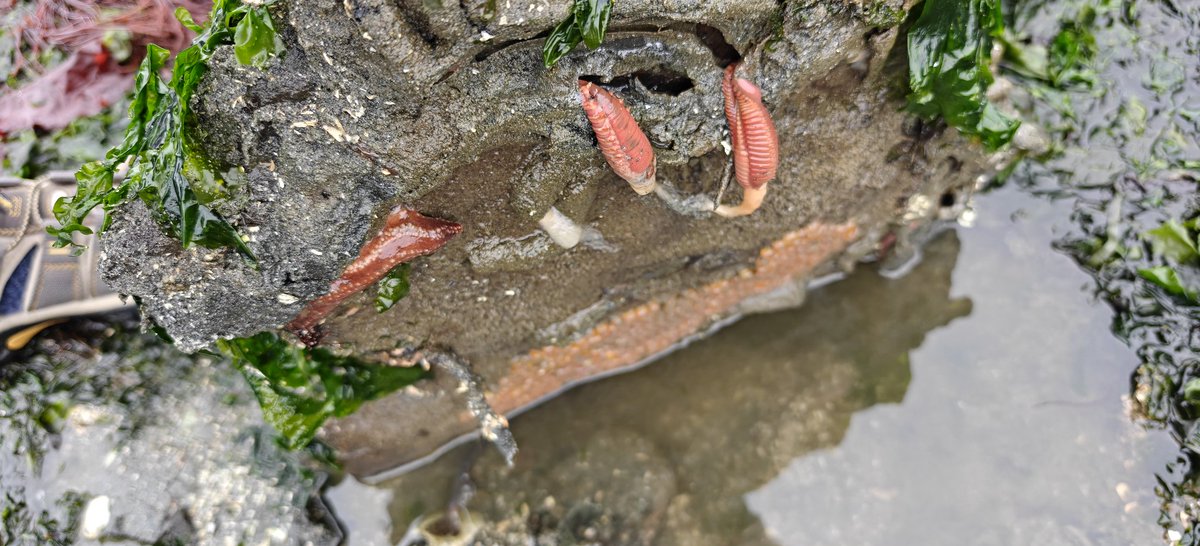
I turned over a rock at Constellation Park in West Seattle during the extra-low tide today. This is two anenomes mating. One is secreting eggs and the other is fertilizing them.







![Rainmaker1973's tweet photo. Long COVID brain fog is real — and now, we know what’s causing it.
A breakthrough brain scan reveals the science behind the symptoms.
Scientists in Japan have identified a biological cause behind the cognitive “brain fog” experienced by many Long COVID patients—a breakthrough that could lead to reliable diagnosis and treatment.
A team at Yokohama City University used a cutting-edge brain imaging method to detect abnormal increases in AMPA receptors (AMPARs), molecules essential for learning and memory, in people suffering from Long COVID. These elevated receptor levels, observed using [11C]K-2 PET imaging, were closely linked to the severity of cognitive symptoms and inflammation markers, offering the first clear molecular explanation for the condition.
The findings, published in Brain Communications, show that AMPAR density not only tracks with brain fog severity but also enables near-perfect distinction between affected and healthy individuals—100% sensitivity and 91% specificity. This offers promise for both diagnostic tools and treatments, such as drugs that suppress AMPAR activity. With brain fog affecting over 80% of Long COVID sufferers globally, this research marks a significant step toward validating the condition and accelerating efforts to address it with targeted therapies.
[“Systemic increase of AMPA receptors associated with cognitive impairment of long COVID” by Yu Fujimoto et al., 1 October 2025, Brain Communications]](https://pbs.twimg.com/media/HA4HM5iW4AAcbH3.png)