Entrepreneurship is both the art of understanding yourself and the science of figuring out what people will pay for.
Simon Sinek calls it your Why.
Jim Collins calls it your Hedgehog Concept.
The Japanese call it your Ikigai.
Aligning what you’re good at, what you enjoy, and what the world needs is the reason entrepreneurs say it’s the best self-development you’ll do.
The longer you stay in the game, the more clarity you have and the more success is attracted to you.
But finding your ‘Why’ or passion or whatever you call it is incredibly hard.
It takes time, self-understanding, trying and failing at different things over and over again.
A shortcut and something I wish I knew earlier was to begin with your values.
If you build a business inside-out, with your values at the core, you’re tapping into positive motivation. It never runs out.
The business becomes an extension of what you already love to do and you’re pulled towards something greater.
Contrast this with outside-in, where you’re looking for problems to solve and pushing away from your current situation through negative motivation.
The truth is this method will burn you out right when you need to keep going.
I’m not saying defining values is solution for everyone, but so much business content starts with the medium (SaaS, Agency, Ecom) instead of the meaning.
If you start with a solid foundation (values), it’s much easier to build a skyscraper.
-from someone who did it the wrong way for a long time
Soon, all software will either be sessions in the cloud or micro-apps (artifacts or similar).
@john_ssuh articulates this very well. The fundamental thesis for vertical saas doesn’t make sense anymore. As the cost of software continues to plummet, we can reduce software to just basic building blocks of isolated computed to host agents + the state they work with.
From there, the user can make the perfect customizable solution. And because it’s so cheap, they can do this whenever they have any pain point.
Actors are the perfect primitive for this future. They are cheap to spawn so you can spin up millions. They are concurrency safe, so having dozens of agents all working on a design canvas doesn’t suffer from race conditions and collisions.
Ultrafast models are the final piece of this puzzle. We can now spawn visualizations stupidly fast. This will greatly increase adoption of artifacts as humans process visuals much faster than text.
Grokbot and Claude artifacts are just the start, it’s about to get very real.
Ok I do have a view on NVIDIA without Jensen.
I’ll tell you the real reason $NVDA will likely fail without him and why the frontier labs and hyperscalers are the biggest winners. (Elon has been in a really good mood recently. Have you noticed?)
The biggest threat to NVIDIA is its own customers, the frontier labs. NVIDIA has to become a frontier lab faster than frontier labs are becoming chip companies. And with Jensen out, they likely won't maintain the momentum to get there.
With recursive self-improvement (RSI), every frontier lab and hyperscaler must become a chip company or lose the AI race. It's that simple, and they've all laid the groundwork (Google TPUs, OpenAI and Meta building custom ASICs with Broadcom, Anthropic building an in-house silicon team, and SpaceX/xAI/Tesla building Terafab).
That's because software-only RSI has clear physical limits. Software can reduce how much computation and data movement a model needs, but it can't change the chip's physical bandwidth, memory capacity, or interconnect. Custom silicon gives labs another way to improve performance: designing the memory system, compute, and networking around their own workloads.
To get the real compounding effect of RSI, you have to co-design the model and the silicon so it becomes a two-way feedback loop: smarter models design better custom chips, and those chips train and run the next model faster. You can't do that on off-the-shelf NVIDIA GPUs because you get zero proprietary edge buying the same chip as everyone else, and getting your next-gen architecture into NVIDIA's silicon means sharing your roadmap with them years before tape-out (which they then sell to your rivals). Plus, AI now automates writing compilers and porting CUDA kernels to other chips, which kills the CUDA moat.
Jensen argued custom ASICs aren't more cost-efficient than GPUs because models change too fast for fixed hardware, and partners like Broadcom charge fat margins too. But hardware doesn't fall behind model changes when AI co-designs the next model and chip together instead of humans designing them separately (which Google and OpenAI are already doing). And labs aren't building custom silicon just to save on NVIDIA's 75%+ gross margins. Closing that hardware-software loop is the main goal, though the cost savings are still massive since RSI requires 24/7 internal inference where custom ASICs are way cheaper and more power-efficient than general-purpose GPUs.
That's why NVIDIA has been trying so hard to become a frontier open-weight lab, buying Groq (fast inference IP), Poolside + Nemotron (internal coding models), and Hugging Face (distribution). If closed labs win, enterprises just call their APIs running on the labs' own custom silicon and NVIDIA gets cut out. Subsidizing free open-weight models is the only way to make enterprises buy or rent NVIDIA GPUs to run the models themselves.
With Jensen gone, it's unclear if the Hugging Face deal even survives DOJ approval (can a GPU company own the whole stack?), and a non-founder is unlikely to take the massive risks needed to become a frontier lab: putting billions of capex into internal clusters and free open-weight models instead of just selling GPUs, while competing directly with its own biggest customers $GOOG, $META, $SPCX, $ANT, $MSFT
Announcing $38M Seed & Series A from Sequoia, First Round, and Hummingbird.
Healthleap's mission is to improve the health outcomes of as many people as possible.
Results so far:
• faster healing resulting in 1.6 shorter hospital stays per patient flagged as at risk by HealthLeap (Penn)
• 39% more appropriate diagnoses, same staff (Cedars-Sinai)
• 3 → 50+ hospitals in the past year
We're hiring across all roles.
Unless you’re mapping and qualifying your entire TAM upfront, the way to build GTM systems that never sleep is to identify signals that are always ‘on’, and use that to qualify and build your list.
Think hiring, posting content, RSS feeds, competitor mentions.
GTM Engineering 1.0 is getting leads into a sequencer.
2.0 is weaving in signals to identify pains and time your message.
3.0 is building end-to-end systems that deliver value on repeat on time, every time.
As soon as you start scaling outbound, .csv imports slow you down.
Hundreds of mismatches lists scattered across files with constant maintenance.
The key is to go from live input to automated output, instead of static input (.csv) to automated output.
When they post, reach out with genuine value related to your offer.
Right person + right time + valuable message = replies
Bonus tip 1: webhook connects and posts into Slack so you know as soon as something happens
Bonus tip 2: connect to Make and auto-engage with posts
The simplest way to start scaling Founder-led sales:
- Get 100 qualified leads from Clay (free)
- Make an Aimfox/Hey Reach account
- Import your leads and hit send
Don’t add a connection note or a message.
Monitor who connects + turn on their notification bell.
Spoke to a VC once.
'Nothing, nothing, nothing, something.'
It's the advice they give every founder pre-PMF.
Getting to 'something' goes a lot faster if you can test ideas rapidly, but unless you know how to run outbound, you're in for a long grind doing things manually.
Is OpenWhispr the best free and open source alternative to WisprFlow and Granola?
You tell me! Would love your feedback.
Links to the website and github in the comments, a star would go a long way <3
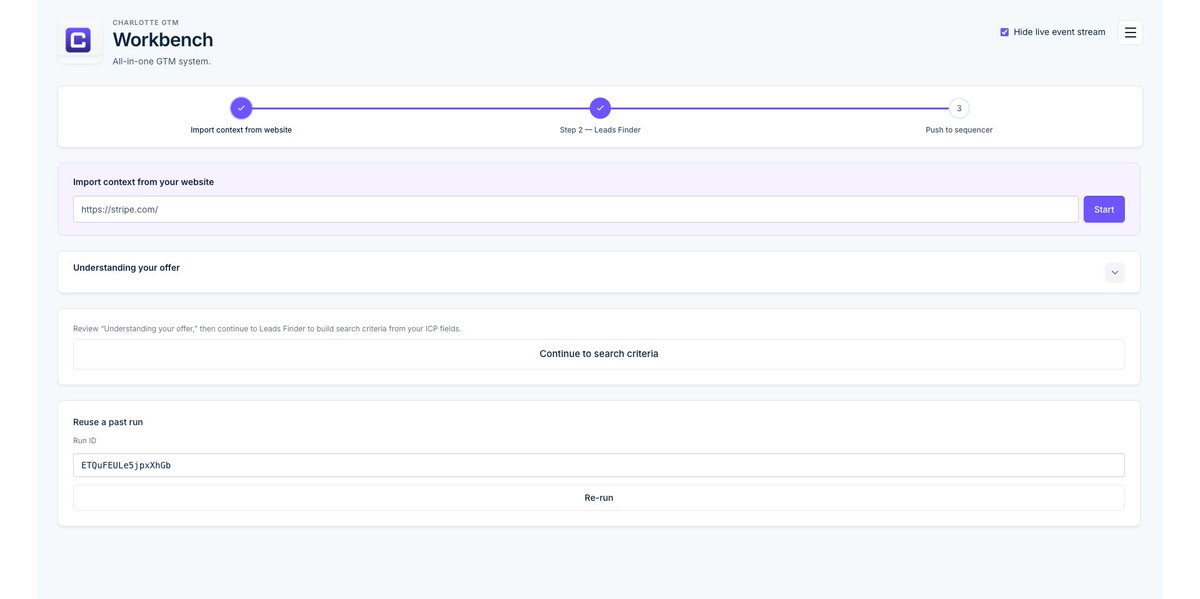
While building @anitarecruitcha, we needed an effective system to find leads, qualify, and reach out at the right time.
I'm distilling every learning into Charlotte, like Charlotte's web, a tool that helps founders sell and test their ideas without needing to master outbound.
As outbound channels get pumped with even more AI-slop and the technical barrier to GTM lowers, leveraging AI in creative ways to connect the dots is where founders and GTM teams will win.
Curious who else is exploring this space?
What happened to coding with Cursor is happening to GTM Engineering with Clay MCP.
3 days ago, Clay released their new MCP integration, allowing anyone to work with tables through chat.
Find, enrich, and send all from ChatGPT or Claude.
The moat is in how GTM leaders can combine public data to make it valuable, not just personalized.
For example, using data to infer real problems your ICP is having, instead of heuristics from the old firmographics x signals method.