After reflection, this new narrative by Palantir is probably much more consequential than people may assume.
Palantir is basically being the canary in the coal mine announcing the death of two major assumptions propping up the US economy right now:
1) that AI labs will be able to extract significant economic rent - as opposed to AI models being mere commodities
2) that other countries can accept structural dependency on US technology and services without pushing back on sovereignty concerns
Why are Palantir specifically starting to be vocal about this?
First off, major middle-powers, even US “allies”, are one by one showing them the door. In June, France announced that the DGSI - its domestic intelligence agency, which had relied on Palantir since the 2015 Paris attacks - would replace it with French firm ChapsVision, with Prime Minister Lecornu explaining (https://t.co/SLhEGprBZC) that France “cannot accept new strategic dependencies in the digital sphere” and shouldn't depend on the goodwill of companies “capable of turning off the tap.”
Germany moved even earlier: its domestic intelligence service, the BfV, also selected ChapsVision over Palantir (https://t.co/pDZVj4SYUY), and the German military has said it will no longer use Palantir at all. Then, just this week, Spain instructed state-controlled companies - including strategic firms like Telefónica, Indra and Navantia - to avoid signing any new contracts with Palantir (https://t.co/0ik4UAFrT7).
Even in the UK, Washington's most loyal vassal, the NHS's £330 million data contract with Palantir is under review following parliamentary pressure (https://t.co/uJl6g4BMsW), and London Mayor Sadiq Khan blocked a proposed £50 million Palantir contract with the Metropolitan Police.
Palantir making a lot of noise around them caring about sovereignty makes a lot of sense: it's damage control since they keep being told they're a sovereignty risk.
I doubt it will work - because it's true: they are a sovereignty risk - but the fact that they feel the need to be vocal around this tells you where the wind is blowing: they're not shaping the narrative, they're reacting to one they're losing.
What they're saying against closed-source AI (basically a broadside attack on OpenAI and Anthropic), is again highly self-serving. Palantir's sudden love of open-weight AI models conveniently coincides with them launching 2 days before a partnership with Nvidia to sell exactly that: open models models (NVIDIA's Nemotron) in sovereign environments.
So it's essentially a product launch.
It doesn't make what they're saying wrong: it is factual that the value proposition of closed-source AI labs looks increasingly unsustainable. I mean: you're paying 10X the price of Chinese open-source AI models for something that's not really better (or just marginally) and on top of that you have zero control over your data, or the models themselves.
When Palantir says that "the architecture that maximally preserves sovereignty is one that enables institutions to own their tribal knowledge, and to compound it as alpha," they're right. I'd add that this also means you shouldn't trust Palantir either with that "tribal knowledge"... they obviously left this part out 😉
When you take a step back, these two things have major implications on many other US companies.
SpaceX - which just went public at the largest IPO valuation in history - is one clear example as I describe in my latest article on the new space race with China (https://t.co/JK3ELAyEVO).
If countries like France concluded with Palantir that they couldn't depend on a company “capable of turning off the tap” when it’s merely analyzing their data, what should they conclude about a company that aims to literally control their entire connectivity - at one man's whim, from space?
What percentage of SpaceX's crazy market cap is based on the assumption that foreign governments will not do to Starlink what they're currently doing to Palantir?
And SpaceX - or Palantir - aren't alone: a significant proportion of the top US tech giants, who rose in a world where no one questioned American technological hegemony, now face an environment that's much less conducive to the kind of lock-in their business models - and valuations - depend on.
When you pair this with the fact that it increasingly looks like the US made a wrong bet with closed-source AI - an extremely expensive wrong bet - the picture that emerges is of a country that bet its economic future on two things - proprietary AI and captive allies - and is losing both at the same time.
And to compound the problem, it doesn't help that the official narrative of the US government - via the voice of Jacob Helberg, the Under-Secretary of State (https://t.co/Z1rotPl9Ee) - is to be vocally opposed to "AI Sovereignty": essentially telling everyone "you know what, your worst fears are real, our tech companies are really out to undermine your sovereignty."
Read Helberg's post (the one I linked) and put yourself in the shoes of - say - a European or Asian leader and ask yourself how you'd react to being told that building your own AI capabilities is "marching in perfect formation into the past," that your pursuit of sovereignty is really just "synchronized mediocrity," and that your only path to the future runs through American technology.
If it was me in a position of power, I'd read this as a massive wakeup call: when another country's official position is that your sovereignty is a problem, history says you're about to need it.
So yes, it looks like - unexpectedly - Palantir, of all companies, is being quite the canary in the big tech mine. Yes they obviously do this for self-serving and cynical purpose, and yes they're of course also very much part of the problem and not the solution. But it doesn't make them wrong: sometimes it takes a vulture to tell you something is dying.
Legacy Media types are calling this Alex Karp interview a “crash-out” so that’s your first clue that he is actually saying something extremely insightful. He is articulating what real “AI safety” looks like in the enterprise.
Not abstract alignment research or certification by a government-run DMV for AI. Real AI safety for businesses is the ability to control their own data, model weights, and compute — so a frontier lab can’t hoover up their proprietary knowledge and turn it into their next product.
As Karp explains, technical customers want “control over their compute, their models, their data stack, and their alpha. They want to know they own the means of production, and it’s not being transferred to someone else.”
Don’t think that can happen? Just look at Figma. According to The Information, Anthropic “blindsided” its then-business partner with the launch of Claude Design. Figma’s founder said Anthropic had not been “consistently honest” with them. Anthropic’s chief product officer had even served on Figma’s board until three days before the launch of Claude Design. Figma’s stock has fallen sharply this year while Anthropic’s valuation has surged.
This isn’t an isolated example. Anthropic has launched Claude Science, Claude Security, Claude Legal, and of course Claude Code — each expanding into categories previously served by companies building on top of their models. The pattern is consistent: watch where value is being created, then move in directly. Dominate the model layer, then use that position to capture the most lucrative verticals.
Dario has argued that open source models powerful enough to compete with Anthropic are “dangerous.” But dangerous to whom? Not to enterprises that want to retain control over their data and workflows. Dangerous to a business model that benefits from customers having few real alternatives at the model layer.
As Karp exposes, true enterprise safety isn’t trusting that a lab’s future roadmap won’t include your business. It’s retaining the ability to choose — at the model layer — who gets to see and use your alpha.
If you can’t be productive from home, it’s a skill issue. If you can’t trust your team to WFH, you’re a bad manager and bad at hiring.
These dudes and their grind-porn podcast enablers are the worst.
I see a lot of people hyped about GLM-5.2. Rightfully so! Having an open weight model surpass GPT-5.4 and every Gemini model is dope.
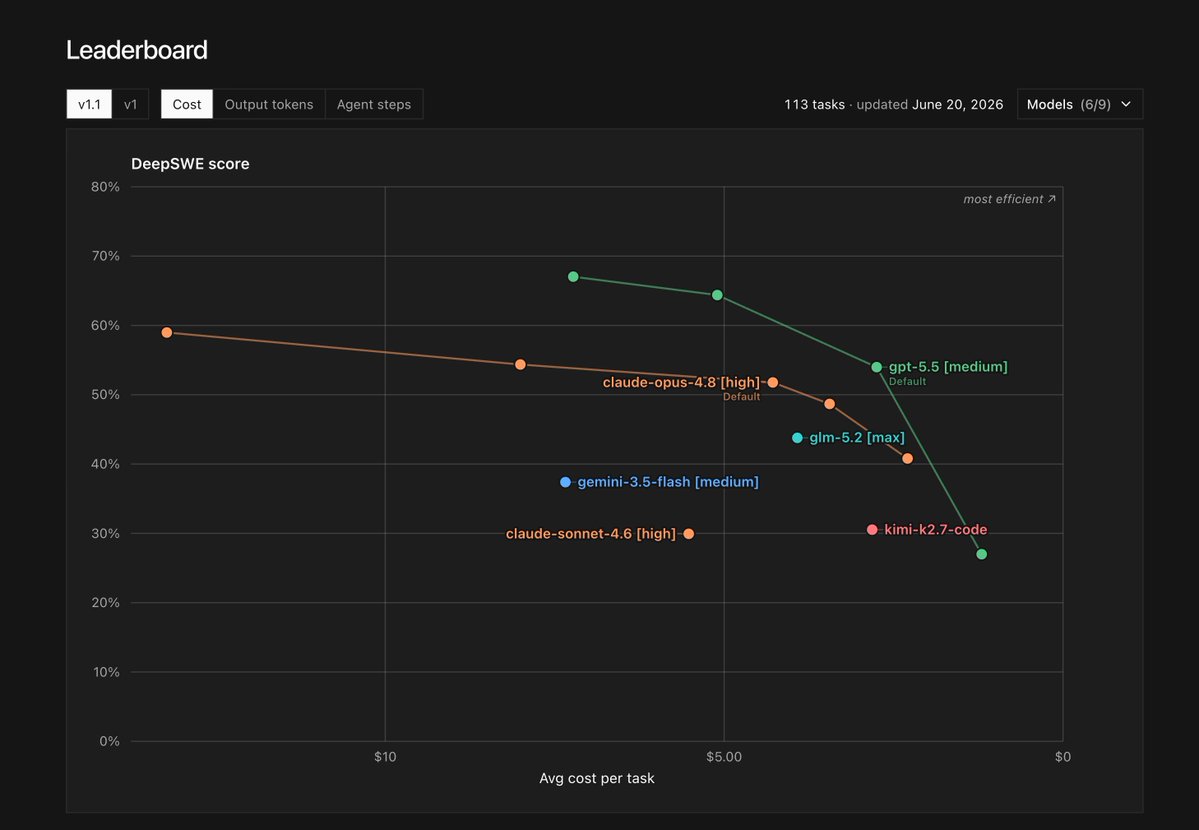
That said - it's not cheap. Both Opus 4.8 and GPT-5.5 set to "medium" are cheaper and smarter than GLM-5.2
Apparently Founding Engineer is the worst deal in tech…
This one guy argues:
> take near-founder risk
> 0.5–1% equity
> work founder hours
> don't control the cap table
> startup fails 90% of the time
> the 10% that survive dilute you to dust
So the expected value of that equity grant is roughly zero.
So how cooked am I? 👀
I made a personal black hole that makes you take breaks 🕳️
A shader for Ghostty that spawns a small black hole in your terminal - it drifts around, gravitationally lensing your text. The longer you work without stopping, the bigger it gets, until it's basically demanding you go touch grass
Take a break and it quietly shrinks away
Things I really dislike about Fable:
1. Anthropic collects my prompt history, stores it, and does whatever they want with it for 30 days. No opt-out
2. They can nerf their most expensive model without telling me, billing me the same amount, wasting my time. Whenever they want
boris cherny goes on a podcast every three months and says something like “i’ve stopped breathing now i just wrote a breath.md” and the next day everyone in sf stops breathing
In 1998, the United States achieved its first federal budget surplus in 29 years, effectively ending a streak of deficits that had lasted since 1969.
This milestone was achieved under President Bill Clinton, following the passage of the Balanced Budget Act of 1997, which resulted in a fiscal surplus of approximately $69 billion for that year.