"So the star that is called Polaris is only 3 degrees and 8 minutes (scruples) distant from the pole, whatever others may write about it." — Gemma Frisius, "Book on the Universal Astrolabe", 1547
@ChiseledTablet Since it’s something our vision does, can you show it happening top down when standing on your head or side to side when laying on your side?
@ChiseledTablet@MichaMWitkowsk1@packers_owner_j “the hyperbolic geometry of the eyes create bottom up obstructions naturally”
Unsupported assertion.
Show that the eyes use hyperbolic geometry and explain how hyperbolic geometry makes ships go hull down.
@ChiseledTablet@MichaMWitkowsk1@packers_owner_j Yes, the Sun and boat are doing the same thing.
The Earth is getting in the way.
You need to invoke “perspective”, “vanishing point”, “hyperbolic solar perception”, etc., to explain it.
Spherical Earth explains it with Earth curve and refraction making a minor contribution.
@ChiseledTablet Perspective makes the entire ship appear smaller as it recedes before disappearing into the vanishing point.
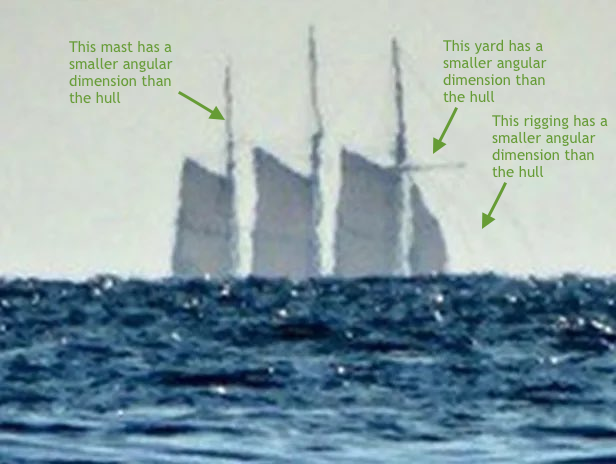
It doesn’t make the lower hull disappear while the upper structure remains visible.
That’s the difference between perspective and what we see.
@ChiseledTablet@MichaMWitkowsk1@packers_owner_j You’re ignoring my actual question.
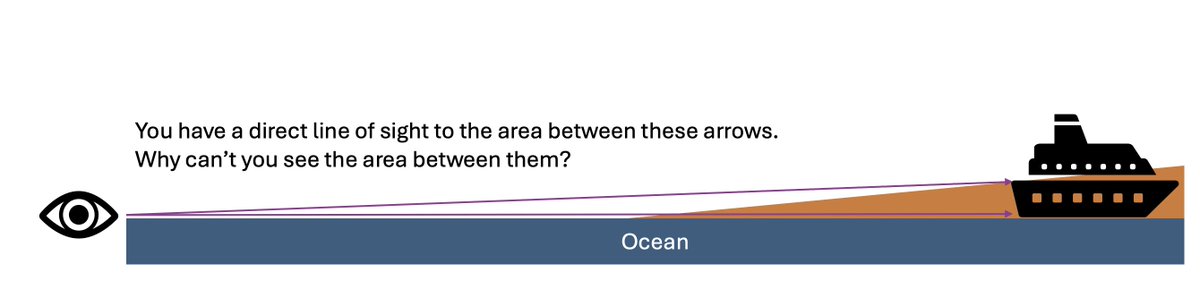
With a direct line of sight, why do we see the tops of ships but not the bottom?
With a direct line of sight, why does the bottom of the Sun disappear before the top?
If the atmosphere and perspective explain these observations, explain how.
@ChiseledTablet@MichaMWitkowsk1@packers_owner_j The 4 mi and 5 mi horizons are within the cone of vision at 6 ft elevation and the 5 mi horizon is still within the cone of vision at 10 ft elevation.
Why can’t the eye see those distances?
What determines which parts of Earth's surface are visible within that field of view?