Last week, government officials had to call Tata and ask if projects are still on schedule
India wants to build its own computer chips. Nearly all that work sits with one company, Tata. Tata is putting up India first chip factory in Gujarat, with government paying half of ₹91,000 Cr cost. They called because Tata top leadership is fighting internally over who should be chairman and whether to list Tata Sons publicly. When government needs to make that call, it tells you how much rides on one group.
India is giving ₹45,500 Cr to Tata for Dholera chip factory that is half of ₹91,000 Cr total cost. ₹91,000 Cr used to equal about $11 billion. Now it equals less than $10 billion because rupee has gotten weaker.
Machines needed to make chips come from Europe and Japan. Those machines are priced in dollars and euros, not rupees. So even as rupee number stays same, real cost of buying equipment keeps rising.
Factory will make chips for cars, phones, and industrial products by 2028
Tata chip factory in Gujarat is half built. Construction reached 50% by April 2026. Dutch company ASML signed deal to supply machines that print chip circuits. Taiwan company Powerchip is sharing recipes for making chips.
Test chips should come out by late 2026, with full production by 2028. Tata has signed 16 supplier deals but needs 450 suppliers total. Soil problems at site already forced redesign earlier. India has never made chips at factory scale before
Every step from building cleanrooms to getting good chip yield will be new territory
Before someone says, “These exports aren’t manufactured in India; they’re merely assembled here”:
That is how manufacturing ecosystems develop: assembly → scale → localised modules → components → materials, machinery, design and IP. (Ref 💚: PIB Release ID: 2247771)
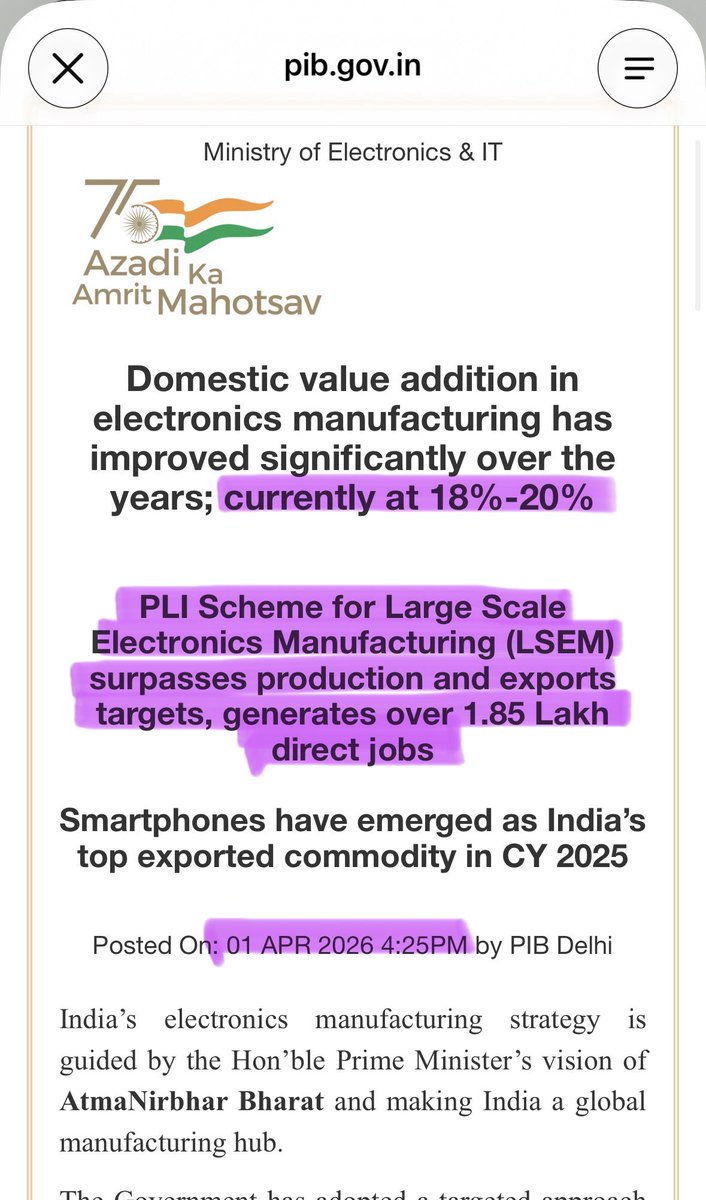
India’s domestic value addition in electronics is still around 18–20%. Nobody claims the transition is complete. The question is whether India is moving upstream. It clearly is. (Ref 💜: PIB Release ID: 2247771)
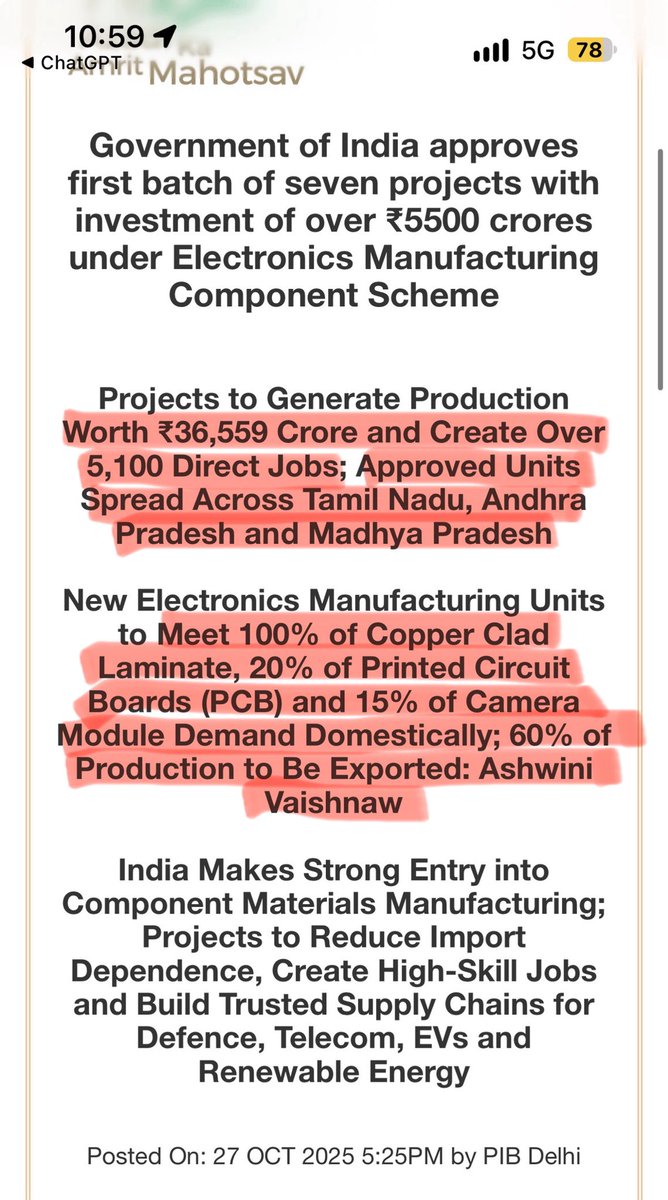
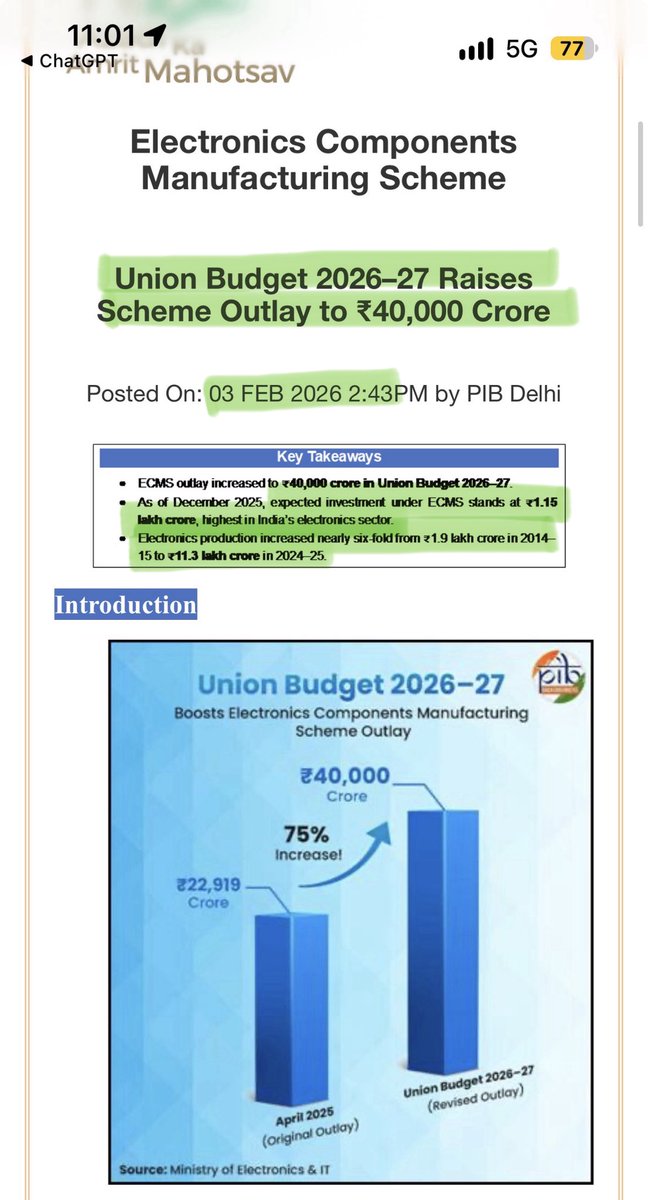
The PLI for Large-Scale Electronics Manufacturing first built scale in finished products. The Electronics Components Manufacturing Scheme, notified in April 2025 with ₹22,919 crore and expanded to ₹40,000 crore in Budget 2026–27, now targets PCBs, camera modules, passive and electro-mechanical components, optical transceivers, raw materials and even manufacturing equipment. (Ref ❤️: PIB Release IDs: 2222519, 2182986)
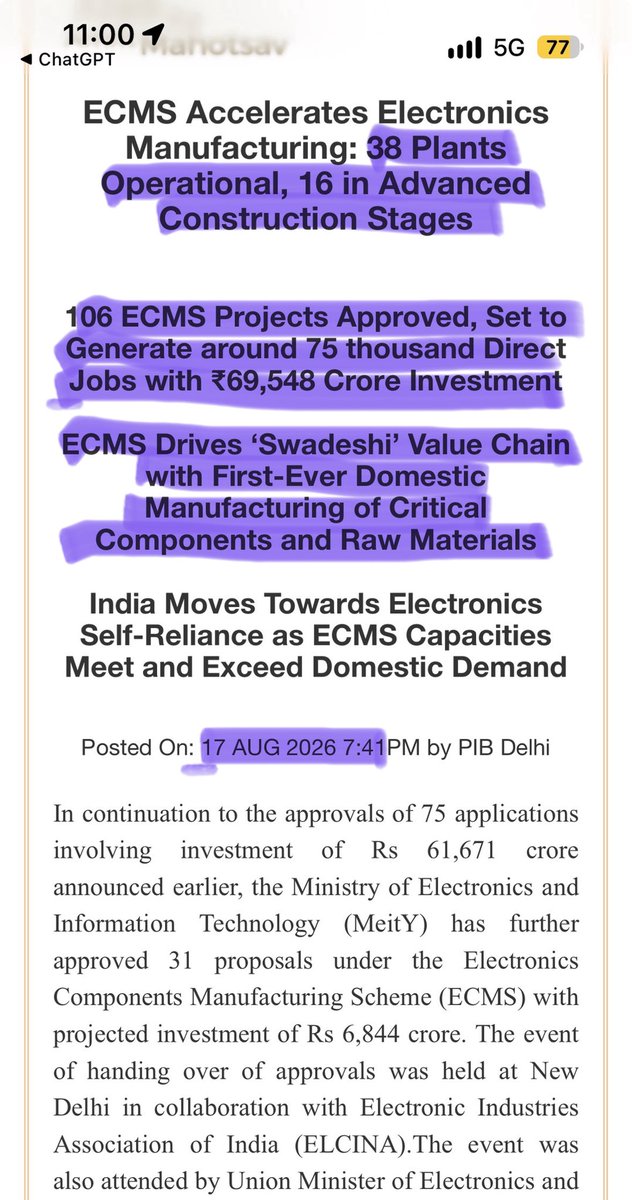
By August 2026, 106 ECMS projects across 15 states had attracted ₹69,548 crore in approved investment, with 38 plants already manufacturing. (Ref 💙: PIB Release ID: 2300625)
And I do not even need to mention India’s progress in semiconductor manufacturing that is another major step in the same journey. (PIB Release ID: 2222519)
Importing some inputs does not reduce domestic production to “mere assembly.” China, South Korea and other manufacturing economies also climbed the value chain through imported technology, production scale, supplier development and progressive localisation.
The real question is not whether India still imports components. Of course it does.
The real question is whether India is progressively replacing those imports with domestic capabilities and increasing value addition.
That transition is already underway.
Derating of large caps is the market's way of forcing them to invest and reinvent themselves. This is exactly how the market must work and is going to work.
I feel that many of our businesses will figure out a way to reinvent themselves as they get clarity on the current situation. I think the analysis here takes a very static view of how the people running this business will think about their own future.
India is selling more manufactured goods to China, with electronics emerging as a bright spot in a trade relationship that remains overwhelmingly tilted in Beijing’s favor https://t.co/YA7hlpjBH5
We spent time on the floor at Semicon India 2026, looking at it through an investor's lens.
One line sums up what changed: India's chip story just moved upstream. The money is no longer only in the fabs. It is in everything a fab needs to run.
Sharing our insights and investor perspective on how the industry is evolving.
Ramesh Mantri of @WhiteOakCap says he is extremely bullish on Indian markets right now and within his funds , this is the highest allocation to equities he has made in the last 3 years !
He says we now have evidence of two quarters of corporate earnings growth and lead indicators like car sales , cement sales , credit and export growth all pointing upwards.
Full episode out now on The Money Mindset ! ✨
Country To Get Its First Precision Manufacturing Institute, Announces Ashwini Vaishnaw
🎓 Five-tier skilling plan; level one runs 240 hours
💰 Semicon 2.0 outlay Rs 1.275 trillion, six pillars
https://t.co/gNEaTOhpCi
5-10 Years down the line, we will see similar headlines for semiconductors as well
Everyone will shift their base or build a part of their overall capacity in a Geopolitically Neutral country like India!
Good times ahead in Manufacturing!
First in my bloodline to see a company publically ditching China to come India.
Nexperia (Netherland based) is one of the critical companies of world ecosystem.
100 billion chips annually, 25% of Global production.
Last year, Netherland govt took control of the company when China attempted to takeover it and move it entirely to China.
From last night, Entire Chinese Social media is cursing India for executing the deal with Nexperia. 😎😎
Allow me to shut down(4th time in last 45 days) this propoganda from Aunindyo with a single image.
We are now on a stage where Indian Suppliers have started exporting Iphone Component to China. To China where entire Iphone ecosystem was originally made!!!
'At some point, the US will have to 'FIX' bond yields. Expect Gold to rip to $10,000"
Chris Wood of Jefferies tells @_prashantnair
U.S. yield suppression would drive a long-term weaker USD - a tailwind for EM equities & Gold
#IranWar#Nifty#BankNifty#Trading
“Anthropic’s gross margins are above 80% before accounting for revenue shared with distribution partners, including Amazon, and the cost of training its models.”
Wow.
And you should add that the so-called controversy is about the quarterly estimate for 2025 Q2 according to a 15 year old base year estimate and the new 2022-23 base year estimate - Only in India does the media entertain such vacuous debates - #ONLYININDIA
As expected, with the fiscal headwinds fading and monetary headwinds (falling credit growth till 1HFY26) becoming tailwinds (credit growth accelerating), GDP growth is surprising on the upside, and should help push up consensus trend-growth estimates to 7%-plus. That is, with a neutral fiscal and monetary policy, the economy should still register 7.5% growth.
In this light, I was shocked to see the ill-educated and egregiously wrong claims made by some that if the 'original' base of June-2025 quarter was used, growth in the June-2026 quarter would be much lower.
The new series introduced in Feb-2026 cleaned up the data and also significantly improved the methodology. For those who track this for a living (and I used to be one such till 45 days ago) - the downward revision in the base was known in March (see our note published on 1-Mar):
https://t.co/3KCHsbIUV9
As our note acknowledged, the new series increased credibility of estimates of real output.
That claim is so obviously wrong that several logical rebuttals have already been made. But bad information tends to travel further than good information, and so it is important to reiterate and reinforce the argument.
That such claims got traction is itself surprising, given that easy-to-track and not-possible-to-fudge indicators of economic activity have been so robust. While June-quarter data was strong, that momentum has picked up:
- personal vehicle (cars, SUVs) dispatches grew 35% YoY in August despite just 9% growth in exports. Even two-wheeler growth is now >20% (though helped by strong exports).
- And if that was consumption, commercial vehicle dispatches grew >40%.
- tax collection growth has picked up meaningfully. This is as real as it gets.
- Credit growth continues to surprise on the upside (albeit on a low base). Last year most believed the then-weak credit growth was a demand problem, whereas we steadfastly stated it was a supply issue - it has for now been addressed.
- indicators of construction are robust.
Hopefully, now there will be fewer people asking "why private sector investment is weak," given that there is clear evidence of investments.
That said, there is still slack in the economy, as seen in weak real-wage growth. It may take several quarters of above-trend growth for that slack to tighten, and bring back sticky inflation pressures.
𝗧𝗵𝗲 "𝟮.𝟲% 𝗿𝗲𝗮𝗹 𝗴𝗿𝗼𝘄𝘁𝗵 𝗿𝗮𝘁𝗲" 𝗰𝗹𝗮𝗶𝗺: a hilarious demonstration of economic ignorance on National TV.
𝗘𝗿𝗿𝗼𝗿 #𝟭: Take a nominal GDP number from the old series and compare it with a nominal GDP number from the new series. Divide one by the other and proclaim 2.6% "growth." That is comparing apples with oranges.
𝗙𝗮𝗰𝘁: When GDP series are revised, historical numbers are re-estimated using the same methodology to ensure an apples-to-apples comparison. Such an ECON 101 error!
𝗘𝗿𝗿𝗼𝗿 #𝟮: Use nominal GDP arithmetic to challenge a real GDP growth rate of 7.8%, while ignoring double deflation, a globally accepted methodology that India now adopts, and the actual constant-price estimates.
𝗘𝗿𝗿𝗼𝗿 #𝟯: Treat routine revisions, based on improved data and methodology, as "manipulation." Historical estimates are revised precisely because new data arrive and better information becomes available.
𝘚𝘶𝘤𝘩 𝘳𝘦𝘷𝘪𝘴𝘪𝘰𝘯𝘴 𝘩𝘢𝘱𝘱𝘦𝘯 𝘳𝘰𝘶𝘵𝘪𝘯𝘦𝘭𝘺, 𝘪𝘯𝘤𝘭𝘶𝘥𝘪𝘯𝘨 𝘸𝘩𝘦𝘯 𝘵𝘩𝘦 𝘱𝘦𝘳𝘴𝘰𝘯 𝘮𝘢𝘬𝘪𝘯𝘨 𝘵𝘩𝘪𝘴 claim 𝘸𝘢𝘴 𝘪𝘯 𝘎𝘰𝘷𝘦𝘳𝘯𝘮𝘦𝘯𝘵.
𝗘𝗿𝗿𝗼𝗿 #𝟰: Claim consumption growth was negative by committing the same errors, when official data show real private consumption grew 7.1%.
Claims about a supposedly "true GDP growth rate" manufactured by comparing incompatible numbers was not economics.
It was a hilarious demonstration of economic ignorance on National TV.
India’s growth is broadening out.
What was a mostly government spending led economy in the first few years after Covid, made way for a government spending + government supported consumption story.
Now there is enough evidence the private sector is stepping up. No clearer sign that bank credit growth, including to industry.
Reuters @manojgulnar and @ShubhsBatra analyse recent economic data to tell the current India growth story.
Read here: https://t.co/Zx4SkXhSIA