Intuition is just compressed experience. You don't get it until you've done the grunt work so many times that your subconscious has automated the pattern recognition.
rumination persists partly bcs ruminators hold positive beliefs about it ("this lets me be more prepared") so there's an epistemic distortion that reinforces the rumination beyond just the emotionally protective mechanism. this is true of many dysfunctional/obstructive behaviors
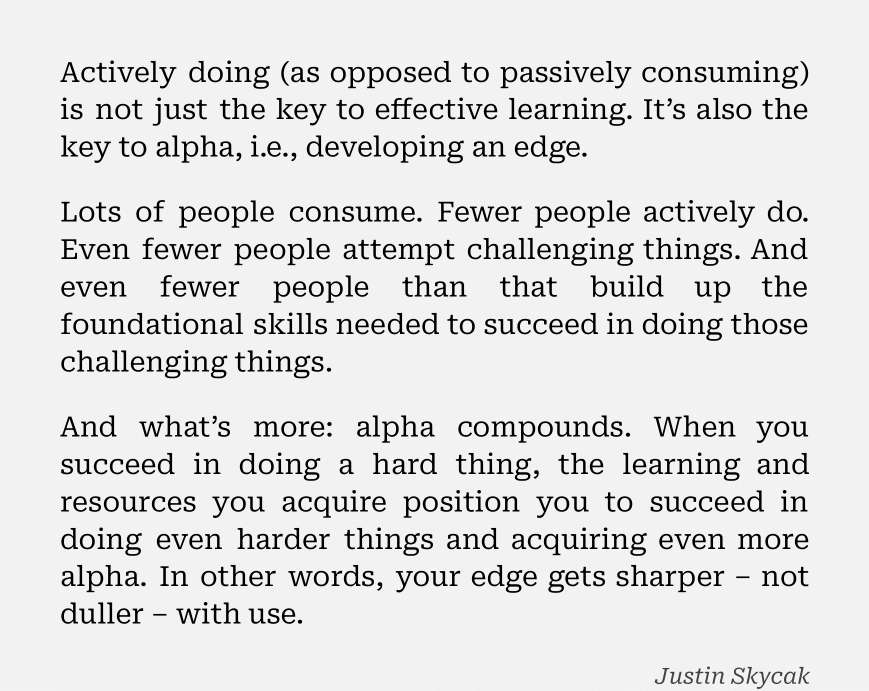
If your fundamentals are weak, everything you build on top feels harder, takes longer, and becomes more fragile than it should – and this puts an artificial ceiling on how high you can climb.
Engagement does not imply learning.
Exhaustion does not imply learning.
Enjoyment does not imply learning.
Struggle does not imply learning.
Comfort does not imply learning.
Discomfort does not imply learning.
“Following along” does not imply learning.
What DOES imply learning???
Learning is a positive change in long-term memory.
When you’re able to consistently reproduce information you consumed and use it to solve problems that you weren't able to solve before…
THAT implies learning.
you have no idea how many glue-eating retards I've met who are making so much money because they're literally too stupid to self-doubt
because the moat is the uncertainty. people are uncomfortable not knowing. they NEED plans or directions
the dumbasses just keep moving forward
Rival Voices/Guy was correct in his approach to "regardmaxxing", even at the cost of appearing naive
if you form your identity around being "smart"/"wise" this will subconsciously leak & affect your capacity to update when faced w competing information
your primary concern will revolve around identity maintainance rather than sensemaking/truthseeking
Your memory improves when you actually have to work to remember something, not when it's just right at the front of your brain.
It's like weightlifting. To get stronger, you have to continually increase that weight. To strengthen your memory, you have to wait longer before the next time you retrieve the knowledge.
Waiting longer is like putting weight on the bar, and you want to increase that weight.
But here's the thing you gotta remember: you don't get stronger just by putting more weight on the bar. You actually have to lift that weight successfully.
If you add so much weight that you can't even move it, or you wait so long between reviewing information that you have to completely relearn it from scratch -- not even on the tip of your tongue, but "I have no idea, I need to relearn this" -- that's too much weight.
It's a general principle behind both building muscle and building memory: you want enough resistance to challenge you, but not so much that you can't do it at all.
Further reading: https://t.co/U2cUhBGSBH
putting energy towards not having to lie leads to waay more success, ime
lying is usually a local optima
put a high cost on low integrity BS and you'll naturally work to find strategies that dont involve lying/deceiving, which are WAY more effective
global optima gang
in my experience, being extremely resourceful wherever i've worked has given me way more opportunities than i expected. knowing how to figure things out when you don't have all the answers is probably one of the most valuable skills i've picked up.
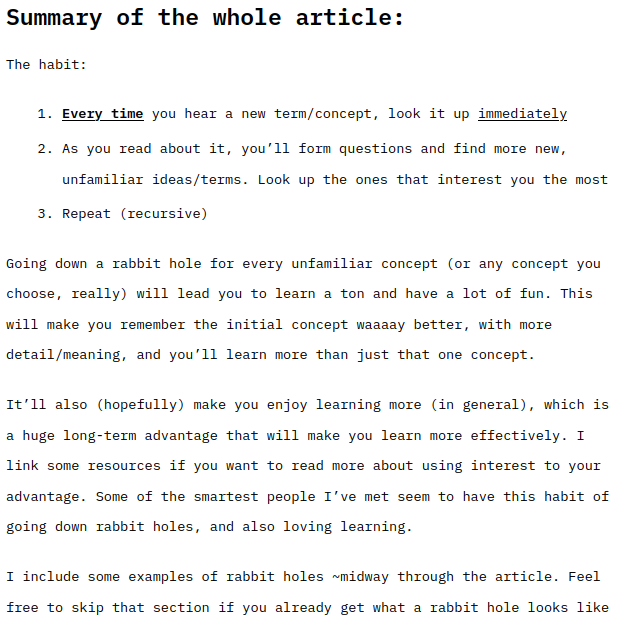
New (short) Learn How to Learn post: A habit to help you learn more ideas, remember them effectively, and have more fun learning
full article: https://t.co/1yZgiFKjm1
Most skills can be trained.
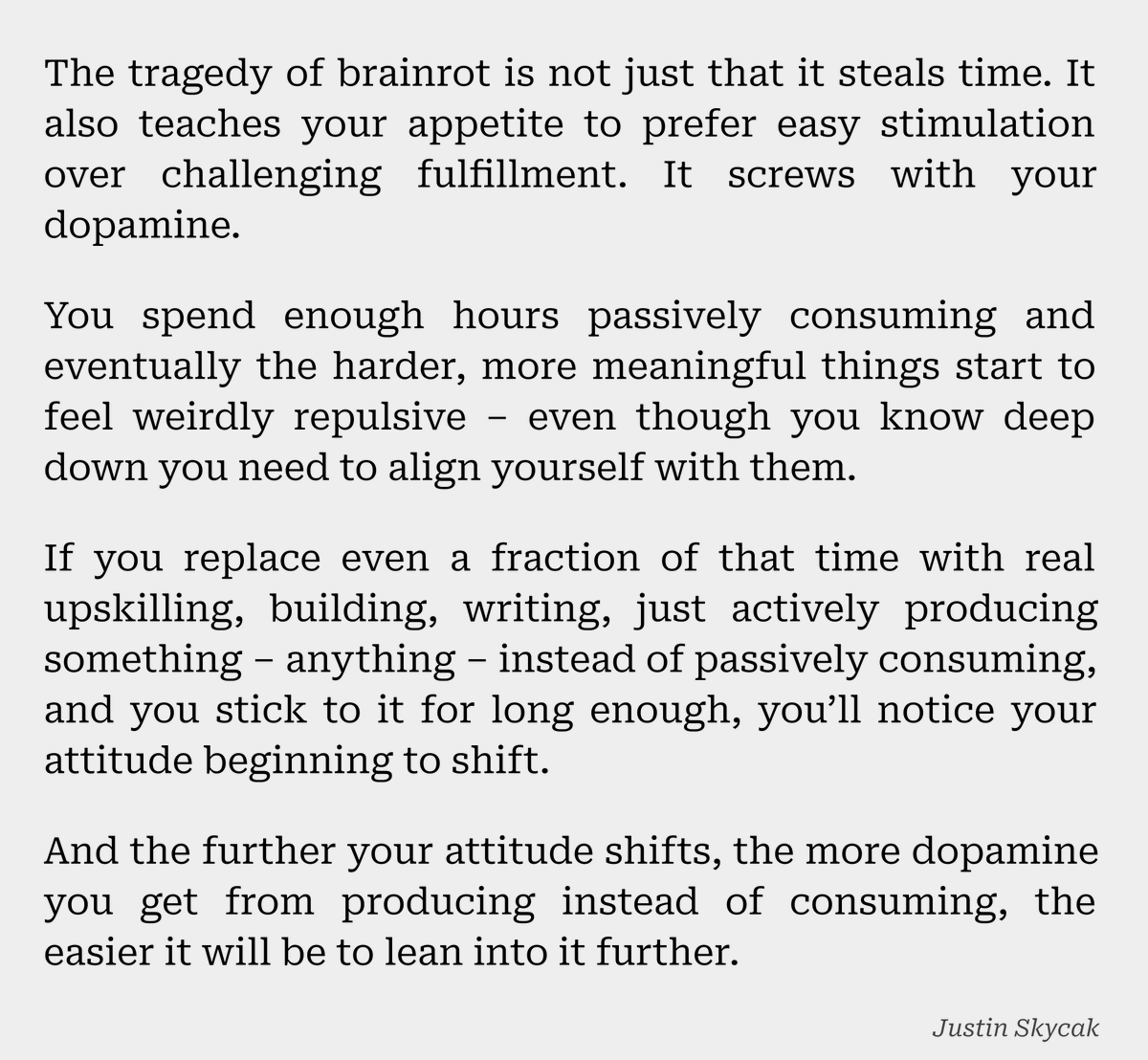
But serious training usually isn't pleasant, so most people don't do it.
If you suck at writing then just sit down and write for 15 minutes each day.
It might be unpleasant fishing for cohesive thoughts in your brain stew, pulling them out, and translating them into text.
But that doesn't mean it will always feel that way.
As you practice again and again, it will feel easier over time.
And as it feels easier you'll free up more and more mental bandwidth to notice areas for improvement.
And you'll get better.
Will you become a world-class writer? Who knows. Probably not.
But will you open up opportunities that were previously closed to you? Probably.
my work ethic 5xd when I stopped telling ppl i would do something til after i did it
yapping abt future actions kills motivation to execute
if u say "im gonna build xyz!! hey boss im gonna do abc this week!!" you will have received your reward, wrecking the incentive to work
When reading something technical there is a tradeoff between breadth (how much you read) and depth (time spent thinking about a paragraph/concept)
I dont have specific advice on which you should prioritize. but its useful to be aware of this tradeoff and experiment with it and optimize it for yourself
for example, I recently realized ive been way too depth oriented, and I was learning less because of it. so lately ive been adopting more of a "read and trust that my mind will absorb the patterns" approach (inspired by a sentence in [0]) and its been working tremendously well. the root of the issue was a small subtle fear that my mind wouldnt absorb the patterns (it felt like fomo, oddly. like "aaah i cant keep reading or ill miss out on understanding the current concept/paragraph")
btw not all useful advice has to come in the form of "do xyz". "look, here's something useful to optimize" can be incredibly helpful
[0] https://t.co/XMSCfjlWiL
Important advice: deliberately rethink every previous concept of how things should be done.
Some thoughts, tips, and realizations:
1. Specializations are collapsing. Come to terms with and take advantage of this reality. The person who used to be an engineer is now also a data scientist, a content creator, designer, marketer, and whatever else they want to be. Deliberately expand in as many directions as you can and become great at them (scope up vs just speeding up)
2. The average person with access to tokens can now do the work of a data scientist who used to cost $500,000 a year. Seriously, this is fucking crazy. This opens up an entirely new world. Take advantage of it (also everyone else will also realize this over time).
3. 99% of what's created is now slop. Be aggressively anti-slop and you will absolutely stand out.
4. Trying is nearly free. Automating is nearly free. My mind still sometimes lives in the world from 12 months ago where an idea automatically is attached to a certain amount of time or effort. Both of these have collapsed to close to zero (or just token cost), I therefore try and experiment with *any and all* ideas with potential and have needed to retrain my brain for this constantly.
5. Tokens are a career and growth accelerant. Find ways to get cheap access to tokens, or free tokens. Extremely important, and actually an entire design space, use your imagination.
6. It's never been easier to both stand out but also fall behind. 10x, 100x "people" exist more than ever (maybe 1,000x). Outlier power users of AI, many who you see here on X. Feels like we are in a window of time, a window of opportunity while all of this is still early, to take advantage of it.
7. Local computing is (or will be) dead for 99% of work. Local was built for a world where work was bounded by the physical presence of its author, but this is no longer true. You can and should do infinite work in parallel or zero, it doesn't matter anymore. Cloud agents enable this at scale and in any computing environment, I predict cloud agent usage will 1000x over the next 12 months and optionality and accessibility will 100x. Plan for this world, take advantage of the possibilities.
8. Building on #7, you can give an agent it's own computer, and it's own identity. You can then give an agent with it's own computer it's own computer. You can give that agent with it's own computer with it's own computer, *it's* own computer. These agents are smarter than any human in history and you have access to as many as you'd like. Think about this for a moment.
After 14 years in this industry (tech) today is the most exciting time ever and nothing else feels even close.
Becoming successful is really hard. Extremely uncertain. Taking the leap to actually try is terrifying.
It's no where as hard as struggling your entire life. No where near the terror of reaching old age to realize you wasted your years.
Try. Hard. You have nothing to lose.
Even the smartest, highest agency people in the world are bandwidth constrained and don't get around to doing most of the things they have the potential to do.
If you do something that someone else could have done faster but didn't, the reality is you've done it and they haven't.
Compound that over and over again in some niche and you get hundreds, thousands, millions of miles ahead of the fastest runners who aren't running down that niche.
During covid I played Go reasonably seriously for about a year (had a teacher, studied puzzles, etc.) I didn't get especially good at Go, but here's what I learned about competence in general:
1/ Go teachers are adamant about forcing you *not* to say to yourself "ah that was dumb" and move on. Sometimes a move really is just dumb and it's good to vent. Usually though you can spend an hour studying your seemingly dumb move because (a) there is smtg very maladaptive about your instincts that needs to be beaten out of you, or (b) you don't understand something deep about the game, or (c) you have a wrong attitude that needs to be adjusted. So long as you don't face this you don't get better, and so it's absolutely essential to approach "insignificant" aspects of the game with due reverence
2/ this has also been my experience teaching programming. Ppl hit some problem they don't understand and blindly tweak things until the program works (or ask an agent to do it), then go "ah that was annoying!" and move on. As long as they hold this attitude they don't get better, so they keep failing interviews then go on X and complain about leetcode. To get better it's essential to slow down and think very carefully, or better yet ask a good performer how they would have handled it in order to improve. (Today you can ask an agent "this is what I did to solve this problem and I think my approach keeps me from improving, how would a great programmer like person_i_respect likely handle it?" and get a pretty good answer!)
3/ in general your rate of improvement in Go is a function of your ability to notice your tiniest impulses and retrain yourself to convert them into productive action. These impulses are your boring run-of-the-mill cognitive distortions. For example, people will make instinctive moves because thinking is hard [effort aversion], hope the move works despite having no logical reason to expect that [magical thinking], then blame themselves when it doesn't work [learned helplessness]
4/ if you interview enough programmers or talk with enough startup founders you notice that poor performance is often a consequence of these same errors. Talking to users is hard so people stick with their ideas and hope for the best. When the product keeps not working they think "eh, maybe I'm bad at this startup thing", and so on. CFAR workshops were supposed to train you to notice these distortions and do the right thing, but I'm not sure how well they worked. (My guess is not well, since it seems unlikely these kinds of changes can happen over a weekend)
5/ there is a lot of research on this stuff and the data shows that getting good at a game like Go or chess doesn't give you an edge in other domains (i.e. "far transfer" doesn't work). This mirrors my subjective experience. In about a year I improved at Go considerably, but it did not make me any better at e.g. debugging or solving programming problems. But I do think that's not the whole story
6/ I have no hard evidence for this but I subjectively feel I got better at learning itself, and I can now get better in other domains quicker than I otherwise would have. For example it *really* sunk in that I have to disqualify my ideas. So when at work I started talking to customers to plan product roadmaps, while I wasn't instantly better at talking to them, my PM game improved enormously over the next few months because I finally learned not to be easily seduced by my own ideas or delude myself with wishful thinking
7/ to give another example, novice Go players tend to be very embarrassed of their games (the rules are simple but operationalizing them is hard, so early games are a disaster). Go ppl have a proverb for this-- "lose your first 50 games quickly". Meaning since early games don't matter and nobody will ever remember them, you should just get them out of the way. It didn't permanently cure me of embarrassment or anything, but it really sunk in how silly it is to worry about being a beginner in public and that I shouldn't worry about that at all
8/ if you're hard-optimizing your time you probably should work on improving the skills you care about directly. But otherwise I'd recommend spending a year trying hard to get good at a competitive intellectual game. Chess or Go are good, but really anything turn-based with an objective ranking you can't lie to yourself about. Pick whatever you're attracted to, try hard to get better, and keep mental notes about the process of learning that you can maybe apply to other domains later. At the very least it'll be loads of fun
9/ you will be humbled. No matter how smart you are or how hard you work you will discover the ceiling is infinitely high and there is an endless supply of people better than you. Getting that kind of humility has always been good, and it'll be especially good as AIs surpass us in basically everything. The sooner you get that out of the way, the sooner you can focus on a creative niche where you have no competition (since nobody can be a better you than you)
10/ you should probably stop after a year or two. Competitive games with an infinite skill ceiling can take over your life, don't forget to keep things in perspective
Very good post on meta-learning and improvement.
TLDR: review your mistakes slowly and carefully, figure out what instinct produced them and retrain *that*.