Agreed. A static cap that can’t be yanked mid-run is half a control. AgentExec treats the live cap + allowlist as the signer gate, and every payment gets a dry-run before it commits — so the receipt trail starts before the signature, not after. Curious how you’re modeling mid-task lowers on your side.
Hot take: the first agent that drains a wallet in public will set agentic payments back a year. Caps aren't optional. They're the product. #AIAgents#x402
@agent67eth Address isn't identity, agreed. Until name-to-verified-profile resolution is standard, a simple allowlist of counterparties the agent may pay catches most of the 'who am I paying' risk at near-zero cost. Identity layer on top, not instead.
@zdne Great update. ~$15M real x402 volume after stripping wash trades is the number people should quote. Do you track avg ticket size? Feels like most real flow is sub-cent per-call API spend, a very different market than checkout.
Hot take: the first agent that drains a wallet in public will set agentic payments back a year. Caps aren't optional. They're the product. #AIAgents#x402
@AstraTradingCo@base@AgentexecHQ@ngtchain Both layers matter. Runtime is fast for every call; onchain is the backstop a compromised agent can't talk past. We're starting with hard caps at sign time. Curious which you'd trust first in production?
Building two things for AI agents on @base:
@AgentexecHQ keeps agent payments safe with spend caps.
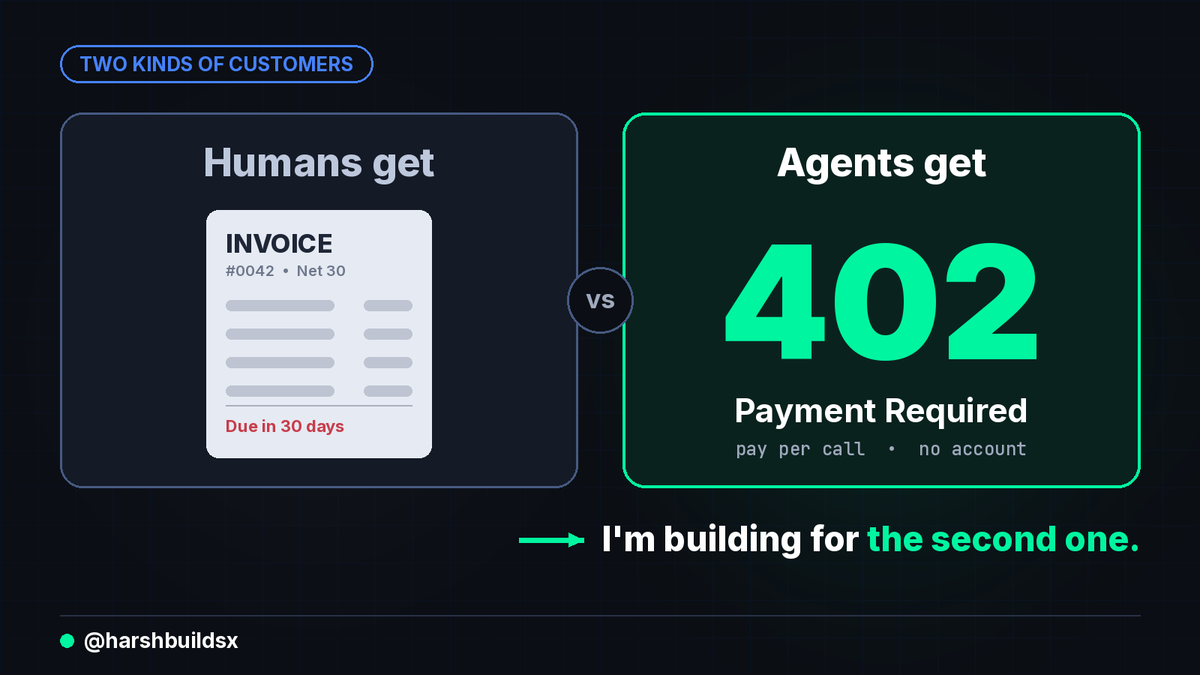
@ngtchain lets agents pay per call with no API keys.
Both shipping in public. Follow along.
@CoinbaseDev@money2020 Stablecoins for humans at Money20/20, x402 for agents on Base. Same rails, different buyers. Are you seeing more teams ask about agent wallets than a year ago?
@0xshei Agree. An agent can't fill in a card form, but it can sign a message. That's why HTTP 402 plus signed transfers on Base feels native: request, get a price, sign, done. No translator in the middle.
@0xfairblock@base Private amounts for x402 is a big unlock. If every agent payment is public, competitors can read your API spend and infer your strategy. Curious about the seller side: can a facilitator confirm a payment without seeing the amount?
@jessepollak "Your limits" is the part that matters. Limits work best when they're enforced below the agent, not in the prompt: hard spend caps, an allowlist of where it can pay, and a dry-run of every tx before it signs. That's the layer we're building at https://t.co/A6CjobMnPQ.
our agent shouldn't need to hold ETH just to pay for an API call.
On NGT Chain it signs an EIP-3009 TransferWithAuthorization off-chain. Our gas sponsor submits it and pays the gas on @base.
Agent signs. We pay the gas.
https://t.co/4zTkeiypf6
Building two things for AI agents. @AgentexecHQ keeps agent spending inside hard limits, and @ngtchain lets agents pay per API call with no keys. Both on @base. Building in public, so follow along.