I'm starting a series digging into crypto projects that actually generate real revenue and have genuine long-term utility .
First up: @BeldexCoin ($BDX) -> a privacy ecosystem that's quietly building with real fundamentals.
– 2,510+ active nodes securing the network
• Every transaction burns 1% of fees – deflationary by design
• BNS domain registration/renewal fees – 100% burned
• Flash transaction fees (layer 2 instant txs) – 100% burned
The numbers don't lie: 10.42M+ BDX already burned 🔥
More details on the next post - stay updated
Starting a new series: Crypto projects with REAL utility for everyday people. No complicated DeFi – just tools you can actually use.
Project #6: @Predictstreet
What it is:
ADI Predictstreet is a licensed prediction market for the FIFA World Cup 2026™ built on @ADIChain_ (Ethereum L2) and backed by Abu Dhabi's royal family.
First time FIFA has partnered with a blockchain prediction platform. Regulated in Gibraltar. Settled via Chainlink oracles.
What you can do TODAY:
1. Predict FIFA World Cup 2026 outcomes
48 teams, 104 matches. Predict winners, scores, top scorers using official FIFA data.
2. Trade predictions in seconds
Explore markets → choose an outcome → take a position. Exit anytime or get paid when the market resolves.
3. Use ADI as gas token – All predictions and settlements use ADI as gas token
4. Earn free rewards
Join Discord, complete verification, invite friends. Community pre-registration is active now.
Why this matters:
→ FIFA official partner – First-ever blockchain partner of the World Cup. Billions of viewers.
→ Backed by Abu Dhabi's royal family – Parent company owned by IHC (UAE's largest investment firm). Led by UAE's Deputy Ruler.
→ Regulated & trustless – Licensed in Gibraltar. Chainlink settles all 104 matches – instant payouts, no disputes.
→ Huge market – Global prediction market surged from $5B to $24B monthly volume in 7 months.
→ Long-term tokenomics – $ADI total supply ~1B, fixed. Vesting over 6-9 years. No inflation.
• Pre-registration live on Discord :
https://t.co/ow6keApPXQ
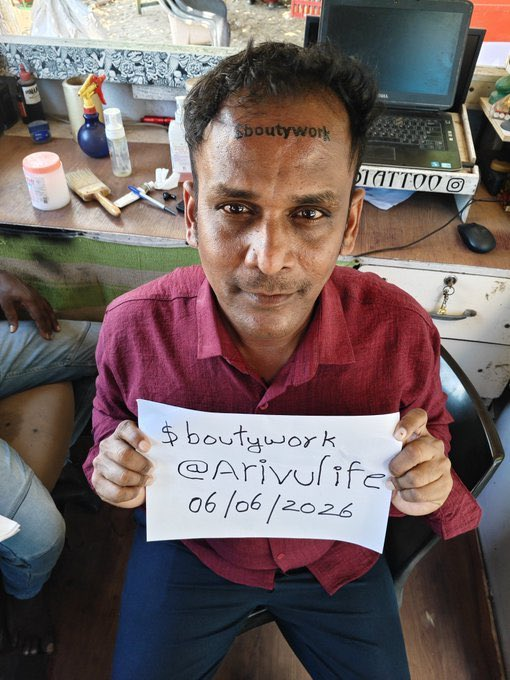
A guy named Ayush made $171k from a boutywork.
Here's what happened 👇
@ayushquantt posted a bounty on Pump fun: tattoo "bountywork" on your forehead and get paid.
But he made a typo and wrote "boutywork" instead.
A poor Indian man saw the post, trusted it completely, and tattooed the exact misspelled word on his forehead.
CT exploded with Memes and Debates.
Meanwhile, @ayushquantt launched a memecoin called Bountywork on the hype wave and made $171K in just a few days.
Total memecoins launche -2,452.
Today, every single one of them is worth ZERO.
was it a Farm, rug, or genius?.
Project #5: Crypto projects with REAL utility for everyday people.
Project #5: @HaikuTrade
What it is:
Haiku is an intent-based DeFi exection engine CEX-grade charting and order flow, but everything settles on-chain.
One click. 22 chains. 45+ protocols. It turns complex multi-step DeFi strategies into a single atomic transaction.
Why Haiku ?
1. Limit orders that PAY YOU (yes, really)
- > Set a price target. When it fills, you earn a bonus on top of your execution.
Most limit orders = you pay a fee.
Haiku = they pay you.
2. Read CEX order flow – trade on-chain
- > Price moves on Binance/Coinbase first. Now you can see that flow and execute with the same edge – without leaving self-custody.
3. One click across 22 chains
- > No more: bridge → approve → swap → approve → deposit.
Declare what you want. Haiku bundles it into one atomic transaction. If anything fails, it all reverts. No stuck funds.
4. Not just swaps
- > Tokens, lending, vaults, pools, YT/PT, CLAMM. All tradeable from one screen. Across 45+ protocols.
5. Live and proven
- > $40M+ volume. 99.8% API success rate. Backed by Big Brain Holdings, Auros, Biconomy CEO.
The degen edge:
→ Get paid to set limit orders
→ Front-run the CEX flow on-chain
→ Stop paying gas on failed txns
→ One interface = less rage clicks
GM
Still thinking about this.
The Hopfield Playground is live. You can draw, store, corrupt, and retrieve watching the memory crawl back pass by pass.
The screen has that old CRT glow. λ = 0.35 gently pulls the pattern back. After 8 passes, the energy drops and the memory comes back from the noise.
@adamilenich would love to know what you think.
I need to share something I built.
A few weeks ago, I discovered @adamilenich 's Pattern Retrieval.
94 ASCII characters. Every printable character from 32 to 126. Each one stored as a memory in a Hopfield network. Then deliberately corrupted – shattered into noise. And then, pass by pass, recalled back into shape.
It stopped me in my tracks.
- > Not just because it looks beautiful CRT phosphor glow, generative audio, that perfect retro terminal aesthetic. But because of what it's doing under the hood.
- > A Hopfield network is an associative memory. It doesn't "draw" the pattern. It remembers it. Like a basin you fall into. A shape that reasserts itself only because the parts agree on what they used to be.
- > I couldn't stop thinking about it therefore I built something.
What I built:
A Hopfield Playground.
An interactive educational tool that lets you see exactly how this works step by step, pixel by pixel.
You can: → Draw any 10x10 pattern (or load a pre-made 'A' or '#') → Store it in a Hopfield network using Hebbian learning → Corrupt it with noise – up to 50% random flips → Retrieve it over 8 passes – watching the memory slowly crawl back from chaos.
It shows you the energy dropping with each pass. The overlap percentage rising. The pixels flickering back into place.
Why I built it:
Because Pattern Retrieval inspired me. It's one thing to see the final result. It's another to understand the mechanics.
I wanted to know:
How do the weights work?
What does λ = 0.35 actually do?
Why 8 passes?
What does "energy" mean in a Hopfield network?
So I reverse-engineered the math. Hebbian learning. Weight matrices. Asynchronous neuron updates. The energy function. The bias term.
And then I rebuilt it. From scratch.
How I built it:
- > I wrote it in HTML, CSS, and JavaScript. No libraries. No frameworks. Just the math.
- > 10x10 grid = 100 neurons
- > Weights matrix: w_ij = (1/N) * Σ (pattern_i * pattern_j)
- > Retrieval update: s_i = sign(∑ w_ij * s_j + λ * stored_i)
- > Asynchronous updates – 15 random neurons per pass, just like the original
- > CRT effects: scanlines, vignette, chromatic aberration, barrel distortion
- > Phosphor glow that lingers and fades
How interested I am in this project:
- > Pattern Retrieval isn't just an NFT project. It's a statement. It asks: what does it cost to hold even the simplest form against entropy?
- > The characters are the most ordinary marks we have. Letters. Digits. Punctuation. Things we type without thinking. And yet, when you watch them corrupt and restore pass after pass, loop after loop it becomes something else. Something meditative. Something fragile and beautiful.
- > I wanted to contribute. Not to copy. To extend. To help people understand.
What this is not:
- > This is not a copy. It's not a competitor. It's not trying to replace anything , It's a love letter.
- > A companion tool for anyone who wants to see the math behind the art.
What's next:
The live demo is up at: https://t.co/uBxNi29NZa
To @adamilenich thank you for making something that made me want to build.