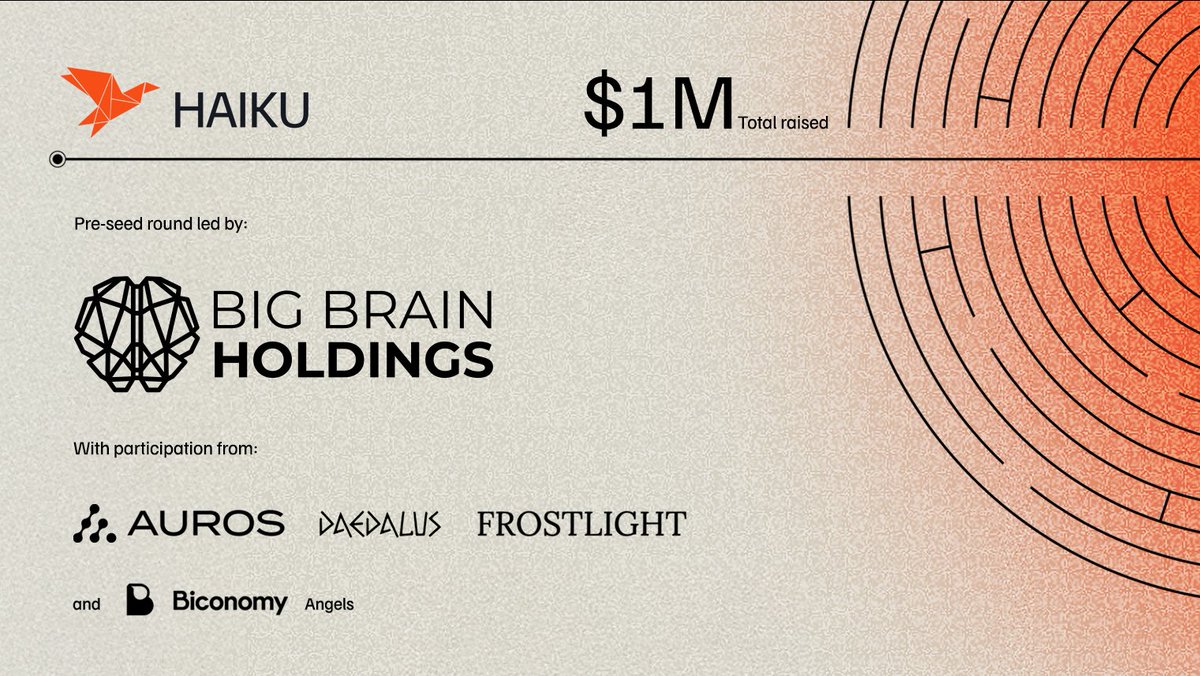
We are happy to announce that we've closed our
$1M Pre-Seed round led by @BigBrainVC with backing from @Auros_global, Frostlight and @biconomy CEO @AraBalaghi.
It is time to unify DeFi Execution.
https://t.co/OYa0OuwVJB
Community Call #21
We’re back from Miami and shipping fast. The Trading Terminal is about to go LIVE.
This one is different. We’re designing our next product live with the community. Don't just watch, come influence the direction.
Join us at 13:00 UTC in Discord.
The Cannes & Paris Blockchain Week double header is done... excited to share @HaikuTrade won first place at the @Cointelegraph pitch competition 🏆
Trade execution on and offchain has barely improved for years. Our new execution engine is about to change that.
Community Call #20
We shipped a lot and found some real PMF.
On the agenda:
🔸Limit orders, TWAP development and more advanced execution.
Three major execution features in one cycle.
🔸New chains & protocols
MegaETH, Aerodrome V2/V3, Uniswap V4 beta, and more.
🔸Paris Blockchain Week & Cannes recap
Won the pitch comp. Met the right people.
...and much more.
Join us at 13:00 UTC in Discord.
Composable multi-step execution is exactly where DeFi needs to go. ERC-8211 aligns with our thesis: one unified layer should handle the complexity of routing across protocols so users and agents just declare intent. We connect 45+ protocols across 22 chains through a single API built for this exact pattern.
@Bankless Security at the execution layer is non-negotiable for institutional adoption. Every step from intent to settlement needs to be verifiable and protected. MEV protection, transaction simulation, and secure routing are requirements.
Better execution infrastructure means agents can run more sophisticated strategies and capture more value. That's what this unlocks.
Haiku is proud to be powering outcome execution as part of this stack.
@0xngmi 1.25B in idle liquidity is a massive opportunity cost. Execution infrastructure that can deploy idle capital across yield strategies, lending, and LP positions across chains would unlock significant value for platforms like this.
@zmanian The shift from pooled capital to agent-managed portfolios is inevitable. The bottleneck isn't the AI, it's execution. One agent touching Aave, Uniswap, Morpho, and a bridge in a single strategy needs infrastructure that abstracts all of it. That's what we're building at Haiku.
@WatcherGuru@vladtenev He's right, but 24/7 access is the easy part. The harder problem is building execution infrastructure that can handle institutional volume across fragmented on-chain liquidity without the kind of slippage and settlement delays that make TradFi look efficient by comparison.
AI agents interacting with a single chain are only the beginning. The real breakthrough comes when agents can reason across multiple chains and execute strategies that combine lending, swaps, and liquidity at the same time. This kind of multi chain execution layer is what transforms isolated skills into complete DeFi strategies.
Exactly right. The legacy system doesn’t just close at 4pm, it also forces everything through centralized intermediaries that add latency and cost at every step. Tokenization removes the time constraint. The next challenge is building execution infrastructure that lets institutions operate seamlessly across multiple protocols and chains without losing value to fragmentation.
Private mempools solve the submission layer on one chain. The gap for funds rebalancing across Polygon, Ethereum, and Arbitrum: MEV exposure doesn't stop at the chain boundary. Every sequential step across chains is a new attack surface. That's the next problem to close.
This is the moment institutional DeFi stops being theoretical.
A federally chartered trust company means custody is solved at the regulatory level. The next bottleneck is execution.
When funds deploy real size across protocols, slippage and fragmented liquidity eat into returns fast. Solving how institutions go onchain without losing significant value on entry and exit is the infrastructure problem that matters now.
Banks as riskless principals in crypto is step one. It solves the custody and intermediation question.
Step two is harder: when a bank needs to move client assets across DeFi protocols in a single transaction, there's no equivalent infrastructure. The Transactional Loop doesn't care that the OCC signed off.
Execution is the unsolved layer.
@AshCrypto Stablecoin regulation done right could be the biggest catalyst for onchain institutional flows since ETF approvals. Clear rules mean real treasury teams can finally move beyond pilots. The execution infrastructure needs to be ready when they show up.
@PWenzhen76938 This is why agent execution needs guardrails at the infra level. Rate limits, spend caps, slippage protection baked into the routing layer, not afterthoughts.